
Private Membership Associations in Texas: What the Law Allows
By Kirk Carmichael · · 8 min read
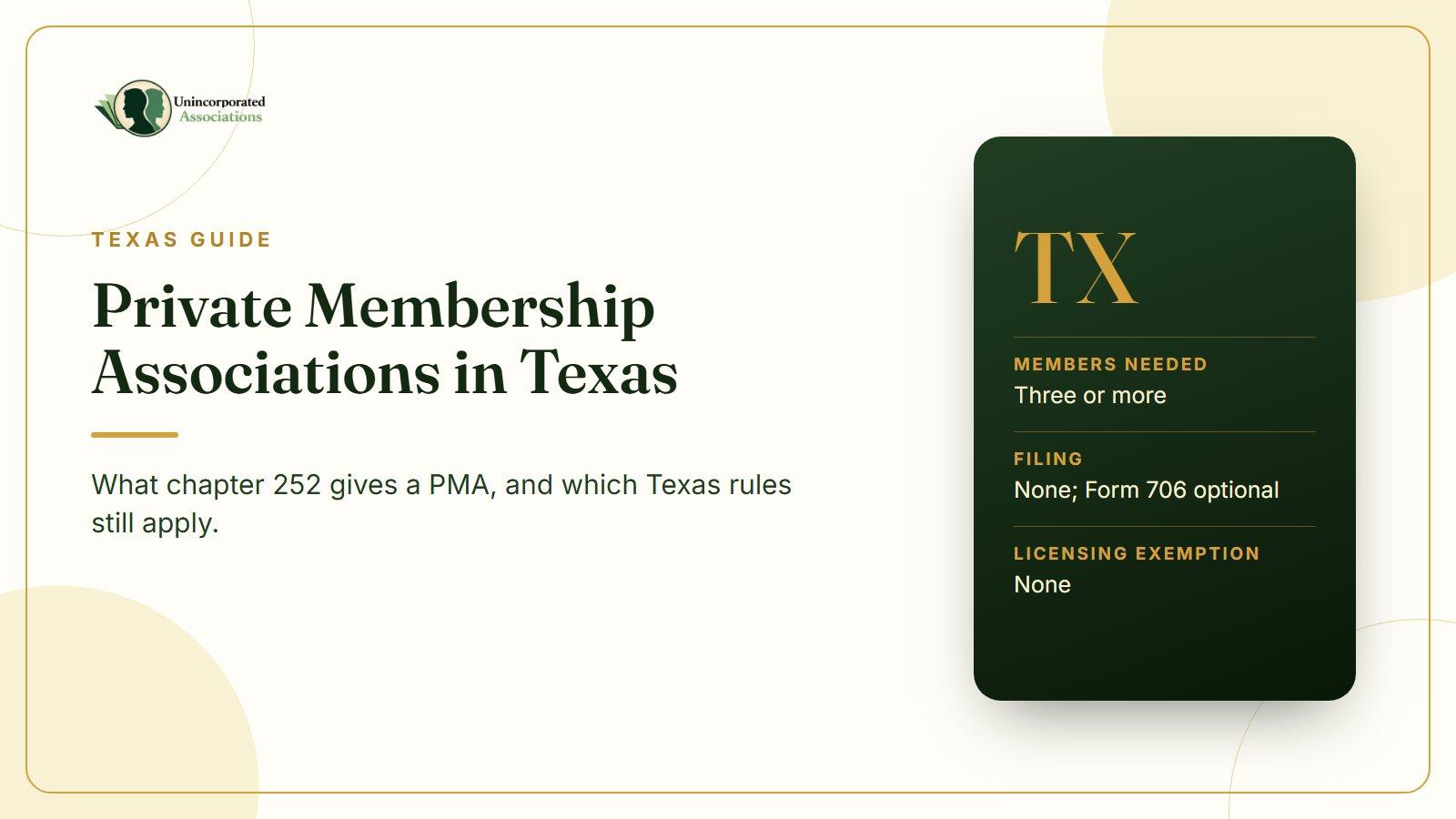
Short answer: In Texas, a nonprofit private membership association is an unincorporated nonprofit association under Business Organizations Code chapter 252: an organization of three or more members joined by mutual consent for a common nonprofit purpose (§ 252.001). Nothing is filed to form it, though filing Form 706 to appoint an agent is optional. Chapter 252 lets it own property, sue and be sued, and protects members from its debts just for being members (§§ 252.004, 252.006, 252.007). A PMA run for members' profit is generally a partnership under § 152.051. And in Texas, as everywhere, the PMA label does not exempt anyone from licensing, consumer protection or tax law.
Texas is a good state for unincorporated associations. It adopted the uniform nonprofit association act as chapter 252 of the Business Organizations Code, so a nonprofit PMA here has a clear statutory footing. Texas also enforces its licensing, consumer and tax rules on what people actually do, which is where PMA promoters sometimes overpromise.
This guide covers how Texas law treats a PMA, the steps to set one up, and which Texas rules still apply. For the general idea, start with what a private membership association is.
Key takeaways: A nonprofit Texas PMA is a chapter 252 nonprofit association. It needs at least three members. It can own property, sue and be sued, and members are protected from its debts. Form 706 is optional. Licensing, DTPA and sales tax rules still apply.
How Texas law sees a PMA
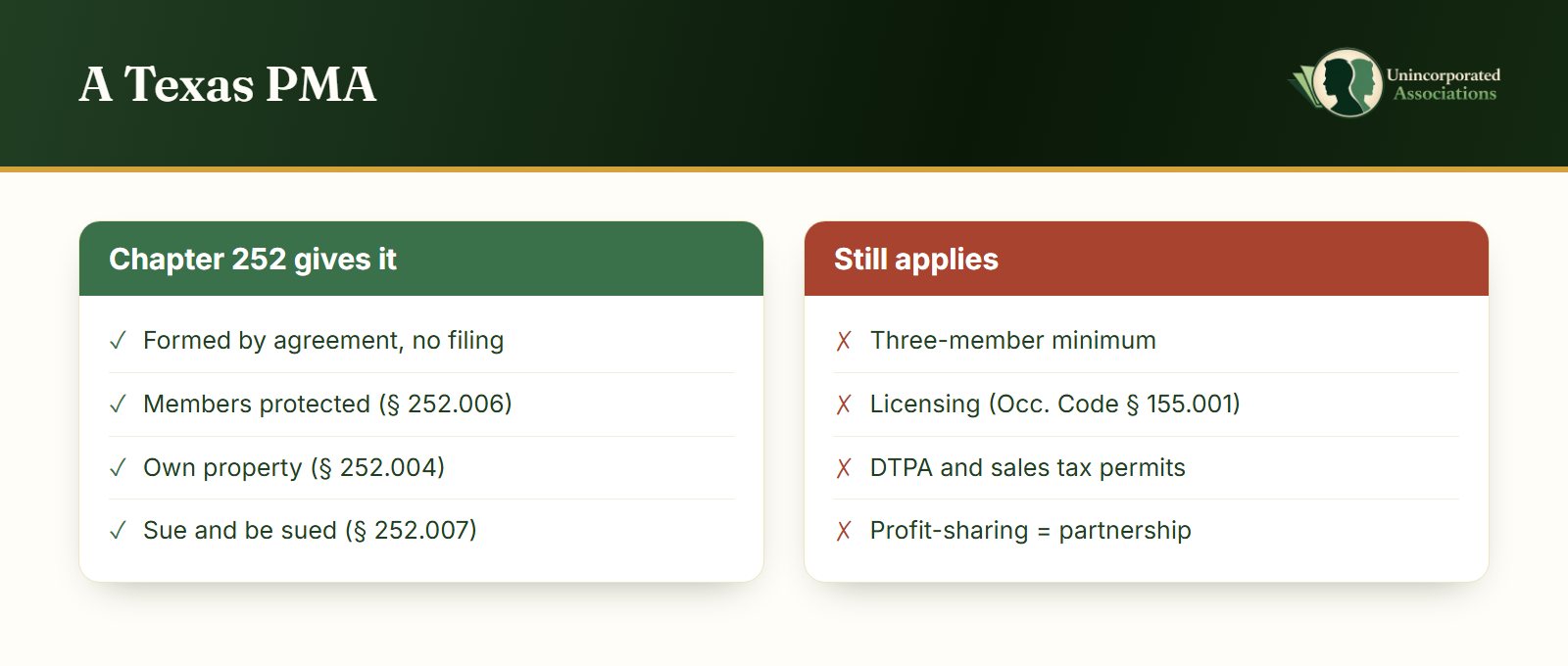
Chapter 252 defines a nonprofit association as "an unincorporated organization, other than one created by a trust, consisting of three or more members joined by mutual consent for a common, nonprofit purpose" (§ 252.001). A nonprofit PMA with three or more members fits that definition, and gets chapter 252's rules:
- Property. It can acquire, hold and transfer property in its own name (§ 252.004).
- Liability. It is a legal entity separate from its members for contract and tort liability, and members are not liable merely for being members (§ 252.006).
- Lawsuits. It can sue and be sued in its own name (§ 252.007).
Two points trip people up. First, three members, not two: a two-person PMA is not a chapter 252 nonprofit association. Second, nonprofit: if members run a business together and share its profits, Texas law says that creates a partnership "regardless of whether the persons intend to create a partnership" (§ 152.051), and partners can be personally liable.
The optional Form 706
A Texas nonprofit association may file a statement with the Secretary of State appointing an agent to receive service of process (§ 252.011). The Secretary of State uses Form 706 for this. It is optional, but it gives banks and counterparties a public record that the association exists and a known address for legal notices. Our Texas formation guide covers it in more detail.
What still applies to a Texas PMA
Professional licensing
Texas licensing statutes regulate the activity. For medicine, the rule is simple: "A person may not practice medicine in this state unless the person holds a license" (Occupations Code § 155.001). There is no exception for services offered only to members. The same applies to other licensed occupations.
Consumer protection
Texas's Deceptive Trade Practices Act lists false, misleading or deceptive acts in trade and commerce (Bus. & Com. Code § 17.46). Selling goods or services to "members" who simply click a box is still trade, and claims made to them are judged by the same standards.
Sales tax
Selling taxable items in Texas generally requires a sales and use tax permit from the Comptroller (Texas Comptroller: sales tax permit). Calling buyers "members" does not change whether a sale is taxable. Some exempt organizations qualify for Texas sales tax exemption, which requires an application to the Comptroller.
Income tax
Federal classification follows the IRS entity rules (26 CFR 301.7701-2). Being a nonprofit association under chapter 252 does not make the PMA tax-exempt. See our guide to PMA taxes.
Watch out: Texas courts and agencies judge the activity, not the label. A "PMA" that offers unlicensed medical care or sells to anyone who signs a click-through form is exposed to the same enforcement as any other business doing the same thing.
Food and products
Food and health products sold or served to members are still regulated by what they are. Texas's food safety and cottage food rules depend on the product and how it is sold, not on a membership agreement. Courts elsewhere have rejected members-only arguments for food sales; see the Wisconsin raw milk ruling. Check the rules for your product before anything changes hands.
Questions to answer before you launch a Texas PMA
- Does our group meet chapter 252's three-member, nonprofit definition?
- Will anyone share profits? If so, why isn't this a partnership under § 152.051?
- Which of our activities need a license or permit, and who holds it?
- Will we sell taxable items, and do we have a sales tax permit?
- Who is liable if a member is harmed?
Answer each one in writing. Kirk's team can walk through them with you on a free call.
A Texas PMA at a glance
| Question | Texas answer |
|---|---|
| Members needed | Three or more (§ 252.001) |
| Filing to form? | None; optional Form 706 (§ 252.011) |
| Members' liability | Not liable just for being members (§ 252.006) |
| Own property? | Yes (§ 252.004) |
| Profit-sharing? | Generally a partnership (§ 152.051) |
| Licensing exemption? | No (e.g., Occ. Code § 155.001) |
| Tax exemption automatic? | No; IRS and Comptroller rules apply |
How to set up a PMA in Texas
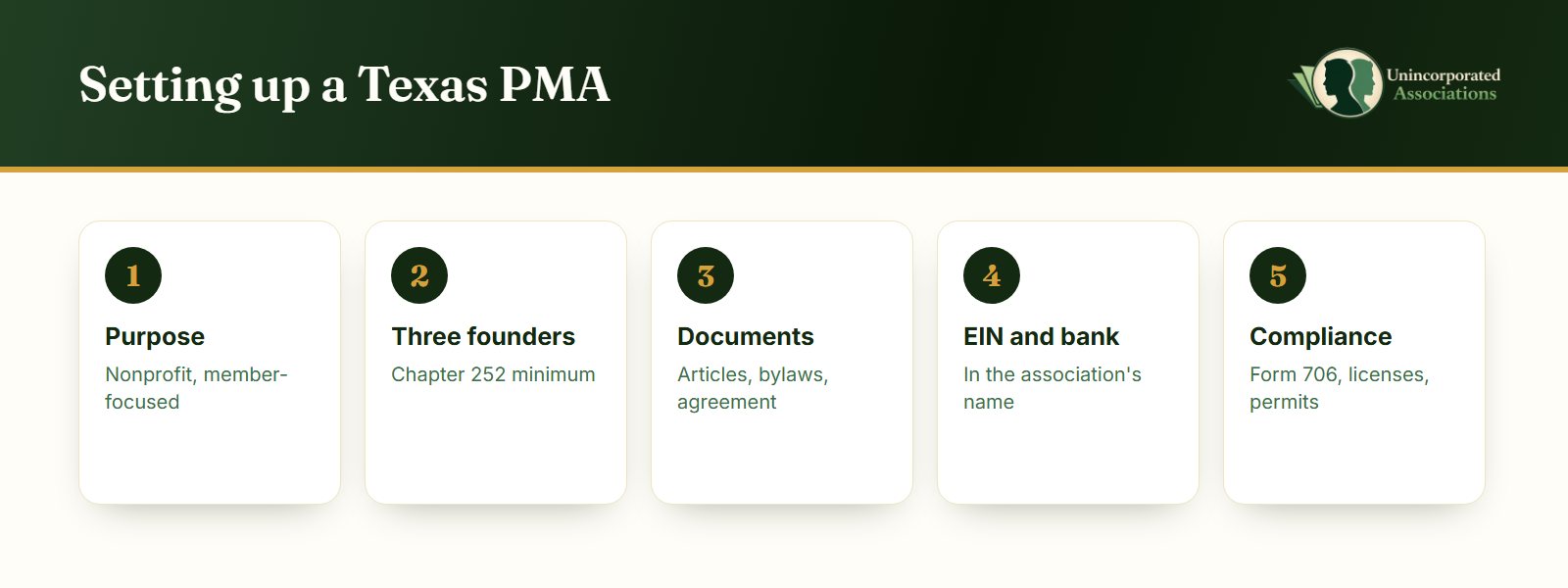
Step 1: Confirm a nonprofit, member-focused purpose
Write it down, and make sure the association will not distribute profits to members. If members want to share profits, compare PMA vs LLC.
Step 2: Recruit at least three founding members
Texas's definition requires three. Record who they are and when they joined.
Step 3: Draft the documents
Articles of association, bylaws, a membership agreement and a member register. See our guide to PMA documents.
Step 4: Sign before services begin
Members sign the agreement before receiving anything. Keep the signed copies.
Step 5: Appoint officers
Record who manages the association and who may sign for it.
Step 6: Get an EIN and bank account
Apply on Form SS-4 and open an account in the association's name. See the CP 575 EIN letter.
Step 7: Consider Form 706, and check compliance
File Form 706 if a public record helps. List each activity and check licenses, permits, sales tax and insurance.
Pro tip: Hold a short founding meeting with all three (or more) founders, adopt the articles and bylaws by vote, and record it in minutes. It proves the association exists, shows the mutual consent chapter 252 requires, and gives your bank what it needs.
Is a Texas PMA right for you?
A Texas PMA fits a member-led, nonprofit group that values privacy and member-written rules: a co-op, a club, a faith or wellness community, or an educational group. It fits poorly when the real goal is a profitable business with customers, which belongs in an LLC or corporation, or when the appeal is avoiding a license, which it will not do. Our PMA pros and cons guide weighs both sides.
Three Texas examples
An Austin homestead skills co-op with fifteen members sharing tools, classes and bulk seed orders. Nonprofit, member-led, no licensed activity. A strong fit for a chapter 252 PMA.
A Houston faith-based wellness community hosting member-only education with licensed practitioners delivering any care under their own licenses. Workable, with care to keep licensed work within each practitioner's license.
A Dallas "PMA" of two friends selling handmade goods online to anyone who ticks a membership box. It fails chapter 252's three-member rule and works like a retail shop, so it needs a sales tax permit. With a third founder, a real membership process and a nonprofit purpose, the picture changes.
Common mistakes in Texas
- Starting with two members and assuming chapter 252 applies.
- Using a generic template that doesn't match chapter 252.
- Using the PMA to sidestep a license.
- Skipping the sales tax permit for taxable sales to members.
- Assuming chapter 252 status means tax exemption.
Frequently asked questions
Is a private membership association legal in Texas?
Yes. A nonprofit PMA with three or more members is a nonprofit association under Business Organizations Code chapter 252. It must still follow Texas licensing, consumer and tax laws.
How many members does a Texas PMA need?
At least three for chapter 252 to apply (§ 252.001).
Do I have to register a PMA in Texas?
No. Filing Form 706 with the Secretary of State to appoint an agent is optional.
Are members of a Texas PMA personally liable?
Under § 252.006, members are not liable for the association's debts just for being members. They remain responsible for their own conduct and personal guarantees.
Can a Texas PMA offer medical services to members?
Only through licensed professionals. Occupations Code § 155.001 requires a license to practice medicine, with no members-only exception.
Sources
- Texas Business Organizations Code § 252.001, § 252.004, § 252.006, § 252.007 and § 252.011
- Texas Business Organizations Code § 152.051
- Texas Occupations Code § 155.001
- Texas Business and Commerce Code § 17.46
- Texas Comptroller: sales and use tax permit
- IRS: Form SS-4
- 26 CFR 301.7701-2
Setting up a PMA in Texas? Book a free 15-minute call with Kirk's team, or join the daily live Q&A.
Have questions? Bring them to the daily call.
Join our live Q&A every weekday and Saturday at 3PM PST, or get a free 15-minute call to see whether a UNA fits your situation.
Have a question about your situation?
Send us a message and we'll get back to you.
Keep reading
 The Well-Meaning Dragon: Straight Answers to the Hardest ObjectionsFor the family and friends who push back because they care — honest answers to the toughest questions about the Federal income tax and Unincorporated Associations.
 It's Not What You Believe, It's What You SignFor the cautious partner in the room: real risk rarely comes from asking questions. It comes from what you signed.
 What Most People Get Wrong About Taxes, Structure, and ControlThe real problem isn't taxes — it's structure, and who actually has control. A look at positioning over loopholes.
Educational, not legal or tax advice. Unincorporated Associations is a document-preparation and education company. Consult a licensed attorney or CPA before acting on any position discussed on this site.