What Is a Private Membership Association (PMA)? A Plain-English Guide
By Kirk Carmichael · · 9 min read
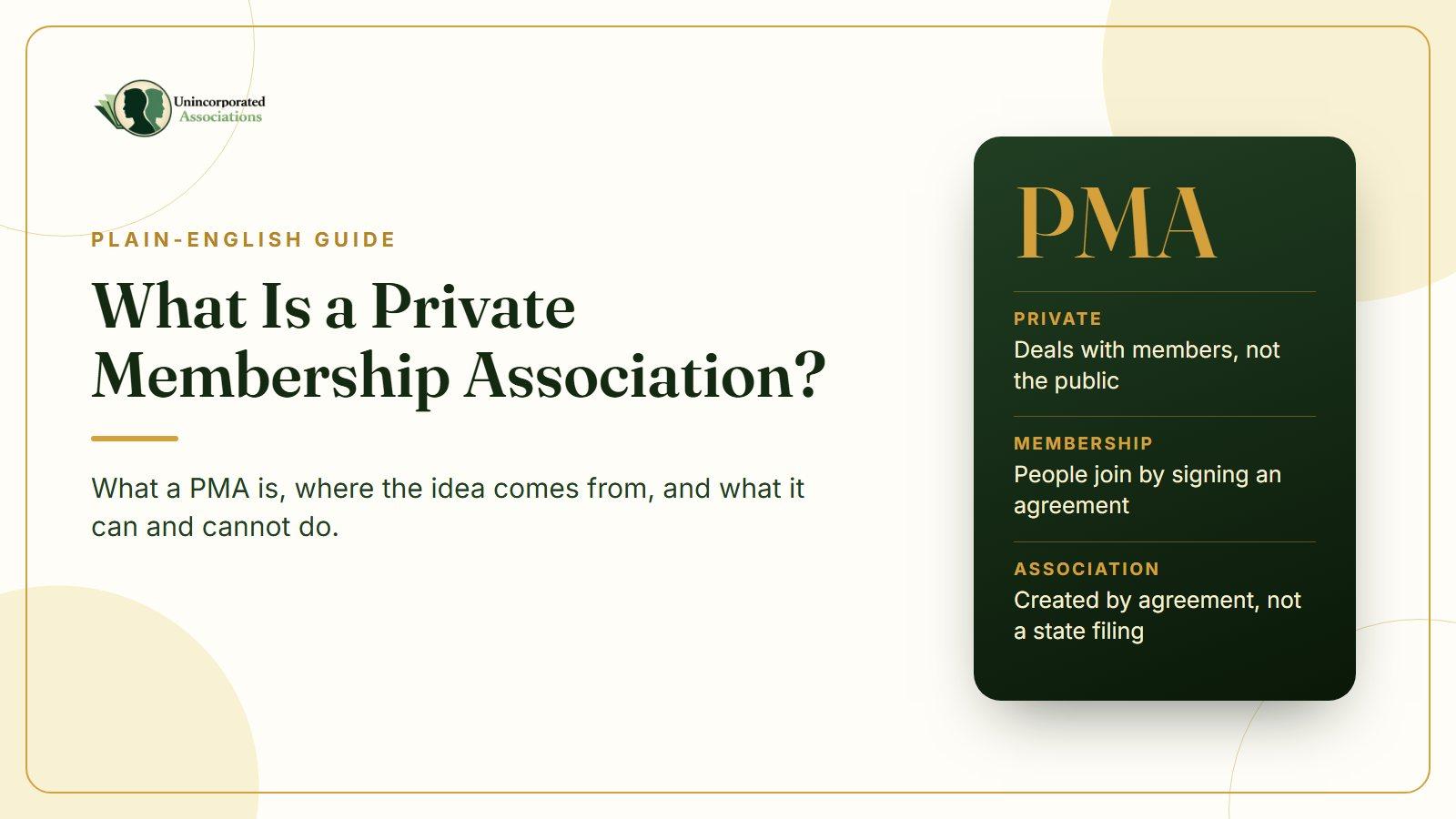
Short answer: A private membership association (PMA) is a group of two or more people who agree in writing to associate for a shared purpose and to deal with each other privately under the group's own rules. It is a type of unincorporated association: nothing is filed with the state to create it, members join by signing a membership agreement, and the association serves members rather than the public. It rests on the freedom of association, but it does not exempt anyone from licensing, health, civil rights or tax laws.
"PMA" gets used in very different ways online. Some people describe it as a simple, private way to organize a group. Others promise it puts a business "outside" the law. The first description is accurate. The second is not, and courts have said so.
This guide explains what a private membership association really is, where the idea comes from, how it compares with structures you may already know, and what to watch for before you join or form one.
Key takeaways: A PMA is a private, member-only unincorporated association created by agreement. Membership is the defining feature: people sign before they receive anything. It is useful for privacy and member-written governance. It is not a shield from regulation.
What does "private membership association" mean?
Take the three words one at a time.
- Private. The association deals with its members, not the general public. It does not advertise goods or services for sale to anyone who walks in.
- Membership. People become part of the association by signing a membership agreement that sets out their rights and responsibilities.
- Association. It is a group of people joined by agreement for a common purpose. In legal terms it is an unincorporated association: no state charter, no articles filed with a Secretary of State.
California's definition of an unincorporated association captures the core idea well: "an unincorporated group of two or more persons joined by mutual consent for a common lawful purpose," in Corporations Code section 18035. A PMA is that, with an extra emphasis on formal membership and member-only dealing.
Where does the idea come from?
The legal foundation is the constitutional freedom of association. Two Supreme Court cases are cited most often:
- NAACP v. Alabama (1958) held that a state could not force an association to hand over its membership list, because exposing members would chill their freedom to associate.
- Roberts v. United States Jaycees (1984) described two protected kinds of association: intimate relationships and association for expression, such as speech, worship or advocacy.
Those decisions protect people's right to come together and keep their membership private. Roberts also shows the limit: the Court let Minnesota apply its anti-discrimination law to a large, unselective membership organization. The freedom to associate is strong, but it is not a blanket exemption from laws that apply to everyone.
How a PMA differs from other structures
| PMA | Nonprofit corporation | LLC | Social club | |
|---|---|---|---|---|
| How it is created | Members' written agreement | Articles filed with the state | Articles filed with the state | Informal, or as an association |
| State filing to form | None | Required | Required | Usually none |
| Who it serves | Members only | The public or its mission | Customers and owners | Members |
| Rules come from | Articles, bylaws, membership agreement | State nonprofit act + bylaws | State LLC act + operating agreement | Bylaws, often informal |
| Public record | No state formation record | Public filing | Public filing | None |
| Tax treatment | Depends on activity | Can apply for exemption | Default pass-through | Depends on activity |
A PMA sits closest to a nonprofit or member-serving unincorporated nonprofit association. The main differences from a nonprofit corporation are that a PMA is not chartered by the state and typically serves only its members. Compared with an LLC, a PMA has no state filing, but its liability rules come from your state's association law instead of an LLC statute.
Who uses private membership associations?
People form PMAs when a group wants private, member-written rules around a shared purpose. Common examples include:
- Food and farm groups. Buying clubs and herd-share groups where members pool resources.
- Wellness and education communities. Groups that share knowledge and resources among members.
- Faith-based groups. Congregations and ministries that prefer a private, member-governed structure.
- Professional and peer networks. Groups that share information or tools among vetted members.
- Family and private groups. Families and close-knit groups organizing a shared purpose under written rules.
Pro tip: The strongest PMAs have a purpose that is genuinely about the members, not a product. "Members share knowledge and resources on regenerative farming" reads like an association. "Selling raw milk to anyone who signs a form" reads like a store.
What a PMA can and cannot do
A PMA can:
- Decide who may join and set the terms of membership
- Keep its member list private
- Govern itself through articles, bylaws and a membership agreement
- Hold money and property for its purpose, under its state's association laws
- Provide goods, services or education to members under the membership agreement
A PMA cannot:
- Make licensing laws disappear. In Wisconsin, an appeals court held that a farm store selling raw milk to members of a private association still needed a license (Food Safety News). In Pennsylvania, a 2023 consent decree in the federal case over Amos Miller's members-only farm required the farm to follow state rules, and state officials raided it in 2024 (National Agricultural Law Center).
- Ignore anti-discrimination laws where they apply, as Roberts v. Jaycees shows.
- Change tax obligations by itself. The IRS classifies organizations by what they are and do under 26 CFR 301.7701-2, whatever they are called.
Watch out: Courts look at what an arrangement actually does. If it is a sale to the public with a membership form attached, the label will not change the outcome. Build the PMA around genuine, members-only dealing.
PMA myths vs facts
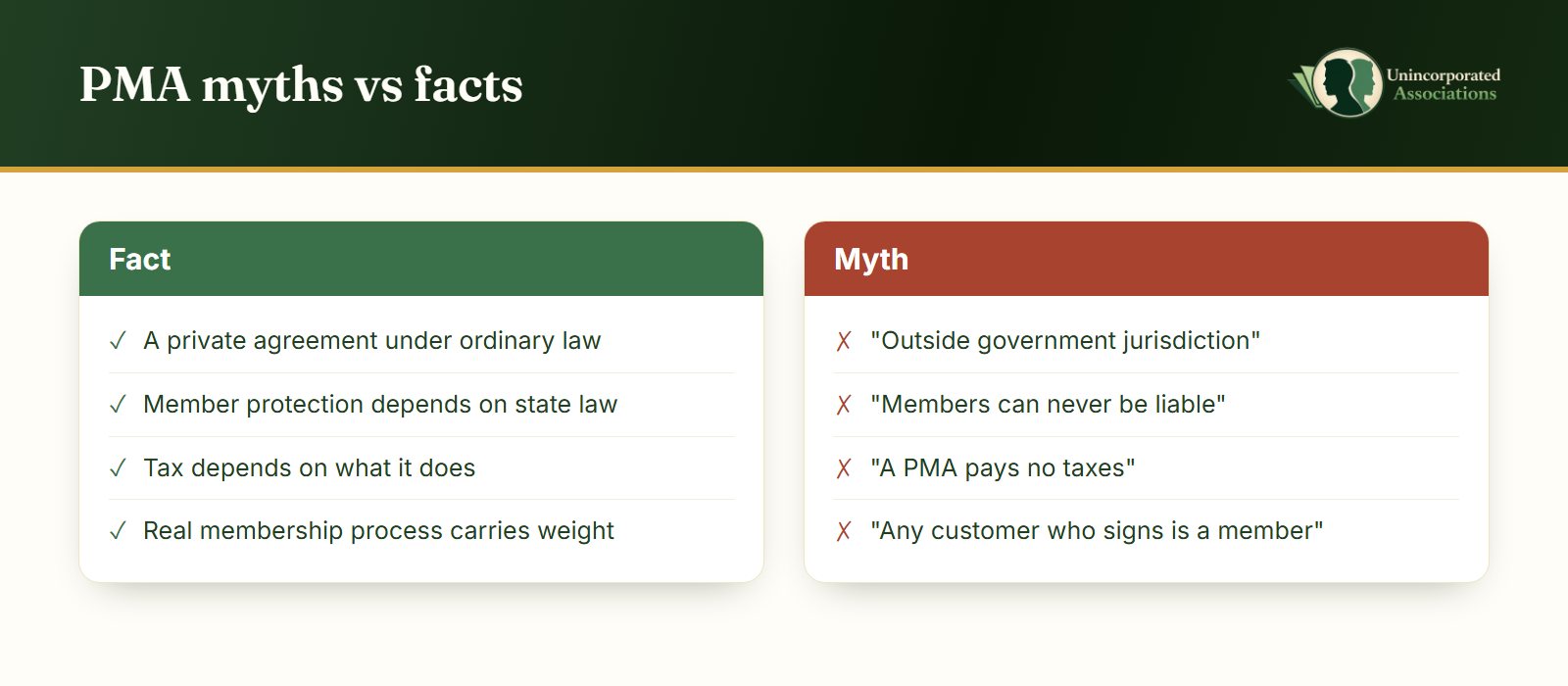
Because so much PMA content online is promotional, it helps to separate the claims from the law.
Myth: "A PMA operates outside government jurisdiction." Fact: a PMA is a private agreement among people who remain subject to the same laws as everyone else. Courts have applied licensing and health rules to members-only operations.
Myth: "Members can never be held liable." Fact: member protection depends on state law. Some states, like California and Texas, give nonprofit association members strong statutory protection; others rely on older common-law rules. And anyone who personally guarantees a debt or personally causes harm can be held responsible.
Myth: "A PMA doesn't pay taxes." Fact: tax treatment depends on what the association does. There is no IRS category that makes a PMA tax-free because of its label.
Myth: "Signing a form makes any customer a member." Fact: courts look at substance. A genuine membership process, clear purpose and real member-only dealing carry weight; a click-through form in front of an ordinary sale does not.
Questions to ask before you join a PMA
- What is the association's written purpose, and does its activity match it?
- Can you read the articles, bylaws and membership agreement before you sign?
- Who runs it, and how are decisions and money handled?
- What are the dues, and are they refundable if you leave?
- Does the activity need a license or permit? If so, does the operator have it?
- Is anyone promising you protection from laws or taxes? If yes, treat that as a red flag.
Is a private membership association legal?
Yes. Forming a private association is a lawful exercise of the freedom of association, and many states have statutes that recognize unincorporated associations. California's Corporations Code, for example, lets an association own property in its own name (section 18105) and protects nonprofit association members from liability for the association's debts just for being members (section 18605).
What is not legal is using the PMA label to avoid laws that apply to the activity itself. A clear way to think about it: the PMA governs the relationship between the association and its members. The law still governs the activity.
How is a PMA taxed?
There is no special "PMA" tax category. The IRS looks at the organization's purpose and activities:
- A PMA that runs a for-profit business for its members can be treated as a partnership or other business entity.
- A PMA organized and operated for a qualifying nonprofit purpose can apply for tax exemption, just like other unincorporated nonprofit associations. The IRS accepts articles of association as an organizing document for 501(c)(3) status.
- Any PMA that opens a bank account or files returns will need an EIN, available through IRS Form SS-4.
Kirk's team covers tax positioning on every intro call, and a CPA should confirm how your specific activities will be treated.
How do you join or form a PMA?
To join one, you read and sign its membership agreement, usually pay any dues, and receive access to what the association provides its members.
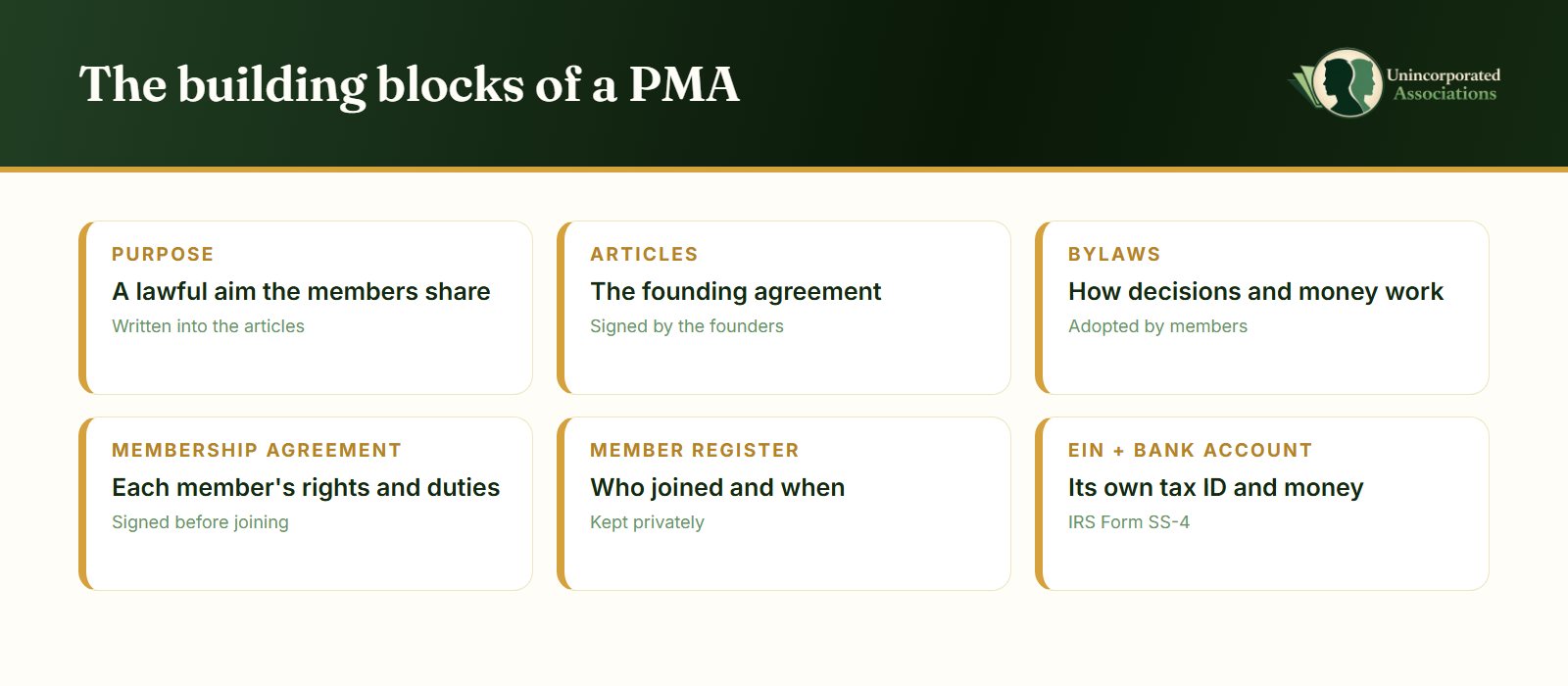
To form one, founders define a lawful shared purpose, sign articles of association, adopt bylaws and a membership agreement, appoint officers, keep a member register, get an EIN and open a bank account in the association's name. Our guide to how to become an unincorporated association covers the documents, and our PMA overview explains how we structure them.
Frequently asked questions
What does PMA stand for?
In this context, PMA stands for private membership association, sometimes written as private member association. It is a type of unincorporated association whose members agree to deal with one another privately under the association's own rules.
Is a PMA the same as an unincorporated association?
A PMA is a kind of unincorporated association. Every PMA is an unincorporated association, but not every unincorporated association is set up as a members-only PMA.
Does a private membership association have to register with the state?
No filing is needed to form one. Some states offer optional filings, such as naming an agent to receive legal papers, and some activities require licenses whatever the structure.
Can a PMA sell to the public?
If it sells to the public, it is no longer operating as a private membership association, and courts will treat the activity like any other public sale. A PMA should provide goods and services only to members who have signed the membership agreement.
Is a PMA tax-exempt?
Not automatically. Tax treatment depends on the association's purpose and activities, and a PMA with a qualifying nonprofit purpose can be exempt. A CPA can confirm how yours will be classified.
Sources
- California Corporations Code section 18035 (definition of unincorporated association)
- California Corporations Code section 18105 (property)
- California Corporations Code section 18605 (member liability)
- NAACP v. Alabama ex rel. Patterson, 357 U.S. 449 (1958)
- Roberts v. United States Jaycees, 468 U.S. 609 (1984)
- 26 CFR 301.7701-2, Business entities defined
- IRS: Exemption requirements for 501(c)(3) organizations
- IRS: About Form SS-4
- Food Safety News: Raw milk distribution schemes cannot escape Wisconsin licensing requirements
- National Agricultural Law Center: Amos Miller and the regulation of raw milk
Curious whether a PMA fits your group? Book a free 15-minute call with Kirk's team, or join the daily live Q&A.
Have questions? Bring them to the daily call.
Join our live Q&A every weekday and Saturday at 3PM PST, or get a free 15-minute call to see whether a UNA fits your situation.
Have a question about your situation?
Send us a message and we'll get back to you.
Keep reading
 The Well-Meaning Dragon: Straight Answers to the Hardest ObjectionsFor the family and friends who push back because they care — honest answers to the toughest questions about the Federal income tax and Unincorporated Associations.
 It's Not What You Believe, It's What You SignFor the cautious partner in the room: real risk rarely comes from asking questions. It comes from what you signed.
 What Most People Get Wrong About Taxes, Structure, and ControlThe real problem isn't taxes — it's structure, and who actually has control. A look at positioning over loopholes.
Educational, not legal or tax advice. Unincorporated Associations is a document-preparation and education company. Consult a licensed attorney or CPA before acting on any position discussed on this site.