
How to Form an Unincorporated Nonprofit Association in Texas (2026 Guide)
By Kirk Carmichael · · 8 min read
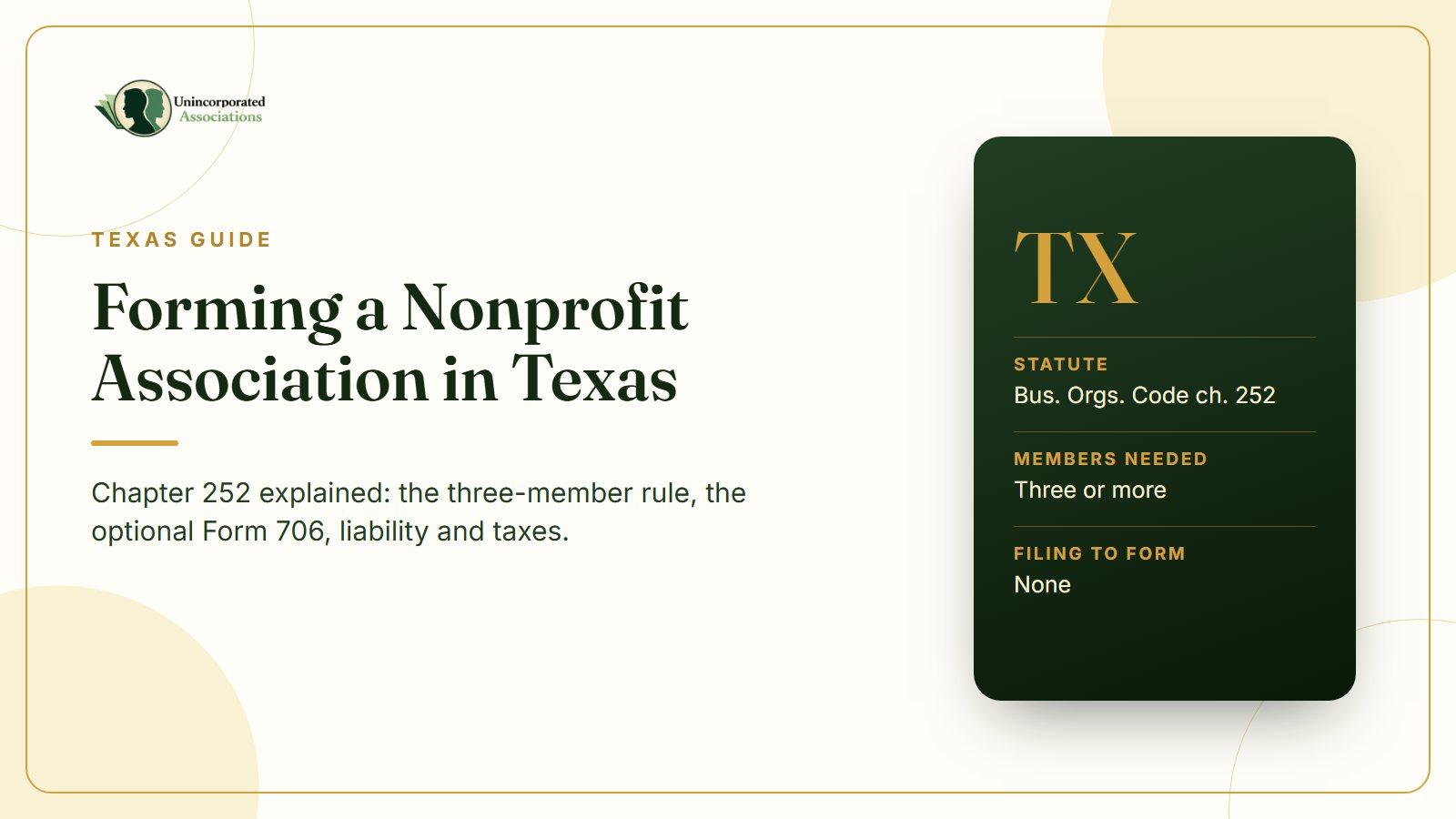
Short answer: In Texas, unincorporated nonprofit associations are governed by Business Organizations Code chapter 252, the state's version of the Uniform Unincorporated Nonprofit Association Act. A nonprofit association needs at least three members joined by mutual consent for a common nonprofit purpose; nothing is filed to form it. Once formed, it is a legal entity separate from its members for contracts and torts, can own property in its own name, and can sue and be sued. Filing Form 706 with the Secretary of State to appoint an agent is optional.
Texas is one of the clearest states in the country for unincorporated nonprofit associations. Chapter 252 gives them entity status, property rights, court standing and member liability protection, all without requiring a state filing to exist.
There are a few Texas-specific details worth getting right, starting with the member count. This guide covers the law, the steps, the optional filing and the tax picture.
Key takeaways: Texas requires three or more members, not two. Nothing is filed to form the association. It is a legal entity for contract and tort purposes, can hold property and can sue in its own name. Form 706 is optional, and nonprofit status does not by itself make the association exempt from federal or state taxes.
What Texas law says
Texas adopted the uniform act as chapter 252 of the Business Organizations Code. The key definitions are in section 252.001:
- A "nonprofit association" is "an unincorporated organization, other than one created by a trust, consisting of three or more members joined by mutual consent for a common, nonprofit purpose."
- A "member" is a person who, under the association's rules or practices, may take part in choosing those who manage it or in developing its policy.
- Co-owning property, by itself, does not create a nonprofit association.
That three-member minimum is the first thing to note. California's definition requires only two people; Texas requires three for chapter 252 to apply.
What a Texas nonprofit association can do
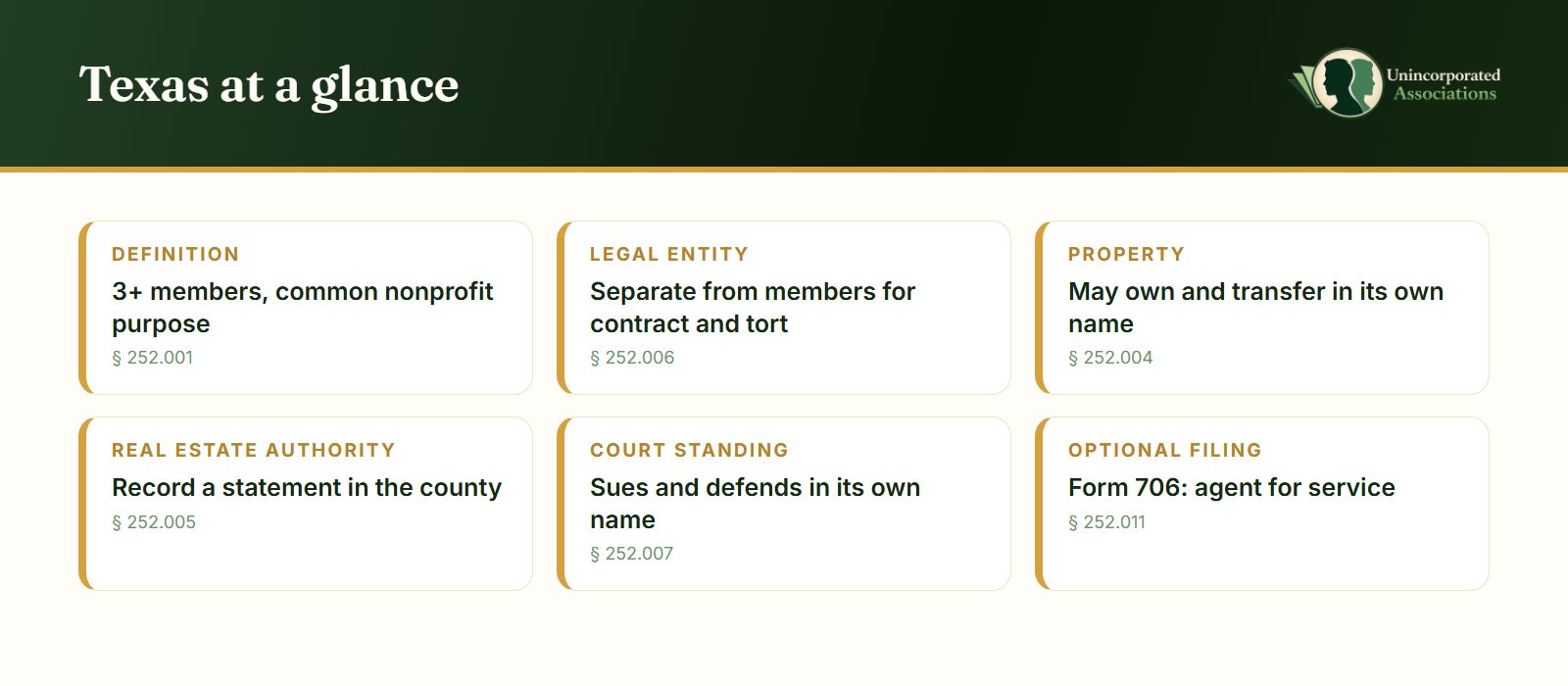
- Be a legal entity. Under section 252.006, a nonprofit association is a legal entity separate from its members for determining and enforcing rights, duties and liabilities in contract and tort.
- Own property. Under section 252.004, it may acquire, hold, encumber or transfer real or personal property in its own name, and may be a beneficiary of a trust, contract or will.
- Record authority for real estate. Under section 252.005, it may record a statement of authority in the county clerk's office naming who can transfer its real property.
- Go to court. Under section 252.007, it may sue, defend and take part in proceedings in its own name, and in some cases assert claims on behalf of its members.
Member liability in Texas
Section 252.006 also protects members. A person is not liable for the association's contracts or torts "merely because the person is a member, is authorized to participate in the management of the affairs of the nonprofit association, or is a person considered as a member by the nonprofit association."
Two limits apply, as they do in every state:
- People remain responsible for their own conduct and their own personal guarantees.
- The protection is for a nonprofit association. A group of co-owners running a business for their own profit is likely a partnership under Texas law, where partners can be personally liable. See section 152.051.
Watch out: Texas counts members carefully. If your group has only two people, chapter 252 may not apply, and the protections in it may not be available. Recruit a third founding member before you rely on the statute.
Step by step: forming a Texas nonprofit association
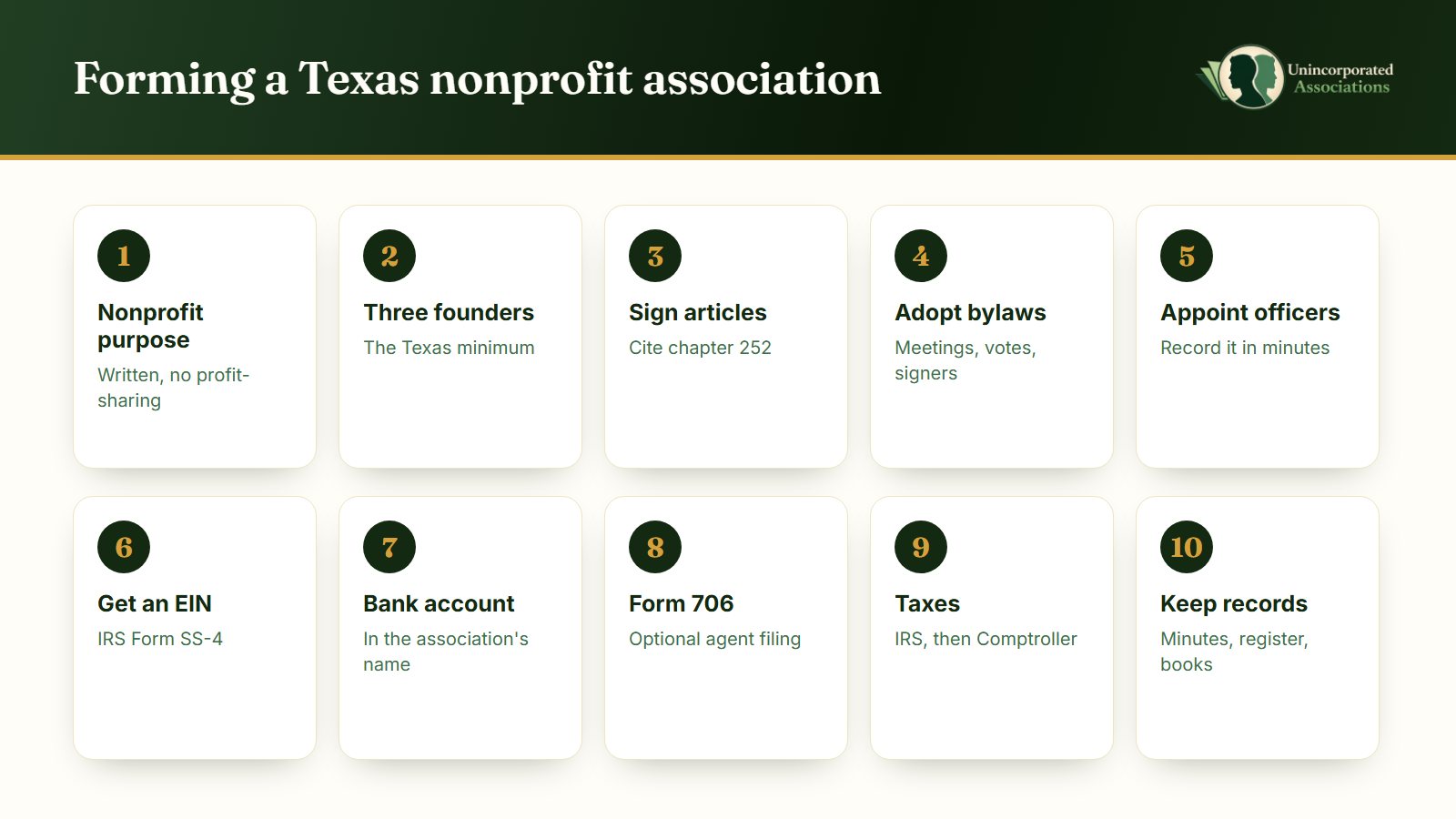
Step 1: Write the nonprofit purpose
State what the association exists to do in a sentence or two, and make clear it is a nonprofit purpose. Avoid language that lets members split profits.
Step 2: Gather at least three founding members
Name the founders, decide who serves as the first officers, and decide how new members join.
Step 3: Sign articles of association
The articles should name the association, state its purpose, confirm it is an unincorporated nonprofit association under Texas Business Organizations Code chapter 252, explain how property is held and how the articles are amended, and say what happens to assets on dissolution.
Step 4: Adopt bylaws
Cover meetings, voting, officers, signing authority, records and disputes. Our guide to UNA bylaws walks through the key clauses.
Step 5: Appoint officers and record it
Record who the officers are in minutes or a resolution. Banks and title companies will ask for it.
Step 6: Get an EIN
Apply with the IRS using Form SS-4 or online. Keep the CP 575 confirmation, and note that the optional Form 706 asks for the association's federal taxpayer ID if it has one.
Step 7: Open a bank account
Bring the signed articles, the EIN confirmation, the officer resolution and signers' IDs. Our association bank account checklist covers the rest.
Step 8: Consider Form 706
See below. Many Texas associations file it so legal papers have a clear destination.
Step 9: Address taxes
Apply for federal exemption if you qualify, and check Texas state tax status with the Comptroller (see the tax section).
The optional Form 706 filing
Under section 252.011, a nonprofit association may file a statement with the Secretary of State appointing an agent to receive service of process. The statement must include:
- the association's name
- its federal taxpayer identification number, if it has one
- its Texas address, including street address if any (or its out-of-state address)
- the name of the person in Texas authorized to receive service of process
The Secretary of State's form for this is Form 706, which must be signed by someone authorized to manage the association's affairs. The Secretary of State lists a $25 filing fee for an unincorporated nonprofit association; confirm the current fee in the Form 706 instructions before filing. Filing it does not create the association; it simply puts an official address for legal papers on record.
Pro tip: Choose an agent who will still be reachable in three to five years, and file a new statement if that person changes. An agent who has moved away is almost as bad as having none.
Taxes in Texas
The Texas Secretary of State is direct about this on its nonprofit organizations page: neither a nonprofit corporation nor an unincorporated nonprofit association is automatically exempt from federal or state taxes.
- Federal. A Texas association with a qualifying purpose can apply for federal exemption; the IRS accepts articles of association as an organizing document for 501(c)(3) status. Once exempt, it files annual returns; see our guide on whether unincorporated associations file tax returns.
- State. Texas exemptions from franchise and sales tax are handled by the Comptroller's exempt organizations section. Organizations with a federal exemption typically apply by sending the Comptroller a copy of the IRS determination letter. Whether your association owes franchise tax depends on its status, so confirm with the Comptroller or a Texas CPA.
Common mistakes Texas associations make
- Starting with two members. The statute's definition requires three. Bring in a third founding member before you sign the articles.
- Leaving "nonprofit" vague. The articles should state a clear nonprofit purpose and how money is used, so the association plainly fits chapter 252.
- Holding property in a member's name. Section 252.004 lets the association hold property itself. Titling property to an officer personally creates problems when that officer leaves or dies.
- No statement of authority for real estate. Without one recorded in the county, every sale or refinance of association property gets harder.
- Assuming state tax exemption is automatic. It is not. Federal exemption comes first, then the Comptroller.
- Letting the Form 706 agent go stale. If the named agent moves or leaves, file a new statement so legal papers still reach the association.
Pro tip: Keep a one-page "association facts" sheet with the legal name, EIN, Texas address, officers, agent and the date each was last updated. It turns every bank, title or Comptroller request into a five-minute job.
Texas vs California at a glance
| Texas | California | |
|---|---|---|
| Statute | Bus. Orgs. Code ch. 252 (uniform act) | Corp. Code Title 3 |
| Minimum members | Three | Two |
| Filing to form | None | None |
| Optional state filing | Form 706: agent for service | Form UA-100: office and agent, expires after 5 years |
| Property in own name | Yes (§ 252.004) | Yes (§ 18105) |
| Member liability | Not liable just for being a member (§ 252.006) | Not liable just for being a member (§ 18605) |
Our full California guide covers the California side.
Frequently asked questions
Do I need to register an unincorporated association in Texas?
No. A Texas nonprofit association exists once three or more members join by mutual consent for a common nonprofit purpose. Filing Form 706 to appoint an agent for service of process is optional.
How many members does a Texas nonprofit association need?
At least three. Business Organizations Code section 252.001 defines a nonprofit association as an unincorporated organization of three or more members joined by mutual consent for a common, nonprofit purpose.
Is a Texas unincorporated association a legal entity?
Yes, for contract and tort purposes. Section 252.006 makes a nonprofit association a legal entity separate from its members, and other sections let it own property and sue or be sued in its own name.
Are members personally liable in Texas?
Not merely for being members or for helping manage the association. Members remain responsible for their own conduct and personal guarantees.
Is a Texas nonprofit association exempt from taxes?
Not automatically. It must qualify for and obtain federal exemption from the IRS and, for Texas taxes, apply to the Comptroller.
Sources
- Texas Business Organizations Code section 252.001 (definitions)
- Section 252.004 (property), 252.005 (statement of authority), 252.006 (legal entity; liability), 252.007 (standing), 252.011 (agent)
- Section 152.051 (partnership formation)
- Texas Secretary of State: Form 706 instructions
- Texas Secretary of State: Nonprofit organizations
- Texas Comptroller: Exempt organizations
- IRS: Form SS-4 and 501(c)(3) requirements
Forming an association in Texas? Book a free 15-minute call with Kirk's team, or join the daily live Q&A.
Have questions? Bring them to the daily call.
Join our live Q&A every weekday and Saturday at 3PM PST, or get a free 15-minute call to see whether a UNA fits your situation.
Have a question about your situation?
Send us a message and we'll get back to you.
Keep reading
 The Well-Meaning Dragon: Straight Answers to the Hardest ObjectionsFor the family and friends who push back because they care — honest answers to the toughest questions about the Federal income tax and Unincorporated Associations.
 It's Not What You Believe, It's What You SignFor the cautious partner in the room: real risk rarely comes from asking questions. It comes from what you signed.
 What Most People Get Wrong About Taxes, Structure, and ControlThe real problem isn't taxes — it's structure, and who actually has control. A look at positioning over loopholes.
Educational, not legal or tax advice. Unincorporated Associations is a document-preparation and education company. Consult a licensed attorney or CPA before acting on any position discussed on this site.