
How to Form an Unincorporated Association in California (2026 Guide)
By Kirk Carmichael · · 10 min read
Short answer: In California, an unincorporated association is formed when two or more people agree to pursue a common lawful purpose; Corporations Code section 18035 needs nothing filed with the state. To form one properly, adopt written articles and bylaws, appoint officers, get an EIN and open a bank account. You can optionally file Form UA-100 with the Secretary of State to list your office and an agent for service of process. If the association's main purpose is not a for-profit business, it is a "nonprofit association," and its members get the liability protections in sections 18605 to 18620.
California is one of the states that took unincorporated associations seriously enough to write a full set of rules for them. Title 3 of the Corporations Code (sections 18000 and following) says what an association is, lets it own property in its own name, sets out when members can and cannot be held liable, and offers an optional filing with the Secretary of State.
That makes California a clearer place to form an association than many states. It also means there are specific rules worth getting right. This guide walks through the law, the steps and the paperwork, from San Diego to Sacramento.
Key takeaways: Nothing is filed to form a California association. A nonprofit association's members are protected by Corporations Code sections 18605 to 18620. Form UA-100 is optional and expires after five years. Being nonprofit does not make an association tax-exempt in California until the Franchise Tax Board says so.
What counts as an unincorporated association in California?
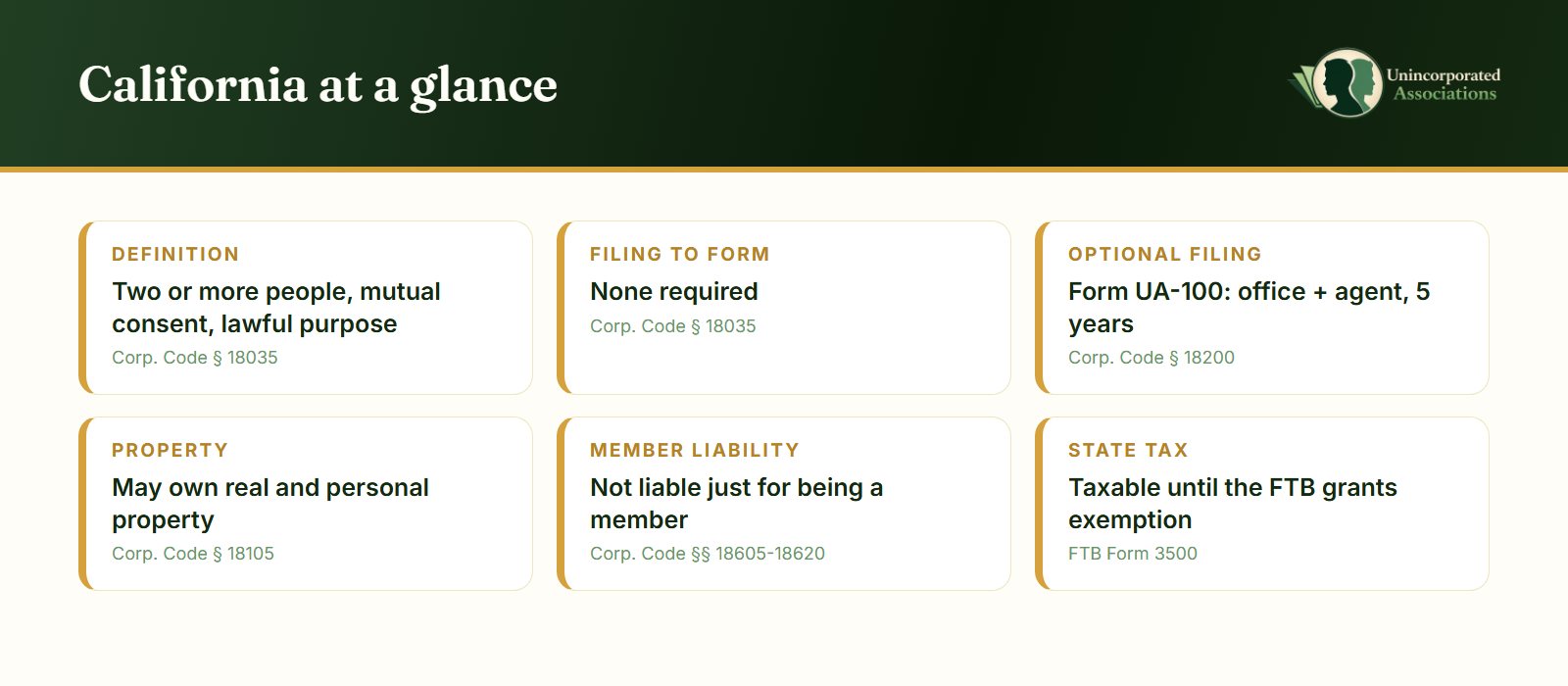
Corporations Code section 18035 defines an unincorporated association as "an unincorporated group of two or more persons joined by mutual consent for a common lawful purpose, whether organized for profit or not." Three things follow from that definition:
- You need at least two people.
- They must agree to join (mutual consent), which is why written articles matter.
- The purpose must be lawful, and it can be for profit or not.
Simply co-owning property does not create an association. Section 18035 says joint tenancy, tenancy in common and similar forms of ownership do not, by themselves, make the owners an association.
Nonprofit association vs for-profit association
California splits associations into two kinds, and the split matters.
Under section 18020, a nonprofit association is an unincorporated association "with a primary common purpose other than to operate a business for profit." It may still run a business, as long as it applies any profit to its lawful activities.
An association whose primary purpose is to run a business for profit is not a nonprofit association. That matters because the member liability protections in sections 18605 to 18620 apply to nonprofit associations. A for-profit group of co-owners is likely to be treated as a general partnership, with personal liability for its partners.
When you write your articles, state the association's primary purpose clearly, and make sure the way it actually operates matches it.
Step-by-step: forming an unincorporated association in California
Step 1: Write down the purpose
One or two sentences on what the association exists to do and who it serves. This is the single most important line in your documents, for the reasons above.
Step 2: Gather at least two founding members
Agree on who the founders are, who will serve as the first officers, and how new members join.
Step 3: Adopt articles of association
The articles state the name, the purpose, that the association is an unincorporated association under California law, how property is held, how the articles are amended and what happens on dissolution. The founders sign and date them.
Step 4: Adopt bylaws
Bylaws cover meetings, voting, officers, who may sign contracts and checks, records and disputes. California has no mandatory bylaw template for associations, so your bylaws are your rulebook. See our guide to UNA bylaws.
Step 5: Appoint officers and record it
Name a chair or president, a secretary and a treasurer, and record the appointments in minutes or a written resolution. You will need that resolution for the bank.
Step 6: Get an EIN
Apply with the IRS using Form SS-4 or the online application. Keep the IRS confirmation letter. Our guide to the EIN for an unincorporated association explains which entity type to choose.
Step 7: Open a bank account
Open an account in the association's name with the articles, the EIN letter, the officer resolution and the signers' IDs. Our association bank account checklist covers what banks ask for.
Step 8: Decide on the optional state filing
See the next section. It is optional, but useful for many California associations.
Step 9: Apply for state tax exemption if you qualify
If the association is organized and run for an exempt nonprofit purpose, apply to the Franchise Tax Board with Form FTB 3500. See the tax section below.
The optional Form UA-100 filing
Corporations Code section 18200 lets an unincorporated association file a statement with the California Secretary of State. The statement can:
- give the street address of the association's principal office in California, and
- name an agent for service of process, so legal papers have a clear place to go.
The form is the Statement by Unincorporated Association (Form UA-100), filed through the Secretary of State's bizfile Online system. A few rules from the statute and the form:
- The agent must be a California resident (with a California street address, not a P.O. box) or a qualified corporate agent. The association cannot name itself.
- You can file a new statement at any time to replace the old one.
- The statement expires five years after December 31 of the year it was filed, so put a renewal date on your calendar.
- There is a small state filing fee; check the current amount on bizfile before filing.
Pro tip: Name someone who will still be reachable in five years as your agent, and set a calendar reminder for the UA-100 expiry date the day it is accepted.
Filing a UA-100 does not create the association or change its legal status. The association already exists once the members agree to form it. The filing simply puts an address and agent on record.
Owning property in California
Section 18105 lets an unincorporated association "acquire, hold, manage, encumber, or transfer an interest in real or personal property" in its own name. That is a big advantage over states where property must be held by trustees for the members.
If the association owns real estate, section 18120 lets it record a statement of authority in the county where the property sits. The statement names the officers or other people authorized to buy, sell or borrow against real property for the association. Title companies and lenders will want to see it.
Member liability in California
California gives nonprofit association members clear protection.
- The general rule. Under section 18605, a member, director, officer or agent of a nonprofit association is not liable for the association's debts or obligations "solely by reason of being a member, director, officer, or agent."
- Contracts. Under section 18610, a member is not liable for the association's contracts unless, for example, they personally assume the obligation in a signed writing or expressly authorize or ratify the specific contract in writing.
- Injuries and harm. Under section 18620, a member, director, officer or agent can be liable for harm caused by the association in specific situations, such as when they expressly assume liability for particular conduct or are personally responsible for it.
Watch out: Section 18610 removes a member's protection for a contract the member personally assumed or expressly authorized in writing. Keep personal signatures off association contracts.
The lesson: the protection is real, but people who sign personal guarantees or personally direct harmful conduct can still be held responsible. Officers should sign contracts in the association's name, with their title, never personally. Our guide to unincorporated association liability goes deeper.
Suing and being sued
Under Code of Civil Procedure section 369.5, an unincorporated association "may sue and be sued in the name it has assumed or by which it is known." That is one reason naming an agent with a UA-100 is useful: it gives a clear, official address for legal papers instead of leaving them to be served on individual members.
California taxes for associations
California taxes are separate from federal taxes, and the Franchise Tax Board (FTB) has its own rules.
According to the FTB's Form 3500 exemption booklet, corporations and unincorporated organizations, even those organized on a nonprofit basis, are subject to California franchise or income tax until the FTB grants exempt status. The booklet also says unincorporated associations organized on a nonprofit basis are subject only to the income tax, not the franchise tax.
To be exempt, an association that qualifies under Revenue and Taxation Code section 23701 must apply with Form FTB 3500 and its governing documents. Since January 1, 2021, the FTB no longer charges the $25 application fee or the $10 annual information return fee.
Federal tax treatment is a separate question, decided by the IRS based on what the association does. Kirk's team covers tax positioning on every intro call, and a California CPA can confirm how your specific activities will be treated.
California at a glance
| Topic | California rule | Where it comes from |
|---|---|---|
| Definition | Two or more persons joined by mutual consent for a common lawful purpose | Corp. Code § 18035 |
| Nonprofit association | Primary purpose other than running a business for profit | Corp. Code § 18020 |
| Filing to form | None required | Corp. Code § 18035 |
| Optional state filing | Form UA-100: office address and agent; expires after five years | Corp. Code § 18200 |
| Owning property | May hold real and personal property in its own name | Corp. Code § 18105 |
| Real estate authority | Record a statement of authority in the county | Corp. Code § 18120 |
| Member liability | Not liable solely for being a member (nonprofit associations) | Corp. Code §§ 18605, 18610, 18620 |
| Lawsuits | May sue and be sued in its own name | Code Civ. Proc. § 369.5 |
| State tax | Taxable until FTB grants exemption; apply with FTB 3500 | FTB 3500 booklet; R&TC § 23701 |
Common mistakes California associations make
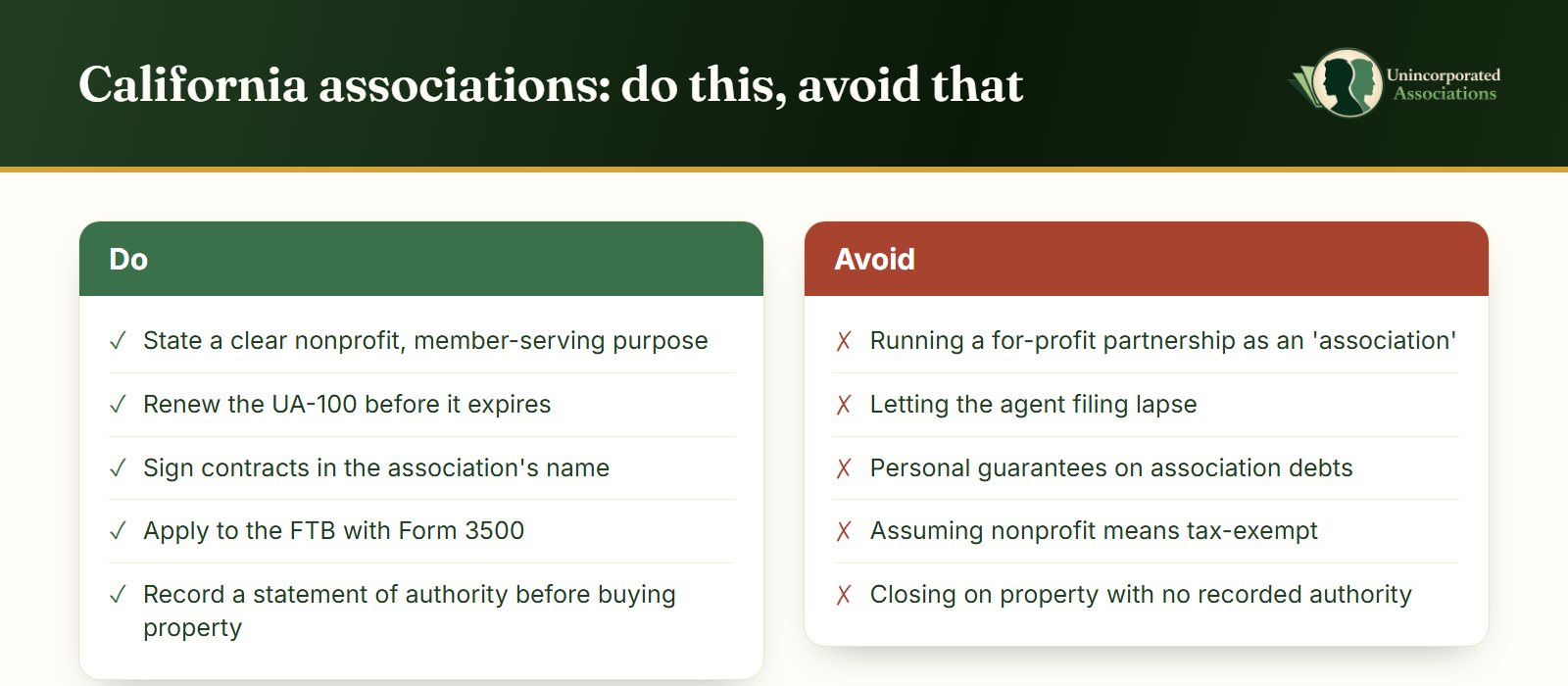
- A vague purpose clause. If the articles don't state the association's nonprofit purpose clearly, it is harder to show which protections apply. Getting this wording right is the most valuable part of the setup.
- Letting the UA-100 lapse. The statement expires after five years. An expired filing means no agent on record.
- Signing contracts personally. Section 18610 protects members, but a personal signature or guarantee can make a member liable.
- Skipping the FTB. Being nonprofit does not make an association tax-exempt in California. Exemption requires an application.
- Buying property without a statement of authority. It slows down every real estate transaction.
Frequently asked questions
Do I have to register an unincorporated association in California?
No. California does not require any filing to form an association. Filing Form UA-100 with the Secretary of State is optional; it records the association's office address and an agent for service of process.
Is an unincorporated association a legal entity in California?
For many purposes, yes. A California association can own property in its own name under section 18105 and sue or be sued in its own name under Code of Civil Procedure section 369.5, and the Corporations Code gives nonprofit association members liability protection.
How much does it cost to form an unincorporated association in California?
There is no state fee to form one. The optional UA-100 filing has a small state fee, and the IRS does not charge for an EIN. Your main cost is preparing the governing documents properly.
Are members personally liable for a California association's debts?
Members of a nonprofit association are not liable just for being members (section 18605). A member can become liable by personally guaranteeing a contract, expressly authorizing a specific contract in writing, or personally causing harm.
Does a California unincorporated association pay state tax?
Until the Franchise Tax Board grants exempt status, it can be subject to California tax. Nonprofit associations are subject only to the income tax, not the franchise tax, and can apply for exemption with Form FTB 3500.
Sources
- California Corporations Code section 18035 (definition)
- California Corporations Code section 18020 (nonprofit association)
- California Corporations Code section 18105 (property)
- California Corporations Code section 18120 (statement of authority)
- California Corporations Code section 18200 (statement and agent)
- California Corporations Code sections 18605, 18610 and 18620 (member liability)
- California Code of Civil Procedure section 369.5
- Franchise Tax Board: Form 3500 exemption application booklet
- California Revenue and Taxation Code section 23701
- California Secretary of State: bizfile Online
- IRS: Get an employer identification number
Forming an association in California? Kirk's team is based in San Diego. Book a free 15-minute call or join the daily live Q&A.
Have questions? Bring them to the daily call.
Join our live Q&A every weekday and Saturday at 3PM PST, or get a free 15-minute call to see whether a UNA fits your situation.
Have a question about your situation?
Send us a message and we'll get back to you.
Keep reading
 The Well-Meaning Dragon: Straight Answers to the Hardest ObjectionsFor the family and friends who push back because they care — honest answers to the toughest questions about the Federal income tax and Unincorporated Associations.
 It's Not What You Believe, It's What You SignFor the cautious partner in the room: real risk rarely comes from asking questions. It comes from what you signed.
 What Most People Get Wrong About Taxes, Structure, and ControlThe real problem isn't taxes — it's structure, and who actually has control. A look at positioning over loopholes.
Educational, not legal or tax advice. Unincorporated Associations is a document-preparation and education company. Consult a licensed attorney or CPA before acting on any position discussed on this site.