
CP 575 E: The EIN Letter for Your Unincorporated Association, Explained
By Kirk Carmichael · · 9 min read
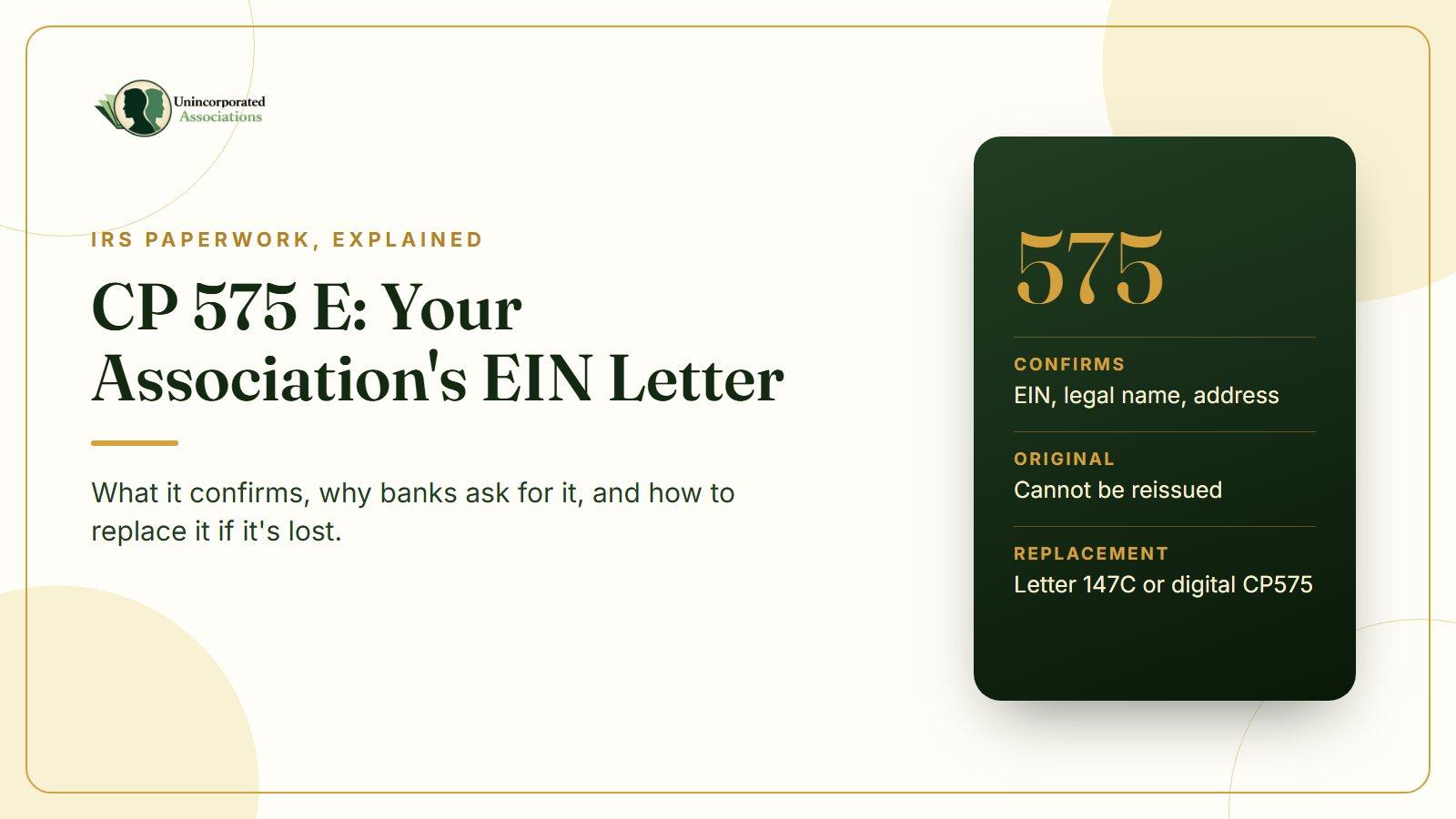
Short answer: The CP 575 E is one version of the IRS "Notice of New Employer Identification Number." It is the letter the IRS issues when it assigns an EIN, and it confirms the organization's legal name, its nine-digit EIN and the address on file. Associations and other organizations often receive the "E" version. Keep the original safe: the IRS cannot reissue it. If you lose it, request Letter 147C or download a digital CP575 from your Business Tax Account.
If you have just formed an unincorporated association and applied for an Employer Identification Number, the CP 575 is usually the first official document your association receives. Banks, payment processors and grant makers ask for it, and many people only realize how important it is when they cannot find it.
This guide explains what the CP 575 E is, what to check the day it arrives, how it fits into opening a bank account, and exactly what to do if it is lost.
Key takeaways: The CP 575 confirms your EIN, legal name and address. The original cannot be reprinted, so copy and store it the day it arrives. Check that the name matches your articles of association exactly. If it is lost, Letter 147C or a digital CP575 from the IRS Business Tax Account replaces it.
What is a CP 575 notice?
When the IRS assigns an Employer Identification Number, it sends a confirmation notice from the CP575 series. The IRS describes this series as the "Notice of New Employer Identification Number," numbered CP575A through CP575J. The letter after "575" reflects the type of entity and filing setup the IRS recorded for the new number.
The notice states, in plain terms, "We assigned you an Employer Identification Number," and shows:
- the EIN itself (nine digits, in the format 12-3456789)
- the legal name of the entity, exactly as the IRS recorded it
- the mailing address on file
- information about which federal returns, if any, the IRS expects
Associations and other non-corporate organizations commonly receive the CP 575 E version, which is why the phrase "575E UNA" is so widely searched. Whatever letter yours carries, it does the same job: it is the IRS's written confirmation that your association has its own tax ID.
How an association gets one
You apply for an EIN with IRS Form SS-4 or through the IRS online application. For an unincorporated association, the key choices are:
- Legal name. Use the exact name in your articles of association, including words like "Association" and any punctuation.
- Responsible party. The IRS asks for the person who ultimately controls the entity, usually a principal officer or trustee, with their SSN or ITIN.
- Type of entity. Associations typically choose "Other nonprofit organization" and describe the type, or "Other" and describe the entity, depending on the association's purpose. The Form SS-4 instructions describe each option.
- Reason for applying. For most new associations this is "Started new business" or "Banking purpose."
Online applications produce a confirmation immediately; paper and fax applications take longer. Our guide to the EIN for an unincorporated association walks through the form line by line.
Pro tip: Decide the association's exact legal name before you apply, and use it identically on the SS-4, the articles, the bank resolution and your website. Most bank delays trace back to a name that differs by one word or one comma.
What to check the day it arrives
- The name. Does it match your articles of association exactly? If not, contact the IRS before you use it anywhere.
- The EIN. Copy it carefully into your records and accounting system.
- The address. Is it the association's mailing address, not a member's personal address you did not intend to use?
- The filing requirements paragraph. Read what the IRS says it expects. If anything looks wrong for your association's situation, ask a CPA before the first deadline.
- Store it. Scan it, save a PDF in the association's records, and keep the paper original somewhere safe.
Why banks and others ask for it
Banks must verify who they are dealing with before they open an account. For an association, the CP 575 is the cleanest proof that the EIN on the application really belongs to the association, under that exact name. The IRS itself says confirming an EIN is commonly needed "when you open a bank account for your entity or obtain other business services" (IRS: Understanding your CP575 notice).
You will typically be asked for it by:
- banks and credit unions opening an association account
- payment processors and merchant services
- grant makers and donors who need a W-9 and EIN confirmation
- vendors and landlords setting up accounts in the association's name
Our checklist for opening an unincorporated association bank account lists the other documents banks want alongside it.
What the CP 575 does not do
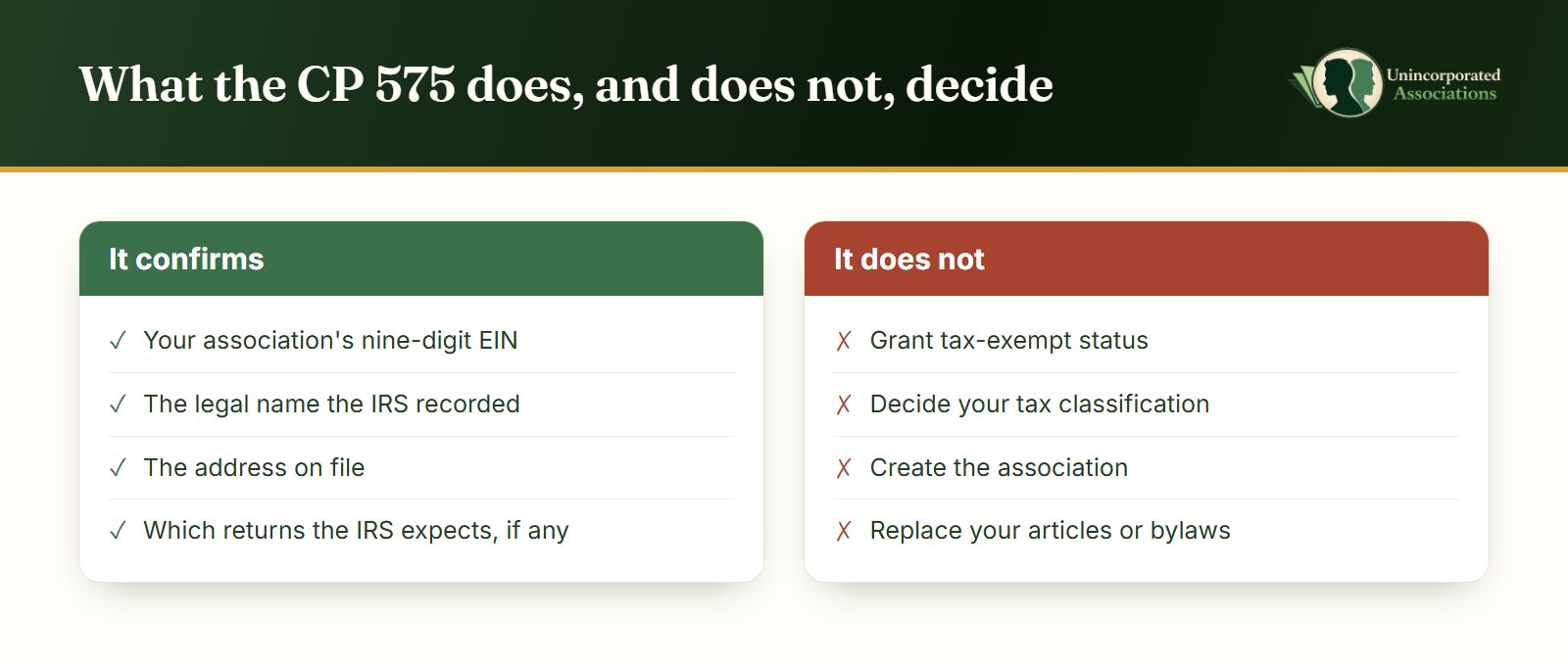
The notice confirms a number. It does not decide anything else:
- It is not an exemption ruling. The notice confirms a number; it does not decide whether the association is tax-exempt. That depends on whether the association meets a section of the tax code, such as 501(c)(3). Some organizations must apply for IRS recognition, while churches and many other groups can be exempt without applying.
- It does not decide your tax classification. How the IRS treats the association depends on what it does, under the entity classification rules at 26 CFR 301.7701-3.
- It does not create the association. Your association exists because its members signed the governing agreement. The EIN simply gives it a federal tax ID.
Watch out: Do not post a copy of your CP 575 publicly or email it carelessly. It contains the EIN and legal details that can be misused. Share it only with the bank or organization that needs it, through a secure channel.
Lost your CP 575? How to replace it
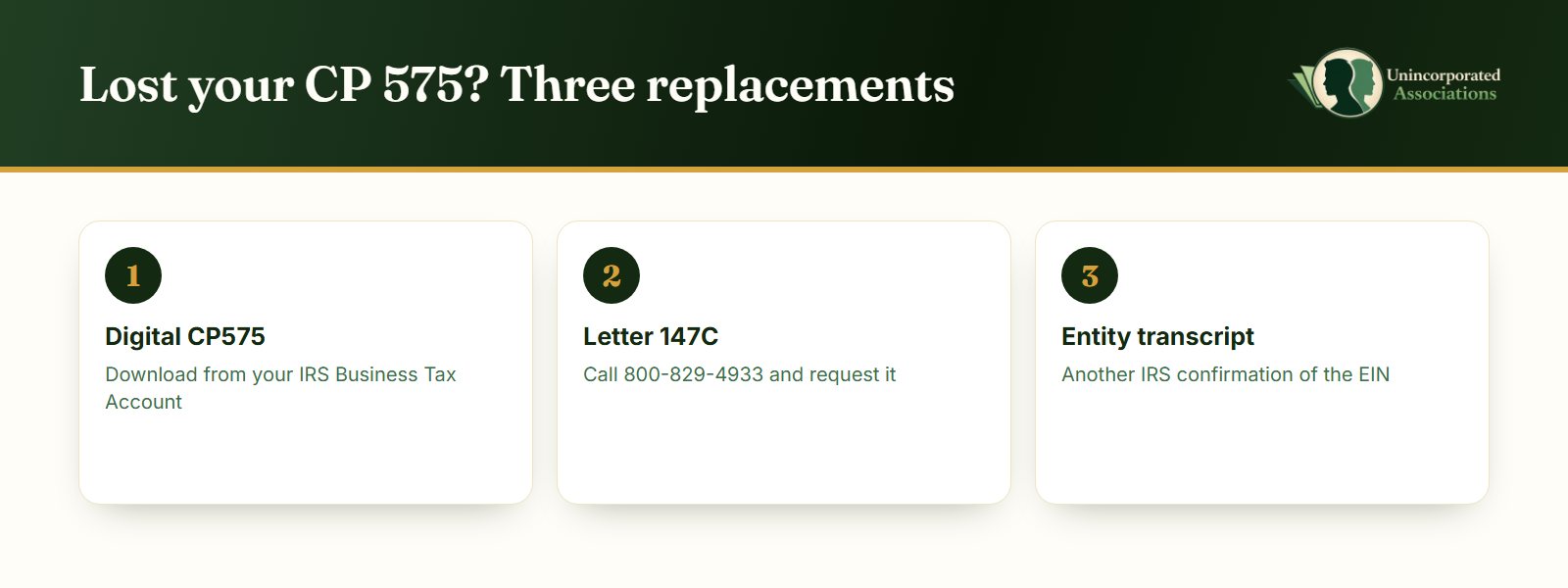
The IRS is clear on this: the original CP575A–J notice "cannot be duplicated or recreated" (IRS). But you have three good options:
- Download a digital CP575 from your Business Tax Account. Eligible users can download a digital CP575, Employer Identification Number Verification Notice, which the IRS says can substitute for both the original CP575 and Letter 147C.
- Request Letter 147C, "EIN Previously Assigned." Call the IRS Business and Specialty Tax Line at 800-829-4933. After verifying that you are authorized, the IRS can fax or mail a 147C letter.
- Request an entity transcript. The IRS lists this as another way to confirm an EIN (IRS: Employer identification number).
The IRS also confirms that the digital CP575 "is accepted by banks and other institutions as written confirmation of an entity's EIN," so you do not need the original paper to open an account.
Keeping your EIN record up to date
If the association's mailing address or responsible party changes, tell the IRS with Form 8822-B. The IRS says changes to the responsible party must be reported within 60 days. If the association changes its name, follow the IRS business name change process before updating the bank.
A business entity should have only one EIN. If you suspect your association was issued two, the IRS asks you to call the Business and Specialty Tax Line to confirm which one to use.
Common CP 575 problems, and how to fix them
The name is wrong or shortened. If the IRS recorded a different name than your articles, banks will notice. A small typo can sometimes be corrected by writing to the IRS office that issued the notice; a genuinely different name usually needs the IRS name change process. Fix it before you open accounts, not after.
The responsible party is someone who has left. Officers change. When the person named as responsible party steps down, file Form 8822-B within 60 days so the IRS record points to someone who can act for the association.
You applied twice and got two EINs. It happens when two founders each apply. Do not use both. Call the Business and Specialty Tax Line, confirm which number the IRS wants you to keep, and update your records.
The address is a member's home. If the association later gets its own mailing address, update it with Form 8822-B so IRS mail reaches the association and not a former member.
The bank wants "the original." Explain that the IRS cannot reissue originals and offer Letter 147C or the digital CP575. The IRS says banks accept both.
Where the EIN fits in your association's setup
The EIN comes after the association already exists. The usual order is: members agree on a purpose, founders sign the articles of association, the association adopts bylaws and appoints officers, then it applies for its EIN, receives the CP 575, and opens a bank account. If you are still at the start of that list, our guide on how to become an unincorporated association covers the earlier steps, and if your group is set up for members only, see our explainer on what a private membership association is.
CP 575 vs Letter 147C vs digital CP575
| CP 575 (original) | Letter 147C | Digital CP575 | |
|---|---|---|---|
| When you get it | Automatically, when the EIN is assigned | On request, after the fact | Downloaded from Business Tax Account |
| How | Mail, or on screen after online application | Phone request; fax or mail | Online download |
| Can it be reissued? | No | Yes, on request | Yes, download again |
| Accepted by banks? | Yes | Yes | Yes, per the IRS |
Frequently asked questions
What does CP 575 E mean?
CP 575 E is one version of the IRS "Notice of New Employer Identification Number." The CP575 series runs from A to J; the letter reflects the kind of entity and setup the IRS recorded. All versions confirm the same core facts: the EIN, the legal name and the address.
Why did my association get a CP 575 E and not a CP 575 A?
The IRS chooses the version based on the information in the EIN application, such as the type of entity. The version letter does not change what the notice confirms; it is still your official EIN confirmation.
Can I get a copy of my original CP 575?
No. The IRS says the original CP575A–J notice cannot be duplicated or recreated. Request Letter 147C, or download a digital CP575 from your IRS Business Tax Account, as an accepted replacement.
Is the CP 575 proof that my association is tax-exempt?
Not by itself. It confirms the EIN. Exempt status depends on whether the association meets a section of the tax code; some organizations must apply for IRS recognition, and others, such as churches, are exempt without applying. IRS Publication 557 explains which categories must apply and which need not.
Does a bank need the CP 575 or will Letter 147C work?
Banks accept either as written confirmation of the EIN, and the IRS says the digital CP575 is accepted too. Check with your bank which one it prefers before your appointment.
Sources
- IRS: Understanding your CP575 notice
- IRS: Employer identification number
- IRS: About Form SS-4, Application for Employer Identification Number
- IRS: Instructions for Form SS-4
- IRS: About Form 8822-B, Change of Address or Responsible Party
- IRS: Exemption requirements for 501(c)(3) organizations
- 26 CFR 301.7701-3, Classification of certain business entities
Setting up your association's EIN and bank account? Book a free 15-minute call with Kirk's team, or join the daily live Q&A.
Have questions? Bring them to the daily call.
Join our live Q&A every weekday and Saturday at 3PM PST, or get a free 15-minute call to see whether a UNA fits your situation.
Have a question about your situation?
Send us a message and we'll get back to you.
Keep reading
 The Well-Meaning Dragon: Straight Answers to the Hardest ObjectionsFor the family and friends who push back because they care — honest answers to the toughest questions about the Federal income tax and Unincorporated Associations.
 It's Not What You Believe, It's What You SignFor the cautious partner in the room: real risk rarely comes from asking questions. It comes from what you signed.
 What Most People Get Wrong About Taxes, Structure, and ControlThe real problem isn't taxes — it's structure, and who actually has control. A look at positioning over loopholes.
Educational, not legal or tax advice. Unincorporated Associations is a document-preparation and education company. Consult a licensed attorney or CPA before acting on any position discussed on this site.