
Do Unincorporated Associations File Tax Returns? The Rules by Situation
By Kirk Carmichael · · 9 min read
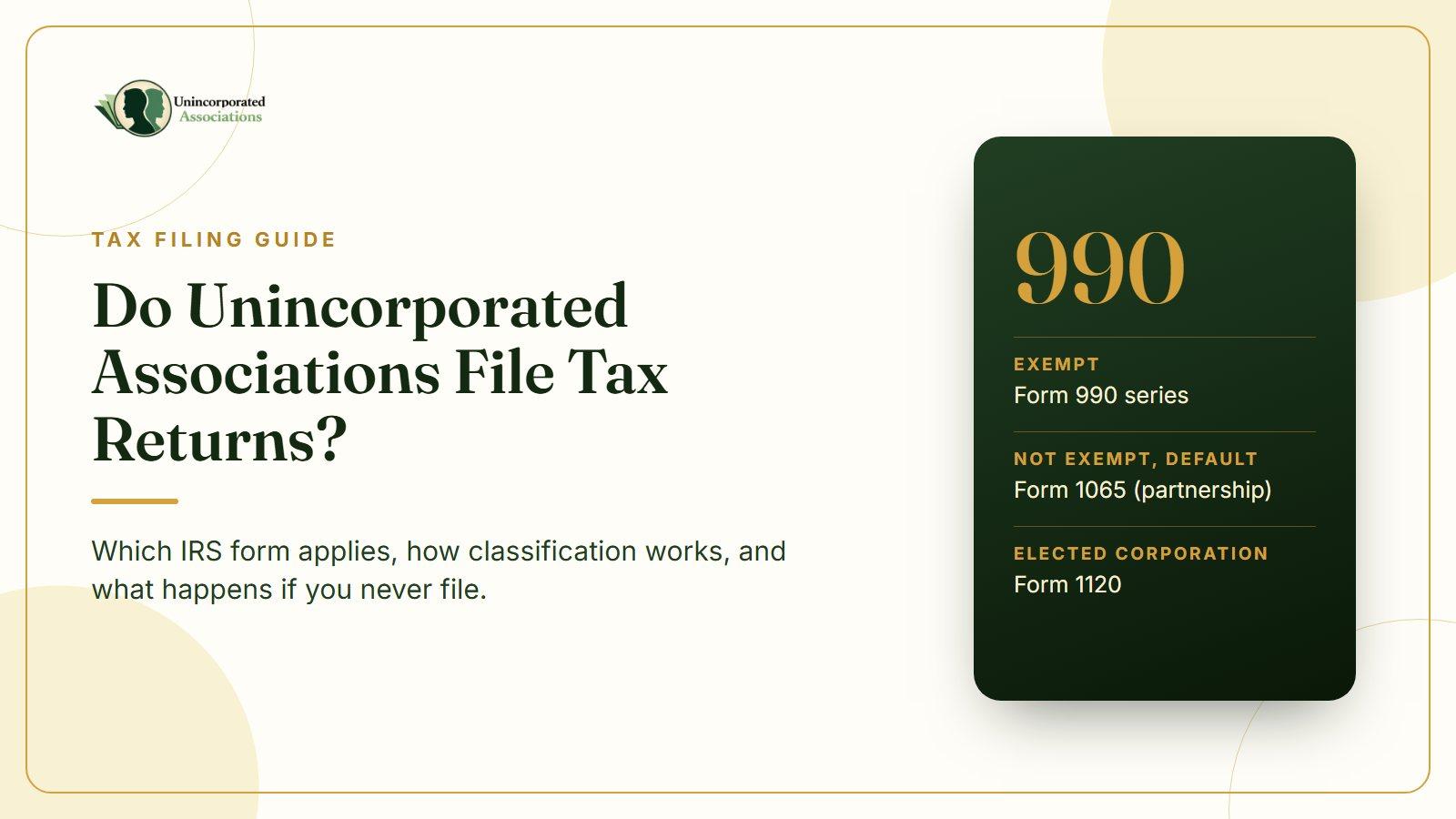
Short answer: It depends on what the association is for tax purposes. A tax-exempt association usually files a Form 990-series return each year (Form 990-N if gross receipts are normally $50,000 or less). A non-exempt association with two or more members that carries on a business and shares its profits is treated as a partnership by default and files Form 1065, unless it elects to be taxed as a corporation and files Form 1120. Special forms apply to homeowners associations (1120-H) and political organizations (1120-POL). Many states have their own filing rules too.
"Do we have to file anything?" is one of the most common questions new associations ask, and one of the most important to get right. The IRS does not have a single "unincorporated association return." Instead, it looks at what your association is for federal tax purposes and assigns the filing that matches.
This guide walks through that decision step by step, explains each form in plain English, and covers the mistakes that cost associations the most.
Key takeaways: There is no one-size-fits-all answer. First ask: is the association tax-exempt? If yes, it files a 990-series return. If no, the IRS classifies it, usually as a partnership (Form 1065) unless it elected corporate treatment (Form 1120). Exempt organizations that file nothing for three years lose their exemption automatically.
Step 1: Is the association tax-exempt?
An association is exempt from federal income tax if it qualifies under a section of the Internal Revenue Code, such as 501(c)(3) for charitable, religious or educational purposes or 501(c)(7) for social clubs. Most 501(c)(3) charities must apply for IRS recognition, while churches, very small charities and most other 501(c) categories can be exempt without applying, as long as they meet the requirements. The IRS explains the categories in Publication 557, Tax-Exempt Status for Your Organization.
Unincorporated associations can qualify. For 501(c)(3), the IRS accepts articles of association as the organizing document, as long as they limit the association's purposes and dedicate its assets properly (IRS: 501(c)(3) requirements).
Step 2a: If it is exempt, which return?
Most exempt organizations file an annual information return in the Form 990 series. Which one depends on size. According to the IRS's Form 990-series filing guide:
| Size of the association | Return to file |
|---|---|
| Gross receipts normally $50,000 or less | Form 990-N (the e-Postcard), filed online |
| Gross receipts under $200,000 and total assets under $500,000 | Form 990-EZ or Form 990 |
| Gross receipts $200,000 or more, or total assets $500,000 or more | Form 990 |
| Private foundation, any size | Form 990-PF |
The 990-N e-Postcard takes only a few minutes: legal name, EIN, address, principal officer and confirmation that gross receipts are normally $50,000 or less. Churches and certain church-related organizations are generally not required to file a 990.
Watch out: The IRS states that organizations that do not file for three consecutive years automatically lose their tax-exempt status, effective on the due date of the third return (IRS: Automatic revocation of exemption). Even a tiny association should file its 990-N every year.
An exempt association can still owe tax on unrelated business income, income from a regular trade or business that is not substantially related to its exempt purpose. If that income reaches $1,000 or more in a year, Publication 557 explains the separate Form 990-T filing.
Step 2b: If it is not exempt, how is it classified?
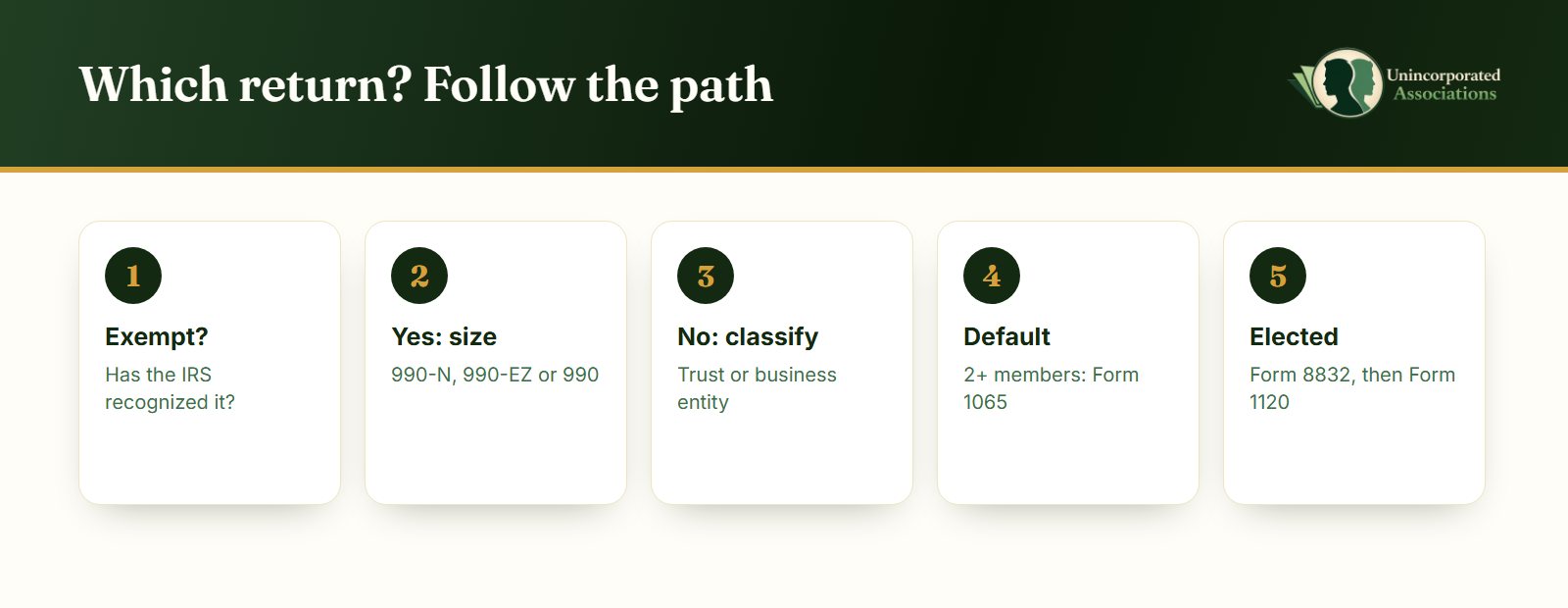
A non-exempt association is not invisible to the IRS. Under the federal entity classification rules, an organization recognized for tax purposes is either a trust or a business entity (26 CFR 301.7701-2). For an unincorporated business entity with two or more members, the default rules at 26 CFR 301.7701-3 say:
- Default: partnership. The association files Form 1065, an information return, and each member reports their share of income on their own return.
- Elected: corporation. If the association files Form 8832 to be classified as an association taxable as a corporation, it files Form 1120 and pays corporate income tax.
A few special situations have their own forms:
- Homeowners associations can elect to file Form 1120-H, which taxes only non-exempt function income.
- Political organizations file Form 1120-POL when they have taxable income.
Which path applies to your association depends on its purpose, its activities, how its income is used and what elections it has made. This is exactly the kind of question to settle with a CPA before the first deadline, not after.
Three example associations, three different answers
Abstract rules are easier to follow with examples. These are simplified illustrations, not tax advice for your situation.
A neighborhood education association. Twenty members run free financial-literacy workshops for the community, funded by small donations. They organized under written articles of association that limit the purpose to education and dedicate assets to another charity on dissolution, then applied for and received 501(c)(3) recognition. Their gross receipts are about $12,000 a year. Filing: Form 990-N each year, plus whatever their state requires.
A members' buying cooperative run for profit. Six members pool money to buy equipment in bulk, resell surplus at a markup and split the profit among themselves. They never applied for exemption and never filed Form 8832. Filing: the IRS default for a two-plus-member business entity is a partnership, so Form 1065 each year, with each member reporting a share of the income. This is also the kind of arrangement state law may treat as a general partnership, which affects liability, not just tax.
An investment group that chose corporate treatment. Members of a larger association filed Form 8832 to be classified as an association taxable as a corporation, so the entity, not each member, pays tax on its income. Filing: Form 1120 each year, plus state corporate returns.
Same legal form, three different federal filings. That is why the first conversation with a CPA should be about classification, not about which box to tick on a single form.
How documents shape the answer
The way your association is documented feeds directly into its tax treatment. A clear, limited purpose clause, a dissolution clause that keeps assets in exempt use, and rules that prevent profits from flowing to members are what the IRS looks for in an exempt organization. Articles that let members split profits point the other way. Our unincorporated nonprofit association overview explains how we draft these clauses, and our guide on how to become an unincorporated association shows where they sit in the documents.
Other federal filings an association may have
Income tax is not the only reason an association files with the IRS:
- Payroll. An association with employees must withhold and report employment taxes (Forms 941 and W-2).
- Payments to contractors. An association that pays independent contractors in the course of a trade or business may need to issue Forms 1099-NEC.
- Changes. Address or responsible-party changes go on Form 8822-B.
Don't forget the state
State rules are separate. In California, for example, the Franchise Tax Board says unincorporated organizations are subject to California tax until the FTB grants exempt status, and exempt organizations file an annual information return (FTB Form 3500 booklet). Other states have their own exemption applications, annual reports and sales tax rules. Our guide to forming an unincorporated association in California covers the FTB side in detail.
The most expensive mistakes
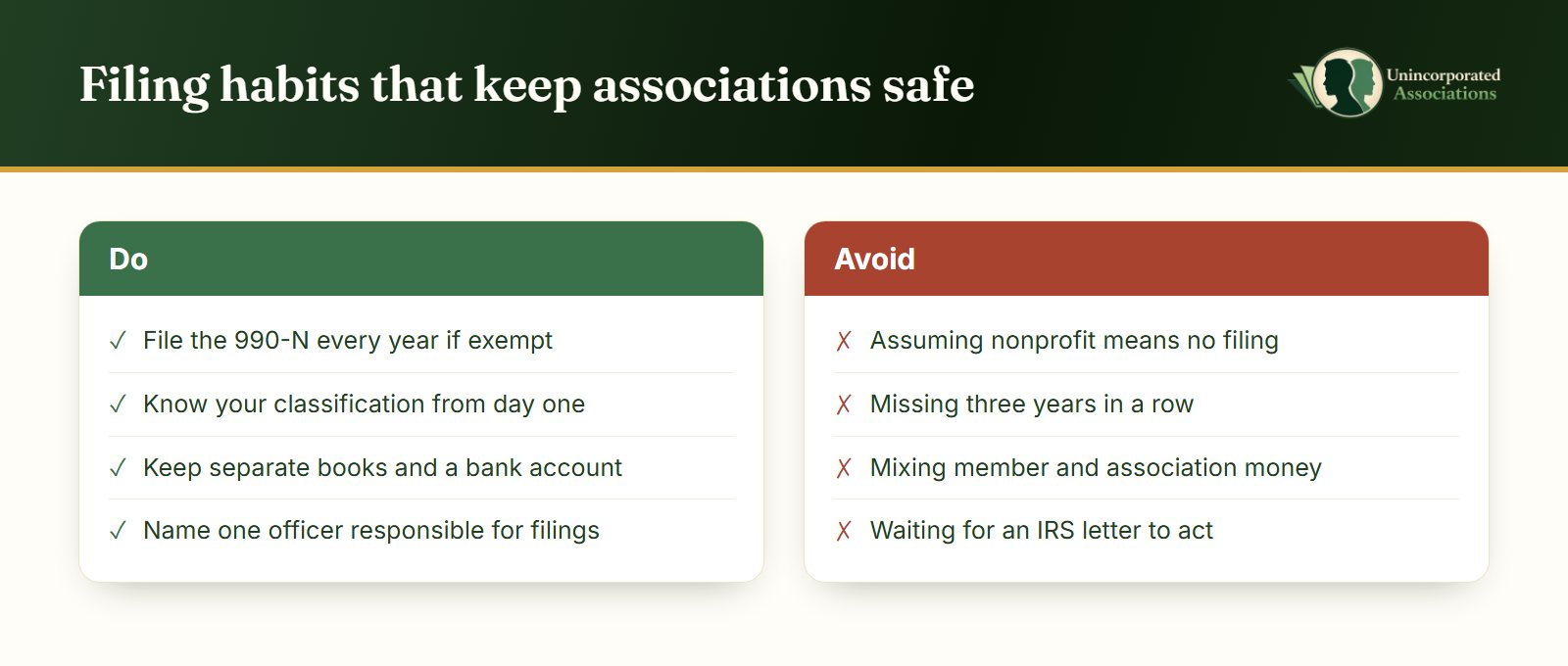
- Assuming "nonprofit" means "no filing." A nonprofit purpose does not by itself make an association exempt or excused from returns.
- Skipping the 990-N because the association is small. Three missed years means automatic loss of exemption.
- Not knowing your classification. If the IRS would treat the association as a partnership, missing Form 1065 can bring per-member penalties.
- Mixing money. Without separate books and a separate bank account, you cannot prepare an accurate return at all.
- Waiting until a letter arrives. Decide your filing path when you get your EIN. The CP 575 notice often states which returns the IRS expects.
Pro tip: Put one officer in charge of tax compliance and give them a simple annual calendar: the federal return or e-Postcard, any state return, and the dates for any 1099s or payroll filings. Most associations that get into trouble had no single person responsible.
A quick self-check
Answer these five questions and take them to your CPA:
- Has the IRS issued a determination letter recognizing the association as exempt? Under which section?
- What were the association's gross receipts and total assets last year?
- Does the association earn income from activities outside its exempt purpose?
- Has the association ever filed Form 8832 to elect corporate classification?
- Does the association have employees, or pay contractors?
Frequently asked questions
Does a small unincorporated association with no income need to file?
If it is a tax-exempt organization, it generally files Form 990-N each year even with little or no income, unless it is a church or another excepted organization. If it is not exempt, whether a return is due depends on its classification and activity, so check with a CPA.
What form does an unincorporated association file?
Exempt associations file a Form 990-series return. Non-exempt associations with two or more members that run a business and share profits default to partnership treatment and file Form 1065, unless they elected corporate treatment with Form 8832, in which case they file Form 1120. A non-exempt association that shares no profits should confirm its classification with a CPA. Homeowners and political associations have special forms.
Do members pay tax on the association's income?
If the association is treated as a partnership, members report their share of its income on their own returns. If it is taxed as a corporation, the association pays its own tax. If it is exempt, its exempt-purpose income is generally not taxed.
What happens if an exempt association never files?
The IRS says an organization that fails to file its required return or notice for three consecutive years automatically loses its exemption, and the IRS publishes the list of revoked organizations.
Does the association also file a state return?
Often, yes. States set their own rules. California, for example, requires unincorporated organizations to apply to the Franchise Tax Board for exemption and file annual returns.
Sources
- IRS Publication 557, Tax-Exempt Status for Your Organization
- IRS: Form 990-series returns, which forms exempt organizations file
- IRS: Form 990-N (e-Postcard)
- IRS: Automatic revocation of exemption
- IRS: Exemption requirements for 501(c)(3) organizations
- 26 CFR 301.7701-2 and 26 CFR 301.7701-3
- IRS: About Form 1065, Form 1120, Form 1120-H, Form 1120-POL, Form 8832
- California Franchise Tax Board: Form 3500 booklet
Not sure which filing applies to your association? Book a free 15-minute call with Kirk's team, or join the daily live Q&A.
Have questions? Bring them to the daily call.
Join our live Q&A every weekday and Saturday at 3PM PST, or get a free 15-minute call to see whether a UNA fits your situation.
Have a question about your situation?
Send us a message and we'll get back to you.
Keep reading
 The Well-Meaning Dragon: Straight Answers to the Hardest ObjectionsFor the family and friends who push back because they care — honest answers to the toughest questions about the Federal income tax and Unincorporated Associations.
 It's Not What You Believe, It's What You SignFor the cautious partner in the room: real risk rarely comes from asking questions. It comes from what you signed.
 What Most People Get Wrong About Taxes, Structure, and ControlThe real problem isn't taxes — it's structure, and who actually has control. A look at positioning over loopholes.
Educational, not legal or tax advice. Unincorporated Associations is a document-preparation and education company. Consult a licensed attorney or CPA before acting on any position discussed on this site.