Private Membership Association Documents: What You Need and What Goes in Each
By Kirk Carmichael · · 8 min read
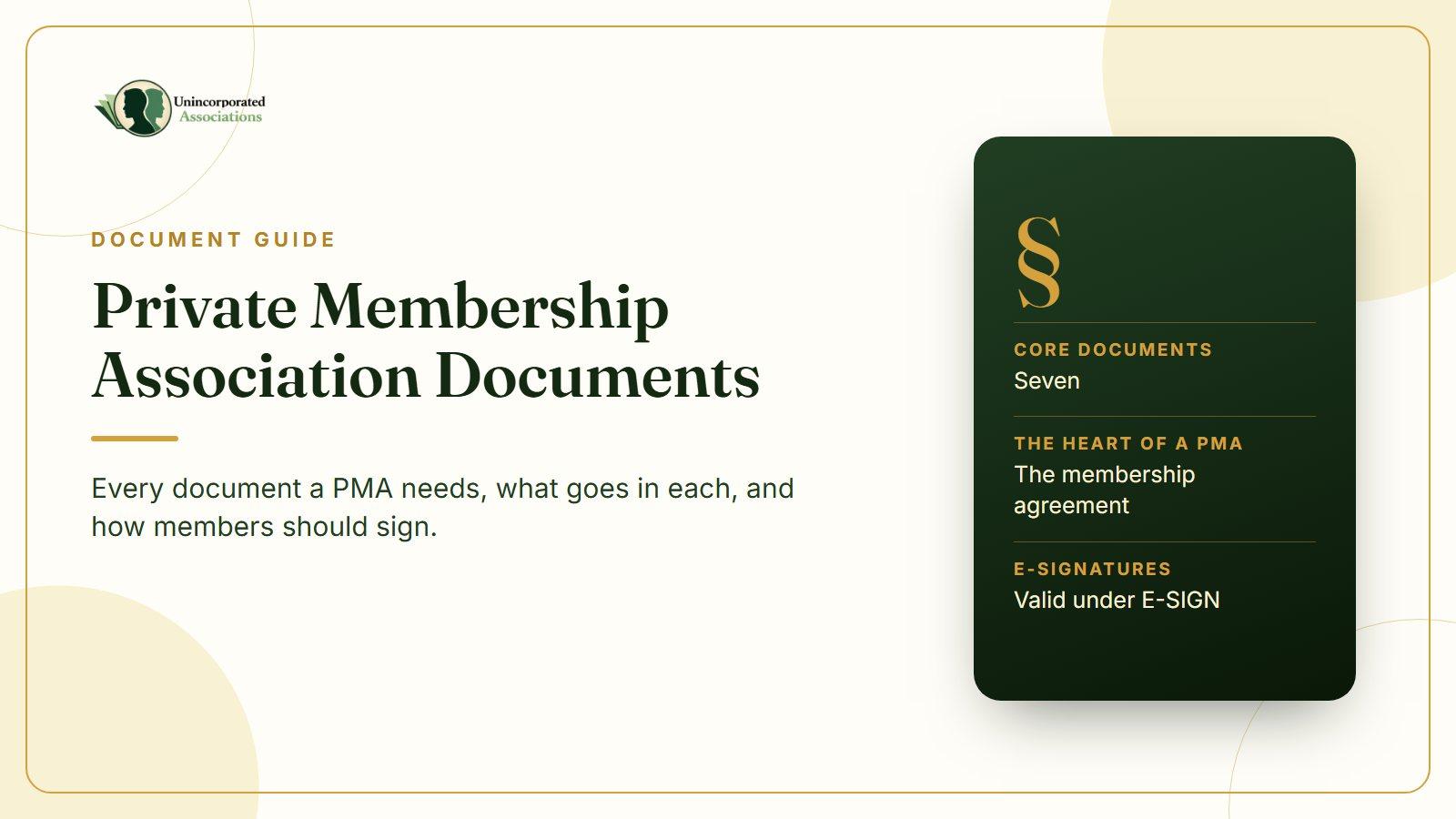
Short answer: A private membership association needs, at minimum: articles of association (founding agreement and purpose), bylaws (operating rules), a membership agreement every member signs before receiving anything, a membership application, a member register, a resolution naming officers and signers, and the IRS EIN confirmation. Many PMAs also adopt a privacy policy, a dues and refund policy, a conflict-of-interest policy and a code of conduct. The documents must be consistent with each other and with your state's association law.
For a PMA, the documents are not paperwork around the association; they are the association. There is no state charter behind it. Its existence, its purpose, its rules and the members-only relationship all come from what the members sign.
This guide lists each document a PMA needs, what it should contain, how to handle signatures, and why templates downloaded from the internet cause so many problems.
Key takeaways: Seven core documents, plus a few recommended policies. The membership agreement is the heart of a PMA; members must sign it before receiving anything. Electronic signatures work. Documents must match each other, your activity and your state's law, which is why generic templates are risky.
The core documents
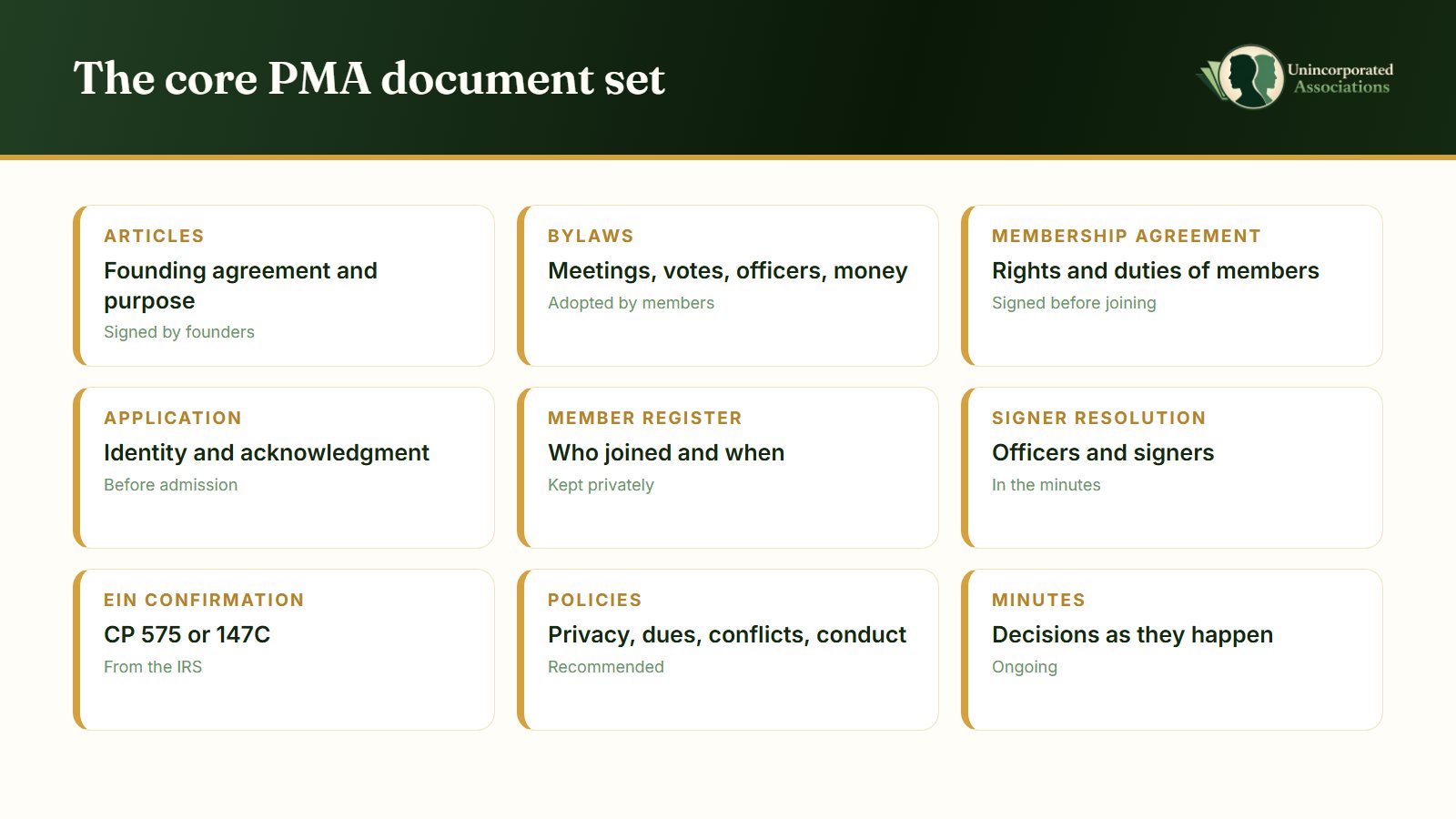
1. Articles of association
The founding agreement. It creates the association by recording that the founders agree to associate for a stated purpose. It should include:
- the association's name and that it is a private, unincorporated association
- its purpose, specific and lawful
- the founding members and first officers or trustees
- how the association holds money and property
- how the articles can be amended
- what happens to assets if the association dissolves
California's definition of an association, "two or more persons joined by mutual consent for a common lawful purpose" (Corp. Code § 18035), is essentially what the articles document.
2. Bylaws
The operating rules: meetings, notice, voting thresholds, officer roles and terms, how officers are chosen and removed, who may sign contracts and checks, finances and records, and dispute resolution. Our guide to UNA bylaws covers the key clauses.
3. Membership agreement
The document that makes a PMA a PMA. Every member signs it before receiving any goods, services or information. It should cover:
- voluntary membership in a private association
- what members receive, and on what terms
- members' responsibilities, including dues and following the rules
- confidentiality expectations, if any
- how members can leave and how membership can end
- dispute resolution
- a plain statement of what the association is not (for example, not a law firm, not legal or tax advice)
4. Membership application
A short form the prospective member completes before admission: identity and contact details, agreement to the purpose, and acknowledgment of the membership agreement. A genuine application and approval step strengthens the private, selective character of the PMA. Keep the questions short and relevant: who the person is, why they want to join, and confirmation that they have read the purpose and the membership agreement. Avoid collecting sensitive information you don't need.
5. Member register
The private list of members: name, date admitted, membership level and a link to the signed agreement. It is your evidence that you deal only with members. The Supreme Court protected an association's membership list from forced disclosure in NAACP v. Alabama, which is a good reason to guard it carefully.
6. Officer and signer resolution
A short resolution, recorded in minutes, naming the officers and who may sign on the bank account and contracts. Banks always ask for it.
7. EIN confirmation
The IRS confirmation of the association's tax ID, usually a CP 575 notice. Apply with Form SS-4 or online.
Recommended policies
| Policy | Why it helps |
|---|---|
| Privacy policy | Explains how member information is collected, used and protected |
| Dues and refund policy | Prevents disputes about money when members leave |
| Conflict-of-interest policy | Protects the association when officers have personal interests in a decision; expected for 501(c)(3) applicants |
| Code of conduct | Sets behavior standards and gives a fair basis for ending a membership |
| Record-retention policy | Says what to keep and for how long |
How members should sign
Members can sign on paper or electronically. The federal E-SIGN Act says a signature or contract "may not be denied legal effect, validity, or enforceability solely because it is in electronic form" (15 U.S.C. § 7001). For a PMA, that means an online application and e-signature process can work well, provided:
- members see the full agreement before signing
- the system records who signed, what they signed and when
- members get a copy of what they signed
- nothing is provided until the signature is complete
Pro tip: Version-control your membership agreement. Put a version number and date at the bottom, store each member's signed copy, and when you update the agreement, have existing members accept the new version. You will always be able to show which terms each member agreed to.
Why downloaded templates cause problems
PMA templates are easy to find online, and they are a common source of trouble:
- Contradictions. The articles say one thing, the bylaws another, the membership agreement a third.
- Wrong state. Association law varies; a template written for one state's rules can mislead in another.
- Overpromising. Many templates claim the PMA puts activities "outside" regulation. Courts have not accepted that: a Wisconsin appeals court required a license for raw milk sold to private association members (Food Safety News). Documents that promise immunity set members up for a fall.
- Missing pieces. No dissolution clause, no signing authority, no exit terms.
Watch out: If a template says your PMA is exempt from licensing, health or tax laws, remove that language. It creates false expectations and can undermine your credibility with banks, members and regulators.
Documents for later stages
As the PMA grows, add documents as needed:
- Minutes of every meeting that makes a decision about money, property or rules
- Contracts and leases signed in the association's name by an authorized officer
- Statement of authority for real estate, where your state allows it (California § 18120)
- Optional state statement naming an agent, such as California's UA-100 under § 18200
- Exemption application if the PMA qualifies (see PMAs and the IRS)
- Dissolution resolution when and if the PMA winds down
A sample onboarding flow
Putting the documents in the right order is what turns them into a working members-only relationship:
- Prospective member applies using the membership application.
- The association reviews and approves the application, according to the bylaws.
- The member receives the articles, bylaws and membership agreement to read.
- The member signs the membership agreement (on paper or electronically) and pays any dues.
- The secretary adds the member to the register with the date and agreement version.
- Only then does the member receive access to the association's services, goods or information.
Every step leaves a record. If anyone later asks whether a person was a member when they received something, the application, signed agreement and register answer the question.
When to update your documents
Review the full set at least once a year, and update it when:
- the association's activities change or expand
- you move to a different state or start operating in a new one
- officers, signers or the address change
- members raise the same question or dispute more than once
- the law changes in an area your documents touch, such as privacy or tax
When you amend the articles or bylaws, follow the amendment procedure they set out, record the vote in minutes, and date the new version.
How long to keep documents
Keep the articles, bylaws, membership agreements and minutes permanently. Keep financial records at least as long as the IRS can examine the related returns; the IRS explains the periods in how long should I keep records.
Common mistakes
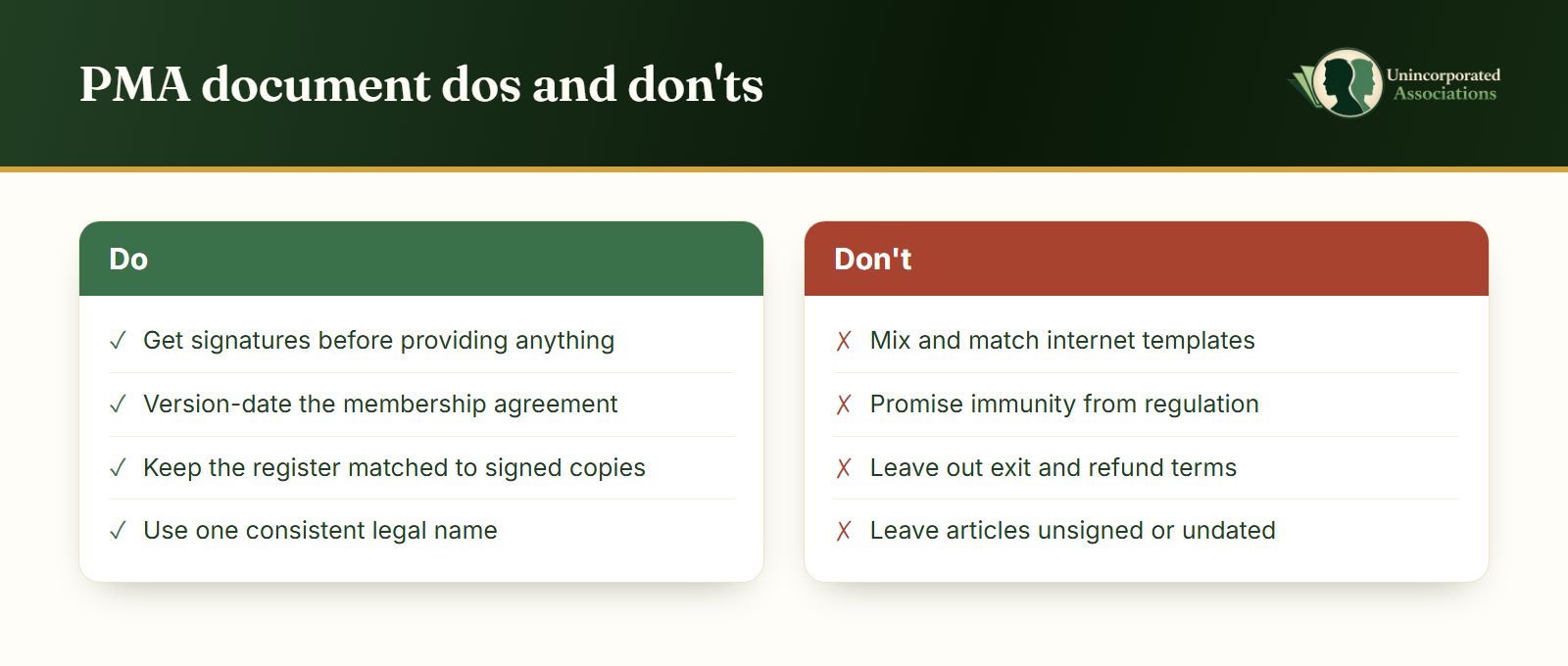
- Letting people in before they sign. It breaks the members-only relationship.
- No member register, or one that doesn't match signed agreements.
- Inconsistent names between the articles, EIN record and bank account.
- Unsigned or undated articles.
- Templates that promise legal immunity.
- No exit or refund terms, leading to disputes when members leave.
Our guides on how to start a private membership association and PMA pros and cons cover the bigger picture.
Frequently asked questions
What documents does a private membership association need?
At minimum: articles of association, bylaws, a membership agreement, a membership application, a member register, an officer and signer resolution, and the IRS EIN confirmation. Policies on privacy, dues, conflicts of interest and conduct are strongly recommended.
Is there a free PMA template I can use?
Templates exist, but they often contradict each other, ignore your state's law or overpromise legal protection. Use one only as a starting point, and have the full set reviewed so it fits your purpose, activity and state.
Can members sign the PMA agreement online?
Yes. Under the federal E-SIGN Act, electronic signatures are generally valid. Make sure members see the full agreement, the system records the signature, and members receive a copy.
Do PMA documents need to be filed with the state?
No filing is needed to form a PMA. Some states offer optional filings, such as an agent statement, and real estate may call for a recorded statement of authority.
What's the most important PMA document?
The membership agreement. It defines the members-only relationship that makes the association a PMA, and every member should sign it before receiving anything.
Sources
- California Corporations Code sections 18035, 18120 and 18200
- 15 U.S.C. § 7001 (E-SIGN Act)
- NAACP v. Alabama, 357 U.S. 449 (1958)
- IRS: Form SS-4
- IRS: How long should I keep records?
- Food Safety News: Wisconsin raw milk licensing ruling
Want a consistent, state-aware PMA document set? Book a free 15-minute call with Kirk's team, or join the daily live Q&A.
Have questions? Bring them to the daily call.
Join our live Q&A every weekday and Saturday at 3PM PST, or get a free 15-minute call to see whether a UNA fits your situation.
Have a question about your situation?
Send us a message and we'll get back to you.
Keep reading
 The Well-Meaning Dragon: Straight Answers to the Hardest ObjectionsFor the family and friends who push back because they care — honest answers to the toughest questions about the Federal income tax and Unincorporated Associations.
 It's Not What You Believe, It's What You SignFor the cautious partner in the room: real risk rarely comes from asking questions. It comes from what you signed.
 What Most People Get Wrong About Taxes, Structure, and ControlThe real problem isn't taxes — it's structure, and who actually has control. A look at positioning over loopholes.
Educational, not legal or tax advice. Unincorporated Associations is a document-preparation and education company. Consult a licensed attorney or CPA before acting on any position discussed on this site.