Private Membership Associations and the IRS: How PMAs Are Taxed
By Kirk Carmichael · · 8 min read
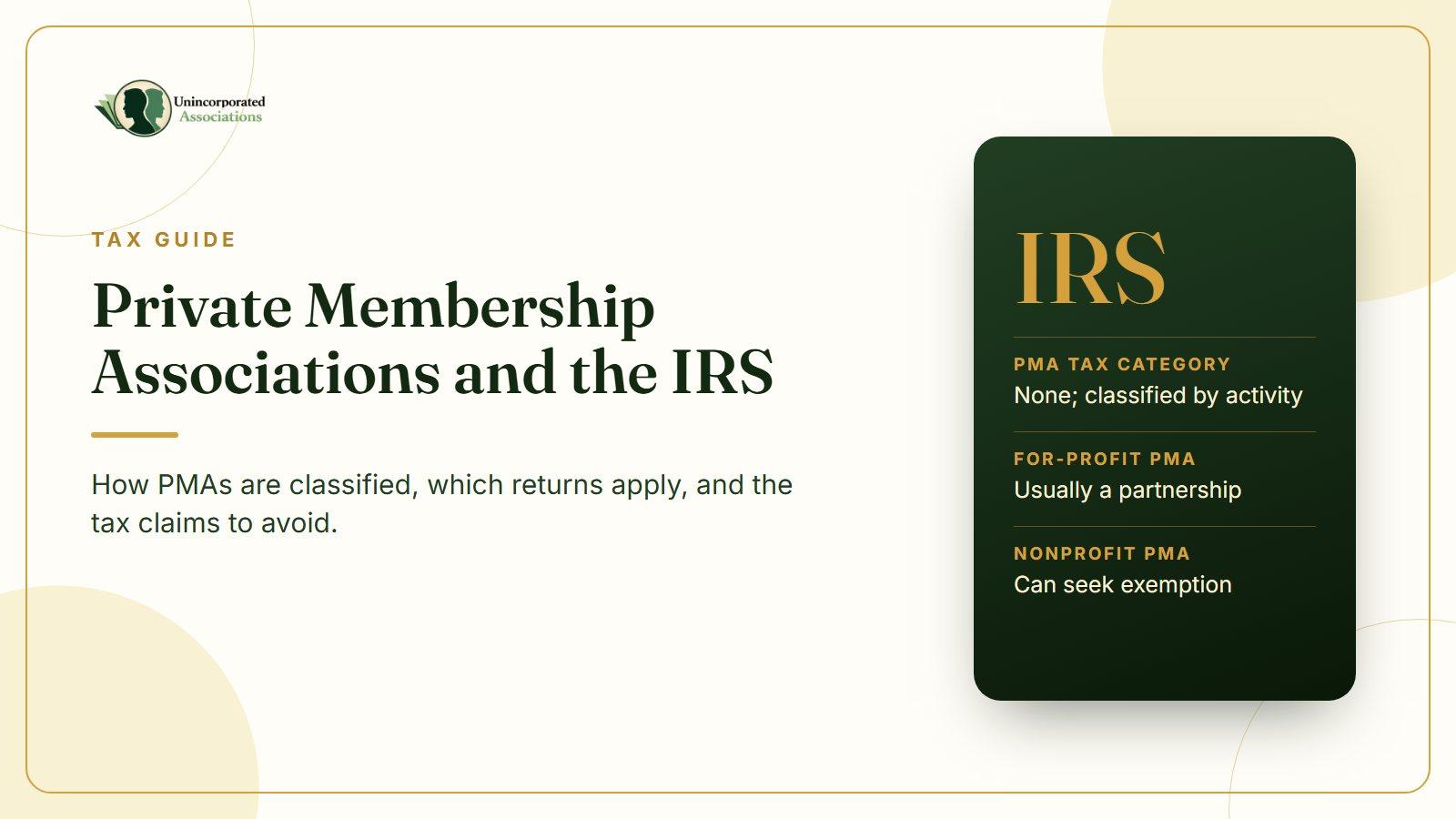
Short answer: The IRS has no special category for private membership associations. A PMA is classified like any other unincorporated association, based on what it does: a PMA that runs a business for its members' profit is usually treated as a partnership and files Form 1065; a PMA organized and operated for a qualifying nonprofit purpose can apply for exemption under section 501(c), such as 501(c)(3) or 501(c)(7) for social clubs. Members' own income stays taxable to them, whatever association they belong to.
PMA material online often makes bold tax claims. The rules themselves are more ordinary: the IRS looks at the substance of an organization, not its label. Understanding that up front protects both the association and its members.
This guide explains how the IRS classifies a PMA, which returns apply, how dues and member payments are treated, and which tax claims to treat as red flags.
Key takeaways: No "PMA" box exists on any IRS form. Classification follows activity: business for members' profit usually means partnership; qualifying nonprofit purpose can mean exemption. A PMA needs an EIN and may owe annual returns. Belonging to a PMA does not change a member's own income tax.
How the IRS sees a PMA
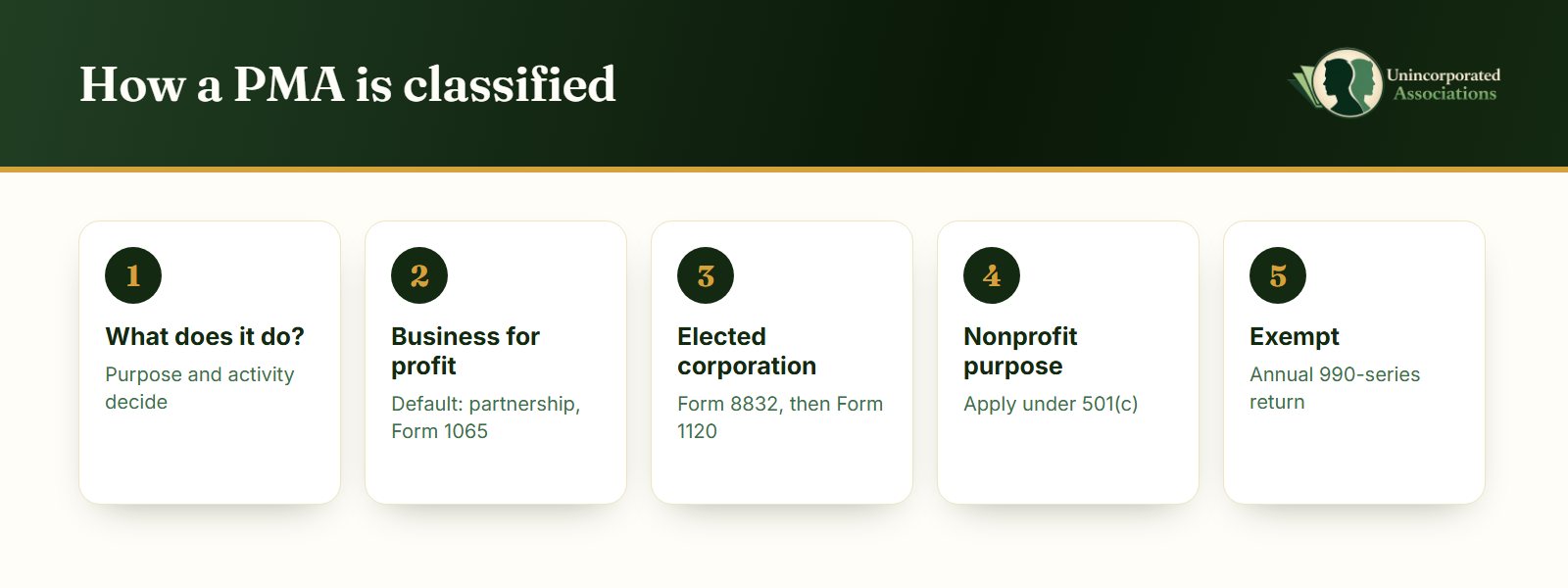
The federal entity classification regulations sort organizations into trusts and "business entities" (26 CFR 301.7701-2). An unincorporated association with two or more members that carries on activity for profit is generally a business entity, and the default rules at 26 CFR 301.7701-3 treat it as a partnership unless it elects otherwise.
A PMA organized and operated for a purpose listed in section 501 can instead seek tax-exempt status. Nothing about the membership agreement, the privacy of the member list or the word "private" changes that analysis.
Path 1: a PMA that runs a business for members' profit
If the PMA sells goods or services and its profits go to its founders or members, it is usually a partnership for federal tax purposes:
- It files Form 1065 each year, an information return.
- Each member receives a Schedule K-1 and reports their share of income on their own return.
- It may elect to be taxed as a corporation with Form 8832, in which case it files Form 1120 and pays corporate tax.
This is also the situation where state law may treat the group as a general partnership for liability purposes. We explain that risk in our PMA vs LLC comparison.
Path 2: a PMA with a qualifying nonprofit purpose
A PMA whose purpose is charitable, educational, religious or social may qualify for exemption. Common fits:
- 501(c)(3): charitable, educational or religious purposes, with articles that limit purposes and dedicate assets. See our guide on whether an unincorporated association can be a 501(c)(3).
- 501(c)(7) social clubs: groups organized for pleasure and recreation, supported mainly by members (IRS: social clubs).
- 501(c)(4): social welfare purposes.
Exempt PMAs file an annual Form 990-series return, and exemption is lost automatically after three years of non-filing (IRS).
How dues and member payments are treated
For the PMA: membership dues are income to the association. Whether they are taxed depends on the path:
- In a partnership PMA, dues and other income flow into the partnership's results.
- In an exempt PMA, dues related to the exempt purpose are generally not taxed, but income from unrelated business can be.
- Some membership organizations that are not exempt can deduct expenses of serving members only up to their membership income, under 26 U.S.C. § 277. This is a technical area worth a CPA's review.
For members: dues paid to a PMA are generally personal expenses, not deductions, unless the PMA is a qualifying charity (in which case part of a payment may be a deductible gift) or the dues are an ordinary business expense of a member's own business.
Members' own income doesn't change
Section 61 of the Internal Revenue Code defines gross income as "all income from whatever source derived" (26 U.S.C. § 61). Joining a PMA does not change how a member's wages, business profits or investment income are taxed. If a member's income passes through the PMA, it is still taxed, either to the PMA or to the member, depending on the path above.
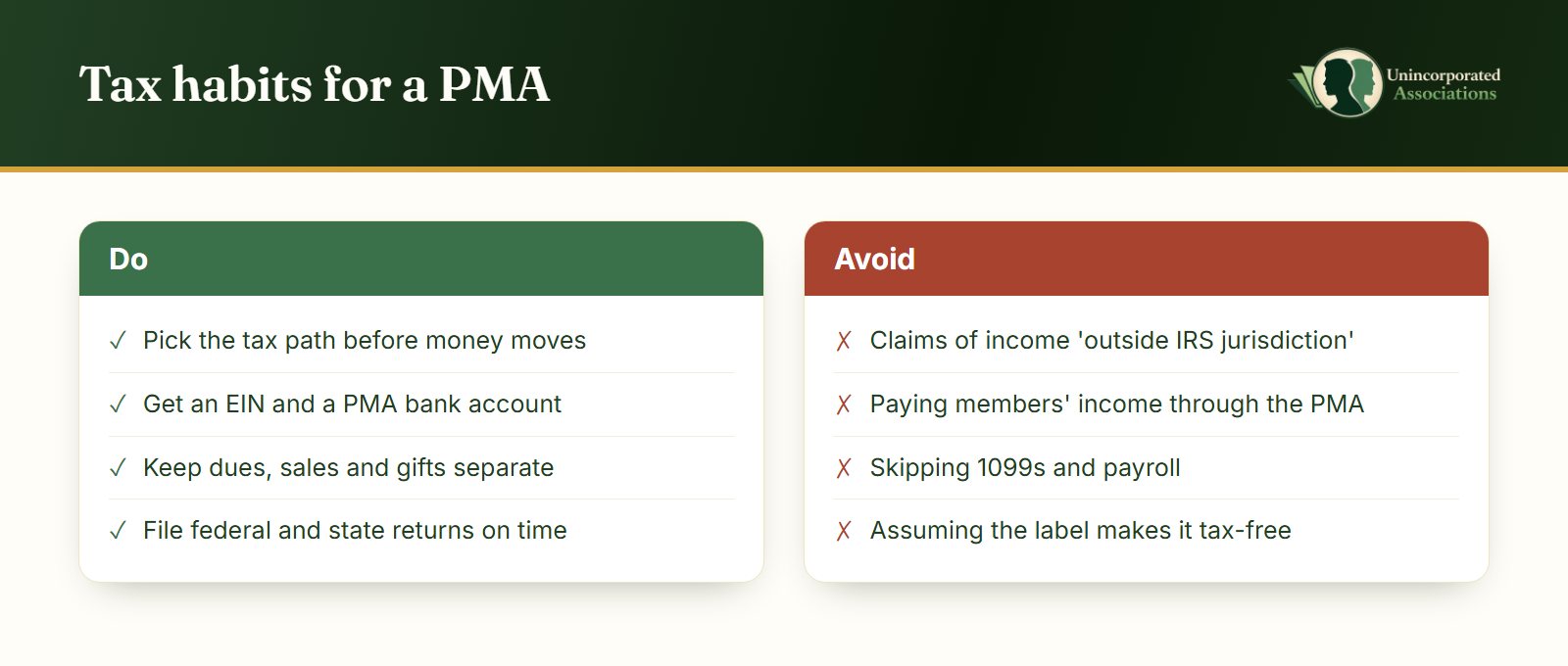
Watch out: Paying income through a members-only contract does not, by itself, change how it is taxed. The tax code looks at substance, so plan the PMA's tax treatment with a CPA from the start, before the first member payment arrives.
Filings a PMA should expect
| Situation | Filing |
|---|---|
| Any PMA with a bank account | EIN (Form SS-4), confirmed by a CP 575 |
| Partnership PMA | Form 1065 and Schedule K-1s yearly |
| PMA that elected corporate status | Form 1120 yearly |
| Exempt PMA | Form 990, 990-EZ or 990-N yearly |
| Pays independent contractors in a trade or business | Form 1099-NEC where required |
| Has employees | Payroll returns (Forms 941, W-2) |
| Changes address or responsible party | Form 8822-B |
Our guide on whether unincorporated associations file tax returns covers each form in more detail.
Don't forget state taxes
States apply their own rules to associations. California, for example, treats unincorporated organizations as subject to state tax until the Franchise Tax Board grants exemption (FTB 3500 booklet). Sales made to members can still be subject to sales tax, depending on the state and the goods.
Questions to settle with your CPA
Bring these to your first meeting with a tax professional:
- What is the PMA's primary purpose, in one sentence? That sentence drives the classification.
- Where will the money come from? Dues, sales to members, donations, events or investment income each have different consequences.
- Where will the money go? Programs, staff, reserves or members. Anything flowing to members needs careful handling.
- Do we qualify for exemption, and under which section? If yes, when should we apply, and which form?
- What state filings apply? Income or franchise tax, sales tax and any exemption applications.
- Who prepares and signs the returns each year? Name a person and a deadline.
Record-keeping the IRS expects
Whatever path your PMA is on, keep:
- the signed articles, bylaws and every member's signed agreement
- minutes showing major financial decisions and who approved them
- a ledger separating dues, sales, donations and other income
- receipts and invoices for expenses
- copies of all returns, the EIN confirmation and any determination letter
- a record of any payments to members, with what each payment was for
Keep these for at least as long as the IRS can examine the related returns, and longer for the founding documents, which you should keep permanently.
Good records are what let you prove the PMA operates the way its documents say, which matters for taxes, for liability and for any bank or regulator that asks.
Three PMAs, three tax outcomes
A members' buying club that resells surplus at a profit to its founders. Usually a partnership: Form 1065, with founders reporting their shares.
A hiking and social club funded by members' dues. May qualify as a 501(c)(7) social club if it meets the requirements; it need not apply, but files a Form 990-series return each year.
An education PMA offering free classes funded by donations. May qualify under 501(c)(3) if its articles and operations meet the tests: apply on Form 1023 or 1023-EZ, then file annually.
Practical steps to stay compliant
- Decide which path your PMA is on before it collects money.
- Get an EIN and open a bank account in the PMA's name.
- Keep books that separate dues, sales, donations and expenses.
- Calendar the annual federal and state returns.
- Issue 1099s and run payroll correctly if you pay people.
- Review the plan with a CPA who understands associations.
Pro tip: Write your PMA's tax path into its first minutes: "The association is organized for [purpose] and will file [Form] annually." It forces the decision early and gives your accountant a clear starting point.
Frequently asked questions
Do private membership associations pay taxes?
They can. A PMA running a business for members' profit is usually a partnership whose income is taxed to its members. A PMA that qualifies for exemption pays no tax on exempt-purpose income but files annual returns. No PMA is tax-free just because of its label.
Does a PMA need an EIN?
Yes, if it will open a bank account, collect dues, pay anyone or file any return. It applies with Form SS-4 or online.
Are PMA membership dues tax-deductible?
Generally not, for individuals. Part of a payment to a qualifying 501(c)(3) PMA may be deductible as a charitable gift, and a business may deduct dues that are an ordinary expense of that business.
Can a PMA be a 501(c)(3)?
Yes, if it is organized and operated exclusively for exempt purposes, with articles that limit its purposes and dedicate its assets. Members-only service can complicate the "public benefit" analysis, so plan carefully.
Is income paid through a PMA taxable?
Yes. Income is taxable to someone: to the PMA if it is taxed as an entity, or to the members if it is a partnership. Paying income through a private association does not remove it from the tax system.
Sources
- 26 CFR 301.7701-2 and 301.7701-3
- 26 U.S.C. § 61 (gross income) and § 277
- IRS: Form 1065, Form 8832, Form 1099-NEC
- IRS: Social clubs
- IRS: Automatic revocation of exemption
- California Franchise Tax Board: Form 3500 booklet
Want your PMA's tax path clear from day one? Book a free 15-minute call with Kirk's team, or join the daily live Q&A.
Have questions? Bring them to the daily call.
Join our live Q&A every weekday and Saturday at 3PM PST, or get a free 15-minute call to see whether a UNA fits your situation.
Have a question about your situation?
Send us a message and we'll get back to you.
Keep reading
 The Well-Meaning Dragon: Straight Answers to the Hardest ObjectionsFor the family and friends who push back because they care — honest answers to the toughest questions about the Federal income tax and Unincorporated Associations.
 It's Not What You Believe, It's What You SignFor the cautious partner in the room: real risk rarely comes from asking questions. It comes from what you signed.
 What Most People Get Wrong About Taxes, Structure, and ControlThe real problem isn't taxes — it's structure, and who actually has control. A look at positioning over loopholes.
Educational, not legal or tax advice. Unincorporated Associations is a document-preparation and education company. Consult a licensed attorney or CPA before acting on any position discussed on this site.