Can an Unincorporated Association Be a 501(c)(3)? Yes, Here's How
By Kirk Carmichael · · 8 min read
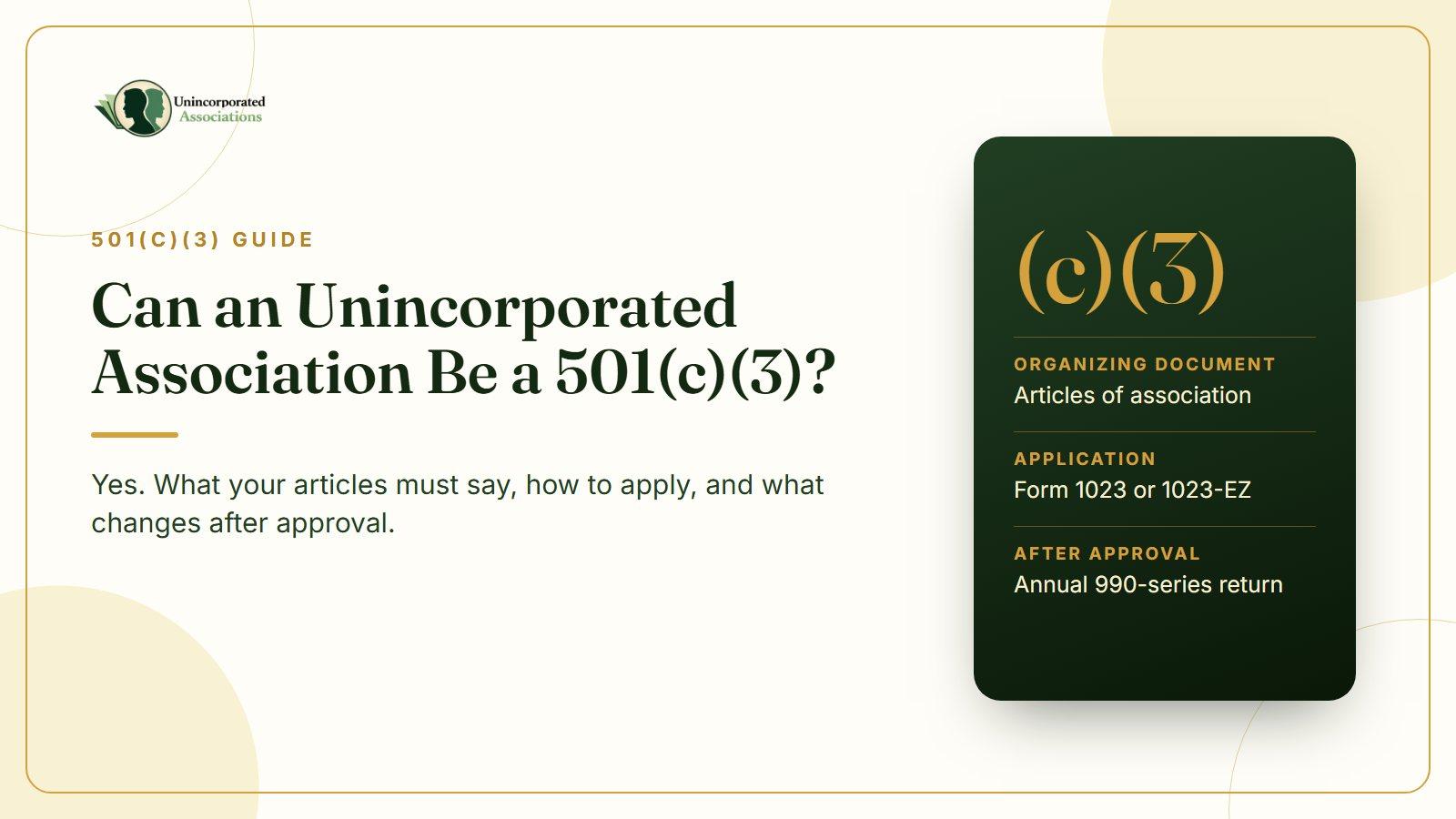
Short answer: Yes. The IRS recognizes unincorporated associations as 501(c)(3) organizations when they are organized and operated exclusively for exempt purposes such as charitable, religious or educational work. The association's organizing document is its articles of association, which must limit its purposes to exempt purposes and dedicate its assets to exempt purposes if it dissolves. It applies on Form 1023 or 1023-EZ, like a nonprofit corporation would.
A common myth says you have to incorporate to become a 501(c)(3). You don't. The tax code cares about purpose and operations, and the IRS accepts several kinds of organizing documents, including an unincorporated association's articles of association.
This guide explains exactly what the IRS looks for in an association's documents, how the application works step by step, the public charity question most groups overlook, and what changes once you are approved.
Key takeaways: An association can be a 501(c)(3). Its articles of association must pass the IRS organizational test: limited purposes and a proper dissolution clause. It applies on Form 1023 or 1023-EZ with an EIN and signed documents. After approval, it must file annually, avoid private benefit and stay out of political campaigns.
Why the IRS accepts associations
Section 501(c)(3) of the Internal Revenue Code exempts organizations "organized and operated exclusively" for religious, charitable, scientific, educational and certain other purposes (26 U.S.C. § 501). The IRS's own guidance lists the acceptable organizing documents: articles of incorporation for a corporation, a trust instrument for a trust, and articles of association or a constitution for an unincorporated association (IRS: organizational test).
Bylaws alone are not an organizing document. The articles of association, signed and dated by the members, are what the IRS reviews.
The organizational test: what your articles must say
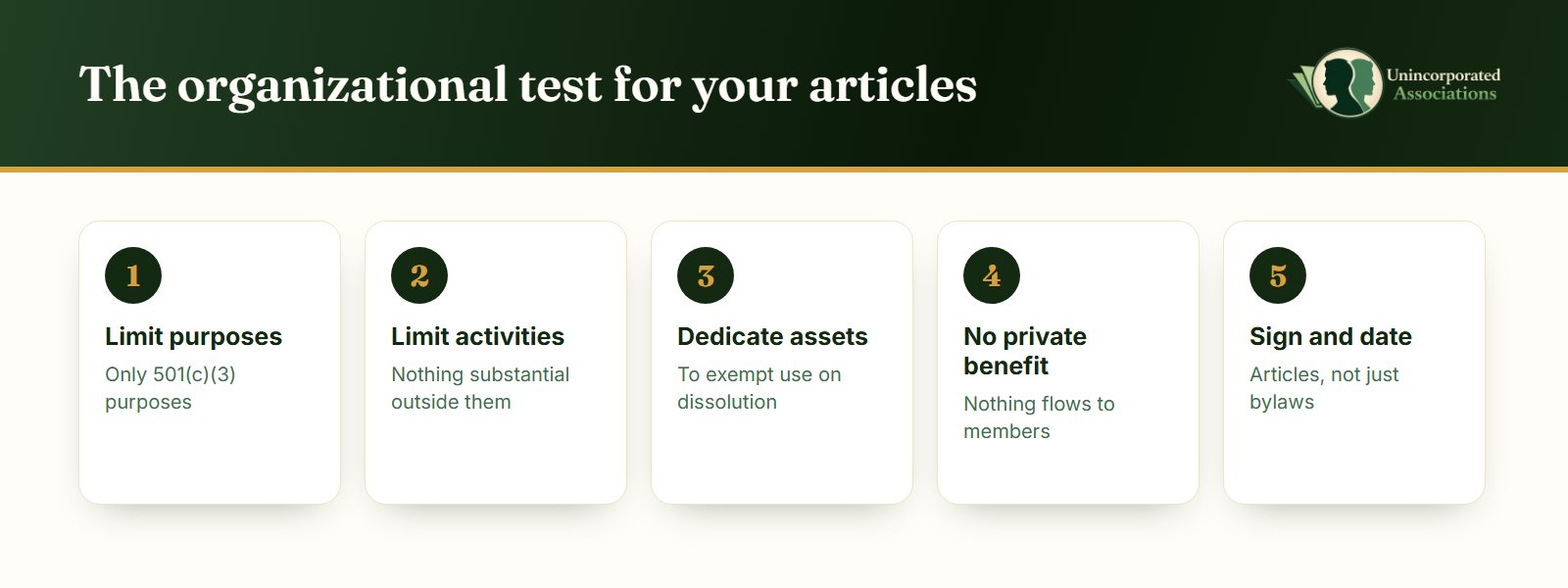
The IRS describes the organizational test in detail. In plain English, the articles must:
- Limit the purposes to one or more exempt purposes under section 501(c)(3).
- Not authorize substantial activities that do not further those purposes, beyond an insubstantial part.
- Dedicate the assets permanently to exempt purposes, so that on dissolution remaining assets go to another exempt organization or a government for a public purpose, not to members.
They should also be consistent with the operational limits: no private inurement to members or insiders, no participation in political campaigns, and no substantial lobbying.
Pro tip: Use plain, specific purpose language that matches what you actually do ("to provide free financial-literacy education to residents of San Diego County"), then add the standard limiting language. Vague purposes and copy-pasted clauses that contradict each other are a common reason for IRS follow-up questions.
What the key clauses look like
These illustrations show the kind of language the IRS expects. Your documents should be drafted for your specific purpose and state.
Purpose clause (illustration): "The Association is organized exclusively for charitable and educational purposes within the meaning of section 501(c)(3) of the Internal Revenue Code, including providing free financial-literacy education to residents of San Diego County."
Limitation clause (illustration): "The Association shall not carry on any activity not permitted to an organization exempt under section 501(c)(3), and no part of its net earnings shall inure to the benefit of any member or private person, except reasonable compensation for services rendered."
Political activity clause (illustration): "The Association shall not participate or intervene in any political campaign on behalf of or in opposition to any candidate for public office."
Dissolution clause (illustration): "Upon dissolution, remaining assets shall be distributed for one or more exempt purposes within the meaning of section 501(c)(3), or to a governmental body for a public purpose."
Step by step: applying as an association
Step 1: Sign the articles of association and bylaws
The founding members sign articles containing the purpose and dissolution clauses above, and adopt bylaws. Our guide on how to become an unincorporated association covers the documents.
Step 2: Get an EIN
The application needs it. Keep the CP 575 confirmation.
Step 3: Decide between Form 1023 and 1023-EZ
Form 1023-EZ is the streamlined version for smaller organizations; generally, projected annual gross receipts must be $50,000 or less and total assets $250,000 or less, and you must complete the eligibility worksheet. Everyone else files the full Form 1023, describing activities, finances and governance.
Step 4: File online and pay the user fee
Both forms are filed electronically through Pay.gov, as the IRS explains on its applying for tax-exempt status page.
Step 5: Answer any follow-up questions
The IRS may ask about activities, finances or document language. Respond promptly and consistently with your articles.
Step 6: Receive the determination letter
It confirms recognition under 501(c)(3) and your public charity or private foundation classification. Keep it permanently.
Common reasons applications get delayed
- Bylaws submitted instead of signed articles. The IRS needs the organizing document.
- Purpose language that is too broad or that conflicts with the activities described.
- A dissolution clause that sends assets to members.
- Compensation to insiders without explanation of how it was set and approved.
- Inconsistent names between the EIN record, the articles and the application.
- Choosing 1023-EZ when not eligible. The IRS can later revoke a determination obtained on the wrong form.
An alternative while you wait: fiscal sponsorship
Some groups that need to accept tax-deductible gifts before their own determination arrives use a fiscal sponsor: an existing 501(c)(3) that agrees to receive and manage funds for the project under a written agreement. It is a useful bridge, but the sponsor keeps control over the funds and charges a fee. Read the agreement carefully.
Public charity or private foundation?
Every 501(c)(3) is either a public charity or a private foundation, and the difference matters. Public charities generally get broad public support or run their own programs; private foundations are typically funded by a single source and face stricter rules and excise taxes. The IRS explains the categories on its public charities and private foundations pages.
Most community associations aim for public charity status by showing they are supported by many donors or members. Plan your fundraising with this in mind from the start.
A quick readiness checklist
Before you file, confirm each of these:
- The articles of association are signed and dated by the founding members.
- The purpose clause names a 501(c)(3) purpose and matches what you actually do.
- The limitation, political activity and dissolution clauses are in the articles.
- The bylaws describe how officers are chosen and how money is approved.
- The association has its own EIN, and the name matches the articles exactly.
- You have a simple budget for the next three years.
- You know whether you qualify for Form 1023-EZ, using the IRS eligibility worksheet.
- You have a plan for public support if you want public charity status.
If any line is a "not yet," fix it first. It is faster than answering IRS questions later.
Associations that don't need to apply
Churches. Congregations that meet 501(c)(3) requirements are automatically treated as exempt and are not required to apply, although many do to give donors certainty (IRS: churches and religious organizations).
Very small organizations. Organizations with annual gross receipts normally not more than $5,000 that are not private foundations are not required to file Form 1023, though they must still meet the 501(c)(3) requirements to be treated as exempt. Many apply anyway, because donors and banks want a determination letter.
Life after approval
Recognition comes with ongoing duties:
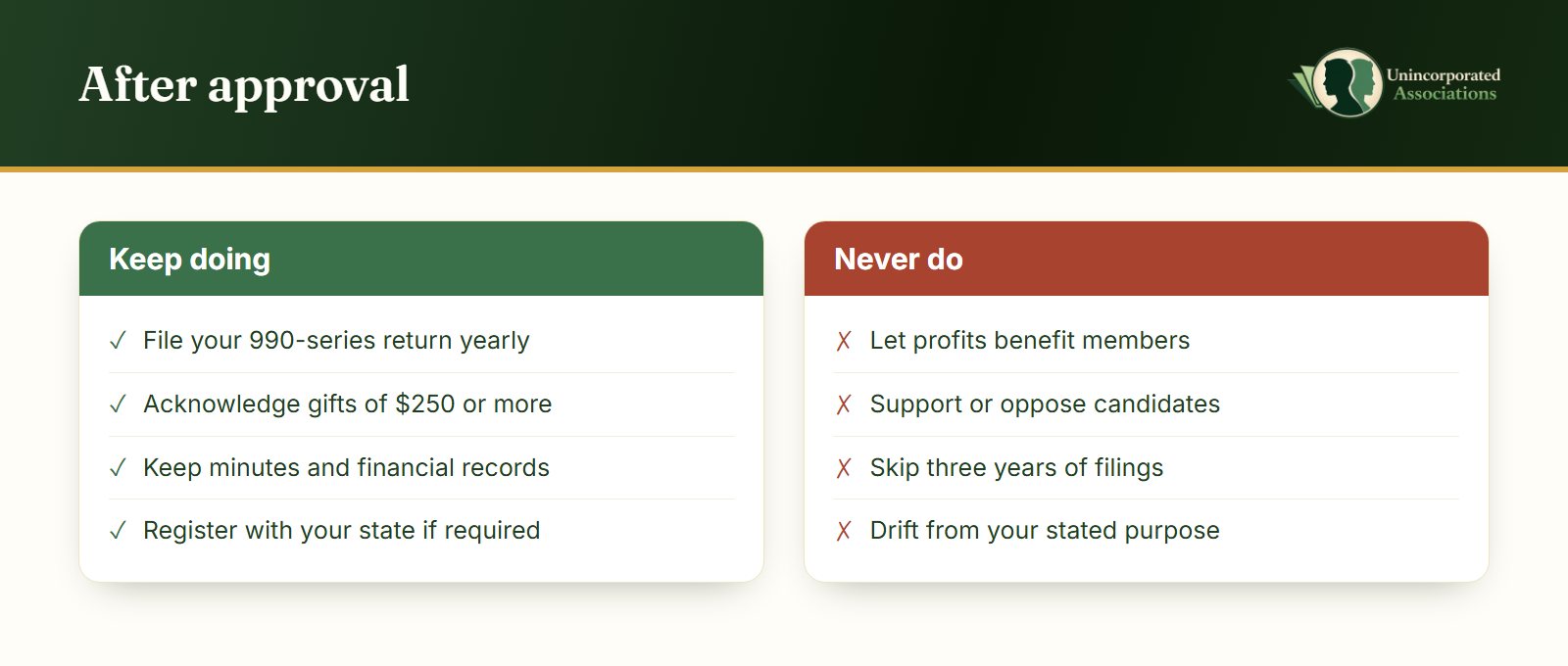
- Annual return. A Form 990-series return each year (990-N for the smallest). Missing three years in a row automatically revokes exemption (IRS). See our guide on whether unincorporated associations file tax returns.
- No private benefit. Earnings must not benefit members or insiders beyond fair value for real services (IRS: inurement and private benefit).
- No campaign activity. A 501(c)(3) may not support or oppose candidates.
- Donor receipts. Donors need written acknowledgment for gifts of $250 or more to claim a deduction, as Publication 526 explains.
- State rules. States require their own exemption and, often, charity registration. California, for example, requires an application to the Franchise Tax Board.
Watch out: A 501(c)(3) association cannot be used to give members tax-free benefits. If the main beneficiaries of the association's money are its own members, that is private benefit, and the IRS can deny or revoke exemption.
Association or nonprofit corporation for a 501(c)(3)?
Both can qualify. The practical differences are formation (no state filing for an association), governance (member-led vs board-led) and recognition by grant makers, some of whom prefer incorporated charities. Our comparison of unincorporated association vs nonprofit corporation covers the trade-offs, and our guide to whether an unincorporated association is tax exempt covers the other exemption categories.
Frequently asked questions
Can an unincorporated association get 501(c)(3) status?
Yes. The IRS accepts articles of association as the organizing document of an unincorporated association, provided they limit its purposes to exempt purposes and dedicate its assets to exempt purposes on dissolution.
Are bylaws enough to apply?
No. The IRS needs the organizing document: for an association, signed and dated articles of association or a constitution. Bylaws are submitted as supporting documents.
Do donations to a 501(c)(3) association qualify for a tax deduction?
Yes, once the association is recognized (or is a church that meets the requirements), contributions are generally deductible for donors who itemize, subject to the normal rules in Publication 526.
How long does approval take?
It varies. Form 1023-EZ applications are generally processed faster than full Form 1023 applications, which can take several months. Respond quickly to any IRS questions to avoid delays.
Is an unincorporated association automatically a nonprofit?
Being a nonprofit is about purpose and use of money. An association whose primary purpose is not to run a business for profit is a nonprofit association under laws like California's, but it is not tax-exempt until it qualifies under the tax code.
Sources
- 26 U.S.C. § 501
- IRS: Organizational test, IRC 501(c)(3)
- IRS: Exemption requirements for 501(c)(3) organizations
- IRS: Form 1023 and Form 1023-EZ
- IRS: Applying for tax-exempt status
- IRS: Public charities and private foundations
- IRS: Inurement and private benefit
- IRS: Churches and religious organizations
- IRS: Automatic revocation of exemption
- IRS Publication 526, Charitable Contributions
Want your association's articles ready for 501(c)(3)? Book a free 15-minute call with Kirk's team, or join the daily live Q&A.
Have questions? Bring them to the daily call.
Join our live Q&A every weekday and Saturday at 3PM PST, or get a free 15-minute call to see whether a UNA fits your situation.
Have a question about your situation?
Send us a message and we'll get back to you.
Keep reading
 The Well-Meaning Dragon: Straight Answers to the Hardest ObjectionsFor the family and friends who push back because they care — honest answers to the toughest questions about the Federal income tax and Unincorporated Associations.
 It's Not What You Believe, It's What You SignFor the cautious partner in the room: real risk rarely comes from asking questions. It comes from what you signed.
 What Most People Get Wrong About Taxes, Structure, and ControlThe real problem isn't taxes — it's structure, and who actually has control. A look at positioning over loopholes.
Educational, not legal or tax advice. Unincorporated Associations is a document-preparation and education company. Consult a licensed attorney or CPA before acting on any position discussed on this site.