
Is an Unincorporated Association Tax Exempt? What It Takes to Qualify
By Kirk Carmichael · · 9 min read
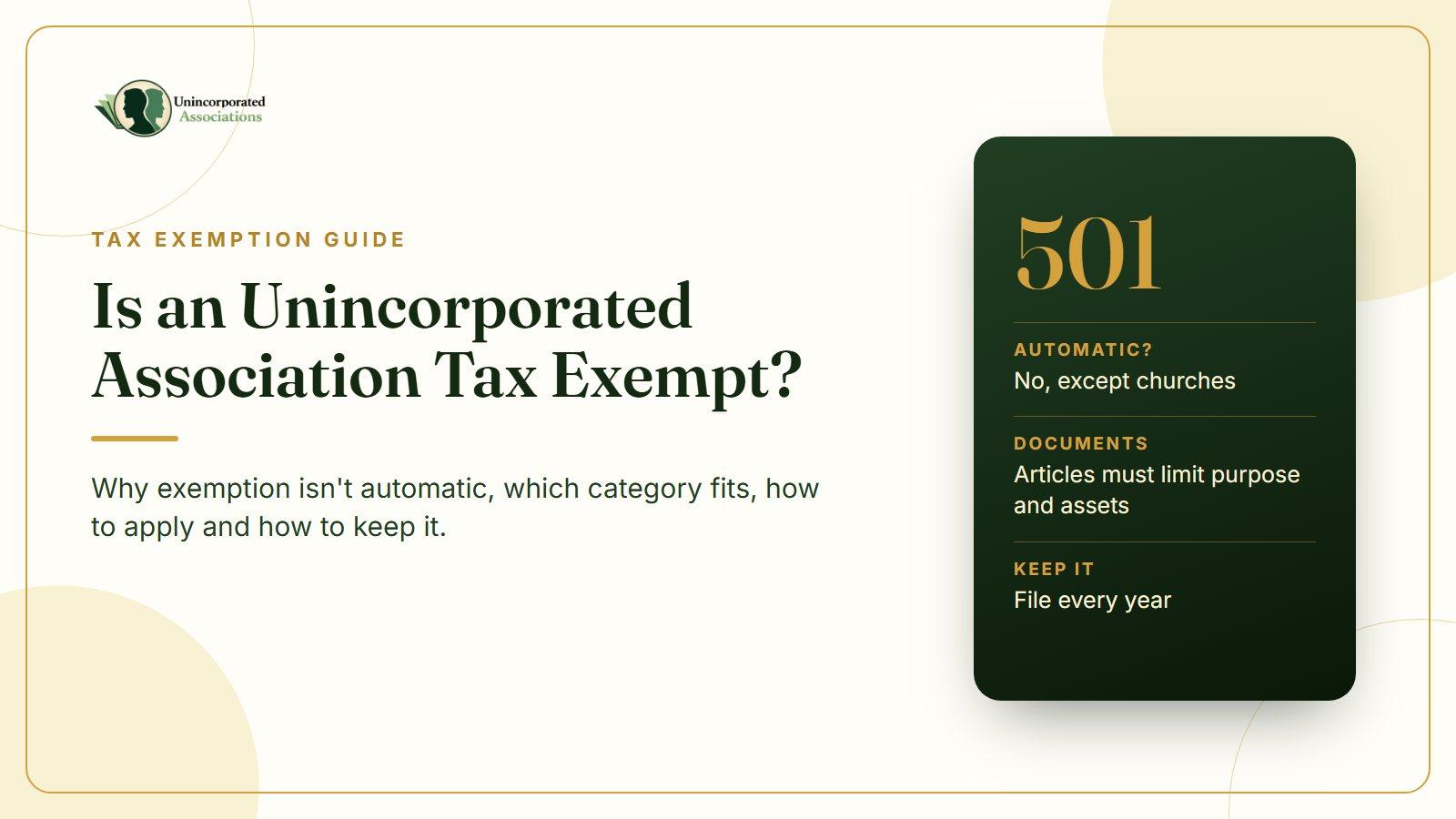
Short answer: It can be. An association is exempt from federal income tax when it is organized and operated for a purpose the tax code exempts, such as charitable, religious or educational work under section 501(c)(3), or a members' social club under 501(c)(7). Being unincorporated or nonprofit is not enough by itself. Most 501(c)(3) charities must apply to the IRS for recognition; churches, very small charities and most other 501(c) categories can be exempt without applying, if they meet the requirements. Unincorporated associations can qualify: the IRS accepts articles of association as the organizing document. States have their own exemption rules on top.
The words "nonprofit" and "tax-exempt" are often used as if they mean the same thing. They do not. "Nonprofit" describes how an organization uses its money. "Tax-exempt" means the organization meets the requirements of a specific section of the Internal Revenue Code, and it comes with conditions.
This guide explains how an unincorporated association becomes tax-exempt, which category fits which kind of group, how the application works and what you must do to keep the status.
Key takeaways: Exemption comes from meeting the tax code's requirements, not from a label. Your articles of association must limit the purpose and protect the assets. Most 501(c)(3) charities apply with Form 1023 or 1023-EZ; churches, very small charities and most other 501(c) categories don't have to. Once exempt, you must file every year and stay within your purpose, or the exemption can be lost.
Why exemption isn't automatic
Federal income tax applies to organizations by default. Section 501 of the Internal Revenue Code, at 26 U.S.C. § 501, lists the kinds of organizations that are exempt and the conditions each must meet. If an association does not fit one of those categories, or does not meet the conditions, it is not exempt, whatever it calls itself.
That is also true at the state level. The Texas Secretary of State says neither a nonprofit corporation nor an unincorporated nonprofit association is automatically exempt from federal or state taxes, and California's Franchise Tax Board treats unincorporated organizations as taxable until it grants exempt status (FTB Form 3500 booklet).
The categories that fit most associations
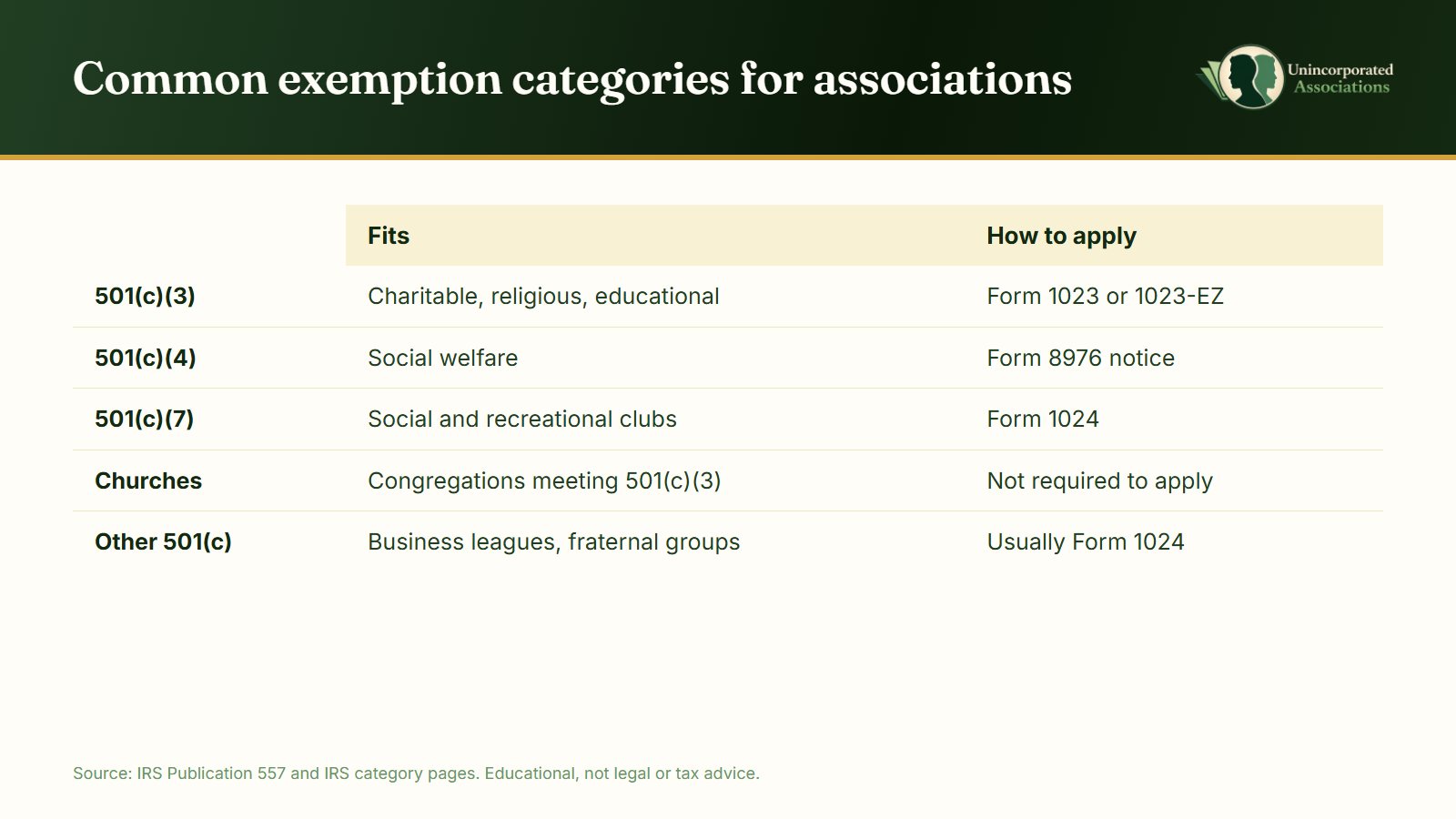
| Category | Who it fits | How to apply |
|---|---|---|
| 501(c)(3) charitable, religious, educational | Charities, ministries, education and community-service groups | Form 1023 or 1023-EZ (churches are not required to apply) |
| 501(c)(4) social welfare | Groups promoting community welfare, including some advocacy | Notify the IRS with Form 8976; may request a determination with Form 1024-A |
| 501(c)(7) social clubs | Clubs organized for pleasure and recreation, funded mainly by members | Not required; may request a determination with Form 1024 |
| Other 501(c) categories | Business leagues, fraternal groups and others | Usually optional (Form 1024); a few categories must apply |
The IRS explains each category in Publication 557, with dedicated pages for social welfare organizations and social clubs.
What the IRS requires of an association
The organizational test: your documents
For 501(c)(3), the IRS looks first at your organizing document. An unincorporated association uses its articles of association, and the IRS accepts them as long as they (IRS: 501(c)(3) requirements):
- limit the purposes to exempt purposes, such as charitable, religious or educational
- do not allow substantial activities outside those purposes
- dedicate the assets to exempt purposes if the association dissolves
Bylaws alone are not enough; the IRS wants the founding document, signed and dated. Our guide on how to become an unincorporated association shows where these clauses sit.
The operational test: what you actually do
The association must be operated primarily for its exempt purpose. Its earnings must not benefit members or insiders (the "private inurement" rule), and a 501(c)(3) must not take part in political campaigns or devote a substantial part of its activities to lobbying.
Watch out: If members receive the association's profits, or the association pays insiders more than fair value, it can fail the operational test. An association designed to channel income to its members is not a candidate for 501(c)(3) exemption.
How to apply
- Get an EIN first. The IRS application asks for it. Keep the CP 575 confirmation.
- Choose the right form. Form 1023 is the standard 501(c)(3) application. Smaller organizations may be eligible for the streamlined Form 1023-EZ; generally that means projected annual gross receipts of $50,000 or less and total assets of $250,000 or less, and you must complete the eligibility worksheet. Most other 501(c) categories use Form 1024.
- Attach your organizing documents. For an association, that means the signed articles of association and bylaws.
- File online and pay the user fee shown on the IRS applying for tax-exempt status page.
- Wait for the determination letter. It states the section you are exempt under and when exemption starts. Keep it with your permanent records.
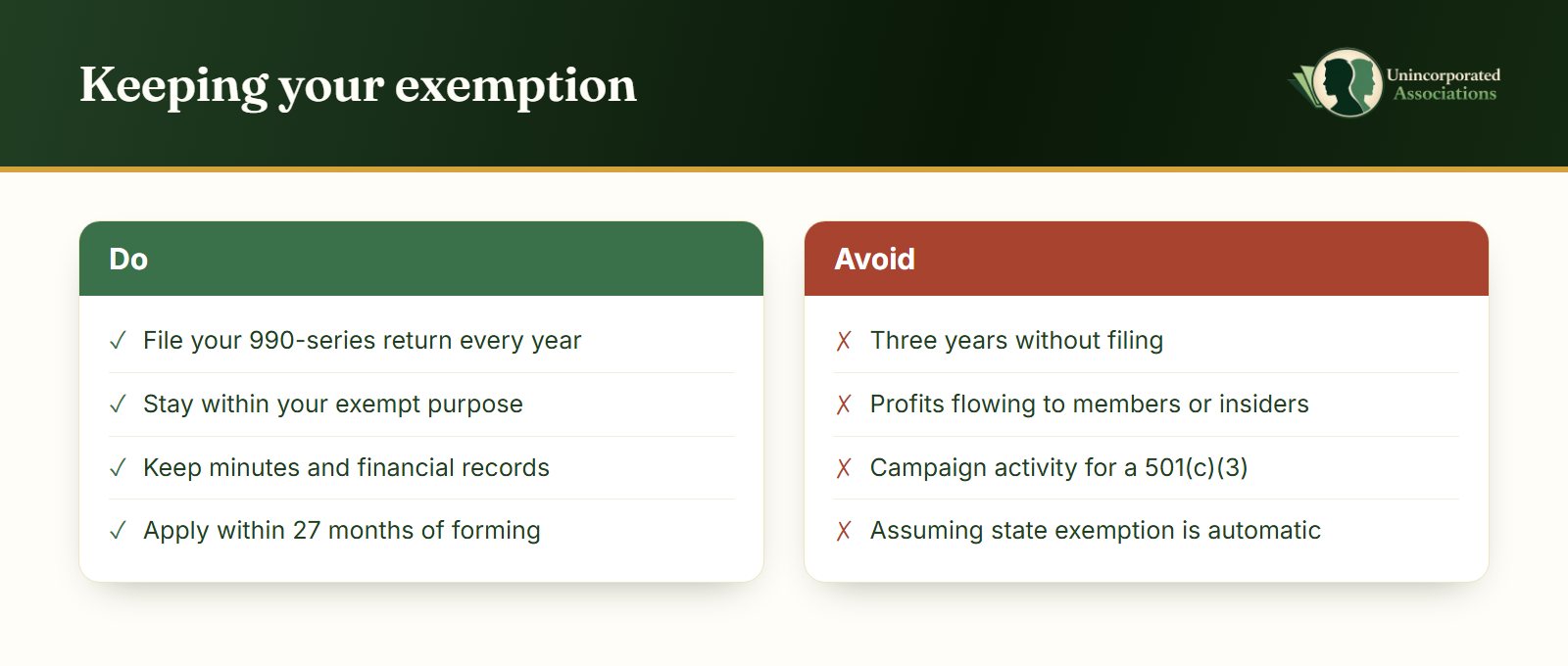
Pro tip: If you apply within 27 months of forming the association, exemption under 501(c)(3) can generally be recognized back to the date you formed it. Waiting longer can leave a gap. Apply soon after you sign the articles.
What an exempt association can and cannot do with its money
Once exempt, an association has real freedom, within limits.
It can:
- pay reasonable salaries and fees for real work, including to members who do that work
- reimburse documented expenses incurred for the association
- build reserves for future activities
- run fundraising events and sell goods connected to its purpose
- own property and invest funds for its mission
It cannot:
- distribute profits to members the way a business pays owners
- pay insiders more than fair value for goods or services
- let its assets be used for members' private benefit
- (for a 501(c)(3)) support or oppose candidates for public office
If your group is set up for members only, our explainer on the private membership association covers how membership interacts with these rules.
The rule of thumb: every dollar should trace back to the association's purpose. If you would be uncomfortable explaining a payment to the IRS or to your donors, do not make it.
A realistic timeline
For a new association aiming for 501(c)(3):
- Week 1: members sign the articles of association and adopt bylaws; officers are appointed.
- Week 1 to 2: the association obtains its EIN and opens a bank account.
- Weeks 2 to 4: the association prepares and files Form 1023 or 1023-EZ online, with its documents attached.
- Following weeks or months: the IRS reviews the application. Form 1023-EZ applications are generally decided faster than full Form 1023 applications, which can take several months.
- On approval: the determination letter arrives; the association then applies for any state exemptions and starts its annual filing calendar.
Keep donors informed during the wait. Gifts made before the determination can still be deductible if exemption is later recognized back to the formation date, but donors deserve to know the status.
Churches and religious associations
Churches are treated differently. The IRS explains in its churches and religious organizations guidance that churches meeting the 501(c)(3) requirements are automatically considered exempt and are not required to apply, although many do so to give donors and banks certainty. Churches are also generally not required to file the annual Form 990. A congregation organized as an association still needs governing documents that meet the organizational test.
Keeping the exemption
Exemption is not a one-time event. To keep it:
- File every year. Most exempt organizations file a Form 990-series return; small ones can use the 990-N e-Postcard. The IRS says organizations that fail to file for three consecutive years automatically lose exemption (automatic revocation). Our guide on whether unincorporated associations file tax returns explains which form.
- Stay within your purpose. Income from a regular business unrelated to your purpose can be taxed as unrelated business income.
- Keep records. Minutes, financial records and documentation of how money was used.
- Report changes. Tell the IRS about name, address or significant structural changes.
State exemption is separate
Federal recognition does not automatically make you exempt from state taxes. California requires an application to the Franchise Tax Board (Form FTB 3500); Texas handles franchise and sales tax exemptions through the Comptroller. Our California guide covers the FTB process in detail.
"Tax exempt" vs "not taxable" vs "not required to file"
These phrases get mixed up, and the difference matters:
- Tax-exempt means the IRS recognizes the organization under a section of the Code, so its exempt-purpose income is not taxed.
- Not taxable on certain income can apply even to exempt organizations; unrelated business income, for example, can still be taxed.
- Not required to file applies to a narrow set of organizations, such as churches for the Form 990. It does not mean the organization is outside the tax system.
A useful question for any tax plan: which Code section does the association rely on, and does it meet that section's requirements? Kirk's team covers tax positioning on every intro call, and a CPA should confirm the details for your situation.
Frequently asked questions
Are unincorporated associations automatically tax exempt?
Not by itself. An association is exempt if it is organized and operated for a purpose listed in section 501. Most 501(c)(3) charities must apply for recognition; churches, very small charities and most other categories need not apply.
Can an unincorporated association get 501(c)(3) status?
Yes. The IRS accepts articles of association as the organizing document if they limit the purposes to exempt purposes and dedicate assets to exempt purposes on dissolution.
What form does an unincorporated association use to apply?
Usually Form 1023 or the streamlined Form 1023-EZ for 501(c)(3), and Form 1024 for most other categories. Social welfare organizations under 501(c)(4) notify the IRS with Form 8976.
Is a nonprofit association exempt from state taxes too?
Not automatically. States have their own rules. California requires an FTB application, and Texas handles exemptions through the Comptroller.
Can an exempt association lose its exemption?
Yes. Failing to file for three consecutive years triggers automatic revocation, and operating outside the exempt purpose or letting earnings benefit insiders can also cost the exemption.
Sources
- 26 U.S.C. § 501
- IRS: Exemption requirements for 501(c)(3) organizations
- IRS Publication 557
- IRS: Applying for tax-exempt status
- IRS: Form 1023, Form 1023-EZ, Form 1024
- IRS: Social welfare organizations and social clubs
- IRS: Churches and religious organizations
- IRS: Automatic revocation of exemption
- IRS: Unrelated business income tax
- California Franchise Tax Board: Form 3500 booklet
Wondering whether your association can qualify? Book a free 15-minute call with Kirk's team, or join the daily live Q&A.
Have questions? Bring them to the daily call.
Join our live Q&A every weekday and Saturday at 3PM PST, or get a free 15-minute call to see whether a UNA fits your situation.
Have a question about your situation?
Send us a message and we'll get back to you.
Keep reading
 The Well-Meaning Dragon: Straight Answers to the Hardest ObjectionsFor the family and friends who push back because they care — honest answers to the toughest questions about the Federal income tax and Unincorporated Associations.
 It's Not What You Believe, It's What You SignFor the cautious partner in the room: real risk rarely comes from asking questions. It comes from what you signed.
 What Most People Get Wrong About Taxes, Structure, and ControlThe real problem isn't taxes — it's structure, and who actually has control. A look at positioning over loopholes.
Educational, not legal or tax advice. Unincorporated Associations is a document-preparation and education company. Consult a licensed attorney or CPA before acting on any position discussed on this site.