Unincorporated Association vs Nonprofit Corporation: Which Fits Your Mission?
By Kirk Carmichael · · 9 min read
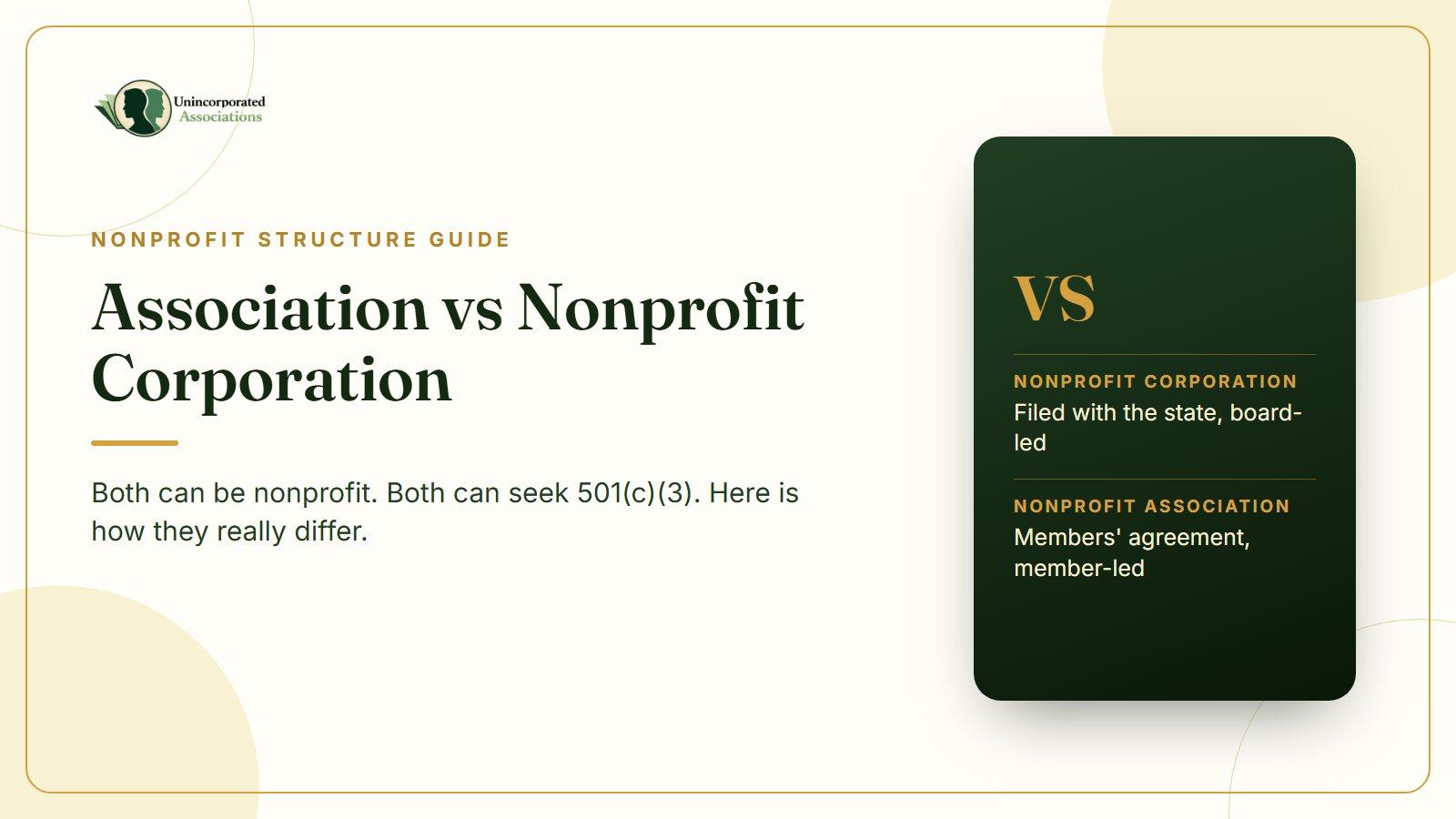
Short answer: A nonprofit corporation is created by filing articles of incorporation under a state's nonprofit corporation law, is run by a board of directors, and appears in public state records. An unincorporated nonprofit association is created by its members' written agreement, with no filing to form it, and is governed by its own articles and bylaws. Both can pursue a nonprofit mission and both can apply for 501(c)(3) or other tax exemption. A nonprofit corporation is easier for banks and grant makers to recognize; an association is simpler, more private and more member-controlled.
Many people assume a nonprofit has to be a corporation. It does not. "Nonprofit" describes the purpose and how money is used. "Corporation" describes one legal form a nonprofit can take. An unincorporated nonprofit association is another form, and for many groups it is the more natural fit.
This guide compares the two side by side and gives you a practical way to choose.
Key takeaways: Both structures can be nonprofit and both can seek tax exemption. A nonprofit corporation brings statutory structure, a public record and easier access to grants. An association brings no formation filing, member-written rules and privacy, with protections that depend on state association law.
What is a nonprofit corporation?
A nonprofit corporation is formed under a state's nonprofit corporation statute. California's version for charities is the Nonprofit Public Benefit Corporation Law, which begins at Corporations Code section 5110; Texas covers nonprofit corporations in Business Organizations Code chapter 22.
To form one, you file articles of incorporation with the Secretary of State, appoint a board of directors, adopt bylaws and file annual or biennial reports. The statute supplies many default rules: how the board acts, director duties, member rights if the corporation has members, and what happens to assets on dissolution.
What is an unincorporated nonprofit association?
An unincorporated nonprofit association is two or more people joined by mutual consent for a common nonprofit purpose. California defines a nonprofit association as an unincorporated association whose primary common purpose is "other than to operate a business for profit" in Corporations Code section 18020. Nothing is filed to form one: members sign articles of association, adopt bylaws and appoint officers.
Many states now treat these associations as legal entities. Texas, which adopted the Uniform Unincorporated Nonprofit Association Act, makes a nonprofit association a legal entity separate from its members for contract and tort purposes in section 252.006. Our unincorporated nonprofit association overview explains how we structure them.
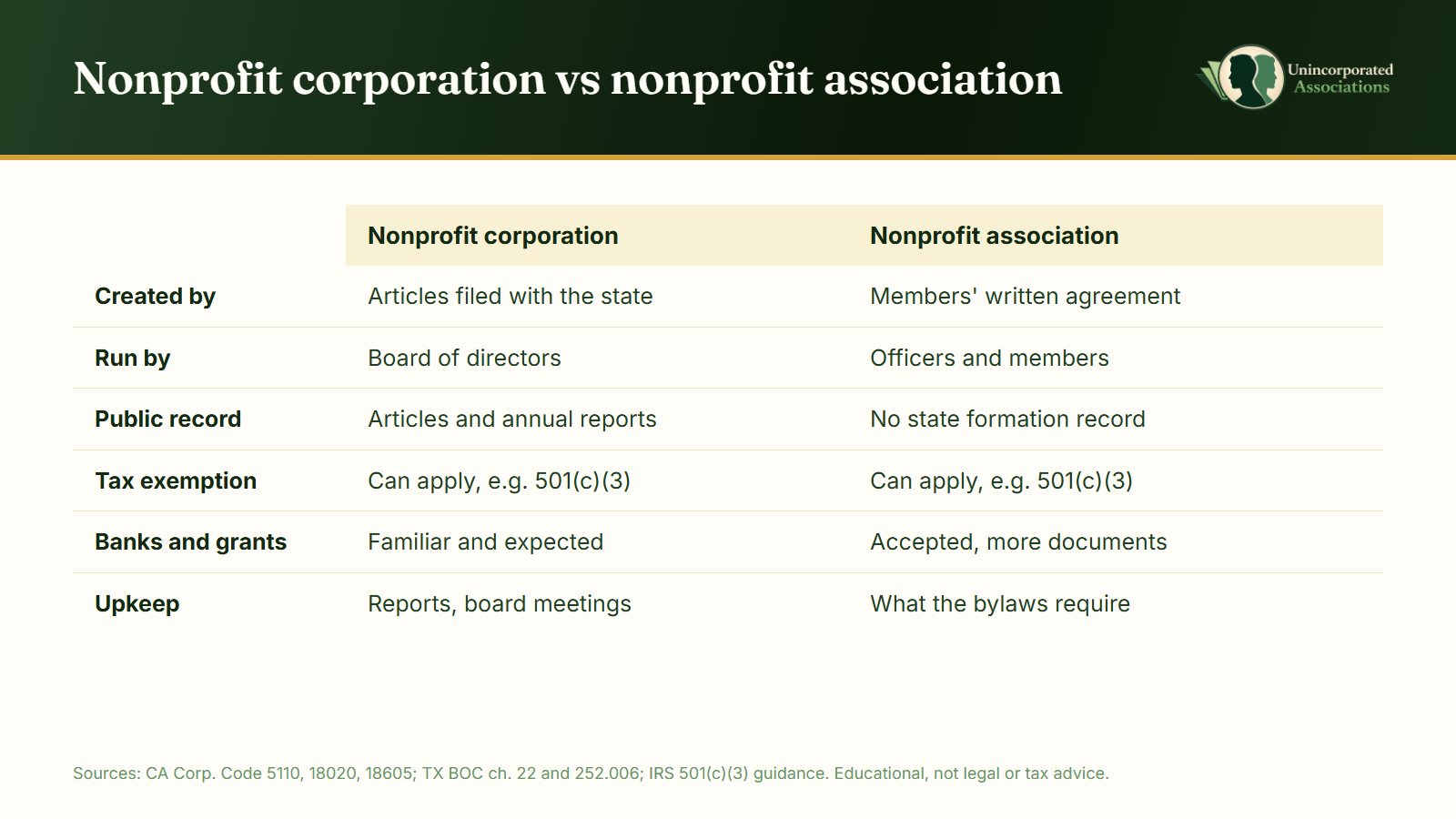
Side by side
| Nonprofit corporation | Unincorporated nonprofit association | |
|---|---|---|
| Created by | Articles of incorporation filed with the state | Members' written agreement |
| State filing to form | Required | None |
| Governing body | Board of directors, under the nonprofit corporation statute | Officers and members, under the association's own documents |
| Public record | Articles, agent and annual reports are public | No state formation record |
| Member liability | Directors and members generally protected by statute | Protected by statute in states like CA and TX; varies elsewhere |
| Tax exemption | Can apply (e.g., 501(c)(3)) | Can apply (e.g., 501(c)(3)) using articles of association |
| Banks and grant makers | Familiar and expected | Accepted, with more documentation |
| Ongoing upkeep | Annual reports, board meetings, statutory duties | What the bylaws require |
| Converting later | Already a corporation | Can incorporate later |
Formation and upkeep
A nonprofit corporation needs a state filing, a registered agent, an initial board and, in most states, regular reports to stay in good standing. Boards are expected to meet, keep minutes and follow the statute's procedures.
An association needs signed articles of association, bylaws, officers and records, but no state filing to exist and usually no state report. That makes it faster to start and cheaper to run. The trade-off is that your documents do all the work the statute would otherwise do, so they need to be clear. Our guide on how to become an unincorporated association lists what to include.
Pro tip: Write the dissolution clause on day one. Both the IRS and state regulators look at what happens to a nonprofit's assets if it closes. A clause that sends remaining assets to another nonprofit for the same purpose protects your exemption and your members.
Governance: board-led vs member-led
The biggest day-to-day difference is who decides. A nonprofit corporation is board-led: directors hold legal authority and owe statutory duties of care and loyalty, and members (if any) have only the rights the law and bylaws give them.
An association is member-led by design. The members decide in their bylaws who holds authority, how votes work and how officers are chosen. For community groups, congregations, clubs and mutual-support groups, that often matches how the group actually operates.
Liability
Nonprofit corporations give directors, officers and members a statutory liability shield, and many states add volunteer-protection rules.
Associations now get similar protection in many states. California says a nonprofit association member, director or agent is not liable for the association's debts solely because of that role (section 18605), and Texas says a person is not liable for the association's contracts or torts merely because they are a member. In states without such statutes, older common-law rules can expose members who authorize a decision. Our guide to unincorporated association liability explains the details.
Watch out: "Nonprofit" protection depends on actually operating as a nonprofit. If members share profits among themselves, an association can lose the nonprofit association protections and may be treated as a general partnership.
Tax exemption: same door, different paperwork
Both structures can apply for federal tax exemption. The IRS accepts a corporation's articles of incorporation or an association's articles of association as the organizing document for 501(c)(3) status, provided the documents limit the purposes and dedicate assets properly. The IRS applying for tax-exempt status page explains the forms, and Publication 557 covers the other categories, such as 501(c)(4) and 501(c)(7).
Exemption depends on meeting the tax code's requirements, not on the legal form: most 501(c)(3) charities apply for recognition, while churches and many other exempt categories need not apply. Either way, both must file annual returns once exempt; our guide on whether unincorporated associations file tax returns explains which ones.
Banks, grants and donors
This is where a nonprofit corporation has a real edge. Banks, foundations and government grant programs are used to seeing articles of incorporation and a state certificate of good standing. Some foundations only fund incorporated 501(c)(3)s.
Associations can open bank accounts and receive donations, but expect to provide more: signed articles of association, bylaws, the IRS EIN confirmation, an officer resolution and, if exempt, the IRS determination letter. If your plan depends heavily on large institutional grants, that is a reason to lean toward incorporation.
State oversight of charitable assets
States watch over assets held for charitable purposes. In California, the Attorney General's Registry of Charities and Fundraisers oversees charities operating in the state. If your association holds or raises money for charitable purposes, check whether your state requires registration and annual reports, whatever your legal form. State charity regulators are listed by the National Association of State Charity Officials.
Three groups, three choices
These simplified examples show how the decision usually plays out.
A neighborhood mutual-aid group. Fifteen neighbors collect dues to run a tool library and help older residents with errands. They want to start this month, keep their member list private and make decisions together. Funding comes from members and a few local donors. A good fit for an association: sign articles and bylaws, get an EIN, open a bank account, and apply for exemption if donors need receipts.
A literacy charity planning to hire staff. The founders want to apply for state and foundation grants, hire two employees within a year and recruit a professional board. A good fit for a nonprofit corporation: the grant makers they are targeting expect articles of incorporation and a board with statutory duties.
A congregation that started informally. A small faith community has met for years without any formal structure and now wants a bank account and clear rules for its money. Often a good fit for an association: it can document what already exists, keep its member-led governance and, if it later grows, incorporate.
In each case, the deciding questions were the same: where the money comes from, who should hold authority, and how much public structure the group needs.
How to choose
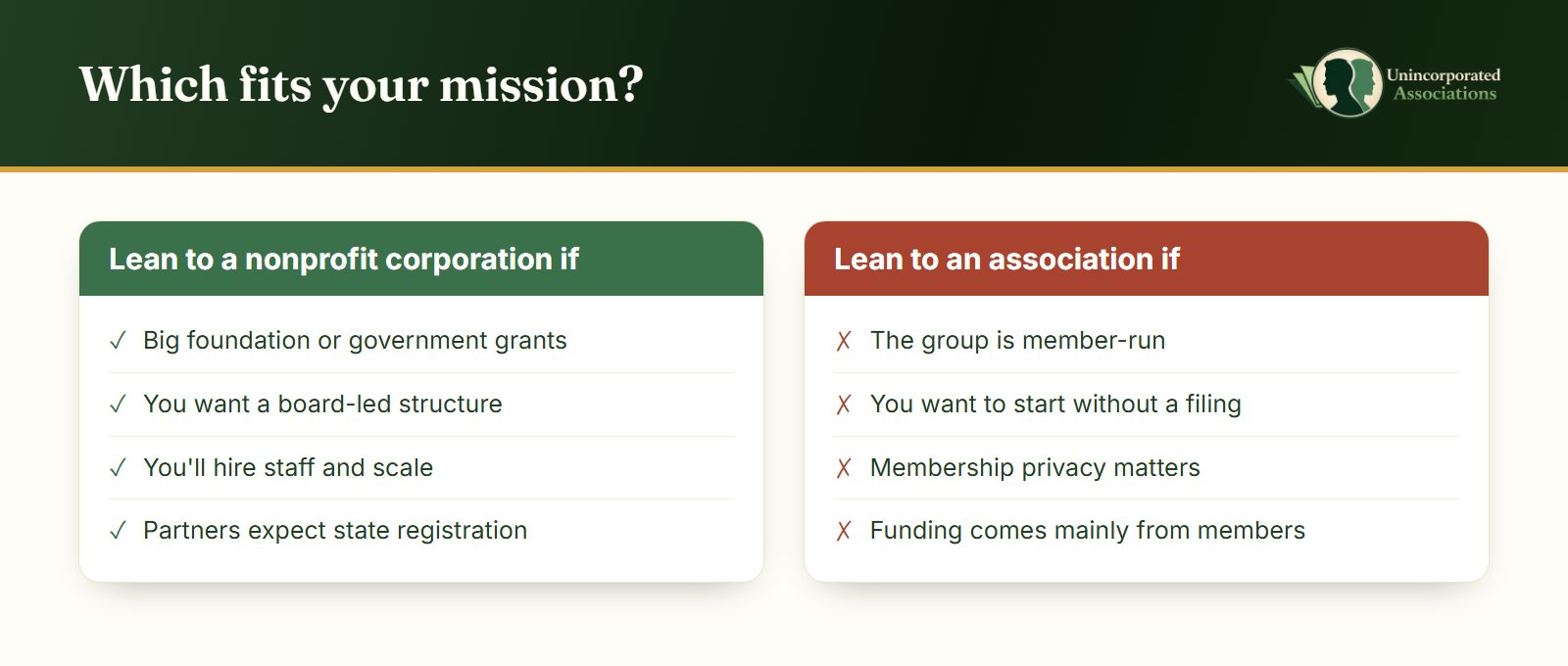
A nonprofit corporation usually fits when:
- Large foundation or government grants are central to your funding.
- You want a board-led structure with statutory roles and duties.
- You expect to hire staff and grow into a larger organization.
- Your partners expect a state-registered nonprofit.
An unincorporated nonprofit association usually fits when:
- The group is member-run and wants to write its own rules.
- You want to start quickly, without a state filing or annual reports.
- Membership privacy matters.
- Funding comes mainly from members and individual donors.
Many groups start as an association and incorporate later if they outgrow it. If your group is members-only by design, see our explainer on the private membership association.
Frequently asked questions
Is an unincorporated association a nonprofit?
It can be. An unincorporated association whose primary purpose is not to run a business for profit is a nonprofit association under laws like California's. Being nonprofit is about purpose and use of money; it does not automatically make the association tax-exempt.
Can an unincorporated nonprofit association get 501(c)(3) status?
Yes. The IRS accepts articles of association as the organizing document, as long as they limit the purposes to exempt purposes and dedicate assets to exempt purposes on dissolution. The association applies just like a corporation.
Which is easier to set up?
An unincorporated association: there is no state filing to form it. A nonprofit corporation needs articles filed with the state, a registered agent and ongoing reports.
Do grant makers fund unincorporated associations?
Some do, especially for smaller grants. Many large foundations and government programs prefer or require incorporated 501(c)(3) organizations, so check each funder's rules.
Can we switch from an association to a nonprofit corporation later?
Yes. You can incorporate and transfer the association's assets and activities to the new corporation under proper resolutions. If the association is tax-exempt, the new corporation may need its own exemption, so plan the transition with an advisor.
Sources
- California Corporations Code section 5110 (Nonprofit Public Benefit Corporation Law)
- California Corporations Code sections 18020 and 18605
- Texas Business Organizations Code chapter 22 and section 252.006
- IRS: Exemption requirements for 501(c)(3) organizations
- IRS: Applying for tax-exempt status
- IRS Publication 557
- California Attorney General: Registry of Charities and Fundraisers
- National Association of State Charity Officials
Deciding between an association and a nonprofit corporation? Book a free 15-minute call with Kirk's team, or join the daily live Q&A.
Have questions? Bring them to the daily call.
Join our live Q&A every weekday and Saturday at 3PM PST, or get a free 15-minute call to see whether a UNA fits your situation.
Have a question about your situation?
Send us a message and we'll get back to you.
Keep reading
 The Well-Meaning Dragon: Straight Answers to the Hardest ObjectionsFor the family and friends who push back because they care — honest answers to the toughest questions about the Federal income tax and Unincorporated Associations.
 It's Not What You Believe, It's What You SignFor the cautious partner in the room: real risk rarely comes from asking questions. It comes from what you signed.
 What Most People Get Wrong About Taxes, Structure, and ControlThe real problem isn't taxes — it's structure, and who actually has control. A look at positioning over loopholes.
Educational, not legal or tax advice. Unincorporated Associations is a document-preparation and education company. Consult a licensed attorney or CPA before acting on any position discussed on this site.