
Private Membership Association vs LLC: Which Should You Use?
By Kirk Carmichael · · 8 min read
Short answer: An LLC is a business entity created by a state filing, with liability protection set by statute in every state and a standard tax treatment. A private membership association (PMA) is an unincorporated association created by members' written agreement, that deals only with its members under private contract. Choose an LLC to run a business that sells to the public. Consider a PMA when the group exists for a shared, members-only purpose. A PMA does not exempt an activity from licensing, health or tax laws, so it is not a substitute for an LLC when you are simply running a business.
People often compare these two because both appear in "how to structure your business" conversations. But they answer different questions. An LLC answers: "How do I own and run a business while limiting my personal liability?" A PMA answers: "How does a group of people organize privately around a shared purpose and deal only with each other?"
This guide compares them side by side, explains when each fits, and covers the common setup where both are used together.
Key takeaways: An LLC is the standard vehicle for a business that serves the public. A PMA is a private, members-only association and fits shared-purpose groups. A PMA does not remove regulation from a business activity, and a for-profit "association" risks partnership treatment. Some groups use an LLC for business operations and a PMA for member community.
What each one is
An LLC is formed by filing articles of organization with a Secretary of State. Every state's LLC statute gives members limited liability, and the IRS treats an LLC as a disregarded entity (one member) or partnership (two or more) by default, unless it elects corporate treatment (IRS: LLC).
A PMA is a type of unincorporated association: two or more people joined by agreement for a common lawful purpose (see California's definition in Corporations Code § 18035), with an emphasis on formal membership and member-only dealing. Nothing is filed with the state to form it. Our explainer on what a private membership association is covers the basics.
Side by side
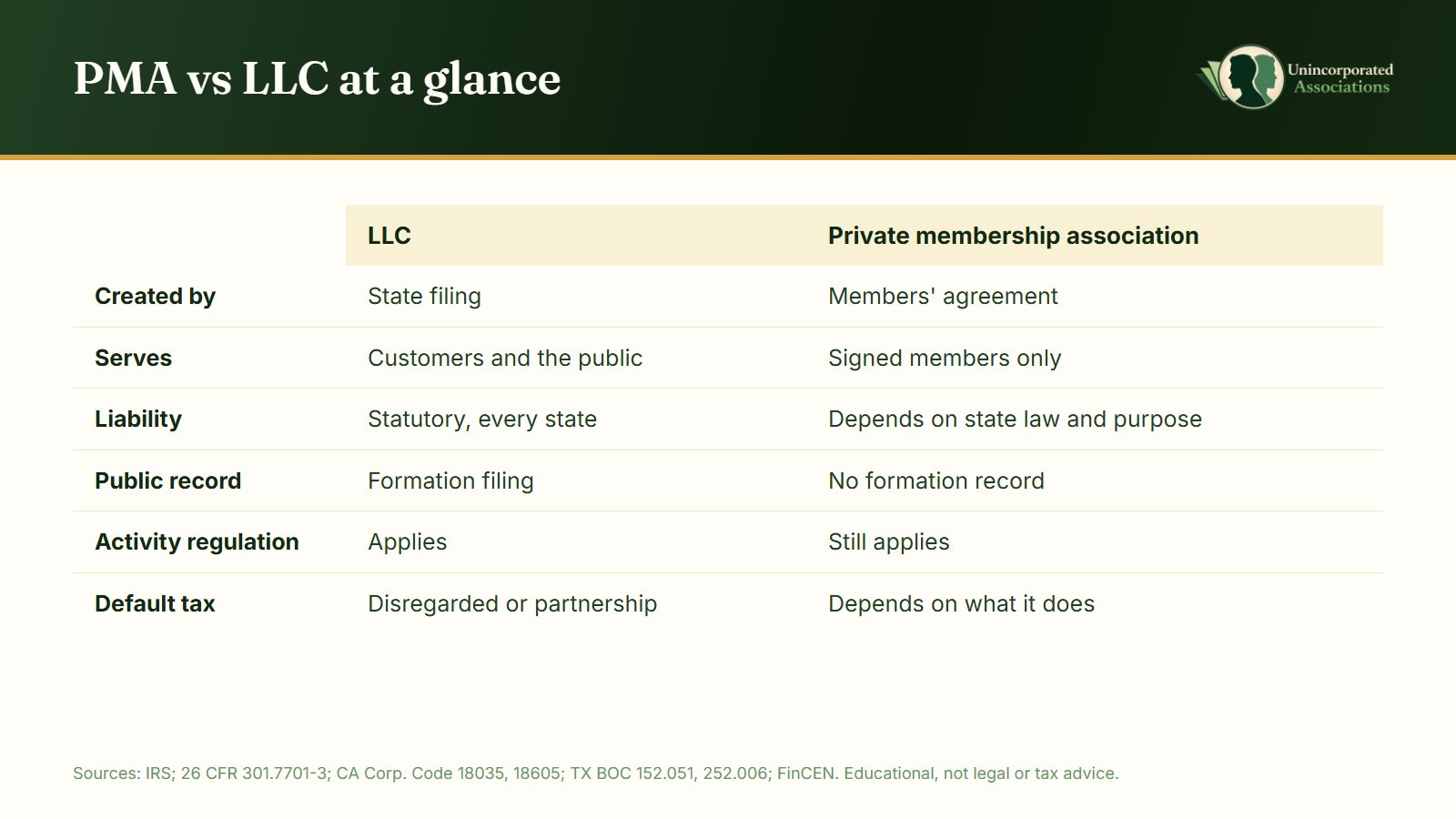
| LLC | Private membership association | |
|---|---|---|
| Created by | Articles of organization filed with the state | Members' written agreement |
| State filing | Required, with fees and usually annual reports | None to form |
| Who it serves | Customers, the public | Members only, under the membership agreement |
| Public record | Name, agent and often managers are public | No state formation record |
| Liability | Statutory shield in every state | Depends on state association law and purpose |
| Default tax | Disregarded or partnership | Depends on what it does |
| Regulation of the activity | Applies | Still applies |
| Banking | Familiar to banks | Possible, with more documents |
| Governance | Operating agreement + state LLC act | Articles, bylaws, membership agreement |
Liability
LLC: the state statute says members are not personally liable for the company's obligations just because they are members. Courts can still pierce the veil for fraud or for mixing personal and company money.
PMA: protection comes from your state's association law. California says a nonprofit association member is not liable for its debts solely by reason of being a member (§ 18605); Texas says much the same for nonprofit associations (§ 252.006). But a PMA run as a business for its founders' profit can be treated as a general partnership. Texas makes that explicit in § 152.051, and general partners are personally liable.
Watch out: Using a PMA instead of an LLC to run an ordinary for-profit business can leave you with less protection, not more. If the business makes money for its owners by selling to the public, an LLC (or corporation) is the structure built for that.
Privacy
An LLC's formation record is public, although some states do not publish member names. Since FinCEN's 2025 rule, U.S. companies no longer file beneficial ownership reports under the Corporate Transparency Act (FinCEN), so that filing no longer separates the two.
A PMA creates no state formation record, and its member list stays with the association. The Supreme Court protected an association's membership list from forced disclosure in NAACP v. Alabama.
Regulation: the biggest misunderstanding
Dealing "privately" with members does not, by itself, put an activity outside licensing and health rules. A Wisconsin appeals court held that a farm store selling raw milk to members of a private association still needed a license (Food Safety News), and a 2023 consent decree in the federal case over Amos Miller's members-only Pennsylvania farm required it to follow state rules (National Agricultural Law Center).
The practical rule: an LLC and a PMA are both subject to the laws that govern the activity itself. Choose based on structure and purpose, not on avoiding regulation.
Taxes
An LLC follows clear defaults under 26 CFR 301.7701-3 and can elect corporate treatment with Form 8832.
A PMA is classified by what it does. A PMA running a business for its members' profit is usually a partnership for tax purposes; a PMA organized and operated for a qualifying nonprofit purpose can apply for exemption. See our guide on whether unincorporated associations file tax returns. There is no tax category that makes a PMA tax-free because of its label.
When to choose each
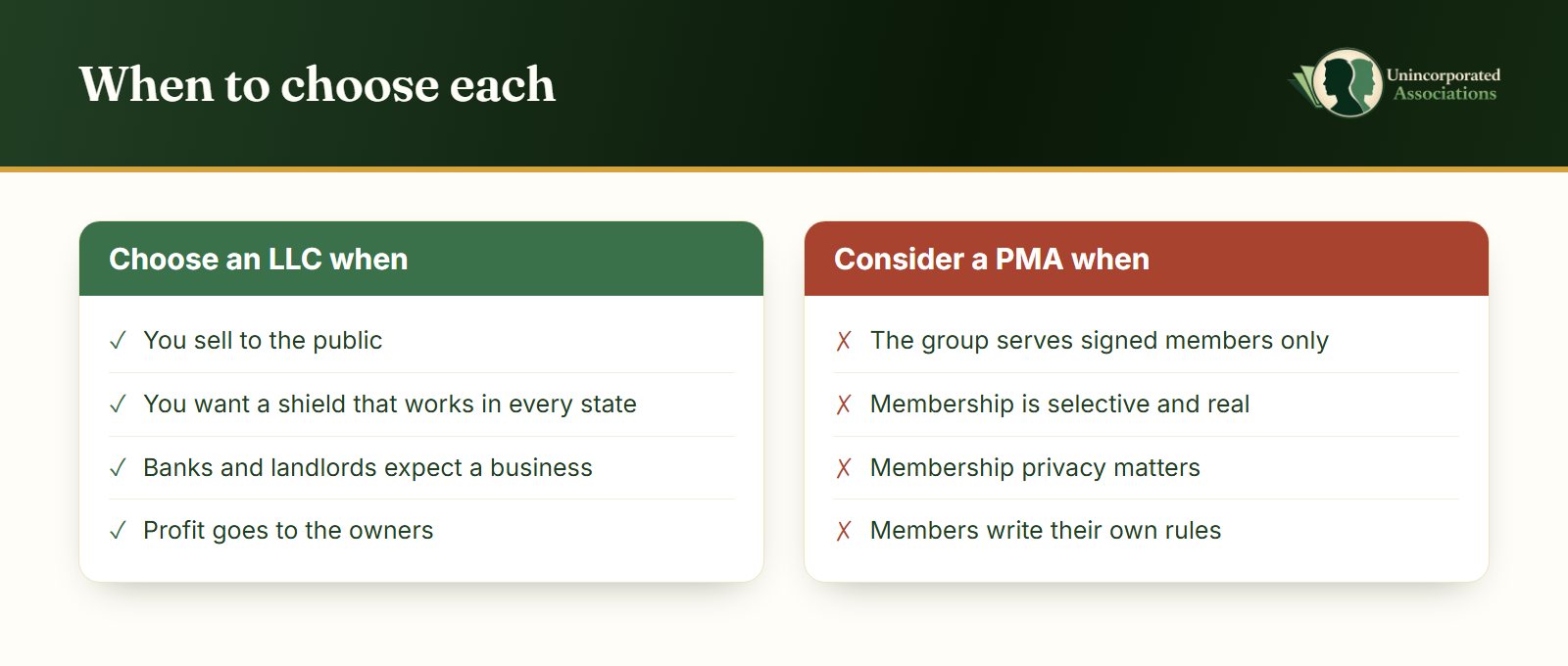
Choose an LLC when:
- You are running a business that sells to the public.
- You want a liability shield that works the same way in every state.
- Banks, landlords, payment processors and licensing boards expect a registered business.
- The business is meant to make profit for its owners.
Consider a PMA when:
- The group exists for a shared purpose among members, not to sell to the public.
- Membership is selective and real: people sign before they receive anything.
- Privacy of membership matters to the group.
- Members want to write their own governance.
Using both together
Some groups use both, each for what it does best:
- An LLC runs the business side: it signs leases, hires staff, holds licenses and sells to customers, with a clean statutory shield.
- A PMA runs the member community: education, events, member support and resources shared among members under the membership agreement.
The two must be kept genuinely separate: separate documents, separate bank accounts and EINs, and clear agreements for anything that passes between them. Mixing them, for example by running the business's public sales through the PMA, undermines both.
Pro tip: If you use both, write down in one page what each entity does and what it never does. That page will guide every decision and help your accountant keep the books clean.
Three scenarios
A yoga studio. It sells classes to anyone who books online, rents a commercial space and employs instructors. LLC. It is a business serving the public, and its landlord, insurer and payment processor will all expect a registered entity.
A homesteading education group. Forty families share skills, tools and seasonal workshops among themselves. People join by application and sign a membership agreement; nothing is sold to outsiders. PMA fits well. The group exists for its members and wants to set its own rules.
A wellness practitioner with a community. The practitioner runs a licensed practice serving the public and also hosts a members-only education community with monthly calls and shared resources. Both, kept separate. The LLC runs the licensed practice; the PMA runs the member community, with its own documents and bank account. The practitioner's license requirements still apply to the practice, whatever the community structure.
A quick decision test
Ask four questions:
- Who receives the goods or services? The public points to an LLC; signed members only points toward a PMA.
- Who gets the profit? Owners point to an LLC; a shared purpose with no profit-sharing fits an association.
- Do you need licenses for the activity? You need them either way; a PMA does not remove that requirement.
- What will your bank and partners expect? Most expect an LLC for commercial activity.
If the answers are "the public," "owners," "yes" and "a registered business," you need an LLC. Our guides to alternatives to an LLC and how to start a private membership association cover the next steps for each path.
Common mistakes
- Choosing a PMA to avoid licenses. Courts look at the activity, not the label.
- Letting the public in without signed agreements. That ends the "members-only" character.
- Splitting profits among founders through a PMA. That looks like a general partnership.
- Mixing LLC and PMA money. Separate accounts, separate books.
- Copying PMA templates that promise legal immunity. No document can deliver that.
- Forgetting the paperwork after formation. Both structures need ongoing records: minutes, member registers or operating agreements, and books that show where every dollar went.
Frequently asked questions
Is a PMA better than an LLC?
Not in general. An LLC is better for running a business that serves the public, with a statutory liability shield in every state. A PMA fits a members-only group with a shared purpose. They solve different problems.
Can a PMA replace an LLC for my business?
Usually not. If your business sells to the public for profit, a PMA does not give you an LLC's statutory protection, does not remove licensing requirements, and risks partnership treatment.
Can I have both an LLC and a PMA?
Yes. Some groups use an LLC for business operations and a PMA for member community and education. Keep them separate with their own documents, EINs and bank accounts.
Does a PMA protect members from liability like an LLC?
It depends on state law. Nonprofit association members in states like California and Texas are protected by statute; elsewhere, older rules may apply. A for-profit PMA can be treated as a partnership.
Does a PMA pay taxes?
Tax treatment depends on what it does. A PMA running a business for members' profit is usually a partnership for tax purposes; a qualifying nonprofit PMA can apply for exemption.
Sources
- IRS: Limited liability company (LLC)
- IRS: Form 8832
- 26 CFR 301.7701-3
- California Corporations Code sections 18035 and 18605
- Texas Business Organizations Code sections 152.051 and 252.006
- FinCEN: Beneficial ownership information
- NAACP v. Alabama, 357 U.S. 449 (1958)
- Food Safety News: Wisconsin raw milk licensing ruling
- National Agricultural Law Center: Amos Miller and the regulation of raw milk
Deciding between a PMA and an LLC? Book a free 15-minute call with Kirk's team, or join the daily live Q&A.
Have questions? Bring them to the daily call.
Join our live Q&A every weekday and Saturday at 3PM PST, or get a free 15-minute call to see whether a UNA fits your situation.
Have a question about your situation?
Send us a message and we'll get back to you.
Keep reading
 The Well-Meaning Dragon: Straight Answers to the Hardest ObjectionsFor the family and friends who push back because they care — honest answers to the toughest questions about the Federal income tax and Unincorporated Associations.
 It's Not What You Believe, It's What You SignFor the cautious partner in the room: real risk rarely comes from asking questions. It comes from what you signed.
 What Most People Get Wrong About Taxes, Structure, and ControlThe real problem isn't taxes — it's structure, and who actually has control. A look at positioning over loopholes.
Educational, not legal or tax advice. Unincorporated Associations is a document-preparation and education company. Consult a licensed attorney or CPA before acting on any position discussed on this site.