
7 Alternatives to an LLC for Small Business Owners (and Who Each Fits)
By Kirk Carmichael · · 8 min read
Short answer: The main alternatives to an LLC are a sole proprietorship, a general partnership, a limited liability partnership (LLP), a limited partnership (LP), an S corporation, a C corporation, a cooperative, and, for member-driven groups, an unincorporated association. Each trades something: the simplest options (sole proprietorship, general partnership) offer no liability shield; corporations offer a strong shield with more formality; an unincorporated association offers privacy and member-written rules but fits a shared purpose, not a business owned for profit.
"Just form an LLC" is the most common small-business advice in America, and for many owners it is good advice. But an LLC costs money to form and maintain, puts your business on the public record, and is not designed for every situation. Knowing the alternatives helps you choose deliberately instead of by default.
This guide covers seven alternatives, what each is good and bad at, and who each one fits.
Key takeaways: No structure is best for everyone. If personal liability is your main worry, a corporation or LLP may be the closest substitute for an LLC. If you want the simplest start, a sole proprietorship works but offers no shield. If your group exists for a shared purpose rather than owner profit, an unincorporated association is worth a look. Get tax advice before you choose.
Why look beyond an LLC?
LLCs are popular for good reasons: limited liability, flexible management and pass-through taxation by default, as the IRS explains. But owners look elsewhere when:
- state formation fees and annual fees add up (some states charge hundreds of dollars a year)
- they do not want their name on a public business registry
- investors want shares in a corporation
- the "business" is really a member-driven group with a shared purpose
- a professional license requires a particular form, such as an LLP or professional corporation
1. Sole proprietorship
The default for one person doing business without forming anything. You and the business are legally the same, and profit goes on your personal return, as the IRS describes for sole proprietorships.
- Good at: zero formation cost, simplest taxes, total control.
- Bad at: no liability shield; your personal assets are exposed to business debts and lawsuits.
- Fits: low-risk solo work, testing an idea, side income.
2. General partnership
Two or more people running a business together for profit form a general partnership automatically, often without realizing it. Texas law, for example, says an association of two or more persons carrying on a business for profit as owners creates a partnership whether or not they intend to (Bus. Orgs. Code § 152.051). The partnership files an information return and partners report their shares, as the IRS explains for partnerships.
- Good at: simple to start, pass-through taxes, flexible.
- Bad at: every partner can be personally liable for the partnership's debts, including debts another partner created.
- Fits: rarely the best deliberate choice; usually it is what happens when no other structure is chosen.
3. Limited liability partnership (LLP)
An LLP is a partnership registered with the state that shields partners from liability for other partners' mistakes. Many states limit LLPs to licensed professions such as law and accounting. Our comparison of LLP vs LLC goes deeper.
- Good at: partnership flexibility with a liability shield; often required for professional firms.
- Bad at: may be unavailable outside professions; state filing and fees.
- Fits: law, accounting and other licensed partnerships.
4. Limited partnership (LP)
An LP has at least one general partner who runs the business and is fully liable, and limited partners who invest but do not manage, with liability limited to their investment, as Cornell's limited partnership entry explains.
- Good at: bringing in passive investors; common in real estate and investment funds.
- Bad at: the general partner carries full liability (often solved by making an LLC or corporation the general partner).
- Fits: investment vehicles with a clear manager and passive investors.
5. S corporation
An S corporation is a regular corporation that elects pass-through taxation by filing Form 2553. Shareholder-employees can split income between salary and distributions, which can reduce self-employment tax, within IRS limits on reasonable compensation (IRS: S corporations).
- Good at: strong liability shield plus pass-through taxes.
- Bad at: limits on who can be a shareholder and how many; payroll and corporate formalities.
- Fits: profitable small businesses whose owners work in the business.
6. C corporation
The standard corporation, taxed at the entity level under 26 U.S.C. § 11, with shareholders taxed again on dividends.
- Good at: raising outside investment, issuing stock, retaining earnings for growth.
- Bad at: double taxation, formalities, annual reports.
- Fits: businesses seeking venture capital or planning to scale and sell.
7. Unincorporated association
An unincorporated association is two or more people joined by agreement for a common lawful purpose, with no state filing to form it. In states like California and Texas, nonprofit associations can own property, sue in their own name and protect members from liability for the association's debts just for being members (Cal. Corp. Code § 18605; Tex. Bus. Orgs. Code § 252.006).
- Good at: no formation filing, no public formation record, member-written governance, privacy.
- Bad at: liability protection depends on state law and on a genuine shared purpose; less familiar to banks and lenders.
- Fits: member-run groups with a shared purpose: communities, clubs, faith groups, mutual-support and education groups.
Watch out: An "association" that is really a business run for its owners' profit can be treated as a general partnership, with personal liability for every owner. An association is an alternative to an LLC for shared-purpose groups, not a way to run an ordinary for-profit business without a shield. We explain this "partnership trap" in our unincorporated association vs LLC guide.
Bonus: the cooperative
A cooperative is owned and controlled by the people who use it: its customers, workers or producers. Most co-ops are formed under a state cooperative statute or as a corporation with cooperative bylaws, and federal tax law has special rules that let co-ops pass earnings back to members as patronage dividends.
- Good at: shared ownership and democratic control (often one member, one vote).
- Bad at: more complex to set up and govern; specialized tax rules.
- Fits: farmer co-ops, worker-owned businesses, buying cooperatives and credit unions.
Can you switch structures later?
Usually, yes, but it is rarely free. Moving from a sole proprietorship to an LLC or corporation is common and fairly simple. Moving assets out of a corporation, or out of an exempt organization, can trigger taxes or require regulator approval. An association can later incorporate, and a corporation can be dissolved and its activity continued in another form, but each step needs proper documents and tax planning.
The practical lesson: choose based on where you expect to be in two to three years, not just where you are today, and get advice before moving anything of value from one entity to another.
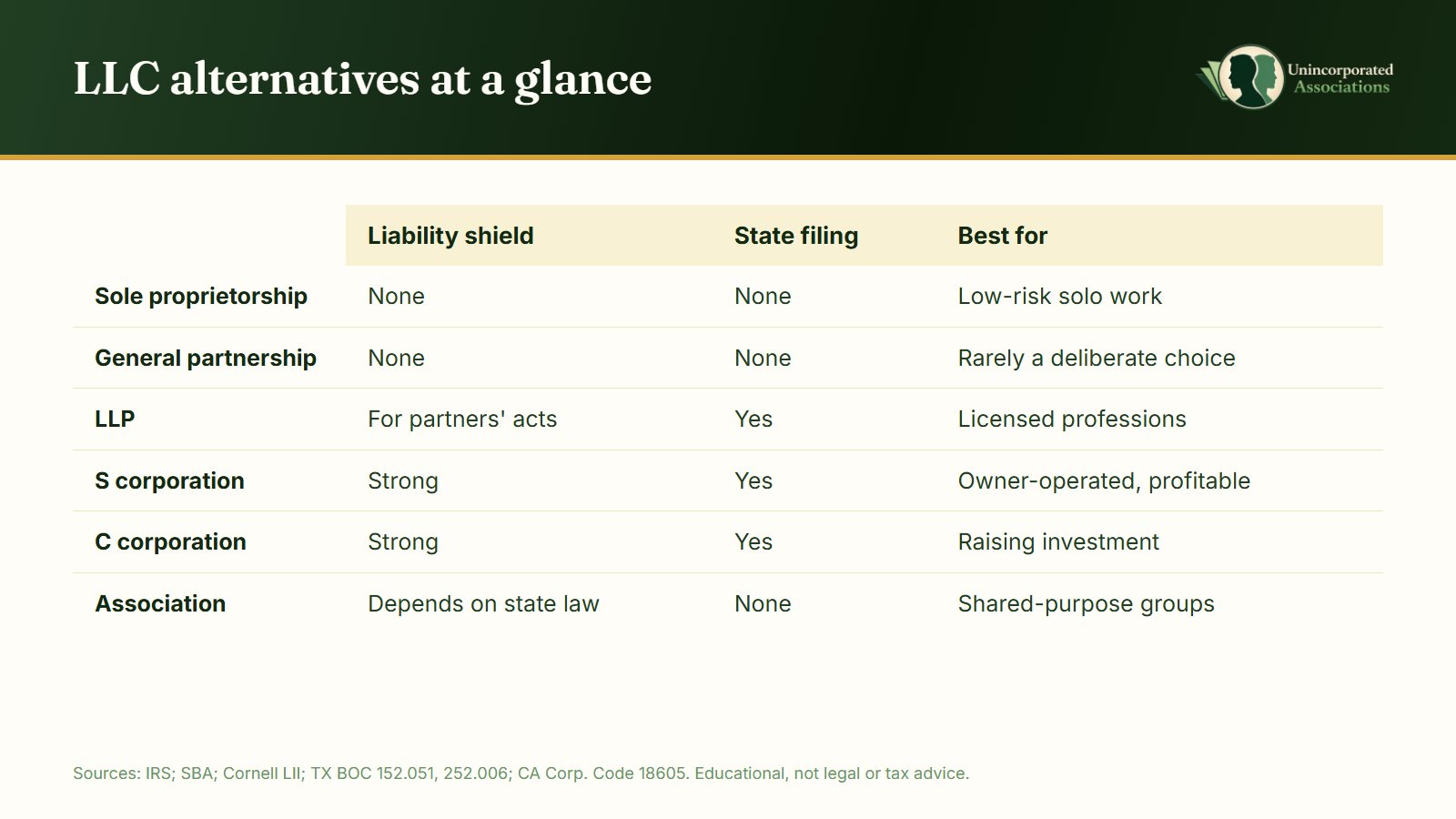
Side-by-side summary
| Structure | Liability shield | State filing | Default tax | Public record |
|---|---|---|---|---|
| Sole proprietorship | None | None (maybe a DBA) | Owner's return | Minimal |
| General partnership | None | None | Pass-through | Minimal |
| LLP | For other partners' acts | Yes | Pass-through | Yes |
| LP | Limited partners only | Yes | Pass-through | Yes |
| S corporation | Strong | Yes | Pass-through (elected) | Yes |
| C corporation | Strong | Yes | Entity-level | Yes |
| Cooperative | Usually strong (often a corporation) | Yes | Special co-op rules | Yes |
| Unincorporated association | Depends on state law and purpose | None | Depends on activity | No formation record |
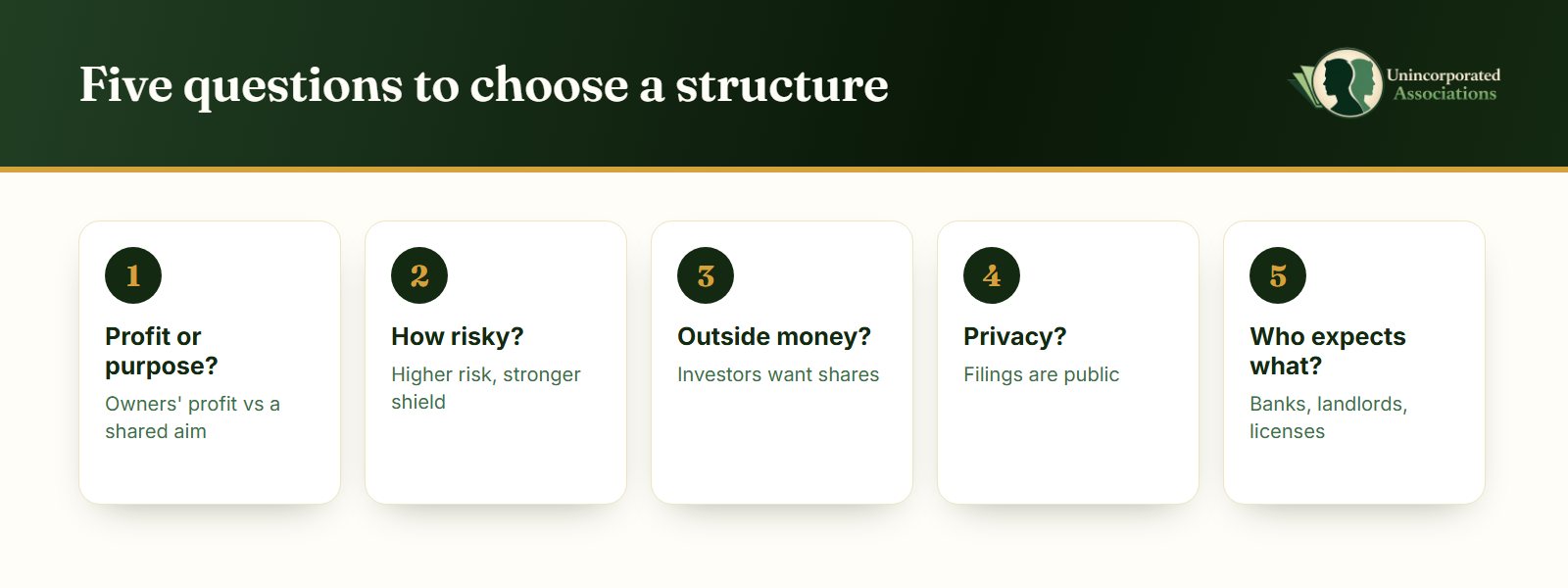
How to choose: five questions
- Is the main goal owner profit, or a shared purpose? Owner profit points to an LLC, corporation or partnership; a shared purpose may suit an association or nonprofit.
- How much personal risk does the activity carry? Higher risk means a strong statutory shield matters more.
- Will you raise outside money? Investors usually want a corporation.
- How much does privacy matter? Every state-registered entity creates a public record.
- What will banks, landlords and licensing boards expect? Some require a specific form.
What about privacy without an LLC?
Owners who want privacy sometimes use an LLC formed in a state that does not publish member names. Others separate holding and operating roles; our guide to holding vs operating companies explains that approach, and our comparison of trust vs LLC covers trusts. For groups organized around members rather than owners, an association avoids a state formation record altogether; see our explainer on the private membership association.
Pro tip: Whatever structure you choose, three habits do most of the protective work: a separate bank account, contracts signed in the entity's name with your title, and written records of major decisions. Skipping them weakens any shield.
Frequently asked questions
What is the cheapest alternative to an LLC?
A sole proprietorship (for one person) or a general partnership (for two or more) costs nothing to form, but neither offers any liability protection. An unincorporated association also has no formation filing, but it fits shared-purpose groups rather than businesses run for owner profit.
Which LLC alternative gives the best liability protection?
Corporations (S or C) offer the most established statutory shield. LLPs protect partners from other partners' acts. An unincorporated nonprofit association's protection depends on state law, and is strong in states like California and Texas.
Can I run a business without an LLC?
Yes. Many businesses operate as sole proprietorships or partnerships, and some choose corporations or other forms. The trade-off is usually liability protection, taxes and formalities. We cover the practical steps in a separate guide on running a business without an LLC.
Is an unincorporated association a good substitute for an LLC?
For a member-run group with a shared purpose, it can be a better fit than an LLC. For a conventional business owned for profit, it is not a substitute: it risks being treated as a general partnership.
Should I get advice before choosing?
Yes. A CPA can model the tax effect of each option, and an attorney can confirm liability rules in your state. Kirk's team can explain how associations work on a free call.
Sources
- IRS: Limited liability company (LLC)
- IRS: Sole proprietorships
- IRS: Partnerships
- IRS: S corporations and Form 2553
- 26 U.S.C. § 11
- Cornell LII: Limited partnership
- Texas Business Organizations Code sections 152.051 and 252.006
- California Corporations Code section 18605
- SBA: Choose a business structure
Wondering which structure fits your situation? Book a free 15-minute call with Kirk's team, or join the daily live Q&A.
Have questions? Bring them to the daily call.
Join our live Q&A every weekday and Saturday at 3PM PST, or get a free 15-minute call to see whether a UNA fits your situation.
Have a question about your situation?
Send us a message and we'll get back to you.
Keep reading
 The Well-Meaning Dragon: Straight Answers to the Hardest ObjectionsFor the family and friends who push back because they care — honest answers to the toughest questions about the Federal income tax and Unincorporated Associations.
 It's Not What You Believe, It's What You SignFor the cautious partner in the room: real risk rarely comes from asking questions. It comes from what you signed.
 What Most People Get Wrong About Taxes, Structure, and ControlThe real problem isn't taxes — it's structure, and who actually has control. A look at positioning over loopholes.
Educational, not legal or tax advice. Unincorporated Associations is a document-preparation and education company. Consult a licensed attorney or CPA before acting on any position discussed on this site.