
$7M Saved: When a UNA Outperforms a Holding vs Operating Company (U.S.)
· 15 min read
A properly structured Unincorporated Nonprofit Association (UNA) can function as a private holding entity in states that recognize it as a separate legal structure, letting members control assets outside the operating company model most people default to. But this only works cleanly where your state has adopted the Uniform Unincorporated Nonprofit Association Act, and even then, banks and lenders sometimes hesitate before treating a UNA like they would a corporation.
TL;DR:
- A UNA can own property and hold assets in its own name only if your state has adopted the Uniform Unincorporated Nonprofit Association Act, and proper procedures like bylaws and an EIN are in place.
- The legal protection and recognition of a UNA vary by state; some states fully adopt the law, while others modify or do not recognize it, affecting liability shielding and asset control.
- UNAs work best for small groups seeking private asset control without public filings or significant third-party financing, but are less suitable for large-scale fundraising or when strong liability protection is required.
- Banks and lenders often hesitate to work with UNAs due to unfamiliarity and lack of public registry, which can cause delays or refusals when transferring major assets or seeking financing.
- Traditional holding companies are designed for passive asset ownership, generate income through dividends or royalties, and provide robust liability and tax shields, unlike UNAs which are primarily member-governed private asset pools.
Table of Contents
- What Is a UNA, and How Does It Hold Assets?
- Operating Company vs Holding Company: What Actually Separates Them
- Weighing the Real Benefits and Limits of a UNA
- Does My State Recognize a UNA as a Separate Entity?
- When a UNA Makes Sense as Your Holding Vehicle (and When It Doesn’t)
- Definition and Core Characteristics of a Holding Company
- Comparing Legal Structures for Holding vs Operating Purposes
- Tax and Liability Stakes for Traditional Holding vs Operating Companies
- Common Business Purposes and Use Cases for Holding Companies
- Why We Recommend UNAs for Certain Holding Needs
- Ready to Form Your Own UNA?
- Sources
- FAQ
What Is a UNA, and How Does It Hold Assets?
An Unincorporated Nonprofit Association is a group of people who join together for a common, nonprofit purpose without forming a corporation or LLC. No shareholders. No board elected under state corporate statutes.
Here’s the part that matters for holding assets: under the Uniform Unincorporated Nonprofit Association Act, an unincorporated nonprofit association can own property, hold interests in real estate, and sue or be sued in its own name, where a state has adopted the Act. That’s a meaningful shift from the old common law “aggregate theory,” which treated an association as nothing more than a loose bundle of individuals with no separate legal identity.
For a UNA to actually function as a holding entity, a few pieces need to be in place:
- Adopt bylaws or a governing document that spells out membership, purpose, and how decisions get made.
- Obtain an EIN from the IRS so the association can open accounts and be identified for tax purposes.
- Open a bank account in the association’s name, not a member’s personal name.
- Record any asset transfers (property deeds, investment accounts, business interests) into the association’s name with proper documentation.
Skip any of these steps and you’re left with a group of people holding assets personally, which defeats the entire point.
Operating Company vs Holding Company: What Actually Separates Them
A holding structure and an operating company aren’t doing the same job, even when people use the terms loosely. A holding entity exists to own things: property, investment accounts, membership interests, intellectual property. An operating company exists to do things: sell products, deliver services, generate revenue through daily activity.
That distinction ripples through everything else:
- Purpose. A UNA used as a holding vehicle sits passively above assets. An operating company (LLC, corporation, partnership) actively transacts, hires, and generates income.
- Contracting and banking. Where UUNAA applies, a UNA can sign contracts and hold bank accounts in its own name. Operating companies do this as a matter of course, but usually under heavier state oversight.
- Tax treatment. A UNA is not automatically tax-exempt. The Texas Secretary of State’s nonprofit FAQ notes that associations don’t file formation paperwork with the state, and tax-exempt recognition depends on separate IRS filings once revenue crosses certain thresholds. Operating companies, by contrast, are taxed on net income by design, whether as pass-through entities or at the corporate level.
- Administrative disclosure. Operating companies typically file annual reports, pay franchise fees, and appear in public state registries. UNAs, in most states, skip that formation filing entirely, which is part of their appeal for people who want asset control without a public paper trail.
The tax angle deserves its own look if you’re weighing how a private structure can reduce your overall tax exposure.
Weighing the Real Benefits and Limits of a UNA
Every structure trades something for something else. A UNA is no exception, and pretending otherwise does readers a disservice.
The upside:
- No public formation filing in most states, which keeps ownership details out of routine public registries.
- Lower administrative costs since there’s typically no annual report fee or franchise tax tied to a UNA.
- Member-based governance, meaning the people who created the association keep control without answering to outside shareholders.
- Potential tax efficiencies when the association’s activities and purpose align with nonprofit treatment, though this requires proper IRS filings, not assumption.
The downside:
- Statutory protection varies by state. Some states have adopted UUNAA in full, some have modified versions, and a handful haven’t adopted it at all, which changes how much liability shielding members actually get.
- Without a clear enabling statute, members can end up personally liable for association debts or obligations, the exact risk a holding structure is supposed to avoid.
- Banks, lenders, and grantors move slower with UNAs than with corporations or LLCs, since the entity type is less familiar to their compliance teams.
Pro Tip: Before transferring a major asset into a UNA, call the bank or lender that will need to recognize the entity and ask directly whether they’ve processed a UNA account before. A five-minute phone call can save months of friction later.
A UNA tends to succeed when the goal is quiet, long-term asset control among a small group. It tends to struggle when the reader needs fast third-party validation, like a mortgage lender or an institutional grantor.
Does My State Recognize a UNA as a Separate Entity?
This is the question that determines almost everything else, and too many people skip it. The Uniform Law Commission drafted UUNAA specifically to modernize this area of law, clarifying separate-entity status and adding winding-up and merger provisions that mirror corporate statutes, including protections for property held for charitable purposes.
Before you rely on a UNA to hold anything of value, run through this checklist:
- Search your state’s statutes or your Secretary of State’s website for language on unincorporated nonprofit associations specifically.
- Confirm the statute grants property-holding and contracting authority in the association’s own name, not just recognition that the group exists.
- Verify what liability protection, if any, extends to members under your state’s version of the law.
- Test banking acceptance directly. Ask a local bank whether they’ve opened accounts for UNAs before you assume it’s routine.
- Cross-check guidance from the Uniform Law Commission and your state’s official Secretary of State FAQ pages rather than relying on secondhand summaries.
Skipping this step is the single most common reason people end up disappointed with a UNA years after forming one.
When a UNA Makes Sense as Your Holding Vehicle (and When It Doesn’t)
Not every situation calls for a UNA, and pretending it’s a universal fix would be dishonest. Here’s how to sort it out quickly.
Signals that favor a UNA:
- You want private control over assets without a public corporate filing trail.
- Your group is small and willing to govern collectively through bylaws.
- You don’t need major third-party financing tied to the entity in the near term.
Signals that favor incorporation or another vehicle instead:
- A lender or institutional grantor requires a corporation or LLC as a condition of funding.
- You need liability protection strong enough to survive aggressive creditor claims, and your state’s UUNAA adoption is thin or absent.
- You’re planning large-scale fundraising or ongoing revenue operations, not passive holding.
Pro Tip: Test the waters before you commit fully. Open a bank account, run one small transaction through it, and confirm your bylaws hold up before transferring your most valuable assets.
Next steps typically include consulting an attorney familiar with your state’s statute, formalizing bylaws properly, and reviewing how to structure the association from the ground up before moving significant property into it.
Definition and Core Characteristics of a Holding Company
Outside the UNA context, a traditional holding company is an entity, usually a corporation or LLC, created to own controlling interests in other businesses or assets rather than to run day-to-day operations itself. It doesn’t sell products or manage employees performing the core business function. It owns the stock, membership interests, real estate, or intellectual property that sits beneath one or more operating businesses.
The core characteristics are consistent across structures. A holding company generates income passively, through dividends, rental income, royalties, or interest, rather than through direct sales. It typically has minimal staff, since operating decisions happen at the subsidiary level. It exists partly to isolate risk: if one operating subsidiary gets sued or goes bankrupt, the holding company’s other assets are generally shielded, provided corporate formalities were properly maintained.
Ownership concentration is another defining trait. A single holding company might sit atop several operating subsidiaries, consolidating control for a family, a group of investors, or a single founder without merging their legal liabilities. This layered approach is why families with multiple properties or business interests often gravitate toward some form of holding structure, corporate or otherwise, rather than owning everything directly in their own names.
Comparing Legal Structures for Holding vs Operating Purposes
Choosing a structure means matching legal form to function, and the options differ sharply depending on which side of the ledger you’re building.
| Factor | Holding structure | Operating structure |
|---|---|---|
| Purpose | Owns assets, investments, or subsidiary interests | Runs daily business activities and generates revenue |
| Contracting/property authority | Varies by entity type; UNAs need UUNAA adoption, corporations and LLCs have it by default | Full contracting authority under standard corporate or LLC statutes |
| Liability exposure for owners | Generally shielded if formalities are maintained; UNA protection depends on state law | Shielded for corporations/LLCs; sole proprietors and general partners remain exposed |
| Tax status and reporting | Can range from pass-through to nonprofit treatment; UNAs require separate IRS steps for exemption | Taxed on operating income, either at the entity or owner level depending on structure |
| Administrative burden | Often lighter; UNAs may skip formation filings entirely in many states | Heavier; annual reports, franchise fees, and public filings are standard |
LLCs and corporations remain the default choice for a straightforward operating company because the liability shield is well established and courts have decades of precedent to draw from. A UNA occupies a narrower lane: private asset holding where the owner values reduced disclosure and lower ongoing cost over maximum institutional familiarity.
Tax and Liability Stakes for Traditional Holding vs Operating Companies
A traditional corporate holding company doesn’t automatically escape taxation just because it doesn’t sell products directly. Dividend income, capital gains, and rental income flowing up to the holding company are still taxable events, though the structure can sometimes defer or reduce taxation compared to holding assets personally, depending on how the entity is set up and which state and federal rules apply.
Liability works in layers. If an operating subsidiary is sued, a properly maintained holding company structure usually keeps that liability contained to the subsidiary, protecting the parent’s other assets. That containment isn’t automatic. Courts can “pierce the corporate veil” when formalities are ignored, commingled funds go unchecked, or the holding company is treated as a mere shell rather than a genuine separate entity.
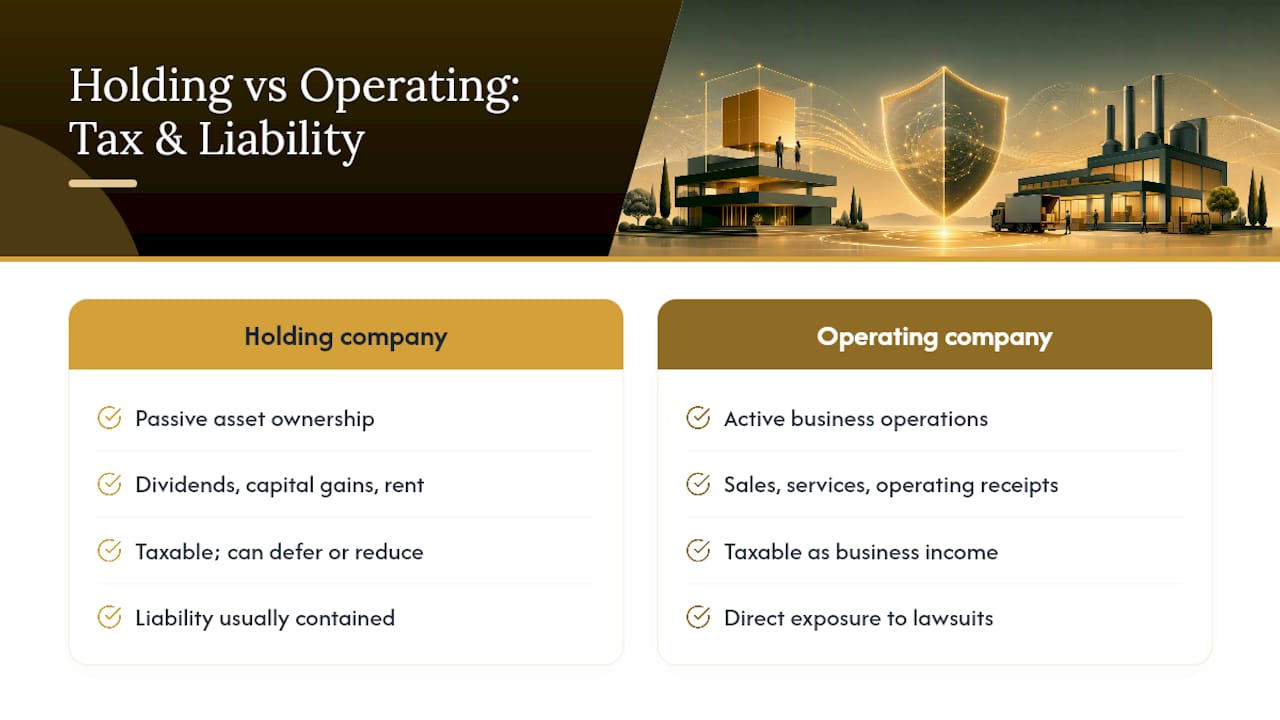
Operating companies carry the opposite risk profile. They’re exposed to lawsuits arising directly from daily activity, whether that’s a customer injury, a contract dispute, or an employment claim. That’s precisely why so many business owners split functions: keep valuable assets (real estate, equipment, intellectual property) in a holding entity, and run the riskier day-to-day activity through a separate operating entity that can absorb a lawsuit without dragging down everything else. This layering principle is the same logic that makes a UNA appealing for readers who want their personal assets separated from operational or business risk, just without the corporate registry footprint.
Common Business Purposes and Use Cases for Holding Companies
Holding companies show up most often in three scenarios. Family wealth consolidation is the first: multiple properties, investment accounts, or business interests get pulled under one ownership umbrella so a family can manage succession and estate planning without untangling a dozen separate ownership records.
The second is business risk isolation. A company with several revenue lines, say a restaurant group with five locations, might place the real estate for each location into a holding entity while each restaurant operates as its own separate entity underneath. If one location faces a lawsuit or lease default, the underlying property stays protected.
The third is intellectual property and licensing. Companies often place trademarks, patents, or software IP into a holding entity, then license usage rights to the operating business. This keeps valuable IP insulated if the operating side ever faces financial trouble.
For operating companies, the use cases run in the opposite direction: hiring staff, fulfilling contracts, managing payroll, and handling the logistics of actually delivering a product or service day to day. Understanding how an operating business handles compliance responsibilities, whether that’s employment law or day-to-day regulatory filings, makes clear why so many owners prefer to keep that risk walled off from the assets they’ve spent years building.

Why We Recommend UNAs for Certain Holding Needs
Members working with Unincorporated Associations have reportedly saved more than $7 million collectively by moving assets into properly structured UNAs instead of conventional entities, backed by a 4.9 star Trustpilot rating across over 330 reviews. That track record shapes our view: a UNA fits best for people who want private, member-governed control over assets, not for those chasing institutional financing. Always verify your state’s statute and talk to an attorney before transferring anything significant.
— Kirk Carmichael
Ready to Form Your Own UNA?
If everything above has you thinking a UNA fits your situation better than another round of LLC paperwork, the practical question becomes execution. That’s where an attorney-backed formation package removes the guesswork most people run into when trying to draft bylaws or transfer assets on their own.

The formation package is built around key elements for private holding: governing documents, EIN registration assistance, Revocation of Election preparation for tax positioning, customizable association naming, and ongoing support for questions that arise. It’s built for people who want asset control without their ownership details sitting in a public corporate registry, and without an annual filing fee chasing them every year.
If you’re ready to see whether a UNA fits your specific assets, start with the attorney-backed formation service or book a one-on-one consultation to walk through your state’s requirements before you transfer anything.
FAQ
Can a UNA legally own real estate?
Where a state has adopted UUNAA, a UNA can generally own and convey property in its own name, according to the Uniform Law Commission’s text of the Act. States without that adoption may treat property held by a UNA differently, so confirming your state’s statute first matters.
Is a UNA automatically tax-exempt?
No. State guidance, including the Texas Secretary of State’s nonprofit FAQ, makes clear that tax-exempt status requires separate IRS recognition and filings, not just formation as an association.
How is a UNA different from an operating company like an LLC?
A UNA typically holds passive assets and is governed by members under bylaws, while an operating company like an LLC actively runs a business, generates revenue, and carries different tax and filing obligations.
Does every state recognize UNAs the same way?
No. Recognition and the protections available depend on whether a state has adopted UUNAA or a similar statute, which is why checking your specific state’s law before relying on a UNA is essential.
Who benefits most from forming a UNA through Unincorporated Associations?
Individuals, families, and small business owners who want private, member-governed control over assets without a public corporate filing trail tend to benefit most, particularly those prioritizing privacy and lower ongoing costs over rapid institutional financing.
Recommended
- Order Your UNA + ROE Package — $4,950
- Order Your UNA + ROE Package — $4,950
- Order Your UNA + ROE Package — $4,950
- Order Your UNA + ROE Package — $4,950
This article is provided for general informational and educational purposes only and does not constitute legal, tax, accounting, or financial advice. Reading this content or contacting UnincorporatedAssociations.com does not create an attorney-client, CPA-client, or other professional-client relationship. In accordance with IRS Circular 230, any discussion of federal tax matters herein is not intended or written to be used, and cannot be used, for the purpose of avoiding penalties.
Have questions? Bring them to the daily call.
Join our live Q&A every weekday and Saturday at 3PM PST, or get a free 15-minute call to see whether a UNA fits your situation.
Have a question about your situation?
Send us a message and we'll get back to you.
Keep reading
 The Well-Meaning Dragon: Straight Answers to the Hardest ObjectionsFor the family and friends who push back because they care — honest answers to the toughest questions about the Federal income tax and Unincorporated Associations.
 It's Not What You Believe, It's What You SignFor the cautious partner in the room: real risk rarely comes from asking questions. It comes from what you signed.
 What Most People Get Wrong About Taxes, Structure, and ControlThe real problem isn't taxes — it's structure, and who actually has control. A look at positioning over loopholes.
Educational, not legal or tax advice. Unincorporated Associations is a document-preparation and education company. Consult a licensed attorney or CPA before acting on any position discussed on this site.