
Unincorporated Association vs LLC: Which Structure Actually Fits You?
By Kirk Carmichael · · 12 min read
Short answer: An LLC is created by filing with a state, and the state's LLC statute gives every member liability protection, a default tax status and annual paperwork. An unincorporated association is created by members signing a private agreement; nothing is filed to form it, and how it is treated for liability and tax depends on what it does and which state's law applies. Choose an LLC if you want a standard, state-registered business; consider an association if you want a private, member-governed body built around a shared purpose.
People usually land on this question for one of two reasons. Either they already run an LLC and wonder whether an association would give them more privacy and control, or they are starting something new and want to know whether they need to file with the state at all. Both are fair questions, and the honest answer is that these are two very different tools. One is a product of state law. The other is a product of agreement between people.
This guide compares them point by point, shows where each one is strong and where it is weak, and ends with the questions to settle before you choose.
Key takeaways: An LLC trades privacy for predictable, statute-based liability rules in every state. An association trades a state filing for member-written rules, and its protection depends on your state and on a genuine member-serving purpose. A for-profit business run by co-owners can be treated as a general partnership, whatever you call it.
What is an LLC?
A limited liability company is a business entity that exists because a state statute says it can. You create one by filing articles of organization (some states call them a certificate of formation) with the Secretary of State, paying a filing fee, and naming a registered agent. From that moment the LLC appears in a public database with its name, its agent and, in many states, its organizers or managers.
The state's LLC act then supplies most of the rules. It says members are generally not personally liable for the company's debts. It fills in default rules for voting, profit sharing and dissolution unless your operating agreement says otherwise. And it usually requires an annual or biennial report and fee to stay in good standing.
For federal tax purposes, the IRS does not treat an LLC as its own tax category. According to the IRS guidance on LLCs, a single-member LLC is disregarded and reported on the owner's return by default, a multi-member LLC is taxed as a partnership by default, and either can elect corporate treatment by filing Form 8832.
What is an unincorporated association?
An unincorporated association is a group of two or more people who agree to pursue a common purpose under rules they set themselves. There is no state filing that brings it into existence. The members sign a governing document (articles of association, a charter or bylaws), and the association exists from that agreement.
What the law says about an association depends heavily on the state and on the association's purpose:
- Nonprofit associations are covered by specific statutes in many states. California's rules are in Title 3 of the Corporations Code, and section 18605 says a member is not liable for the association's debts solely because they are a member. Texas adopted the Uniform Unincorporated Nonprofit Association Act, and Business Organizations Code section 252.006 treats a nonprofit association as a legal entity separate from its members for contract and tort purposes.
- Uniform act states. A group of states adopted the original or the revised Uniform Unincorporated Nonprofit Association Act, which gives nonprofit associations entity status, the right to hold property and member liability protection. Iowa's version is in Iowa Code chapter 501B, for example.
- Everywhere else, associations fall back on older common-law rules, which were less generous to members.
If you are new to the concept, our guide on what an unincorporated association is covers the basics, and the unincorporated nonprofit association overview explains how we structure them.
Unincorporated association vs LLC: side by side
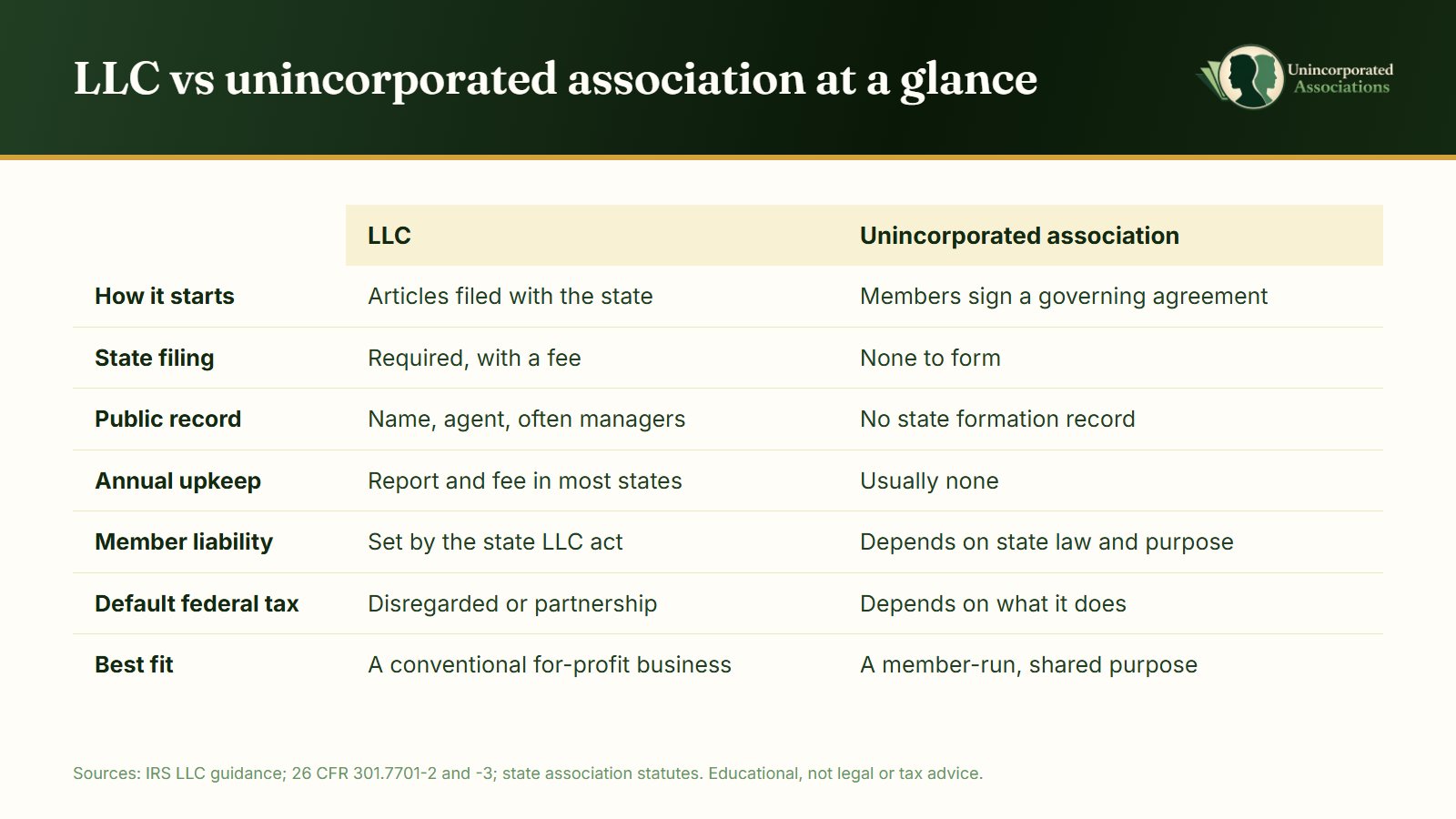
| LLC | Unincorporated association | |
|---|---|---|
| How it is created | Articles of organization filed with the state | Members sign a private governing agreement |
| State filing to form | Required, with a fee | None to form; some states offer optional statements |
| Public record | Name, registered agent and often managers are public | No state formation record |
| Who is involved | Members (owners) with ownership interests | Members who join for a shared purpose |
| Governing document | Operating agreement plus the state LLC act | Articles of association or bylaws you write |
| Liability for members | Set by the state LLC statute, broadly protective | Depends on state law and the association's purpose |
| Ongoing state paperwork | Annual or biennial report and fee in most states | Usually none |
| Default federal tax status | Disregarded (one member) or partnership (two or more) | Depends on activity; see the tax section below |
| EIN | Yes, through the IRS | Yes, through the IRS |
| Bank account | Standard business account | Possible with the right documents |
| Best fit | A conventional for-profit business | A member-run body with a shared purpose |
Formation and paperwork
LLC: filing, fees and upkeep. You file articles, pay the state fee (it ranges from under $100 to several hundred dollars depending on the state), appoint a registered agent, and calendar the annual report. Miss the report and the state can administratively dissolve the company, which can put your liability protection at risk.
Pro tip: If you keep an existing LLC for one business line, calendar its annual report the day you form it. Administrative dissolution for a missed report is one of the most common, and most avoidable, ways owners lose their liability shield.
Association: documents, not filings. Formation is the drafting and signing of the governing agreement, appointing officers or trustees, and recording who the members are. There is usually no annual report to a state and no state renewal fee. That simplicity is a big part of the appeal, but it also means the quality of your documents carries all the weight. A weak or vague agreement leaves members guessing about authority, money and what happens if someone leaves. Our step-by-step guide on how to become an unincorporated association walks through those documents.
Liability: who is on the hook?
This is where most people's assumptions are wrong in both directions.
LLC liability is predictable. Every state's LLC act says members are not personally liable for the company's obligations just because they are members. Courts can still "pierce the veil" when owners mix personal and business money, undercapitalize the company or use it to commit fraud, but the starting point is clear.
Association liability depends on where and what. In California and the uniform act states, nonprofit association members have statutory protection similar in spirit to an LLC's. The Texas statute is explicit that a person is not liable for the association's contracts or torts merely because they are a member or help manage it. In states without such a statute, older common-law rules can expose members who authorize or take part in a decision to personal liability for it.
Two practical points follow:
- An association's protection is strongest when it genuinely operates as a nonprofit association under its state's statute, keeps its own records and keeps its funds separate.
- No structure protects you from your own wrongdoing. Personal guarantees, personal torts and fraud follow the person in both an LLC and an association.
Watch out: Signing a lease or loan in your own name, even "for the association," can make you personally responsible for it. Officers should sign in the association's name with their title.
We cover the details in our guide to unincorporated association liability.
The for-profit trap most comparisons skip
Here is the point that matters most and gets mentioned least. If two or more people run a business together to make a profit for themselves, the law may treat them as a general partnership, whatever they call their arrangement. Texas puts it plainly: under Business Organizations Code section 152.051, an association of two or more persons carrying on a business for profit as owners creates a partnership, whether or not they intend to and whatever name they give it. Most states have the same rule.
General partners are personally liable for the partnership's debts.
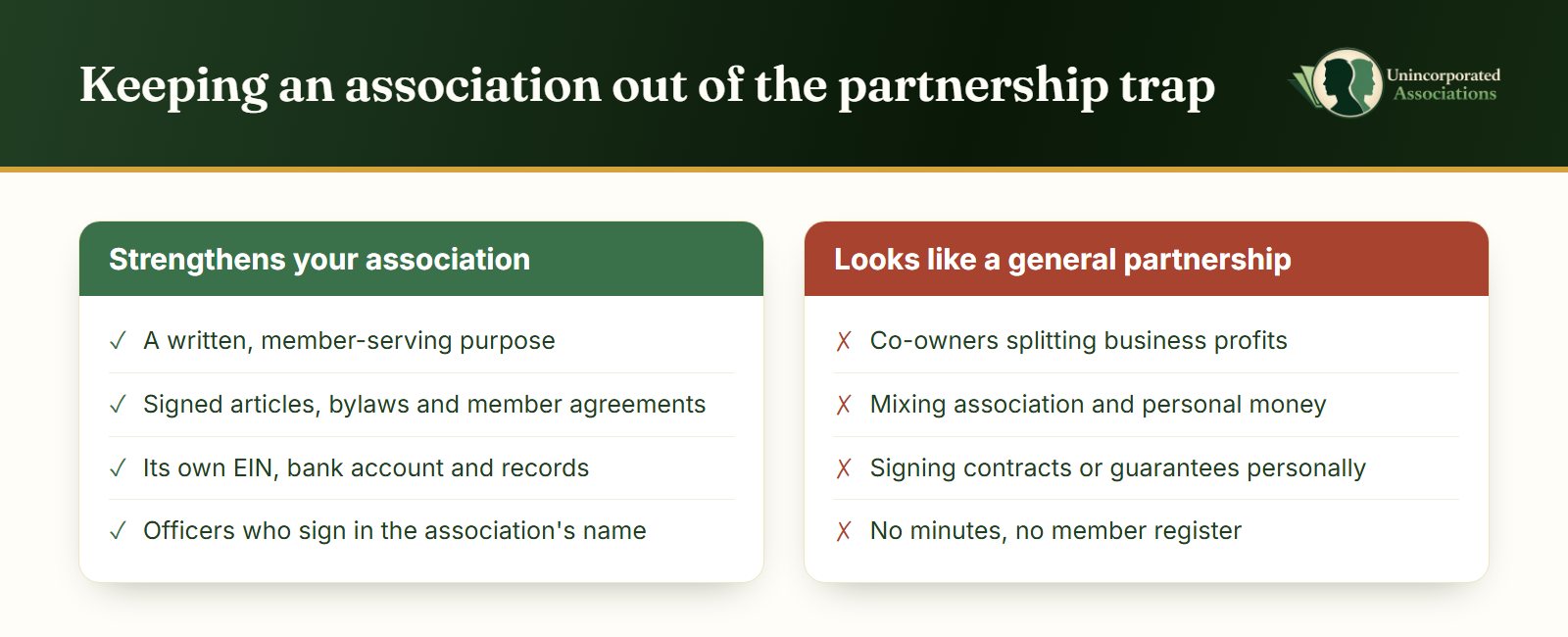
So an "association" that is really a for-profit business owned by its members can end up with less protection than an LLC, not more. The nonprofit association statutes protect associations formed for a common nonprofit purpose. That is why the purpose written into your governing document, and how the association actually operates, matter so much.
How each one is taxed
LLCs follow the IRS default rules described above, set out in the entity classification regulation at 26 CFR 301.7701-3. Profits flow to the members unless the LLC elects to be taxed as a corporation.
Associations are classified by what they do, not what they are called. Under 26 CFR 301.7701-2, an organization recognized for federal tax purposes is either a trust or a "business entity," and a business entity with two or more members that does not elect otherwise is treated as a partnership. A nonprofit association that meets the requirements can apply for tax exemption: the IRS accepts articles of association as an organizing document for 501(c)(3) status.
That is why the tax question has no one-line answer. How an association is treated depends on its purpose, its activities, where its income comes from and how it is documented. Kirk's team covers tax positioning on every intro call, and anyone making a tax decision should also run it past a CPA or tax attorney.
Privacy and control
Privacy. An LLC's formation record is public in every state. An association does not create a state formation record, so its member list is not published by the state. One more change worth knowing: since FinCEN's 2025 rule, U.S. companies no longer file beneficial ownership reports under the Corporate Transparency Act, so that particular filing is no longer a difference between the two.
Control. In an LLC, the state act fills every gap your operating agreement leaves. In an association, your governing document is close to the whole rulebook: who can join, how decisions are made, who signs for the association and what happens on dissolution. That gives members more control, and more responsibility to write the rules well.
Banking, EINs and contracts
Both structures can obtain an Employer Identification Number from the IRS, and both can open bank accounts. Banks know LLCs well and ask for the articles, the EIN letter and the operating agreement. With an association, expect more questions: banks will ask for the articles of association, the IRS EIN confirmation, minutes or a resolution naming who may sign, and IDs for those signers. Our guides on getting an EIN for an unincorporated association and opening an association bank account cover the exact documents.
For contracts, an LLC signs in its own name everywhere. A nonprofit association in a state like Texas or California can contract in its own name under the statute; elsewhere, contracts are often signed by officers or trustees on the association's behalf, and the governing document should say who has that authority.
Is an LLC an unincorporated association?
Technically, yes, in one narrow sense. An LLC is not a corporation, so some laws and IRS forms group LLCs, partnerships and associations together as "unincorporated" entities. But in everyday use, an LLC is a state-registered business entity with its own statute, while an unincorporated association is a member-formed body that exists by agreement. They are not interchangeable, and you cannot convert one into the other by changing a name.
Which one fits you?
An LLC usually fits when:
- You are running a conventional for-profit business and want the most widely recognized structure.
- Lenders, landlords or partners expect a state-registered entity.
- You value predictable, statute-based liability rules in every state over privacy.
An unincorporated association is worth a serious look when:
- The group exists for a shared, member-driven purpose rather than to pay out profits to owners.
- You want governance written by the members rather than defaulted by a state act.
- You want to avoid a public state formation record and annual state filings.
- You are prepared to keep proper documents, records and separate funds.
Some people use both: an LLC for a conventional business line and an association for a member-based purpose. There is also a middle option some lawyers suggest: a nonprofit LLC, which several states allow and which the American Bar Association's Business Law Today discusses in detail. It keeps the LLC's statutory liability rules but gives up the privacy of an association. If you are weighing other options too, our comparisons of LLP vs LLC and the services we offer show where each structure fits.
Questions to answer before you decide
- What is the purpose: profit for owners, or a shared purpose for members?
- Which state's law will apply, and does that state have a nonprofit association statute?
- Is the activity a for-profit business owned by the members? If so, the partnership rules above may apply.
- Who needs to see a state registration: banks, landlords, licensing boards, payment processors?
- Who will sign for the group, and how will members join and leave?
- How will money be kept separate and recorded?
- Have you run the tax treatment past a CPA for your specific activities?
Frequently asked questions
Is an unincorporated association better than an LLC?
Neither is better in general. An LLC gives standard, statute-based liability rules and wide recognition. An association gives privacy and member-written governance with no state formation filing, but its legal treatment depends on state law and on how well it is documented.
Do I have to register an unincorporated association with the state?
Usually not to form one. An association comes into existence when members sign the governing agreement. Some states offer optional filings, such as a statement naming an agent for service of process, and some activities require licenses whatever the structure.
Can an unincorporated association get an EIN like an LLC?
Yes. An association can apply to the IRS for an Employer Identification Number, which it needs for a bank account and for any tax filings that apply to it.
Are members of an unincorporated association personally liable?
In states with a nonprofit association statute, such as California and Texas, members are not liable for the association's debts simply for being members. In states without one, older common-law rules can expose members who authorize or take part in a decision, so state law matters.
Can I convert my LLC into an unincorporated association?
Not by filing a form. You would form the association separately, move the relevant activity and assets under proper documents, and dissolve or keep the LLC as your situation requires. Get advice on the tax effects of moving assets before you do it.
Sources
- IRS: Limited liability company (LLC)
- IRS: About Form 8832, Entity Classification Election
- 26 CFR 301.7701-2, Business entities defined
- 26 CFR 301.7701-3, Classification of certain business entities
- California Corporations Code section 18605
- Texas Business Organizations Code section 252.006
- Uniform Law Commission: Unincorporated Nonprofit Association Act
- Iowa Code chapter 501B (Revised Uniform Unincorporated Nonprofit Association Act)
- IRS: Exemption requirements for 501(c)(3) organizations
- FinCEN: Beneficial ownership information
- Texas Business Organizations Code section 152.051 (partnership formation)
- Business Law Today (ABA): Nonprofit LLCs
- SBA: Choose a business structure
Want to know which structure fits your situation? Book a free 15-minute call with Kirk's team, or join the daily live Q&A.
Have questions? Bring them to the daily call.
Join our live Q&A every weekday and Saturday at 3PM PST, or get a free 15-minute call to see whether a UNA fits your situation.
Have a question about your situation?
Send us a message and we'll get back to you.
Keep reading
 The Well-Meaning Dragon: Straight Answers to the Hardest ObjectionsFor the family and friends who push back because they care — honest answers to the toughest questions about the Federal income tax and Unincorporated Associations.
 It's Not What You Believe, It's What You SignFor the cautious partner in the room: real risk rarely comes from asking questions. It comes from what you signed.
 What Most People Get Wrong About Taxes, Structure, and ControlThe real problem isn't taxes — it's structure, and who actually has control. A look at positioning over loopholes.
Educational, not legal or tax advice. Unincorporated Associations is a document-preparation and education company. Consult a licensed attorney or CPA before acting on any position discussed on this site.