
How to Start a Private Membership Association (PMA), Step by Step
By Kirk Carmichael · · 11 min read
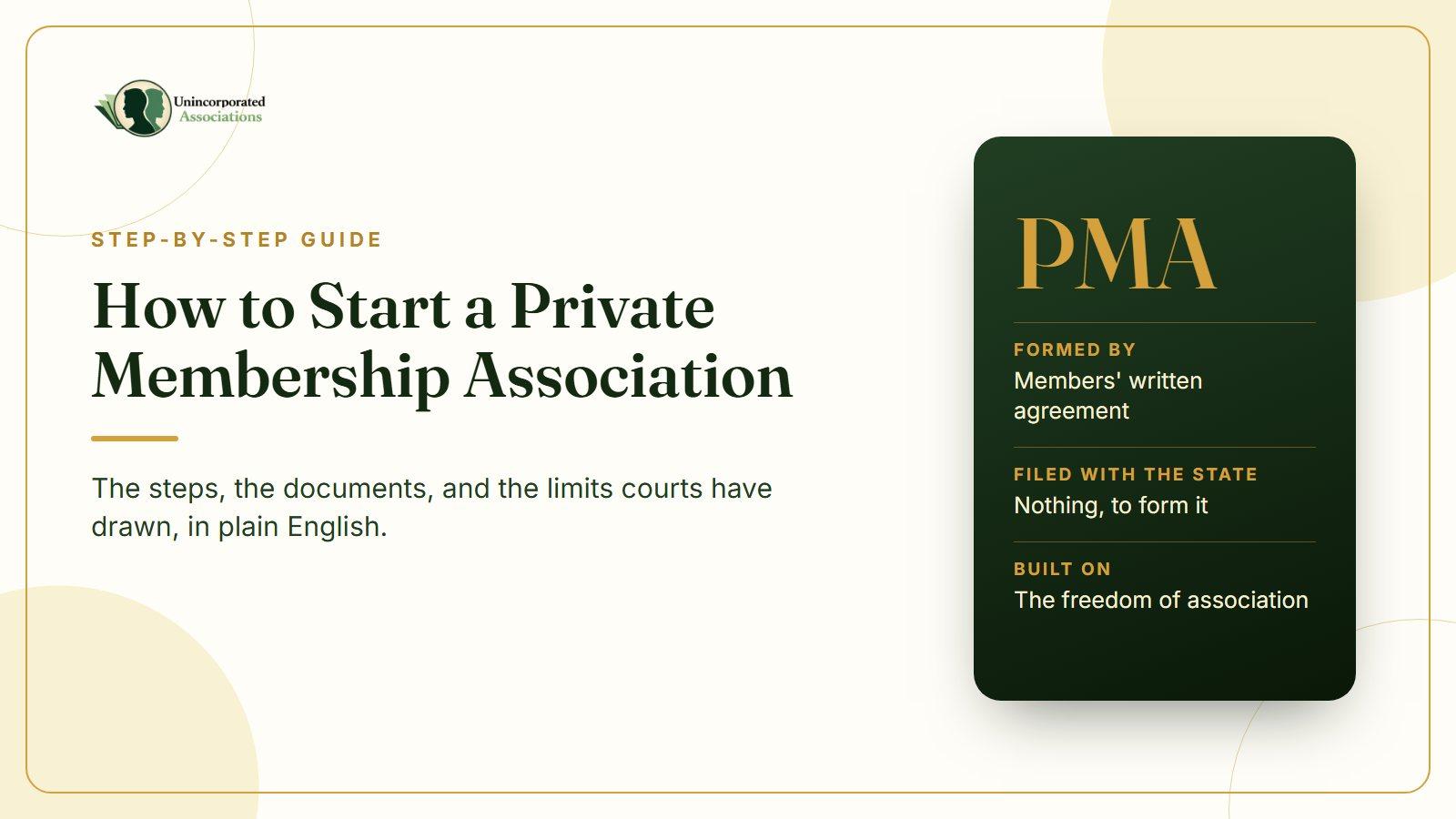
Short answer: To start a private membership association, define a lawful shared purpose, gather at least two founding members, adopt articles of association and a membership agreement, appoint officers or trustees, keep a member register, get an EIN from the IRS and open a bank account in the association's name. Nothing is filed with the state to form it. A PMA governs how members deal with each other; it does not exempt the association from licensing, health, safety or tax laws.
A private membership association, or PMA, is a form of unincorporated association. What sets it apart is the emphasis on membership: people join by signing an agreement, and the association offers its services, goods or knowledge to members only, under the terms of that agreement, instead of to the general public.
People form PMAs for all kinds of reasons: farm buying clubs, wellness and education communities, professional networks, faith-based groups, and family or business groups that want private, member-written rules. This guide covers how to set one up properly, the documents you need, and the limits you should understand before you start.
Key takeaways: A PMA needs at least two founders, signed articles, bylaws and a membership agreement every member signs before receiving anything. It needs an EIN and its own bank account. It protects how members deal with each other; it does not exempt anyone from licensing, health, safety, civil rights or tax laws.
What is a private membership association?
A PMA is two or more people who agree, in writing, to associate for a shared purpose and to deal with one another under private contract. Legally, it sits in the same family as other unincorporated nonprofit associations: there is no state charter, and the association exists because its members agreed to form it.
The idea behind a PMA draws on the constitutional right of people to associate. The Supreme Court recognized that right in NAACP v. Alabama (1958), which protected the privacy of an association's membership list, and described two kinds of protected association, intimate and expressive, in Roberts v. United States Jaycees (1984). Those cases protect the freedom to associate. As covered below, they do not turn ordinary business activity into something outside state regulation.
For a fuller overview, see our private membership association guide.
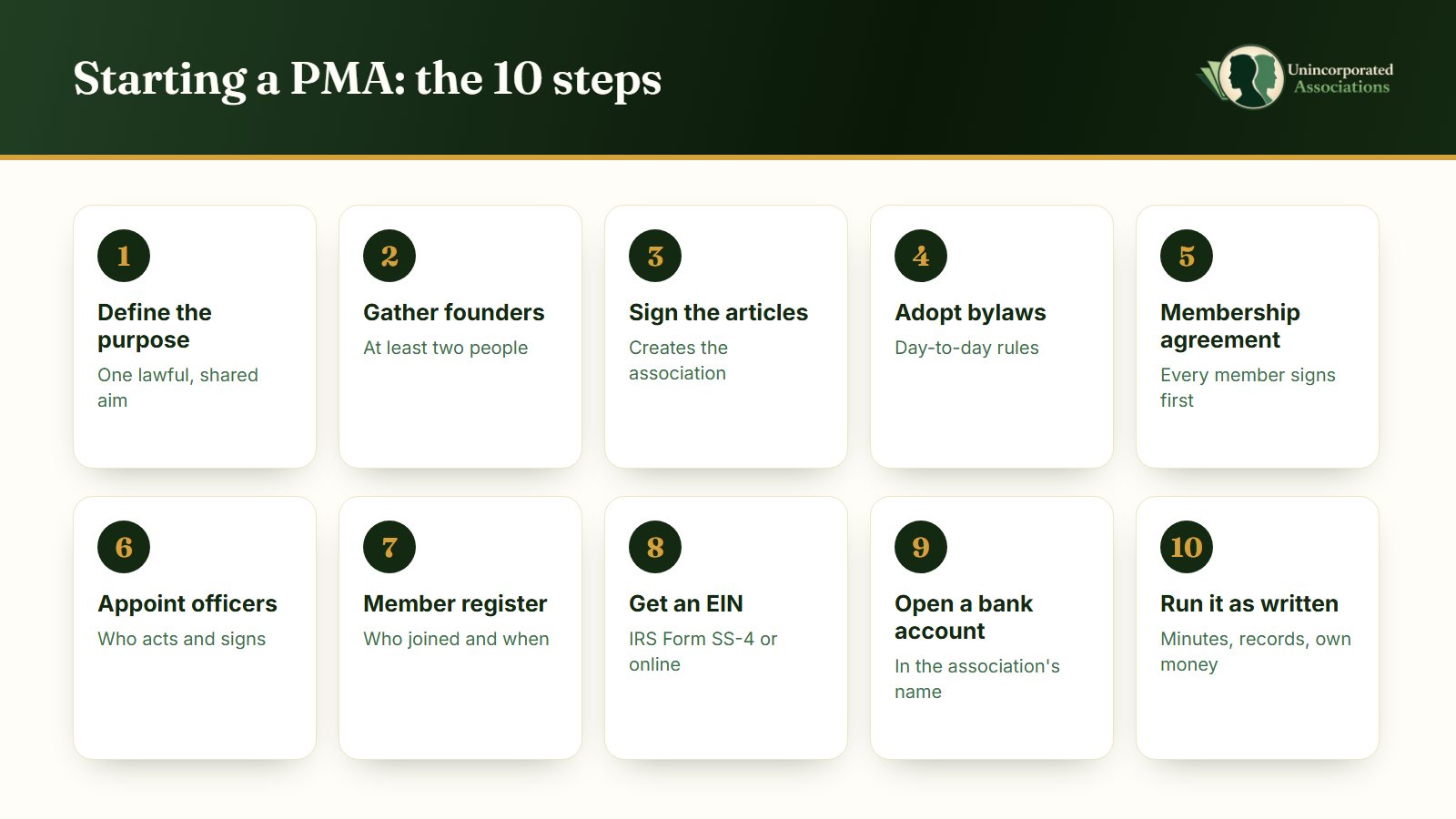
Step 1: Define a lawful purpose
Everything starts with purpose. Write one or two sentences that say what the association exists to do and who it serves: "to share knowledge and resources on regenerative farming among members," for example, or "to provide members with education and peer support on family asset planning."
A clear purpose does three jobs:
- It tells members what they are joining.
- It shapes how the law classifies the association. A nonprofit, member-serving purpose is what the nonprofit association statutes in states like California and Texas are written for.
- It keeps the association focused if disagreements come up later.
Avoid writing a purpose that is really "to sell X to anyone who signs up." If the association is in substance a business selling to the public, the membership label will not change how regulators and courts see it.
Step 2: Gather your founding members
You need at least two people to form any association. Most PMAs start with a small group of founders who will also serve as the first officers or trustees. Agree among yourselves on who will lead, how decisions will be made in the early days, and how new members will be admitted.
Step 3: Adopt the articles of association
The articles of association (sometimes called a charter or declaration) are the association's founding document. They usually cover:
- The association's name and purpose
- That it is a private, unincorporated association
- Who the founding members and first officers or trustees are
- How the association holds property and money
- How the articles can be amended
- What happens to assets if the association dissolves
The founders sign and date the articles. Keep the signed original with the association's records.
Step 4: Write the bylaws
Bylaws are the day-to-day operating rules. They set out how meetings are called, how votes work, how officers are chosen and removed, who can sign contracts and checks, how records are kept and how disputes are handled. Our guide to UNA bylaws walks through the clauses that matter most.
Step 5: Create the membership agreement
The membership agreement is what makes a PMA a PMA. Every member signs it before receiving anything from the association. It typically covers:
- That the person is joining a private association voluntarily
- The member's rights, including access to the association's services, goods or information
- The member's responsibilities, such as dues and following the bylaws
- How the member can leave, and how the association can end a membership
- How disputes are resolved
Write it in plain language and make sure each member actually reads and signs it. A membership agreement nobody understands is easy to attack later.
Pro tip: Date-stamp every signed agreement and store it with the member register. If anyone ever questions whether you deal only with members, a complete, dated file is your best evidence. Our article on the membership agreement for an association has a clause-by-clause breakdown.
Step 6: Appoint officers or trustees
Name the people who will act for the association: typically a president or chair, a secretary to keep records and a treasurer to manage money. Record the appointments in minutes or a written resolution. Banks and other organizations will ask to see who is authorized to act for the association.
Step 7: Keep a member register
Keep a private, up-to-date list of members with the date each person joined and a copy of their signed agreement. This is your evidence that you are dealing with members, not the public. It also matters for privacy: the Supreme Court's decision in NAACP v. Alabama is a reminder of why membership lists deserve careful handling.
Step 8: Get an EIN
An association that will open a bank account, take dues or file any tax return needs an Employer Identification Number. You apply with the IRS using Form SS-4 or the online EIN application. The IRS confirms the number in writing. Keep that letter; banks ask for it. Our guide to getting an EIN for an unincorporated association explains which entity type to choose on the form.
Step 9: Open a bank account
Open an account in the association's own name and keep its money separate from every member's personal money. Bring the signed articles, the EIN confirmation, the resolution naming authorized signers and their IDs. See our checklist for opening an association bank account.
Step 10: Run it like the association you said it is
Most PMA problems come from the gap between the documents and real life. Keep minutes, collect signed agreements before dealing with anyone, keep money separate, and make decisions the way your bylaws say. Our guide to collecting member dues covers the money side.
Design your membership: tiers, dues and onboarding
The software companies that write most "start an association" guides are right about one thing: the membership experience decides whether the association works. Before you invite anyone, settle:
- Who can join. Open to anyone who signs, or invitation only? A genuinely selective process strengthens the private character of the association.
- Tiers. One membership level is simplest. If you need more (founding, standard, supporting), write what each tier gets into the membership agreement.
- Dues. Decide whether dues are one-time, annual or monthly, what they fund, and whether they are refundable. Record every payment against the member's name.
- Onboarding. A new member should receive the articles, bylaws and membership agreement, sign the agreement, be added to the register and get a welcome note explaining how to take part. Nothing is provided to anyone before that signature.
- Leaving. Make exit simple and documented, and say what happens to dues already paid.
How long it takes and what it costs
There is no state filing fee to form a PMA, and the IRS does not charge for an EIN. The real costs are document preparation (whether you draft the documents yourself, use a lawyer, or use a preparation service like ours), a bank account, and any licenses your activity needs anyway. With documents ready, founders can sign, appoint officers, get an EIN online the same day and open a bank account within a week or two, depending on the bank.
Common mistakes to avoid
- Treating the PMA as a shield from regulation. It is not one, as the cases below show.
- Providing anything before the agreement is signed. That turns a member-only arrangement into a public one.
- Mixing money. Paying association expenses from a personal account, or the reverse, undermines the association's separate existence.
- Copying documents from the internet. Templates written for a different purpose or state often contradict each other.
- No records. Without minutes, a member register and signed agreements, you cannot prove the association works the way its documents say.
The documents at a glance
| Document | What it does | Who signs |
|---|---|---|
| Articles of association | Creates the association and states its purpose | Founding members |
| Bylaws | Sets the operating rules | Adopted by the founders or members |
| Membership agreement | Defines each member's rights and duties | Every member, before joining |
| Officer or trustee resolution | Names who can act and sign for the association | Members or the governing body |
| Member register | Records who the members are and when they joined | Kept by the secretary |
| IRS EIN confirmation | Gives the association its tax ID number | Issued by the IRS |
| Minutes | Record decisions as they are made | Secretary, approved by members |
What a PMA can and cannot do
This is the part many online guides leave out, and it is the part that keeps people out of trouble.
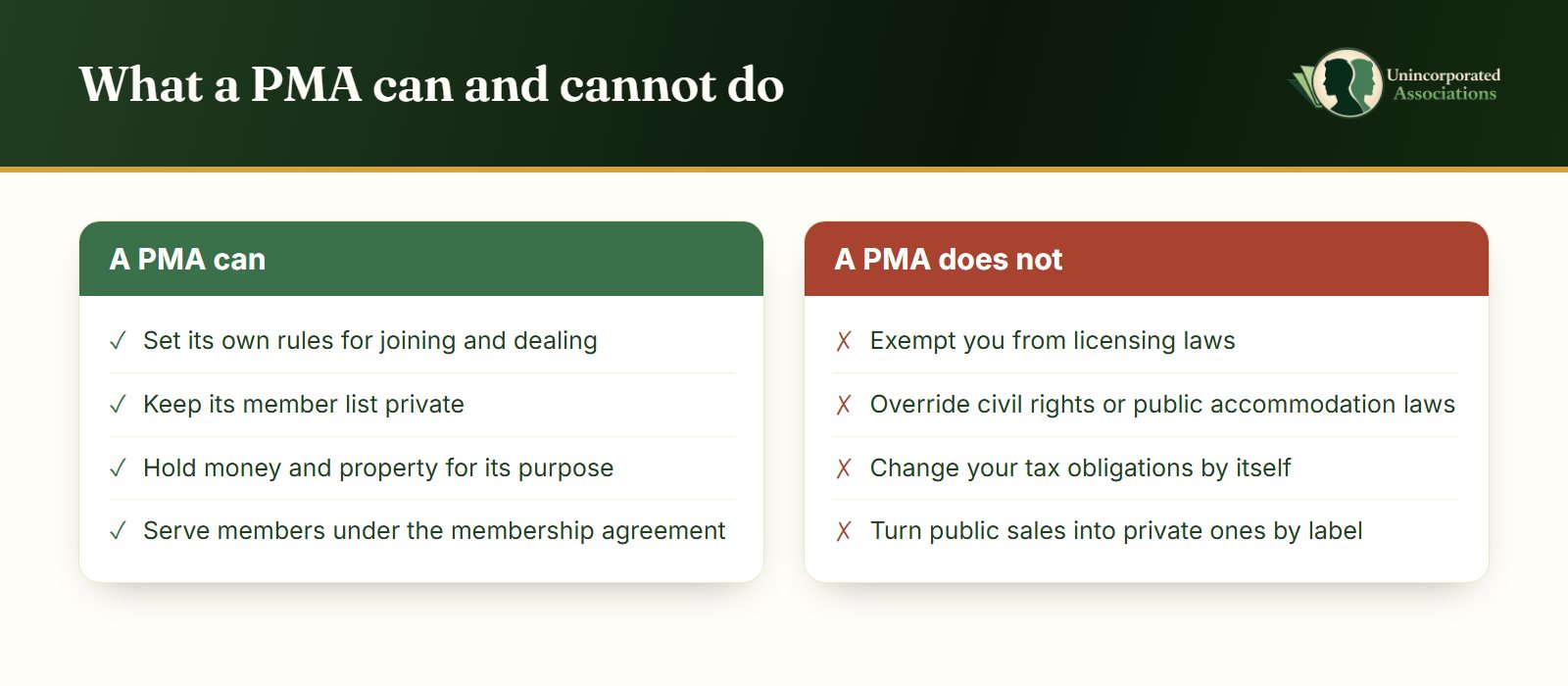
A PMA can:
- Set its own rules for who joins and how members deal with each other
- Keep its member list private
- Hold money and property for its purpose, under its documents and your state's association laws
- Offer services, goods or education to members under the membership agreement
Watch out: Courts have not accepted the PMA label as a way around licensing, health or tax law. Plan your PMA for what it really does: private, member-based dealing under clear documents.
A PMA does not:
- Exempt you from licensing laws. Courts have looked past the membership label when the real activity is selling to the public. In Wisconsin, an appeals court held that a farm store selling raw milk to members of a private association still needed a state license (Food Safety News report). In Pennsylvania, a 2023 consent decree in the federal case over Amos Miller's members-only farm required the farm to follow state rules, and state officials raided it in 2024 (National Agricultural Law Center).
- Override civil rights or public accommodation laws. In Roberts v. United States Jaycees, the Court held that a large, unselective membership organization could be required to follow a state anti-discrimination law.
- Change your tax obligations by itself. The IRS classifies an organization by what it is and does, under the entity classification rules at 26 CFR 301.7701-2. A PMA that runs a for-profit business for its members can be treated as a partnership. Talk to a CPA about how yours will be treated.
The pattern in these cases is consistent: courts ask whether the arrangement is genuinely private and member-based, or a sale to the public with a membership form attached. The more real your membership process, documents and operations are, the stronger your position.
PMA vs other structures
A PMA is not the only way to organize a group. Compared with an LLC, it has no state filing and no public formation record, but its liability rules depend on your state's association law rather than an LLC statute. Compared with a nonprofit corporation, it is simpler to run but less familiar to banks and grantors. We compare the options in detail in our guide on what an unincorporated association is, and we explain how we structure associations on our services page.
Frequently asked questions
Do I have to register a private membership association with the state?
Not to form it. A PMA comes into existence when the founding members sign the articles of association. Some states allow optional filings, such as naming an agent to receive legal papers, and some activities need licenses whatever the structure.
How many people do I need to start a PMA?
At least two. An association is an agreement between people, so a single person cannot form one alone. Most PMAs start with two to five founders who also serve as the first officers or trustees.
Is a private membership association legal?
Yes. Forming a private association is a lawful exercise of the freedom of association. What courts have rejected is the idea that a membership label exempts ordinary commercial activity from licensing, health, safety or anti-discrimination laws.
Does a PMA need an EIN?
If it will open a bank account, collect dues, pay anyone or file any tax return, yes. The IRS issues EINs to associations through Form SS-4 or the online application.
Can a PMA sell products to its members?
A PMA can provide goods and services to members under the membership agreement. If the activity would need a license or permit when done for the public, assume it still needs one, and check with a lawyer in your state before you start.
Sources
- NAACP v. Alabama ex rel. Patterson, 357 U.S. 449 (1958)
- Roberts v. United States Jaycees, 468 U.S. 609 (1984)
- IRS: About Form SS-4, Application for Employer Identification Number
- IRS: Get an employer identification number
- 26 CFR 301.7701-2, Business entities defined
- Food Safety News: Raw milk distribution schemes cannot escape Wisconsin licensing requirements
- National Agricultural Law Center: Amos Miller and the regulation of raw milk
Thinking about starting a PMA? Book a free 15-minute call with Kirk's team, or bring your questions to the daily live Q&A.
Have questions? Bring them to the daily call.
Join our live Q&A every weekday and Saturday at 3PM PST, or get a free 15-minute call to see whether a UNA fits your situation.
Have a question about your situation?
Send us a message and we'll get back to you.
Keep reading
 The Well-Meaning Dragon: Straight Answers to the Hardest ObjectionsFor the family and friends who push back because they care — honest answers to the toughest questions about the Federal income tax and Unincorporated Associations.
 It's Not What You Believe, It's What You SignFor the cautious partner in the room: real risk rarely comes from asking questions. It comes from what you signed.
 What Most People Get Wrong About Taxes, Structure, and ControlThe real problem isn't taxes — it's structure, and who actually has control. A look at positioning over loopholes.
Educational, not legal or tax advice. Unincorporated Associations is a document-preparation and education company. Consult a licensed attorney or CPA before acting on any position discussed on this site.