
Nine Copy Ready Sections: Membership Agreement for U.S. Associations
· 11 min read

A short membership agreement covering term, dues, benefits, conduct, privacy, incorporation of governing documents, termination, and dispute resolution is the practical baseline every U.S. association needs. You’ll find a copy-ready template below, along with the clause-by-clause reasoning behind it. For associations handling significant assets or high membership fees, attorney-backed drafting through a service like Unincorporated Associations closes the gaps a generic template can’t.
TL;DR:
- Most associations should customize their membership classes to clearly specify rights like voting and event access, preventing disputes over ownership claims.
- Fixed membership terms usually last one year with auto-renewal and a 30 to 60-day cancellation window, with dues payable within 30 days of billing.
- Benefits must be explicitly listed, stating they are subject to change and clarifying that membership does not confer ownership or equity in the association.
- Dispute resolution should prioritize mediation followed by arbitration, with governing law based on the association’s operational state, to avoid costly court battles.
- Incorporating bylaws by reference and including signature, privacy, and contact information sections make the agreement more enforceable and align members with current rules.
Table of Contents
- Membership Agreement for Association Template You Can Copy
- What Should Membership Classes and Termination Language Say?
- How Do You Define Benefits Without Overpromising?
- What Privacy and Notice Language Belongs in the Agreement?
- How Should Dispute Resolution and Liability Clauses Work?
- Why Incorporate Bylaws by Reference?
- Drafting Checklist Before You Publish the Agreement
- Why Attorney-Backed Agreements Reduce Risk
- How Unincorporated Associations Can Help
- Sources
- FAQ
Membership Agreement for Association Template You Can Copy
Here’s the skeleton. Every U.S. association, from a homeowners group to a professional trade body, needs some version of these nine sections. Fill in the bracketed notes with your own numbers and links.
- Membership — defines the class of membership being granted and confirms it does not convey ownership or equity in the association.
- Term & Renewal — states the initial term (commonly one year), the renewal mechanism (auto-renew unless canceled), and required notice periods.
- Dues & Payment — lists the fee amount by membership class, due date, and payment method. (List the membership dues schedule here without specifying any particular amounts.)
- Benefits — describes exactly what membership includes, with a line noting benefits are subject to change at the association’s discretion.
- Conduct — sets behavioral expectations and ties violations to a disciplinary process.
- Privacy & Notices — consents to electronic communication and links to the association’s privacy policy. (Insert privacy policy URL.)
- Intellectual Property — restricts use of the association’s name, logo, and marks. (Insert specific mark descriptions.)
- Termination — spells out grounds for termination and effect on dues already paid.
- Dispute Resolution & Signatures — names a governing-law state and dispute forum, followed by signature lines.
Pick a governing-law state that matches where your association actually operates, and have counsel review the document if members’ fees or asset exposure run high.
What Should Membership Classes and Termination Language Say?
Membership classes exist to answer one question clearly: what does this person actually get? Vague class descriptions are where most membership disputes start. A trade group offering “Individual,” “Corporate,” and “Affiliate” tiers, for instance, needs to spell out exactly which rights (voting, event access, directory listing) attach to each tier, and just as importantly, which rights don’t. Language like “Membership confers no ownership, equity, or voting interest in the Association’s assets except as expressly stated in Section X” heads off a common source of confusion.
Term and renewal mechanics come in a few standard shapes:
- Fixed term with manual renewal — cleanest for small associations, but requires active outreach every cycle.
- Fixed term with auto-renewal — the default for most trade and professional groups, paired with a 30 to 60 day cancellation notice window.
- Rolling month-to-month — flexible, but weaker for associations that budget on annual dues.
Payment timing deserves its own sentence in the agreement. The American Clean Power Association’s membership agreement sets fees due within 30 days of the effective date, a common and defensible standard. Non-payment should trigger a defined sequence: notice, a short cure period, then suspension, then termination. Nonrefundable-fee language should be explicit rather than implied: “Dues paid are nonrefundable except as required by law.”
Pro Tip: Don’t bury the nonrefundable clause in a footnote. Put it in the same paragraph as the payment amount so no member can claim they missed it.
How Do You Define Benefits Without Overpromising?
Benefits sections cause more disputes than almost any other part of a membership agreement, usually because they’re written like marketing copy instead of contract language. The fix is narrow, specific drafting: list what’s included, list what’s excluded, and reserve the association’s right to modify benefits going forward.
- State plainly that membership does not create ownership, equity, or a claim on association assets.
- Note that benefits are offered “subject to availability and Association discretion,” not as a guaranteed entitlement.
- Include a short intellectual property clause: members may reference their affiliation but may not use the association’s name, logo, or marks in advertising without written permission.
- Attach a brief disciplinary pathway for misuse. A risk-management guide from IEEE’s insurance program treats clear conduct and IP rules as core liability protection, not just housekeeping.
Legal counsel routinely flags the membership-versus-ownership distinction as a top source of nonprofit disputes, according to UpCounsel’s guidance on nonprofit membership structures. One sentence in your agreement can prevent a lawsuit years later.
What Privacy and Notice Language Belongs in the Agreement?
Every U.S. association handling member contact information needs consent language for how it communicates and what it does with that data.
- Add a consent-to-electronic-delivery clause: “By signing, Member consents to receive notices, invoices, and communications electronically at the address provided.” The RAIN Alliance’s membership agreement uses this exact structure alongside a requirement that members keep contact information current.
- Link directly to your privacy policy rather than summarizing it inline; policies change, and a link stays accurate.
- Note any state-specific handling rules briefly, and flag that sensitive data (health, financial, biometric) warrants a direct conversation with counsel rather than boilerplate language.
Keeping notice language simple protects the association just as much as it protects members. A missed notice because a member’s email bounced is a much smaller problem than a missed notice because the agreement never required an updated address.
How Should Dispute Resolution and Liability Clauses Work?
Dispute clauses only work if they’re realistic. A mediation-first, arbitration-second structure resolves most membership disagreements faster and cheaper than heading straight to court, and it signals good faith to members before things get adversarial.
- Mediation before arbitration keeps small disputes small; pick an arbitration provider and city in advance so there’s no argument about logistics later.
- Choose governing law based on where the association is formed or primarily operates, not wherever feels convenient.
- Keep indemnity language scoped to actual risks (property damage, third-party claims from events) rather than open-ended liability transfer that a court may refuse to enforce anyway.
- Build in a notice-and-cure period before termination for cause. Terminating a member without warning invites the exact dispute the clause was meant to prevent.
Reasonable, narrow language holds up better than aggressive, broad language, especially when a judge is reading it for the first time with no context on your association.
Why Incorporate Bylaws by Reference?
An agreement that doesn’t reference your bylaws leaves a gap members can exploit. If your bylaws set rules the membership agreement never mentions, a member can plausibly argue they never agreed to follow them. ASAE’s guidance on governing documents recommends explicitly incorporating bylaws and articles by reference, with a note on where members can access the current version.
Add a short reaffirmation clause too: an annual acknowledgment, or a notice triggered by material bylaw changes, that asks members to confirm they’re still bound. Best-practice guidance on reaffirmation agreements treats this as cheap insurance against later claims that a member never saw an updated policy. Close with voluntary-execution language, and recommend counsel review for any agreement involving significant fees.

Drafting Checklist Before You Publish the Agreement
Run through this before sending the agreement to a single member.
- Confirm every core clause is present: term, dues, benefits, conduct, privacy, incorporation by reference, termination, dispute resolution.
- Verify the payment deadline and nonrefundable language match your actual fee structure.
- Check that bylaws and articles are correctly incorporated and hosted somewhere members can actually reach.
- Confirm the dispute forum and governing-law state are named, not left generic.
- Review the signature block and privacy policy link for accuracy.
Watch for red flags: vague refund language, indemnities with no scope limit, clauses that quietly contradict your bylaws, and termination language with no enforcement mechanism behind it.
Pro Tip: Print the final version and read it as if you were the newest, least legally savvy member joining tomorrow. If any clause confuses you on a first read, it will confuse them too.
Why Attorney-Backed Agreements Reduce Risk
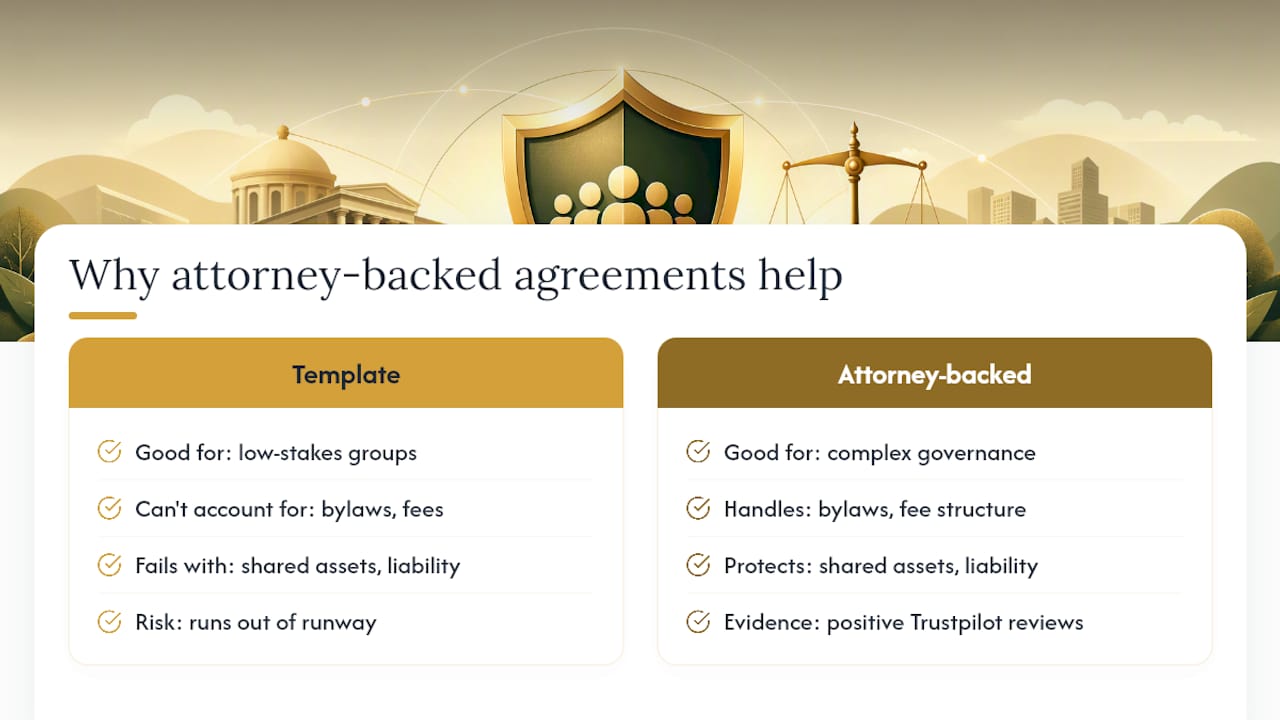
Templates get an association most of the way there. What they can’t do is account for your specific bylaws, your fee structure, or the liability exposure that comes with holding real assets under a membership model. Unincorporated Associations offers attorney-backed formation services and has received positive reviews on Trustpilot.
Associations with high membership fees, shared assets, or complex governance structures face the steepest downside from a poorly drafted agreement. That’s exactly where a generic template runs out of runway. Learn more about how private unincorporated associations distinguish membership from ownership before relying solely on a do-it-yourself draft for anything beyond a low-stakes group.
How Unincorporated Associations Can Help
DIY templates get you a starting draft. What they can’t give you is a document tested against your specific bylaws, fee structure, and state law, which is exactly where a done-for-you package earns its cost. There are services available that provide attorney-backed formation, state registration, EIN assignment, Revocation of Election preparation, customizable naming, and lifetime support with daily Q&A access.
Instead of assembling a membership agreement clause by clause and hoping it holds up, you get documentation built around how your association actually operates, with ongoing support if questions come up later. Some packages charge a one-time fee covering formation work and membership documentation together rather than billing separately for each piece. If you’d rather talk through your specific situation first, you can book a consultation with an attorney or explore the full service breakdown to see what’s included before you commit.
Sources
- American Clean Power Association membership agreement (sample clauses)
- ASAE: Give your governing documents a checkup
FAQ
Can You Provide an Example of a Membership Agreement?
Yes. The template in this article covers the nine core sections most U.S. associations need: membership, term and renewal, dues, benefits, conduct, privacy, intellectual property, termination, and dispute resolution. For a real-world example of tiered fees and incorporation-by-reference language, review the RAIN Alliance’s published agreement.
What Are the Different Types of Association Membership?
Most associations use two or three tiers, such as Individual, Corporate, and Affiliate, each with different rights to voting, events, or resources. The key drafting rule is stating explicitly which rights attach to each class and confirming that no class includes ownership or equity in the association.
What Are the Disadvantages of Membership?
Membership can come with dues obligations, conduct expectations, and limited control over how the association’s benefits or governance evolve over time. Members typically have no ownership stake or right to association assets unless the agreement expressly grants one.
Can You Give Me an Example of a Group Agreement?
A group or association agreement typically names the parties, states dues and term, incorporates the bylaws by reference, and sets a dispute-resolution process such as mediation before arbitration. Organizations that want this tailored to their specific assets and governance can get an attorney-reviewed version through the Full UNA package rather than adapting a generic template alone.
Recommended
This article is provided for general informational and educational purposes only and does not constitute legal, tax, accounting, or financial advice. Reading this content or contacting UnincorporatedAssociations.com does not create an attorney-client, CPA-client, or other professional-client relationship. In accordance with IRS Circular 230, any discussion of federal tax matters herein is not intended or written to be used, and cannot be used, for the purpose of avoiding penalties.
Have questions? Bring them to the daily call.
Join our live Q&A every weekday and Saturday at 3PM PST, or get a free 15-minute call to see whether a UNA fits your situation.
Have a question about your situation?
Send us a message and we'll get back to you.
Keep reading
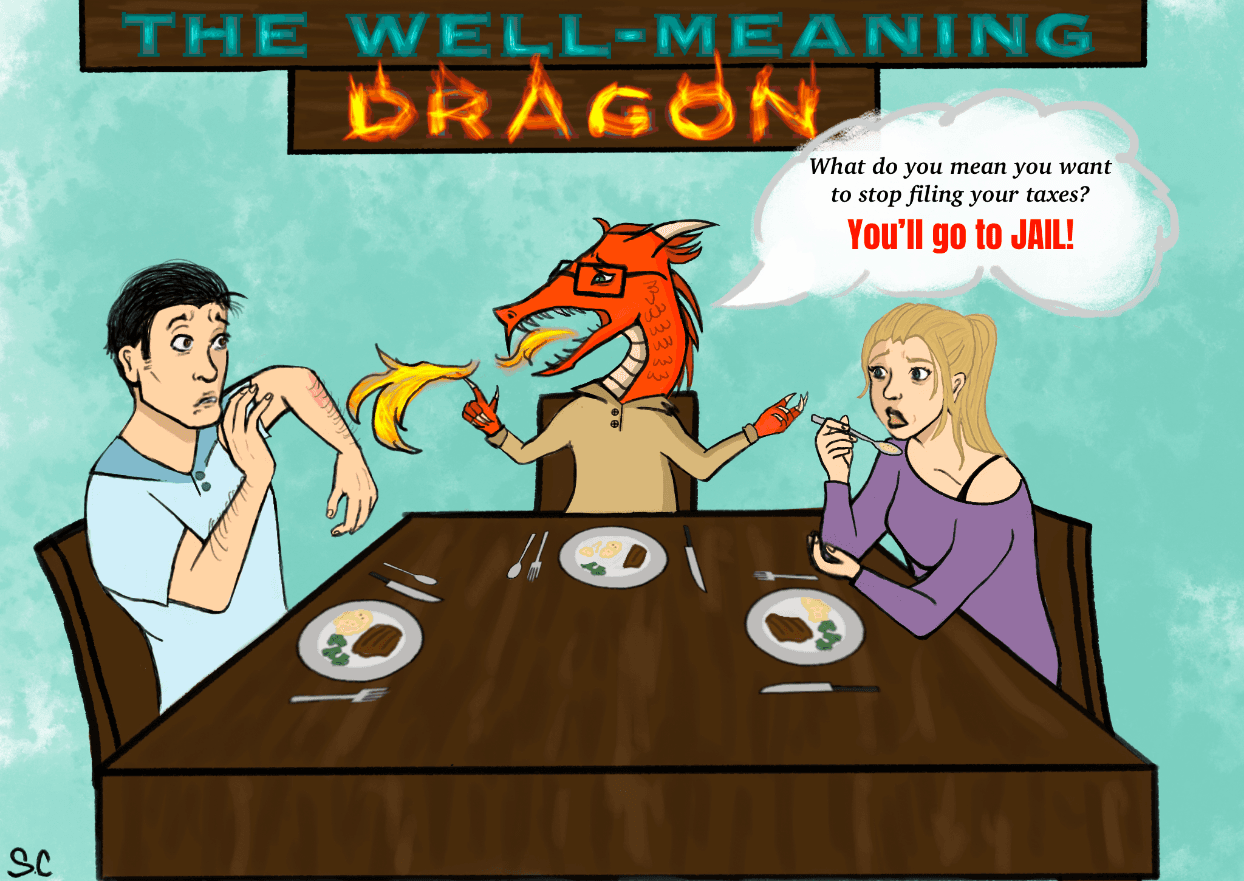 The Well-Meaning Dragon: Straight Answers to the Hardest ObjectionsFor the family and friends who push back because they care — honest answers to the toughest questions about the Federal income tax and Unincorporated Associations.
 It's Not What You Believe, It's What You SignFor the cautious partner in the room: real risk rarely comes from asking questions. It comes from what you signed.
 What Most People Get Wrong About Taxes, Structure, and ControlThe real problem isn't taxes — it's structure, and who actually has control. A look at positioning over loopholes.
Educational, not legal or tax advice. Unincorporated Associations is a document-preparation and education company. Consult a licensed attorney or CPA before acting on any position discussed on this site.