Private Membership Association Pros and Cons: A Balanced Look
By Kirk Carmichael · · 8 min read
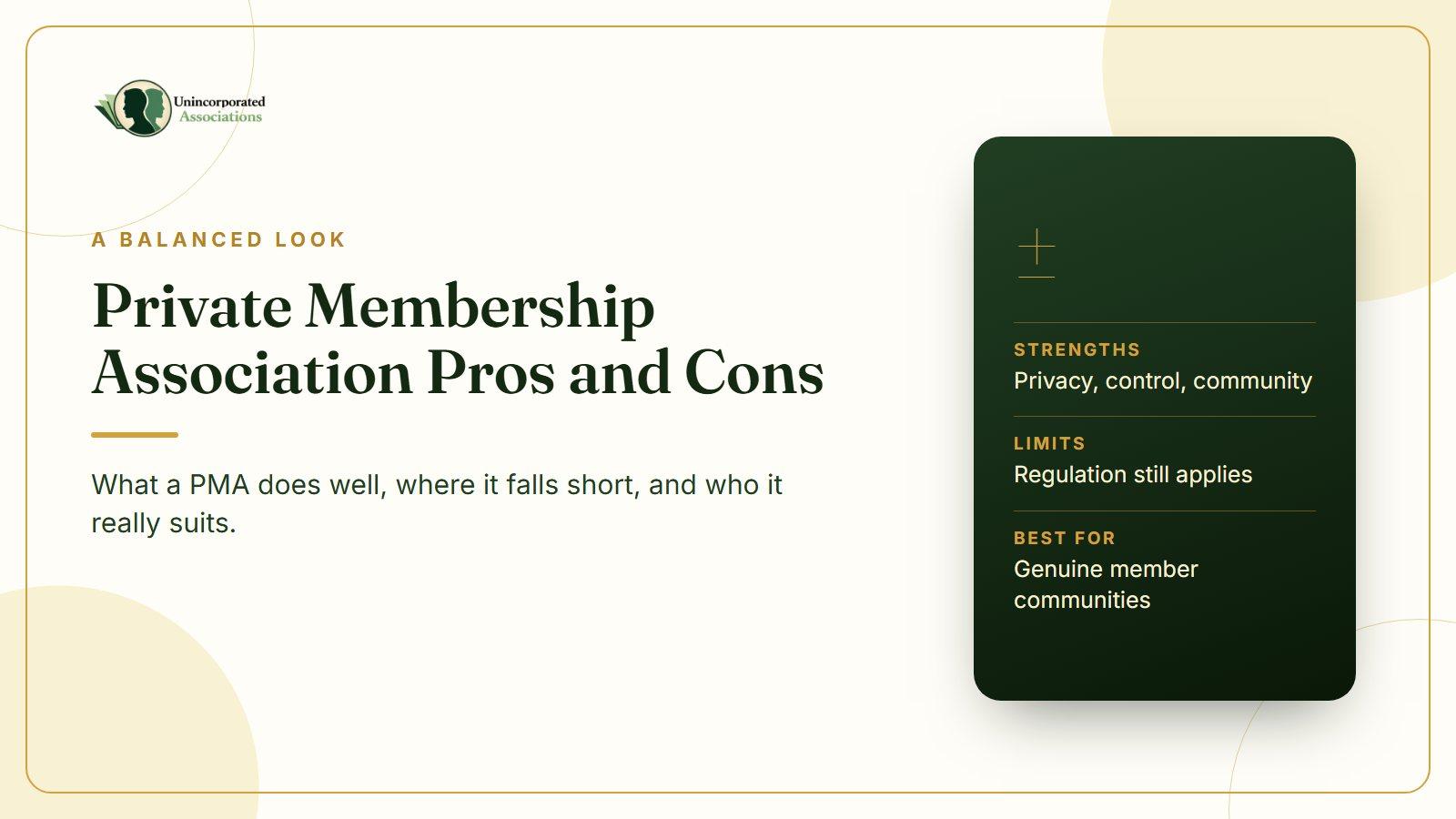
Short answer: The main benefits of a private membership association are privacy of membership, member-written rules, no state formation filing, a clear members-only relationship and a strong sense of community. The main drawbacks are that a PMA does not exempt an activity from licensing, health, civil rights or tax laws; member liability protection depends on state association law; for-profit PMAs risk partnership treatment; and banks and partners may find the structure unfamiliar. A PMA works best for genuine member communities, not as a way around regulation.
PMAs attract strong opinions. Promoters often describe them as a way to step outside the system; critics dismiss them entirely. The truth is in between: a PMA is a lawful, useful structure for the right group, with real limits that anyone forming one should understand.
This guide sets out the advantages and disadvantages honestly, with sources, so you can judge whether a PMA fits your group.
Key takeaways: PMAs offer privacy, control, simplicity and community. They do not offer immunity from regulation, a guaranteed liability shield or a tax exemption by label. They suit selective, member-driven groups with a shared purpose.
The advantages
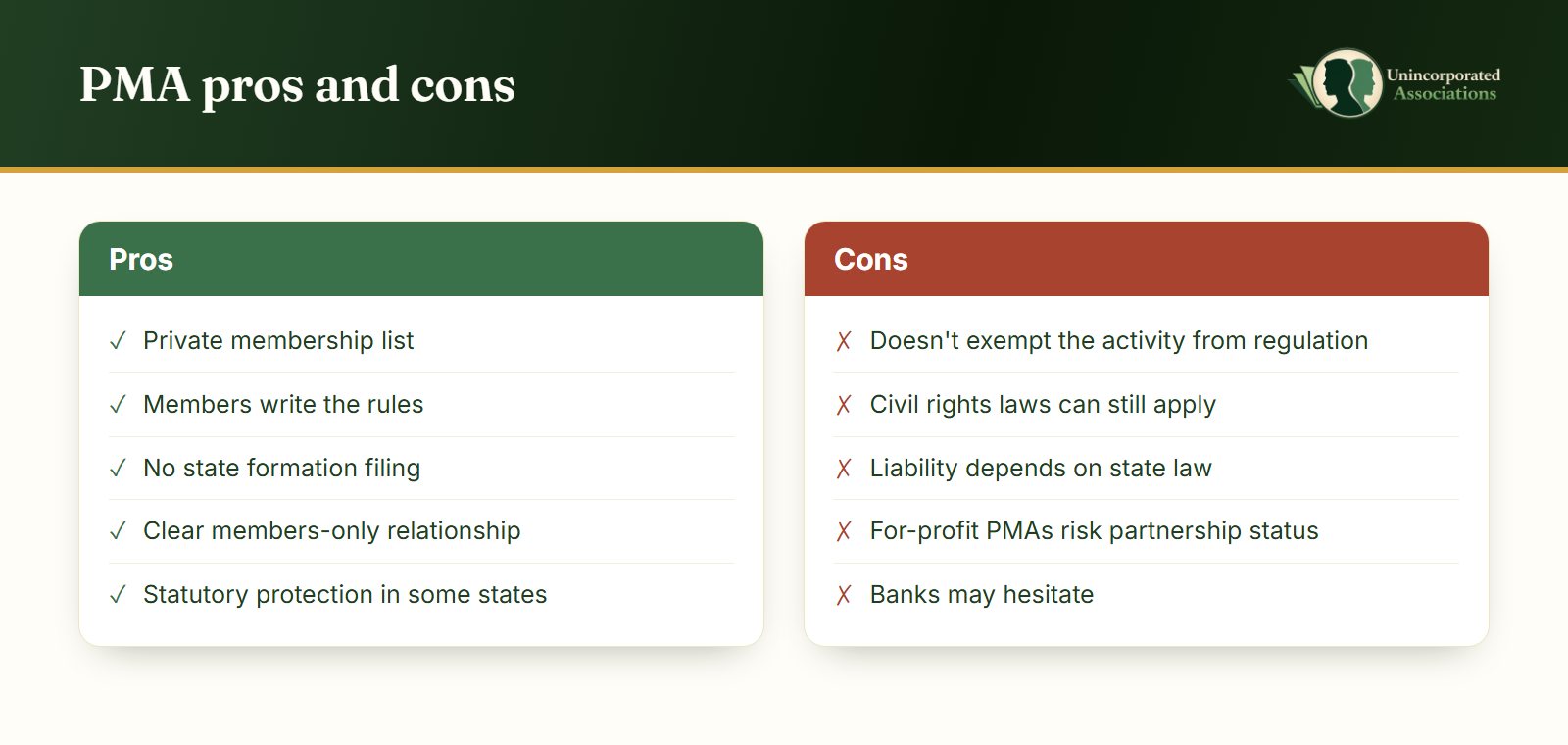
1. Privacy of membership
A PMA keeps its own member register, and no state filing lists its members. The Supreme Court recognized the importance of membership privacy in NAACP v. Alabama, where it barred a state from forcing an association to disclose its members.
2. Members write the rules
The articles, bylaws and membership agreement govern the PMA. Members decide who joins, how decisions are made and what members receive. That makes a PMA a natural home for communities with strong shared values.
3. No state formation filing
A PMA exists when its members sign its documents. California defines an unincorporated association as "two or more persons joined by mutual consent for a common lawful purpose" (Corp. Code § 18035), with no filing required.
4. A clear members-only relationship
The membership agreement defines what members receive and what they agree to. For groups that share knowledge, resources or services among themselves, that clarity is valuable.
5. Real legal standing in many states
In states with modern statutes, a nonprofit PMA can own property and go to court in its own name, and its members are not liable for its debts just for being members (California § 18605; Texas § 252.006).
6. Community and commitment
Because members sign an agreement and often pay dues, PMAs tend to have committed, engaged members, which many groups value more than any legal feature.
The disadvantages
1. It does not exempt the activity from regulation
This is the most important limit. Courts have applied licensing and health rules to members-only operations: a Wisconsin appeals court required a license for raw milk sold to members of a private association (Food Safety News), and a 2023 consent decree in the federal case over Amos Miller's members-only Pennsylvania farm required it to follow state rules (National Agricultural Law Center).
2. Civil rights and public accommodation laws can apply
In Roberts v. United States Jaycees, the Supreme Court allowed a state anti-discrimination law to apply to a large, unselective membership organization. The more open and commercial a PMA is, the less its private character protects it.
3. Liability protection depends on state law
California, Texas and the uniform-act states protect nonprofit association members by statute. Elsewhere, older common-law rules may apply. A PMA does not have the uniform, statute-based shield an LLC has in every state.
4. For-profit PMAs risk partnership treatment
If founders run a business through a PMA and split the profits, the law may treat them as general partners (Tex. Bus. Orgs. Code § 152.051), with personal liability.
5. No tax category of its own
The IRS classifies a PMA by what it does under 26 CFR 301.7701-2. It is not tax-free by label; see our guide on PMAs and the IRS.
6. Banks and partners may hesitate
Some banks, landlords and payment processors are unfamiliar with PMAs. Expect to provide complete documents and explain the structure. Community banks and credit unions are often more willing to take the time; bring your articles, bylaws, EIN confirmation and an officer resolution to the first meeting.
7. Reputation risk
Because some promoters oversell PMAs, some people view them with suspicion. A PMA that is transparent about what it is, and isn't, avoids most of that. Clear documents, honest marketing and a visible commitment to following the law in the activity itself go a long way toward earning trust from members, banks and the public.
Pros vs cons, side by side
| Advantage | The matching limit |
|---|---|
| Private membership | Privacy doesn't override regulation of the activity |
| Member-written rules | Documents must be clear and consistent |
| No formation filing | Less familiar to banks and partners |
| Statutory protection in some states | Protection varies by state |
| Clear member relationship | Only works if every member truly signs first |
| Strong community | Open, commercial PMAs lose their private character |
Watch out: If the main reason you are considering a PMA is to avoid a license, permit or tax, stop and get independent legal advice. That is exactly the use courts have rejected.
Where the pros and cons show up in practice
The homestead skills network (pros win). Sixty families teach each other preserving, carpentry and gardening. Membership is by application, everyone signs the agreement, dues cover tools and venues, and nothing is sold to outsiders. Privacy, member control and community are exactly what they wanted, and no license issue arises because they teach each other rather than sell to the public.
The wellness product shop (cons win). A seller wants to offer supplements to "members" who click a box at checkout, mainly to avoid labeling and licensing rules. Anyone can join instantly, profits go to the seller and the activity is ordinary retail. This is the arrangement courts look past: the PMA adds paperwork without adding protection.
The faith community with a school (mixed). A congregation organized as an association runs worship privately for members, which suits a PMA-style structure well. But its small school serves children from outside the congregation, employs teachers and must meet education, safety and employment rules. The community keeps its member-led association for worship, and treats the school as a regulated operation in its own right.
Questions to ask before you form a PMA
- Would this group still exist if there were no regulatory or tax angle at all?
- Does every member sign before receiving anything?
- Who receives the money, and is that consistent with a shared purpose?
- Does the activity need a license? If yes, have we got it?
- Does our state have a nonprofit association statute, and do our documents fit it?
- Are we prepared to keep minutes, registers and separate books?
If the honest answer to the first question is "no," a PMA is probably not the right tool.
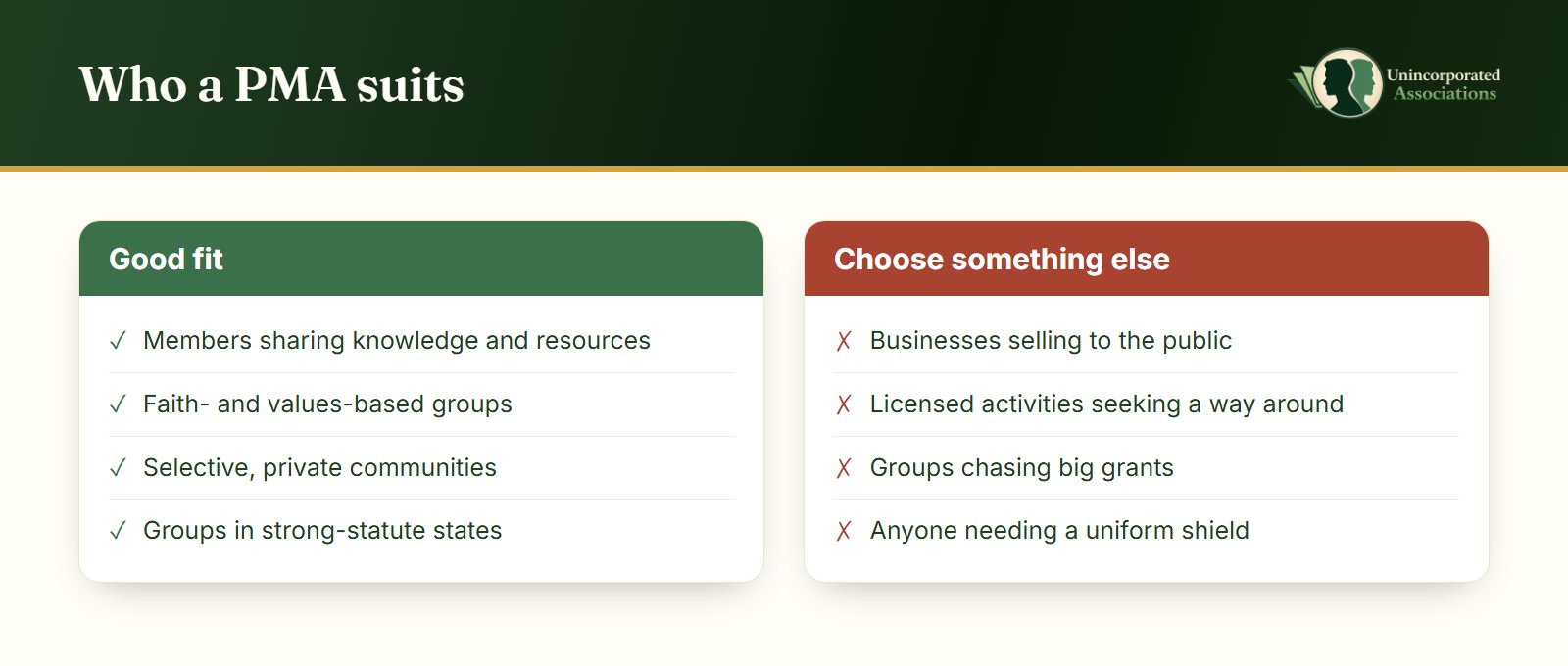
Who a PMA suits
- Communities that share knowledge, skills or resources among themselves
- Faith-based and values-based groups that want member-written governance
- Groups that value privacy and selective membership
- Groups in states with strong association statutes
Who should choose something else
- A business selling to the public for profit: an LLC or corporation fits better
- Activities that need licenses: a PMA does not remove that need
- Groups seeking large institutional grants: a nonprofit corporation may be more familiar to funders
- Anyone wanting a guaranteed liability shield in every state
Making the pros count and the cons small
- Write a genuine shared purpose and make sure the activities match it.
- Make membership real: application, signed agreement, then access. Never the other way round.
- Get the licenses the activity needs, whatever the structure.
- Keep a separate EIN, bank account and books.
- Know your state's association law and draft with it in mind.
- Be transparent with members about what the PMA does and does not do.
Our guides on what a PMA is, how to start one and PMA vs LLC cover each step.
Pro tip: Put a short "What this association is not" paragraph in your membership agreement: not a law firm, not a license substitute, not a tax shelter. It sets honest expectations and protects the association's reputation.
Frequently asked questions
What are the benefits of a private membership association?
Privacy of membership, member-written rules, no state formation filing, a clear members-only relationship and, in many states, real legal standing and member liability protection for nonprofit associations.
What are the downsides of a PMA?
It does not exempt the activity from licensing, health, civil rights or tax laws; liability protection depends on state law; for-profit PMAs risk partnership treatment; and some banks find PMAs unfamiliar.
Is a PMA worth it?
For a genuine members-only community with a shared purpose, often yes. As a way to avoid regulation or taxes, no: courts and the IRS look at substance.
Are PMAs legal?
Yes. Forming a private association is lawful. What courts reject is using the PMA label to avoid laws that apply to the activity.
Can a PMA replace an LLC?
For a business serving the public, no. For a member community, a PMA may be the better fit. Some groups use both, kept strictly separate.
Sources
- NAACP v. Alabama, 357 U.S. 449 (1958)
- Roberts v. United States Jaycees, 468 U.S. 609 (1984)
- California Corporations Code sections 18035 and 18605
- Texas Business Organizations Code sections 152.051 and 252.006
- 26 CFR 301.7701-2
- Food Safety News: Wisconsin raw milk licensing ruling
- National Agricultural Law Center: Amos Miller and the regulation of raw milk
Wondering whether a PMA fits your group? Book a free 15-minute call with Kirk's team, or join the daily live Q&A.
Have questions? Bring them to the daily call.
Join our live Q&A every weekday and Saturday at 3PM PST, or get a free 15-minute call to see whether a UNA fits your situation.
Have a question about your situation?
Send us a message and we'll get back to you.
Keep reading
 The Well-Meaning Dragon: Straight Answers to the Hardest ObjectionsFor the family and friends who push back because they care — honest answers to the toughest questions about the Federal income tax and Unincorporated Associations.
 It's Not What You Believe, It's What You SignFor the cautious partner in the room: real risk rarely comes from asking questions. It comes from what you signed.
 What Most People Get Wrong About Taxes, Structure, and ControlThe real problem isn't taxes — it's structure, and who actually has control. A look at positioning over loopholes.
Educational, not legal or tax advice. Unincorporated Associations is a document-preparation and education company. Consult a licensed attorney or CPA before acting on any position discussed on this site.