Private Membership Associations in California: What the Law Allows
By Kirk Carmichael · · 8 min read
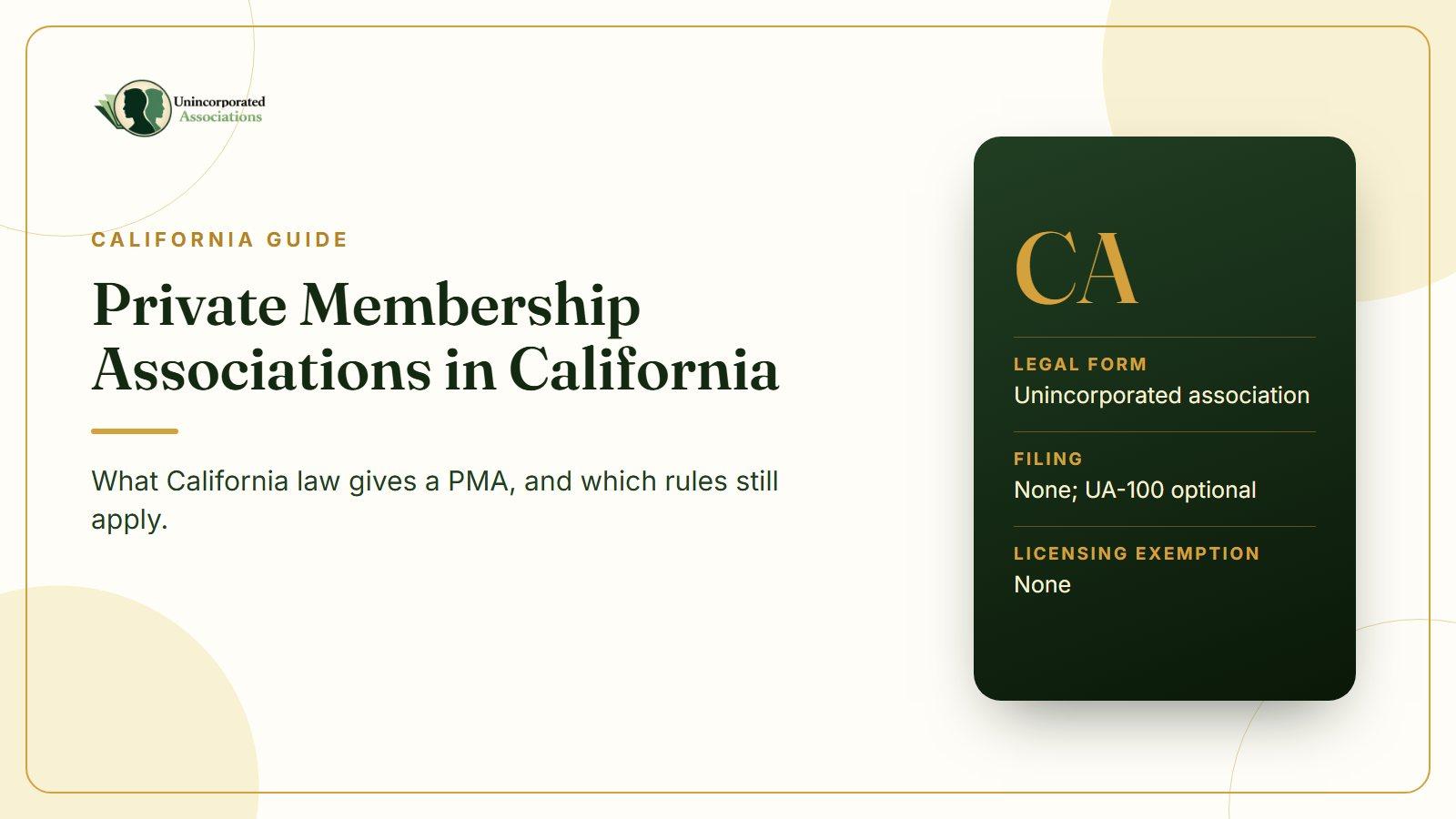
Short answer: In California, a private membership association is an unincorporated association: two or more people joined by mutual consent for a common lawful purpose (Corporations Code § 18035). Nothing is filed to create it. If it is a nonprofit association, California's Corporations Code gives it useful protections, including limits on members' liability for its debts (§ 18605) and the right to hold property in its own name (§ 18105). What a PMA does not do in California is exempt anyone from licensing, health, civil rights or tax law. California courts look at what an organization actually does, not what it calls itself.
California has some of the most developed law on unincorporated associations in the country, so a PMA here sits on solid legal ground as an association. It also has some of the strictest licensing, consumer and civil rights rules, which apply to PMAs just as they apply to everyone else.
This guide explains how California treats a PMA, how to set one up properly, and which California rules a PMA still has to follow. For the general concept, start with what a private membership association is.
Key takeaways: A California PMA is an unincorporated association. As a nonprofit association it gets statutory liability protection and can hold property. It can file an optional UA-100 statement. It must still follow licensing, Unruh Act, tax and consumer rules.
How California law sees a PMA
California's Corporations Code has a full title on unincorporated associations. An unincorporated association is "an unincorporated group of two or more persons joined by mutual consent for a common lawful purpose, whether organized for profit or not" (§ 18035). A nonprofit association is one that does not operate to distribute gains or profits to its members (§ 18020).
That distinction matters for a PMA:
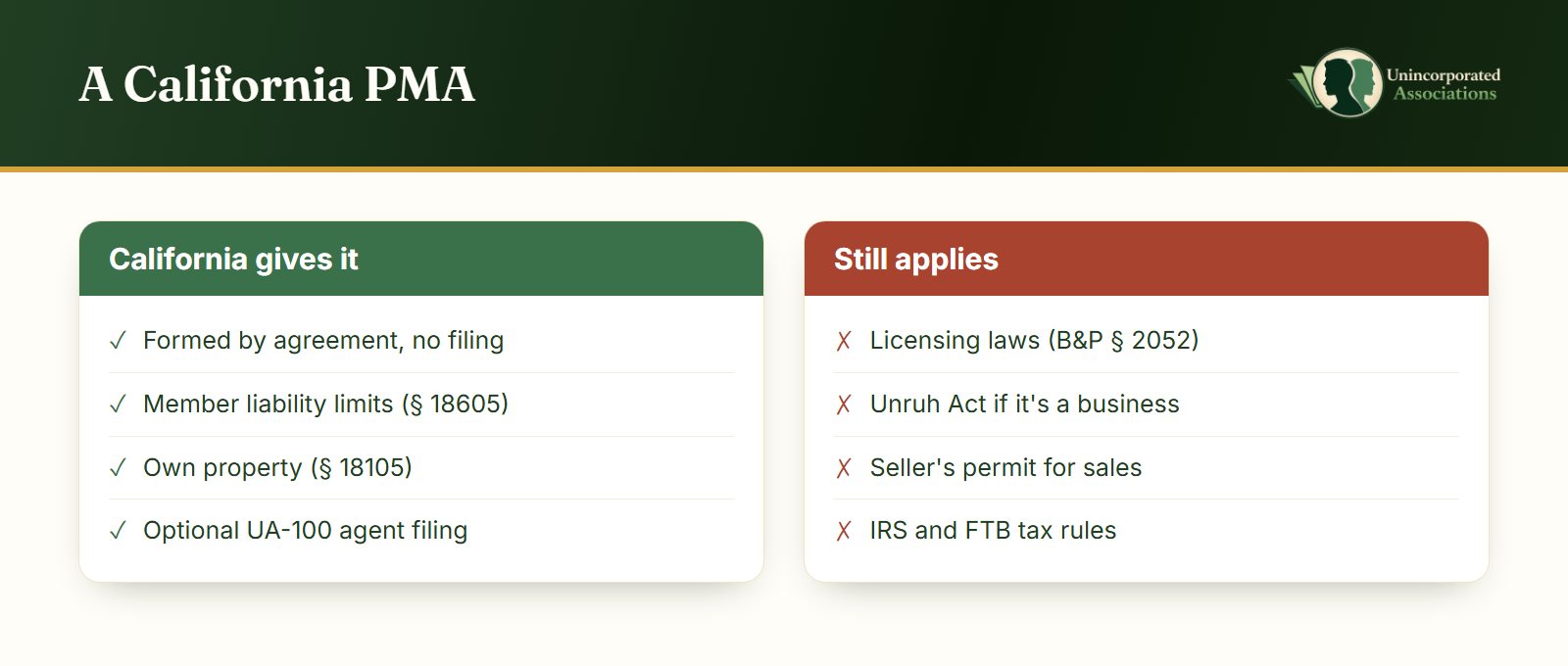
- Nonprofit PMA. Gets California's nonprofit association rules: it can hold property in its own name (§ 18105), and members are not liable for its debts just because they are members (§ 18605).
- Profit-sharing PMA. If members carry on a business as co-owners for profit, California law generally treats it as a partnership (§ 16202), and partners can be personally liable. Calling it a PMA does not change that.
The optional UA-100 statement
A California association can file a Statement by Unincorporated Association (Form UA-100) with the Secretary of State, naming an agent for service of process (§ 18200). It is optional, and many PMAs never file it. It can make it easier for banks and counterparties to confirm the association exists. Our guide to registering an unincorporated association explains when it helps.
What still applies to a California PMA
Professional licensing
California's licensing laws apply to what you do, not to who you do it for. Practicing medicine without a license, for example, is a crime under Business and Professions Code § 2052, and the statute has no exception for services offered only to members. The same logic applies to other licensed professions.
The Unruh Civil Rights Act
The Unruh Act requires "business establishments of every kind whatsoever" to provide full and equal accommodations. Truly private social clubs are generally outside it, but in Warfield v. Peninsula Golf & Country Club (1995), the California Supreme Court held that a private club that regularly did business with nonmembers was a business establishment (opinion summary). The state's Civil Rights Department describes the same rule (Unruh Act FAQ). A PMA that sells to anyone who signs a form may be treated as a business establishment.
Sales tax and seller's permits
Selling tangible goods in California generally requires a seller's permit from the CDTFA, and selling to members is still selling (CDTFA: permits and licenses).
Income tax
Federal classification follows the IRS entity rules (26 CFR 301.7701-2). State exemption requires an application to the Franchise Tax Board (FTB 3500 booklet). See our guide to PMA taxes.
Watch out: A PMA doesn't replace a professional license, a food or health permit, or a seller's permit. California regulators and courts look at the activity, so build those requirements into your plan from day one.
Food and health products
Food made, sold or served to members is still food. California's food safety rules, including the Retail Food Code and the cottage food rules administered by county health departments, turn on the activity, not on whether buyers signed a membership agreement. Courts in other states have rejected the argument that a members-only structure takes food sales outside licensing; see the Wisconsin raw milk ruling. Check with your county before any food or health product changes hands.
Questions to answer before you launch a California PMA
Settle these before you sign up your first member:
- Which California statute do you rely on, and what does it actually say?
- Will members share profits? If so, why isn't this a partnership?
- Which of our activities need a license or permit, and how does the PMA handle that?
- Will we deal with nonmembers at all, and how does that affect the Unruh Act?
- Who is liable if a member is harmed?
Answer each one in writing. Kirk's team can walk through them with you on a free call.
A California PMA at a glance
| Question | California answer |
|---|---|
| Filing to form? | None; optional UA-100 |
| Members' liability | Limited for nonprofit associations (§ 18605) |
| Own property? | Yes, as a nonprofit association (§ 18105) |
| Licensing exemption? | No (e.g., B&P § 2052) |
| Unruh Act exemption? | Only if truly private, not a business establishment |
| Tax exemption automatic? | No; IRS and FTB rules apply |
How to set up a PMA in California
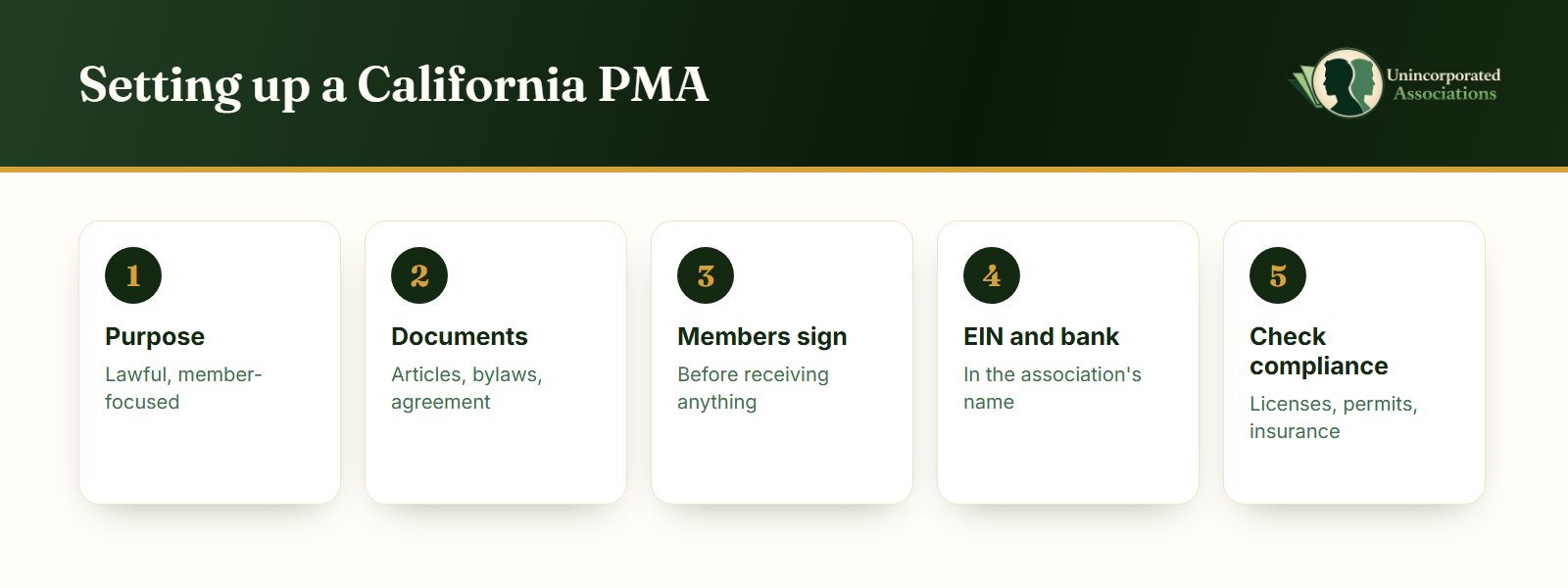
Step 1: Define a lawful, member-focused purpose
Write the purpose clearly. If members will share profits, consider an LLC instead; see PMA vs LLC.
Step 2: Draft the documents
You will need articles of association, bylaws, a membership agreement and a member register. Our guide to PMA documents covers each one.
Step 3: Recruit founding members and sign
Members sign before receiving anything. Keep the signed agreements.
Step 4: Appoint officers and record it
Record who the officers are and who may sign for the association.
Step 5: Get an EIN and bank account
Apply on Form SS-4 and open an account in the association's name. See our guide to the CP 575 EIN letter.
Step 6: Consider the UA-100
File it if banks or counterparties want a public record of the association.
Step 7: Check licenses, permits and insurance
List every activity and check whether it needs a license, permit or seller's permit. Insure the association.
Pro tip: Keep membership real. Require a signed agreement before any service, record approvals in the register, and keep non-member activity out. That is what makes a PMA private, and it is what courts look at.
Is a California PMA right for you?
A PMA fits well when the group is genuinely member-led, values privacy, has a nonprofit purpose and is not using the structure to avoid a license or permit. It fits poorly when the real goal is a profitable business with customers, which is better served by an LLC or corporation, or when the main appeal is escaping regulation, which it will not deliver. If you are unsure, compare it with the alternatives in our PMA pros and cons guide.
Three California examples
A Sonoma seed-saving collective where members share heirloom seeds and gardening knowledge. Nonprofit, member-only, no licensed activity. A good fit for a California PMA.
A Los Angeles wellness group offering member-only education sessions led by a licensed practitioner, with any treatment given under that practitioner's license. Workable, if the licensed work follows the practitioner's licensing rules.
A San Diego "PMA" selling supplements to anyone who clicks "I agree." It is functionally a retail business: it needs a seller's permit and may be a business establishment under the Unruh Act. A real membership process and clear documents would change that picture.
Common mistakes in California
- Treating the PMA as a licensing workaround.
- Letting anyone become a "member" instantly, which undercuts privacy.
- Using a generic template that doesn't fit California's association law.
- Skipping the seller's permit for goods sold to members.
- Assuming the association is tax-exempt without IRS or FTB recognition.
Frequently asked questions
Is a private membership association legal in California?
Yes. A PMA is an unincorporated association under California's Corporations Code. It must follow the same licensing, civil rights, consumer and tax laws as anyone else.
Do I have to register a PMA in California?
No. Filing a UA-100 with the Secretary of State is optional.
Are PMA members personally liable in California?
For a nonprofit association, members are not liable for its debts just because they are members (§ 18605). A profit-sharing PMA may be a partnership, where partners can be liable.
Can a California PMA provide medical services to members?
Only through properly licensed professionals. California's licensing laws, such as B&P § 2052, have no exception for members-only services.
Does a California PMA pay taxes?
It depends on its classification and activities. Exemption requires IRS recognition and an FTB application. See our guide to PMA taxes.
Sources
- California Corporations Code § 18020, § 18035, § 18105, § 18200, § 18605 and § 16202
- California Business and Professions Code § 2052
- California Civil Code § 51 (Unruh Civil Rights Act)
- Warfield v. Peninsula Golf & Country Club (1995) 10 Cal.4th 594
- California Civil Rights Department: Unruh Act FAQ
- CDTFA: permits and licenses
- California Franchise Tax Board: Form 3500 booklet
- IRS: Form SS-4
Setting up a PMA in California? Book a free 15-minute call with Kirk's team, or join the daily live Q&A.
Have questions? Bring them to the daily call.
Join our live Q&A every weekday and Saturday at 3PM PST, or get a free 15-minute call to see whether a UNA fits your situation.
Have a question about your situation?
Send us a message and we'll get back to you.
Keep reading
 The Well-Meaning Dragon: Straight Answers to the Hardest ObjectionsFor the family and friends who push back because they care — honest answers to the toughest questions about the Federal income tax and Unincorporated Associations.
 It's Not What You Believe, It's What You SignFor the cautious partner in the room: real risk rarely comes from asking questions. It comes from what you signed.
 What Most People Get Wrong About Taxes, Structure, and ControlThe real problem isn't taxes — it's structure, and who actually has control. A look at positioning over loopholes.
Educational, not legal or tax advice. Unincorporated Associations is a document-preparation and education company. Consult a licensed attorney or CPA before acting on any position discussed on this site.