How to Register an Unincorporated Association (and Whether You Have To)
By Kirk Carmichael · · 8 min read
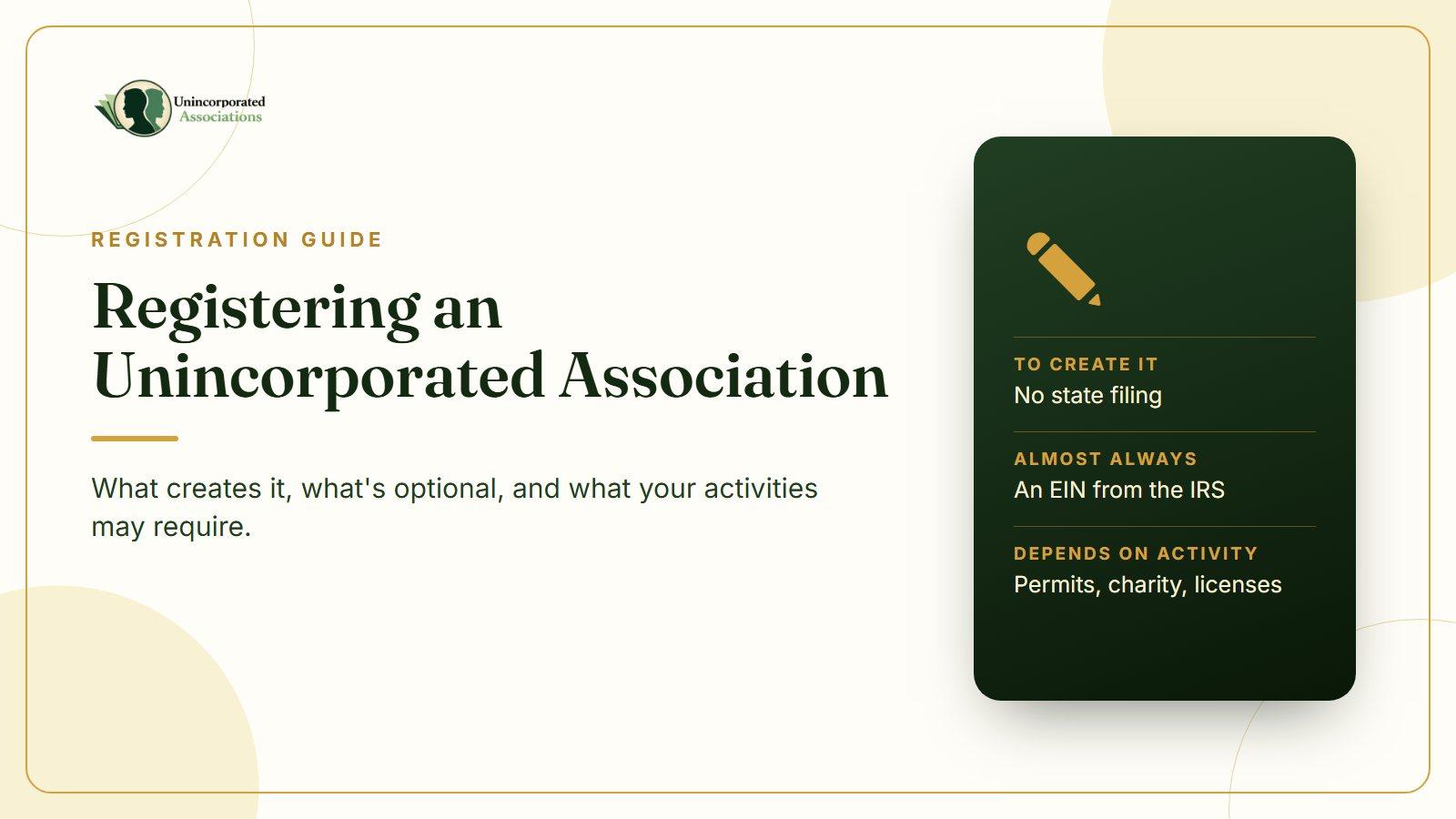
Short answer: You do not register an unincorporated association with the state to create it; it exists once its members agree to form it. What you may need to register depends on what the association does: almost every association needs an EIN from the IRS; some states offer optional filings (California's Form UA-100, Texas's Form 706) to record an address and an agent; and activities can trigger other registrations, such as a seller's permit, a fictitious business name, charity registration or local licenses.
"How do I register my association?" is one of the most searched questions about unincorporated associations, and the honest answer surprises people: there is no registration that creates one. But that does not mean there is nothing to file. Depending on your state and activities, several registrations may apply.
This guide sorts them into three groups: what creates the association, what is optional but useful, and what your activities may require.
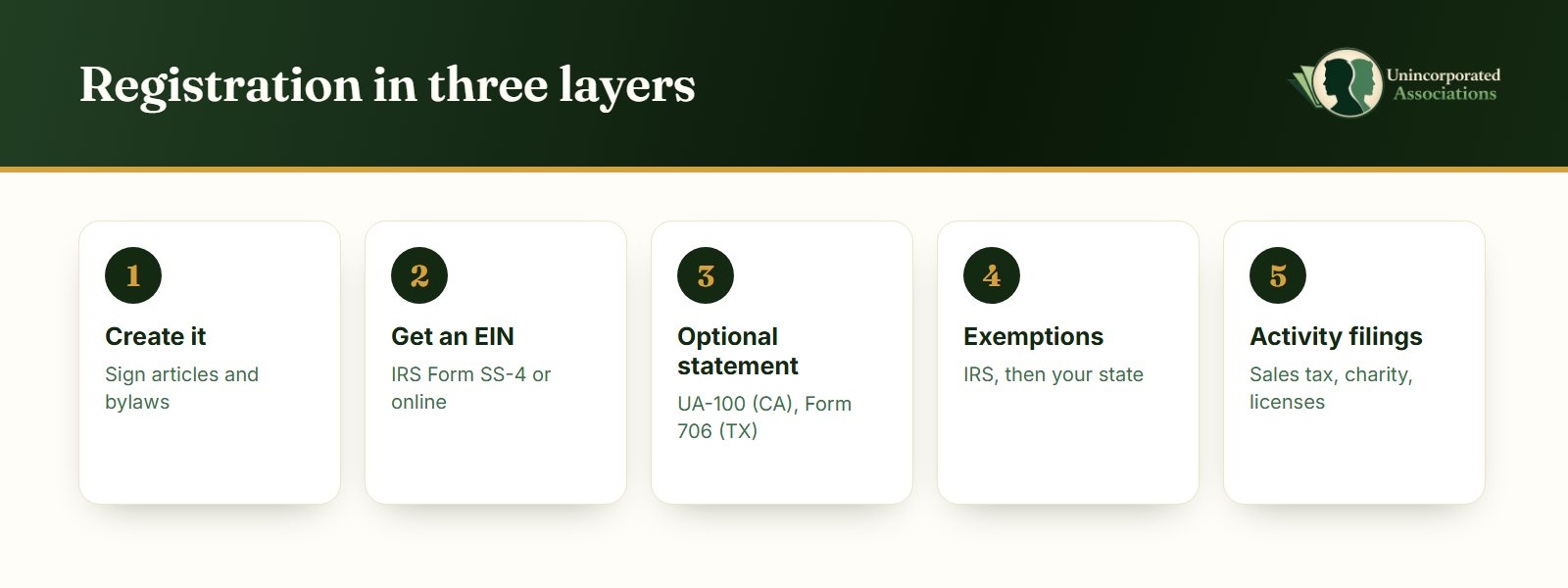
Key takeaways: Signing the governing documents creates the association; no state filing is needed. Get an EIN. Consider your state's optional statement (UA-100 in California, Form 706 in Texas). Then check activity-based registrations: sales tax, fictitious names, charity registration and local licenses.
What creates the association (no filing)
An unincorporated association comes into existence by agreement. California defines it as "two or more persons joined by mutual consent for a common lawful purpose" (Corp. Code § 18035); Texas defines a nonprofit association as three or more members joined by mutual consent for a common nonprofit purpose (Bus. Orgs. Code § 252.001). Neither definition involves a state filing.
So the "registration" that matters first is internal:
- Sign the articles of association stating the name and purpose.
- Adopt bylaws.
- Record the officers and who may sign.
- Keep a member register.
Our guide on how to become an unincorporated association covers these documents.
Registration almost every association needs: the EIN
An Employer Identification Number is the association's federal tax ID. You need one to open a bank account, file any tax return, apply for exemption or hire anyone. Apply with Form SS-4 or online; the IRS confirms it with a CP 575 notice.
Pro tip: Use the association's exact legal name from the articles on the EIN application. A one-word difference between the IRS record and your documents is the most common reason banks delay opening accounts.
Optional state filings worth considering
Some states let associations file a short statement that records an address and an agent to receive legal papers. These filings do not create the association or change its status, but they make it easier for courts, banks and partners to deal with it.
| State | Filing | What it records | Notes |
|---|---|---|---|
| California | Statement by Unincorporated Association (Form UA-100), under Corp. Code § 18200 | Principal office address and/or agent for service of process | Optional; expires five years after the December 31 following filing |
| Texas | Statement appointing agent (Form 706), under Bus. Orgs. Code § 252.011 | Name, EIN if any, Texas address, agent | Optional; small filing fee |
| Uniform-act states | Statements appointing an agent; statements of authority for real estate | Agent; who may transfer real property | Names and forms vary by state |
Real estate deserves its own note. California (§ 18120) and Texas (§ 252.005) let an association record a statement of authority in the county, naming who may sell or mortgage its real property. Title companies will ask for it.
Our California and Texas guides walk through these filings in detail.
Registrations your activities may require
These depend on what the association does, not on its legal form.
Sales tax permits
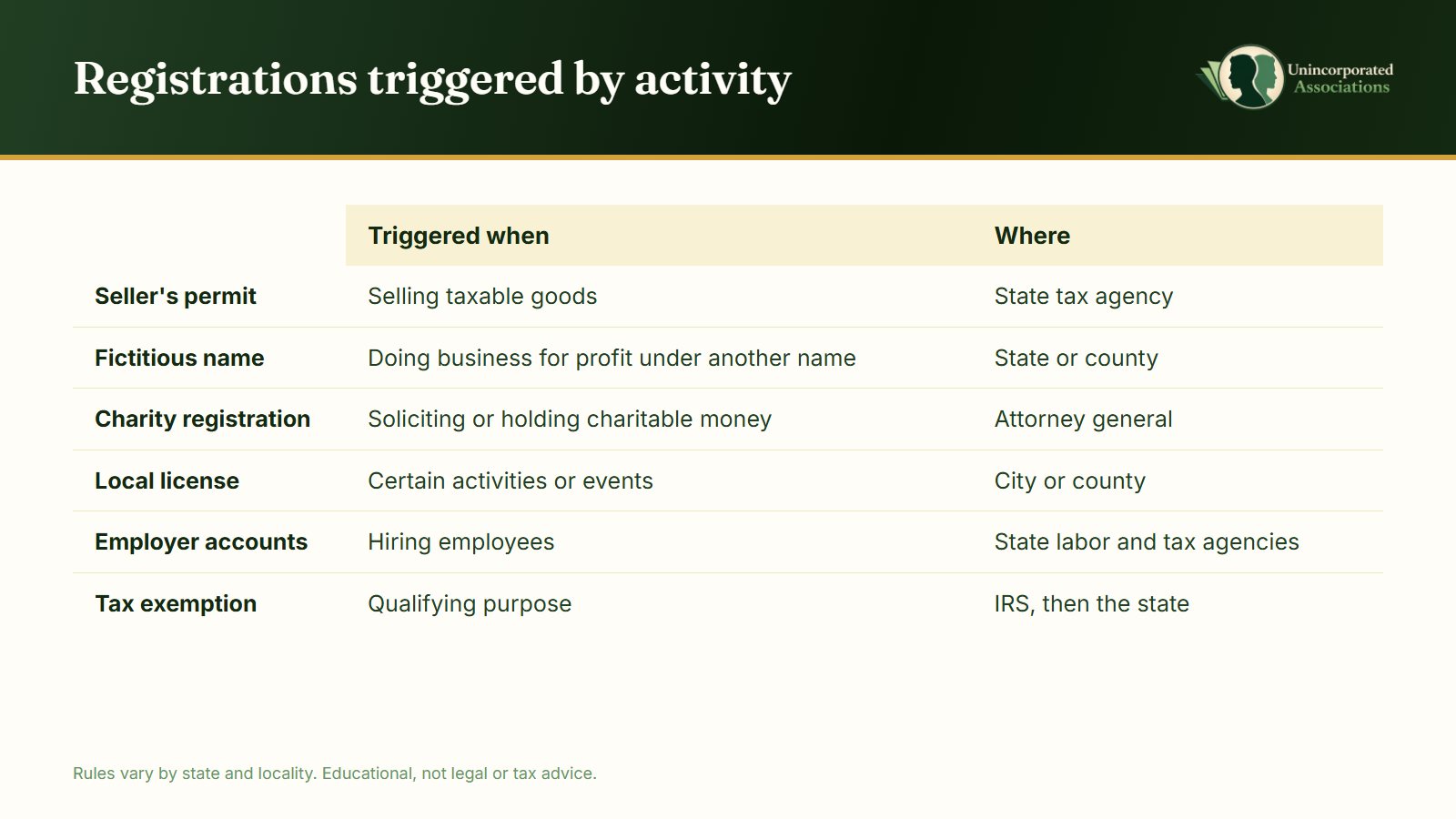
If the association sells taxable goods, most states require a seller's permit or sales tax registration, whatever the structure. Check with your state's tax agency before selling anything, including at events.
Fictitious business name (DBA)
If an association transacts business for profit under a name other than its legal name, a fictitious name filing may be required. California's rule, for example, applies to "every person who regularly transacts business in this state for profit under a fictitious business name" (Bus. & Prof. Code § 17910). Rules and exemptions vary by state and county.
Federal tax exemption
Exemption is not a registration in the usual sense, but it is the filing many associations care about most. Most 501(c)(3) charities apply on Form 1023 or 1023-EZ; churches, very small charities and most other 501(c) categories are not required to apply, though they can. See our guide on whether an unincorporated association is tax exempt.
State tax exemption
States run their own processes, such as California's Form FTB 3500 (FTB booklet) or the Texas Comptroller's exempt organization process.
Charity registration
Associations that solicit or hold money for charitable purposes may need to register with the state attorney general or another regulator. In California, that is the Attorney General's Registry of Charities and Fundraisers. Other states' regulators are listed by the National Association of State Charity Officials.
Local business licenses and permits
Cities and counties may require licenses or permits for certain activities, events, food service or use of premises. The SBA's guide to licenses and permits explains how to find what applies locally.
Employer registrations
If the association hires employees, it must register with the state for withholding and unemployment insurance, in addition to federal payroll filings.
Watch out: "Unincorporated" does not mean "unregulated." If the activity needs a license, permit or registration when a business does it, assume it needs one when an association does it too.
Operating in more than one state
Associations whose members live in several states often ask where to register. The association is usually governed by the law of the state where it is principally located or where its documents say it is organized. Activities can still create obligations elsewhere: holding events, selling goods, employing people or soliciting donations in another state can trigger that state's tax, licensing or charity registration rules. If your association is active in several states, list each state's activities and check each one separately.
Keeping registrations current
Registrations go stale when officers, addresses or activities change. Build three habits:
- Update the IRS with Form 8822-B within 60 days when the responsible party or address changes.
- Refresh state statements before they expire (California's UA-100 expires five years after the December 31 following filing) and whenever the agent changes.
- Review once a year at the annual members' meeting: are all registrations still accurate, and has any new activity triggered a new one?
A short annual review prevents most compliance problems before they become expensive.
Three examples
A neighborhood book club. Ten members, dues of $20 a year, no sales. Needs: signed documents and, once it opens a bank account, an EIN. Nothing else.
A community garden association. It sells vegetables at a weekend market and has a dedicated plot on leased land. Needs: an EIN and bank account, possibly a seller's permit for the market sales, and a written lease in the association's name signed by an authorized officer. A California association might also file a UA-100 so the landlord has an official address for notices.
A charitable education association. It raises donations from the public to run free classes. Needs: an EIN, an exemption application, state charity registration where required, and state tax exemption. If it hires a coordinator, employer registrations too.
Common mistakes
- Searching for a "registration" that creates the association. There isn't one; the documents do that.
- Opening a bank account before the EIN and documents are ready.
- Letting a California UA-100 expire. Calendar the five-year date.
- Selling at events without checking sales tax rules.
- Soliciting donations without checking charity registration.
- Using a trade name without checking fictitious-name rules.
Your registration checklist
- Articles and bylaws signed; officers recorded
- EIN obtained and CP 575 stored safely
- Bank account opened in the association's name
- Optional state statement considered (UA-100, Form 706 or your state's version)
- Statement of authority recorded if the association owns real estate
- Exemption applications filed, if you qualify
- Sales tax, fictitious name, charity and local registrations checked against your activities
- Employer registrations completed, if you hire
Frequently asked questions
Do unincorporated associations need to be registered?
Not to exist. An association is created by its members' agreement. But it will usually need an EIN, and its activities may require other registrations, such as sales tax permits or charity registration.
Can I register my association with the Secretary of State?
Some states let you file an optional statement, such as California's Form UA-100 or Texas's Form 706, to record an address and an agent for service of process. It doesn't create the association, but it can be useful.
Is getting an EIN the same as registering the association?
No. An EIN is a federal tax ID. It lets the association open a bank account and file returns, but it does not create the association or make it tax-exempt.
Do I need a DBA for my association?
Only if your state's fictitious name law applies to how you operate. In California, the requirement applies to anyone who regularly transacts business for profit under a fictitious name. Check your state and county rules.
Do I need to register a nonprofit association as a charity?
If it solicits or holds money for charitable purposes, your state may require charity registration and annual reports. Check with your state's charity regulator.
Sources
- California Corporations Code sections 18035, 18120 and 18200
- California Business and Professions Code section 17910
- Texas Business Organizations Code sections 252.001, 252.005 and 252.011
- IRS: Form SS-4
- California Franchise Tax Board: Form 3500 booklet
- California Attorney General: Registry of Charities and Fundraisers
- National Association of State Charity Officials
- SBA: Apply for licenses and permits
Not sure which registrations apply to your association? Book a free 15-minute call with Kirk's team, or join the daily live Q&A.
Have questions? Bring them to the daily call.
Join our live Q&A every weekday and Saturday at 3PM PST, or get a free 15-minute call to see whether a UNA fits your situation.
Have a question about your situation?
Send us a message and we'll get back to you.
Keep reading
 The Well-Meaning Dragon: Straight Answers to the Hardest ObjectionsFor the family and friends who push back because they care — honest answers to the toughest questions about the Federal income tax and Unincorporated Associations.
 It's Not What You Believe, It's What You SignFor the cautious partner in the room: real risk rarely comes from asking questions. It comes from what you signed.
 What Most People Get Wrong About Taxes, Structure, and ControlThe real problem isn't taxes — it's structure, and who actually has control. A look at positioning over loopholes.
Educational, not legal or tax advice. Unincorporated Associations is a document-preparation and education company. Consult a licensed attorney or CPA before acting on any position discussed on this site.