How to Form an Unincorporated Association in Pennsylvania (2026 Guide)
By Kirk Carmichael · · 8 min read
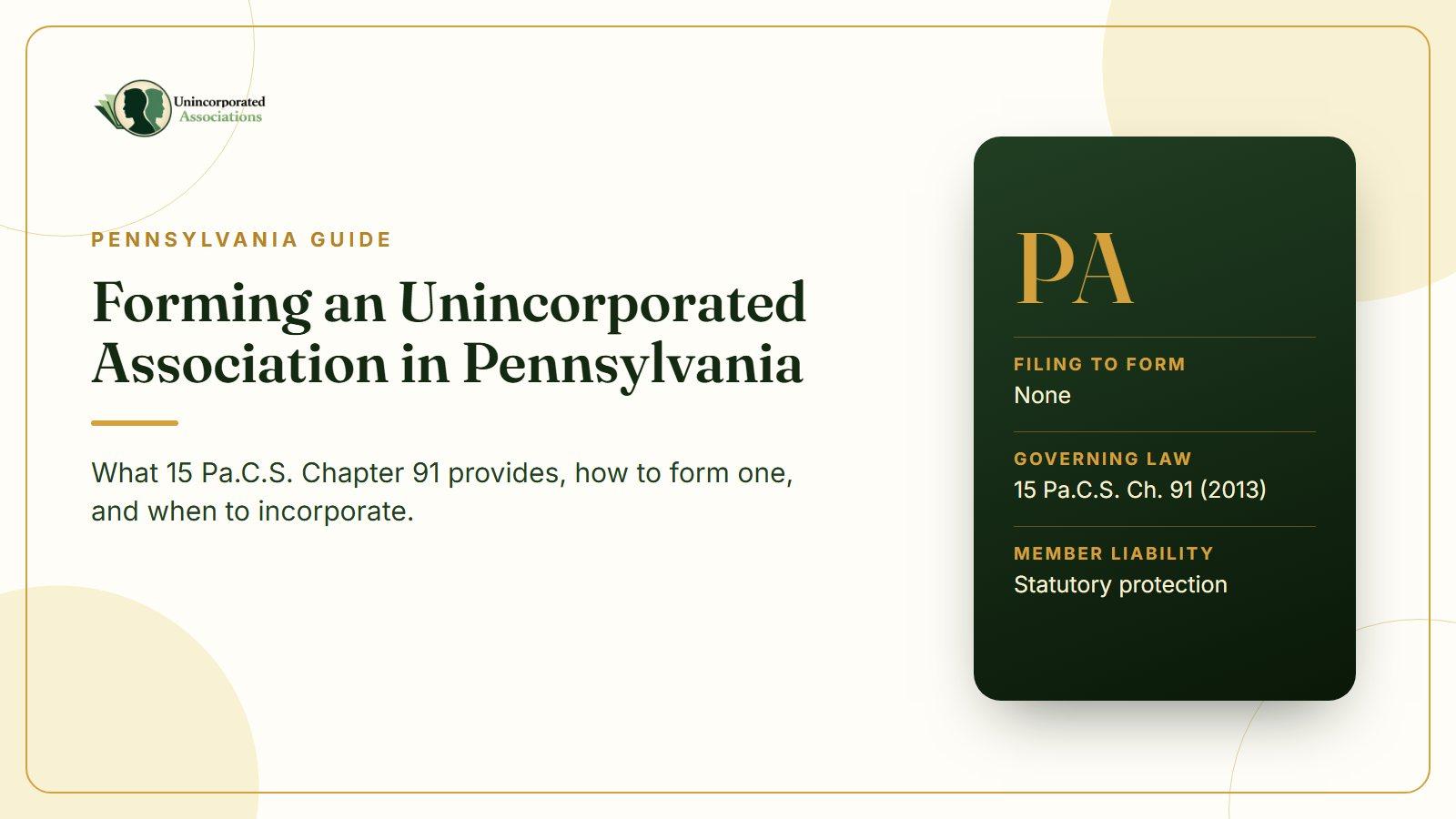
Short answer: In Pennsylvania, a nonprofit association is formed when two or more members agree, orally, in writing or by their conduct, to pursue one or more common nonprofit purposes; nothing is filed with the state to create it. Since 2013, Pennsylvania's Uniform Unincorporated Nonprofit Association Law (15 Pa.C.S. Chapter 91) has given these associations modern rules: a judgment against the association is not a judgment against its members, agents who contract for it are protected, and it can sue and be sued, with lawsuits surviving changes in membership. For-profit groups are not covered, and many growing associations still incorporate under the Nonprofit Corporation Law.
Pennsylvania is one of the states that took the modern route. In 2013 it added a uniform nonprofit association law to Title 15 of its consolidated statutes, joining states like Texas in giving nonprofit associations clear statutory rules instead of leaving them to old common-law doctrines.
This guide explains what Chapter 91 provides, how to form an association in Pennsylvania, what it does not cover, and when a Pennsylvania nonprofit corporation is the better choice.
Key takeaways: No filing is needed. Chapter 91 covers nonprofit associations of two or more members. Members are not liable for the association's judgments just because they are members, and agents who contract for it are protected. The law does not cover for-profit groups. Incorporate when property, staff, funders or risk call for it.
What Pennsylvania law says
Pennsylvania's Uniform Unincorporated Nonprofit Association Law, 15 Pa.C.S. Chapter 91, was added by Act 67 of 2013, signed July 9, 2013. Its key rules:
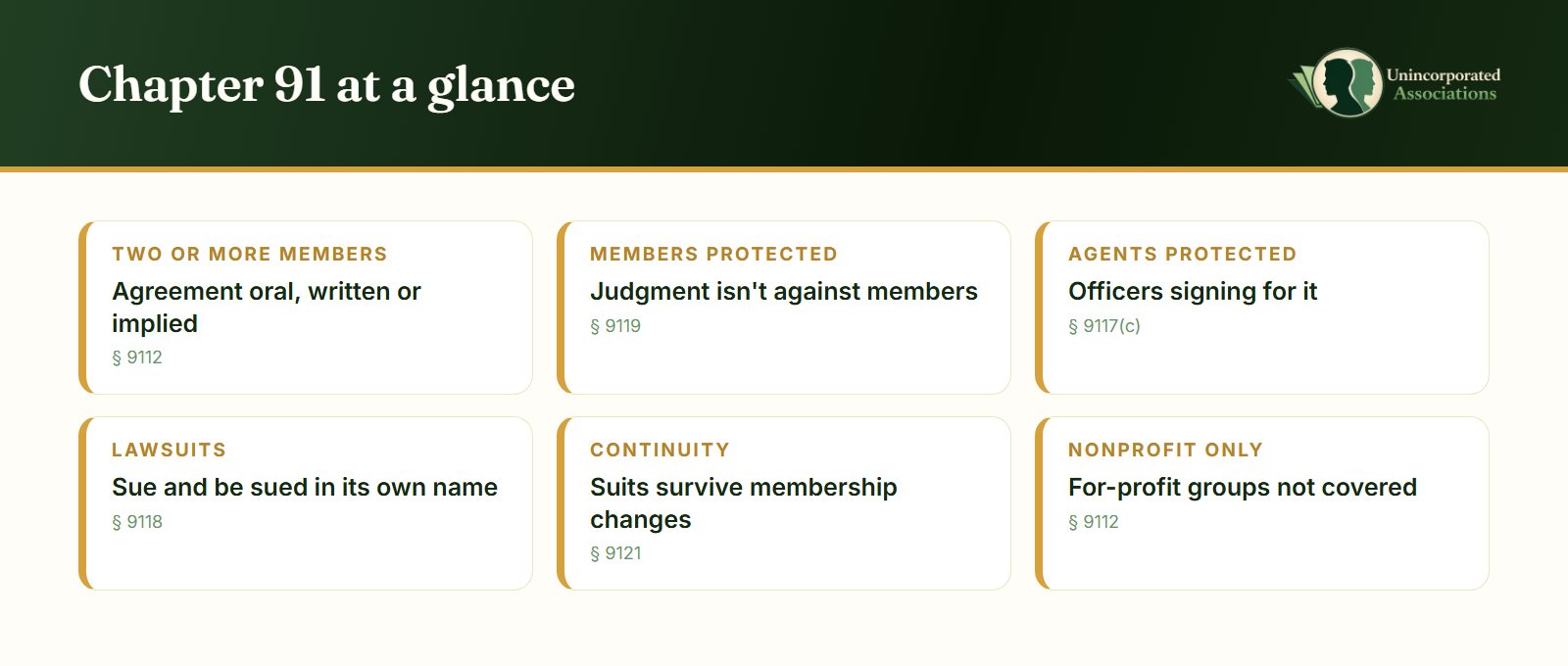
- What counts (§ 9112). A nonprofit association is an unincorporated organization of two or more members joined under an agreement, which may be oral, in a record or implied from conduct, for one or more common nonprofit purposes.
- Member protection (§ 9119). A judgment against the association is not, by itself, a judgment against a member, and members are not personally liable for the association's debts merely because they are members.
- Agent protection (§ 9117(c)). A person acting as an agent of the association, such as an officer signing a contract for it, is not personally liable on that contract just because they acted as its agent.
- Lawsuits (§ 9118). The association can sue and be sued in its own name, and can assert claims on behalf of its members in some circumstances (§ 9118(c)).
- Continuity (§ 9121). A lawsuit by or against the association does not end because its membership or officers change.
The uniform act behind Pennsylvania's law is explained in our guide to the Uniform Unincorporated Nonprofit Association Act.
Why the 2013 law matters
Before Chapter 91, Pennsylvania associations lived with the old common-law view that an unincorporated association was simply its members. That created practical problems: suing or being sued meant dealing with members individually, members who took part in a decision could face personal exposure for the group's debts, and a change in membership could disrupt pending litigation.
Chapter 91 replaced much of that uncertainty with clear statutory rules. For a small nonprofit group, it means you can operate with real protection without filing anything with the state, as long as the group keeps its nonprofit character and acts through clearly authorized officers. It also means Pennsylvania guidance written before 2013 may be out of date, so check the date on any article or form you rely on.
How Pennsylvania compares
| Pennsylvania | New York | Illinois | |
|---|---|---|---|
| Filing to form | None | None | None |
| Governing law | 15 Pa.C.S. Ch. 91 (uniform act) | General Associations Law | 735 ILCS 5/2-209.1 plus common law |
| Sue and be sued | In own name (§ 9118) | Through president or treasurer | In own name |
| Member liability | Statutory protection (§ 9119) | Only if all authorized (Martin v. Curran) | Common-law principles |
| Agent protection | Statutory (§ 9117(c)) | Common law | Common law |
Compare our New York and Illinois guides.
What Chapter 91 does not cover
The law applies to nonprofit associations. Three limits matter:
- For-profit groups. If members run a business to share its profits, Chapter 91 does not apply. That arrangement is generally a partnership, and partners can be personally liable.
- Your own conduct. Member protection covers the association's liabilities. It does not protect a member or officer from liability for their own wrongful acts, or for debts they personally guarantee.
- Tax status. Being a nonprofit association under state law is not the same as being tax-exempt. Federal exemption requires IRS recognition, and state sales tax exemption has its own application.
Watch out: "Nonprofit" under Chapter 91 means the association is not run to distribute profits to members. It does not mean the group is automatically tax-exempt or that donations to it are tax-deductible.
Step by step: forming an association in Pennsylvania
Step 1: Confirm a nonprofit purpose
Chapter 91 covers groups with common nonprofit purposes. Write the purpose down, and make sure no profits will be distributed to members.
Step 2: Gather at least two members
The statutory definition requires two or more.
Step 3: Put the agreement in writing
The law accepts oral or implied agreements, but a written agreement avoids disputes. Sign articles of association covering the name, purpose, membership, officers, money, amendments and dissolution. If you may seek exemption, add the IRS purpose and dissolution language (IRS: 501(c)(3) requirements).
Step 4: Adopt bylaws
Cover meetings, voting, officers, signing authority, records and disputes. See our guide to UNA bylaws.
Step 5: Appoint officers
Record who the officers are and who may sign for the association.
Step 6: Get an EIN and open a bank account
Apply with Form SS-4, keep the CP 575 letter, and open an account in the association's name.
Step 7: Insure and document
Carry insurance suited to your activities and keep minutes of major decisions.
Pro tip: Sign every contract as "[Association name], by [name], [title]." Chapter 91's agent protection works best when the record clearly shows the officer was acting for the association.
Taxes and registrations in Pennsylvania
- Federal: classification follows the IRS entity rules (26 CFR 301.7701-2). See how unincorporated associations are taxed.
- Pennsylvania sales tax: qualifying charitable, religious and similar organizations apply to the Department of Revenue for a sales tax exemption, now available online as well as on the REV-72 paper form (PA Revenue announcement).
- Charitable solicitation: organizations soliciting contributions in Pennsylvania may need to register with the Department of State's Bureau of Corporations and Charitable Organizations (PA Department of State: charities).
When to incorporate in Pennsylvania
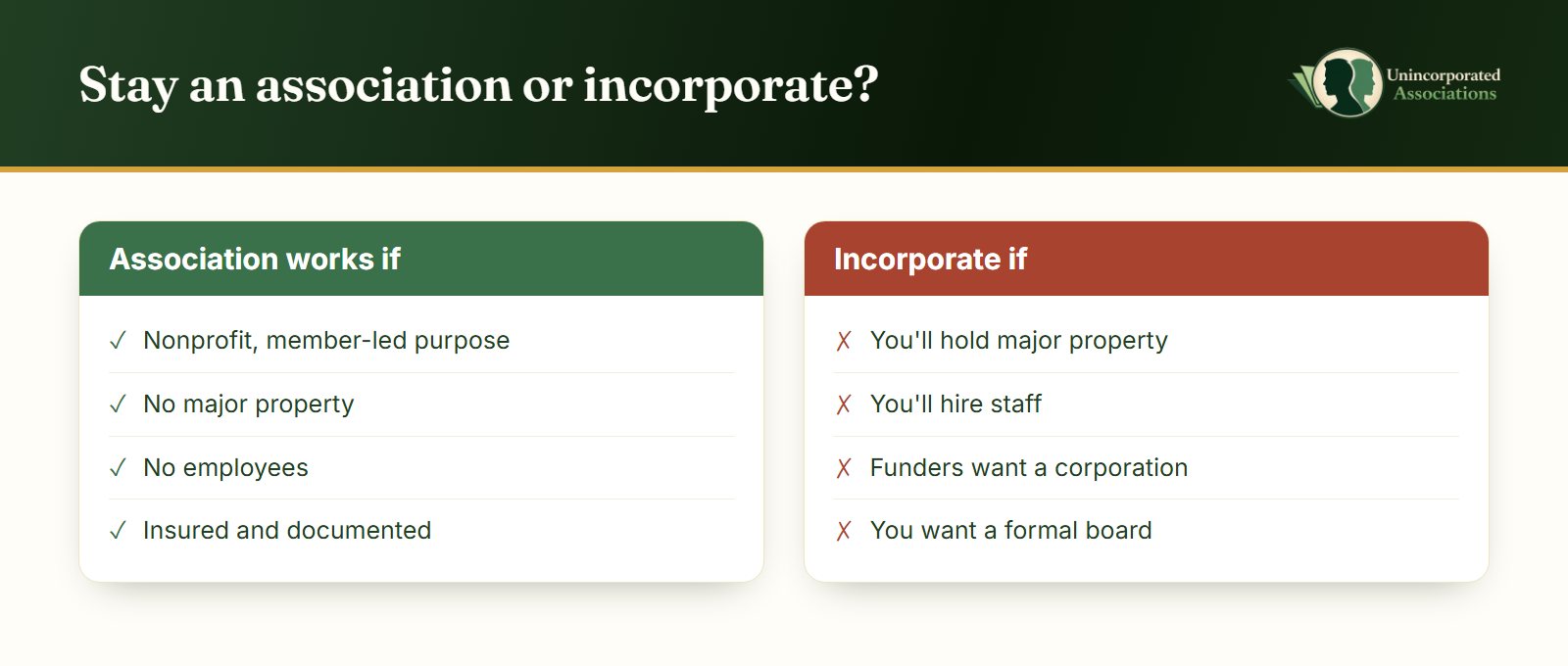
Chapter 91 gives Pennsylvania associations solid protection, so incorporating is a choice, not a necessity. Consider a Pennsylvania nonprofit corporation, formed with the Department of State, when:
- the group will hold significant property or sign long leases
- it will hire employees
- funders, lenders or landlords require a corporation
- it wants a standardized board structure
Pennsylvania's Nonprofit Corporation Law also provides a procedure for incorporating an existing unincorporated association (15 Pa.C.S. § 5331). Our guide to incorporated vs unincorporated associations explains how to plan the move.
Three Pennsylvania examples
A Philadelphia community garden with a dozen members, small dues and a city license for its lot. It is a nonprofit association under Chapter 91, signs its license in the association's name, and buys a modest liability policy.
A Pittsburgh youth robotics club run by parents, raising money for competition fees. It stays an association, keeps written parent agreements and, before soliciting the wider public, checks whether it must register as a charity.
A Harrisburg alumni chapter collecting dues for scholarships and reunions. Nonprofit and member-led, so Chapter 91 applies; it keeps a simple ledger, minutes and a bank account in the chapter's name.
Common mistakes in Pennsylvania
- Treating Chapter 91 as covering any group. It covers nonprofit associations only.
- Relying on an oral agreement when a short written one would prevent disputes.
- Officers signing without the association's name and their title.
- Assuming nonprofit status means tax exemption or deductible donations.
- Soliciting donations without checking charity registration.
Pennsylvania formation checklist
- Written articles with a nonprofit purpose and no profit distribution to members
- At least two founding members recorded
- Bylaws covering meetings, voting and signing authority
- Officers recorded in minutes
- EIN, CP 575 letter and a bank account in the association's name
- Insurance sized to activities
- Sales tax exemption and charity registration, if they apply
Frequently asked questions
Do I need to register an unincorporated association in Pennsylvania?
No. A Pennsylvania nonprofit association is formed by its members' agreement. Tax and charity registrations may apply depending on its activities.
Are members personally liable in Pennsylvania?
Not merely for being members. Under 15 Pa.C.S. § 9119, a judgment against the association is not a judgment against its members. Members remain responsible for their own conduct and personal guarantees.
Can a Pennsylvania association sue and be sued?
Yes, in its own name, under § 9118. A lawsuit does not end because members or officers change (§ 9121).
Does Chapter 91 apply to a for-profit group?
No. It covers nonprofit associations. A group run for members' profit is generally a partnership and should consider an LLC or partnership agreement.
Can a Pennsylvania association become a corporation later?
Yes. Pennsylvania's Nonprofit Corporation Law includes a procedure for incorporating an existing unincorporated association.
Sources
- 15 Pa.C.S. Chapter 91 (Uniform Unincorporated Nonprofit Association Law)
- 15 Pa.C.S. § 9112 (Justia)
- Pennsylvania Department of State: business filings
- Pennsylvania Department of State: charities
- Pennsylvania Department of Revenue: online sales tax exemption application
- IRS: Form SS-4
- IRS: Exemption requirements for 501(c)(3) organizations
- 26 CFR 301.7701-2
Forming an association in Pennsylvania? Book a free 15-minute call with Kirk's team, or join the daily live Q&A.
Have questions? Bring them to the daily call.
Join our live Q&A every weekday and Saturday at 3PM PST, or get a free 15-minute call to see whether a UNA fits your situation.
Have a question about your situation?
Send us a message and we'll get back to you.
Keep reading
 The Well-Meaning Dragon: Straight Answers to the Hardest ObjectionsFor the family and friends who push back because they care — honest answers to the toughest questions about the Federal income tax and Unincorporated Associations.
 It's Not What You Believe, It's What You SignFor the cautious partner in the room: real risk rarely comes from asking questions. It comes from what you signed.
 What Most People Get Wrong About Taxes, Structure, and ControlThe real problem isn't taxes — it's structure, and who actually has control. A look at positioning over loopholes.
Educational, not legal or tax advice. Unincorporated Associations is a document-preparation and education company. Consult a licensed attorney or CPA before acting on any position discussed on this site.