How to Form an Unincorporated Association in New York (2026 Guide)
By Kirk Carmichael · · 8 min read
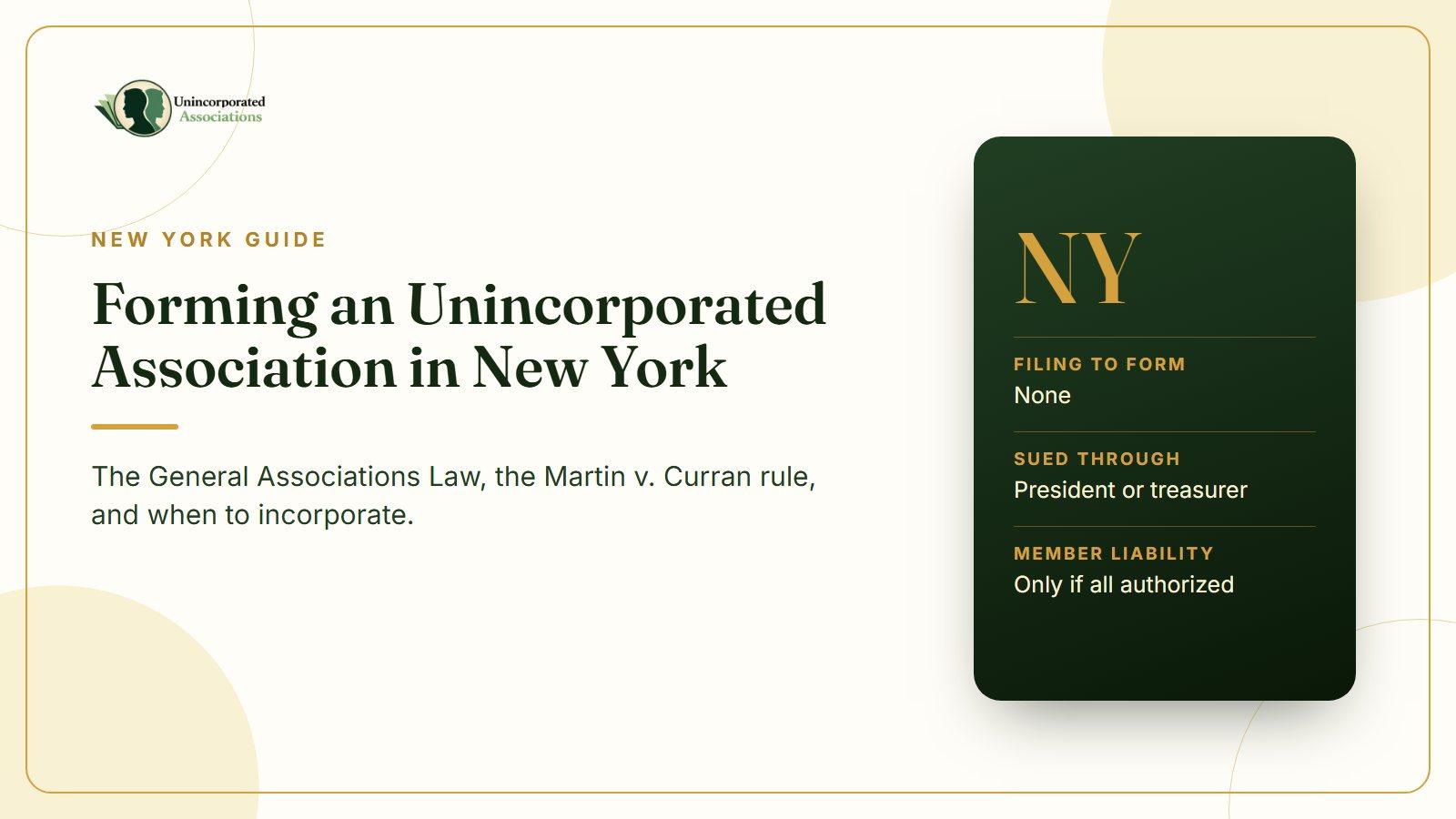
Short answer: In New York, an unincorporated association is formed when its members agree to pursue a common purpose; nothing is filed with the state to create it. New York's General Associations Law lets the association sue and be sued through its president or treasurer (§§ 12 and 13), and a judgment in such a suit is collected from the association's property first (§ 15). Under the courts' long-standing Martin v. Curran rule, members are generally liable for the association's acts only if every member authorized or ratified them. New York has not adopted the uniform nonprofit association act, so many groups that own property or hire staff incorporate under the Not-for-Profit Corporation Law.
New York takes its own path on unincorporated associations. It does not treat them as full legal entities the way California or Texas do. Instead, it has a set of procedural rules, written more than a century ago, that let the group act through its president or treasurer, and a court rule that makes individual member liability hard to establish.
This guide explains how those rules work, how to form an association in New York, and when a New York not-for-profit corporation is the better choice.
Key takeaways: No filing is needed to form a New York association. It sues and is sued through its president or treasurer. Judgments reach the association's property before any member. Members are rarely liable personally unless all of them authorized the act. For property, staff or larger risk, consider a New York not-for-profit corporation.
What New York law says
New York's rules for associations sit in Article 3 of the General Associations Law. Four sections do most of the work:
- § 12, suing. The association's president or treasurer may bring an action on any claim all the members could bring together, and may recover from members their share of money the association lawfully spent for them (§ 12).
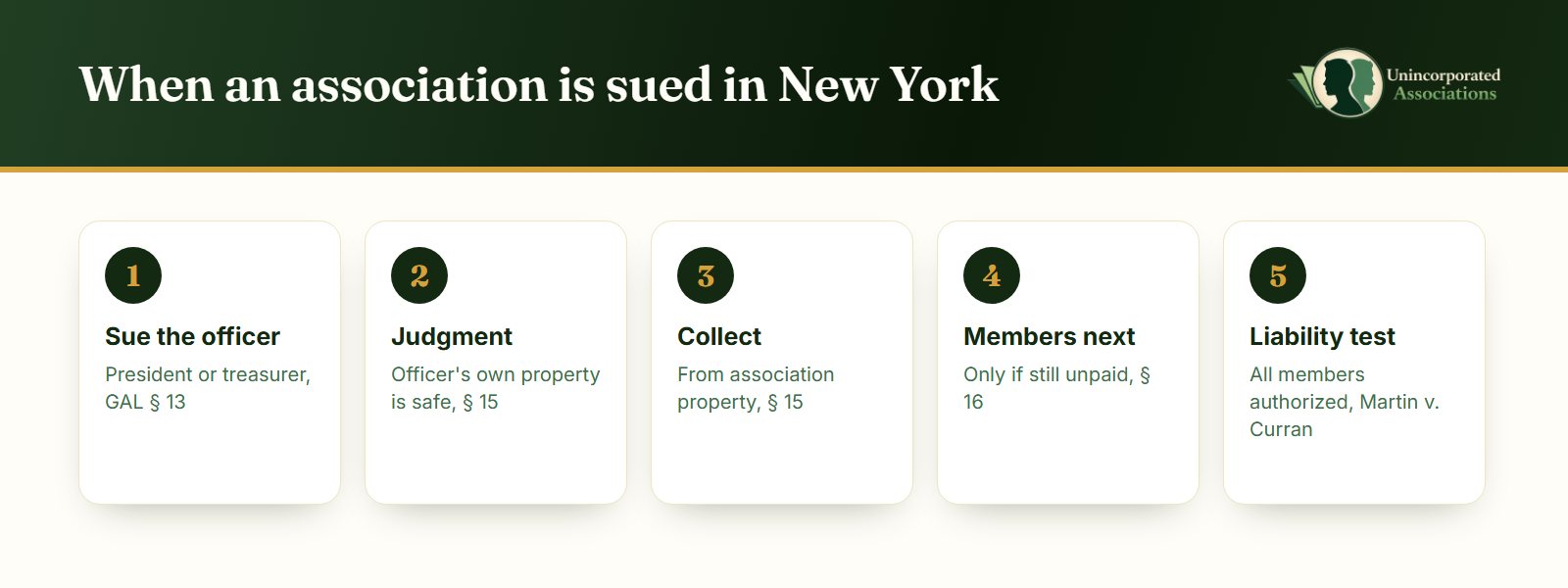
- § 13, being sued. A claim that could be brought against all the members may be brought against the president or treasurer instead (§ 13).
- § 15, collecting a judgment. The officer sued cannot be arrested, and a judgment against them in that role does not reach their own property. A money judgment is satisfied from the association's property, or property all the members own together (§ 15).
- § 16, members second. A plaintiff cannot sue individual members for the same claim until the action against the officer has gone to final judgment and that judgment has gone wholly or partly unpaid (§ 16).
The Martin v. Curran rule
The courts added an important layer. In Martin v. Curran (1951), New York's Court of Appeals held that an association is neither a partnership nor a corporation, and that a claim against it through its officer succeeds only if the plaintiff could have held every member liable, which generally means showing that all the members authorized or ratified the conduct.
In Palladino v. CNY Centro, Inc. (2014), the Court of Appeals reaffirmed that rule and said that any change should come from the Legislature, not the courts (decision).
In practice, the rule makes it hard to win tort or contract claims against large associations, and it protects ordinary members from personal liability for decisions they did not join. It is one reason New York associations, from labor unions to clubs, have long operated without incorporating.
Watch out: The Martin v. Curran rule protects members from the association's liability. It does not protect an individual from their own conduct. An officer who personally signs a contract, or a member who personally causes harm, can still be liable as an individual.
How New York compares
| New York | Texas (uniform act) | Illinois | |
|---|---|---|---|
| Filing to form | None | None | None |
| Who sues and is sued | President or treasurer (GAL §§ 12–13) | Association in own name (§ 252.007) | Association in own name (735 ILCS 5/2-209.1) |
| Member liability | Only if all members authorized (Martin v. Curran) | Statutory shield (§ 252.006) | Common-law principles |
| Judgment collected from | Association property first (GAL § 15) | Association | Association, then common-law rules |
| Own real estate in own name | No clear statute; often trustees | Yes (§ 252.004) | No clear statute; often trustees |
See our Texas and Illinois guides for those states.
Step by step: forming an association in New York
Step 1: Define a lawful common purpose
Write it down clearly. If members will run a business to share its profits, an LLC or partnership agreement is the honest structure: a profit-sharing business run by co-owners is generally a partnership, and partners are personally liable.
Step 2: Gather your founding members
Agree on who the first members are and record them.
Step 3: Sign articles of association
Include the name, purpose, membership rules, officers (including a president and treasurer, since New York's procedural rules run through them), that funds belong to the association, amendments and dissolution. If you may seek tax exemption later, include the purpose-limiting and dissolution language the IRS expects (IRS: 501(c)(3) requirements).
Step 4: Adopt bylaws
Set out meetings, voting thresholds, which decisions need a members' vote, who signs contracts and checks, and how records are kept. See our guide to UNA bylaws.
Step 5: Elect a president and treasurer
In New York these offices matter more than in most states, because lawsuits by and against the association run through them. Record the election in minutes.
Step 6: Get an EIN and open a bank account
Apply with Form SS-4, keep the CP 575 letter, and open an account in the association's name.
Step 7: Arrange insurance and property
Insure the association's activities. For real estate, use written trustee arrangements or incorporate first.
Taxes in New York
- Federal: classification follows the IRS entity rules (26 CFR 301.7701-2). See how unincorporated associations are taxed.
- New York sales tax: a qualifying exempt organization applies to the Tax Department on Form ST-119.2 for an exempt organization certificate, then gives vendors the ST-119.1 purchase certificate the Department sends (NY Tax: exempt organizations).
- Charities registration: many organizations that solicit contributions or hold charitable assets in New York must register with the Attorney General's Charities Bureau (Charities Bureau; Charities registry).
Pro tip: Before soliciting donations from New Yorkers, check the Charities Bureau's registration rules. Registration obligations depend on what you do, not on whether you are incorporated.
When to incorporate in New York
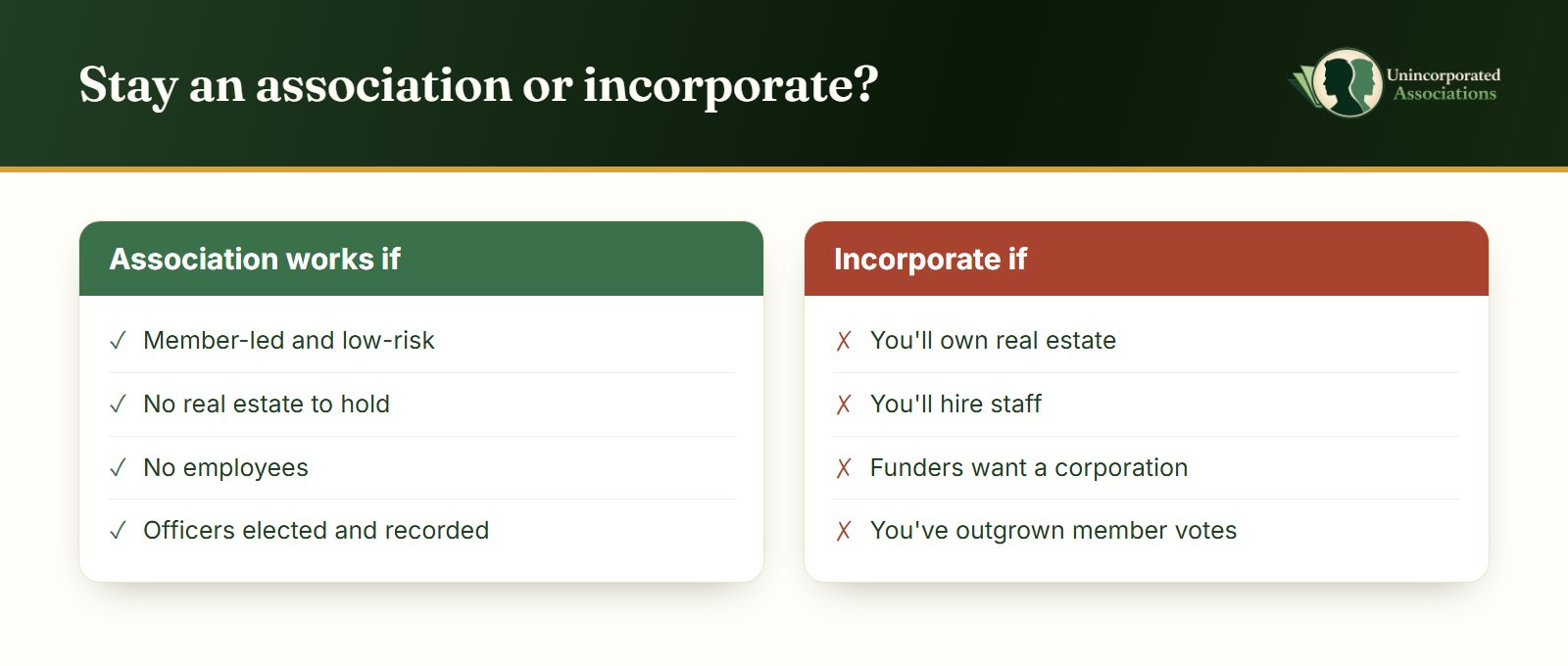
New York's protections are strong for members but leave practical gaps: no clear way to own real estate in the association's name, and procedures that run through individual officers. Consider a New York not-for-profit corporation under the Not-for-Profit Corporation Law, formed with the Department of State, when:
- the group will own real estate or sign long leases
- it will hire employees
- funders, lenders or landlords want a corporation
- it has grown beyond member-led decisions
Our guide to incorporated vs unincorporated associations explains how to make the move.
Three New York examples
A Brooklyn tenants' association collecting small dues and meeting monthly. No property, no staff. It stays an association, elects a president and treasurer each year, and keeps minutes of every vote.
A Buffalo amateur sports league renting fields and running a season of games. It stays an association but buys liability coverage, has players sign waivers, and signs field permits in the league's name with the officer's title.
A Long Island congregation buying a building and hiring a part-time administrator. With property and employees on the horizon, it incorporates as a not-for-profit corporation (New York also has a separate Religious Corporations Law for congregations) and moves its assets over carefully.
Common mistakes in New York
- Leaving the president or treasurer office vacant. New York's procedures assume those officers exist.
- Officers signing personally. Martin v. Curran protects members from the association's liability, not an officer from their own signature.
- Relying on other states' guides that describe statutory entity status New York does not provide.
- Holding property in one member's name without a written trust.
- Soliciting donations without checking charity registration.
New York formation checklist
- Articles of association naming a president and treasurer office
- Bylaws covering meetings, voting and signing authority
- Minutes recording officer elections and major decisions
- EIN, CP 575 letter and a bank account in the association's name
- Insurance sized to activities
- A written plan for property: trustees or incorporation
- ST-119.2 and Charities Bureau registration, if they apply
Frequently asked questions
Do I need to file anything to form an unincorporated association in New York?
No. A New York association is formed by its members' agreement. Tax and charities registrations may apply depending on its activities.
Can a New York unincorporated association sue or be sued?
Yes, through its president or treasurer, under General Associations Law §§ 12 and 13. A money judgment is satisfied from the association's property first.
Are members of a New York association personally liable?
Rarely for the association's own acts. Under Martin v. Curran, reaffirmed in 2014, a claim generally requires showing every member authorized or ratified the conduct. Individuals remain liable for their own conduct and personal signatures.
Can a New York association own real estate?
New York has no clear statute letting associations hold real estate in their own name, so property is commonly held by trustees, or the group incorporates.
Should a New York group form a not-for-profit corporation instead?
If it will own property, hire staff, take on real risk or seek institutional funding, a not-for-profit corporation is often the better fit.
Sources
- N.Y. General Associations Law § 12, § 13, § 15 and § 16
- Palladino v. CNY Centro, Inc., 2014 NY Slip Op 02378 (reaffirming Martin v. Curran, 303 N.Y. 276 (1951))
- N.Y. Not-for-Profit Corporation Law § 201
- New York Department of State: corporations
- New York Tax Department: exempt organizations
- New York Attorney General: Charities Bureau
- IRS: Form SS-4
- 26 CFR 301.7701-2
Forming an association in New York? Book a free 15-minute call with Kirk's team, or join the daily live Q&A.
Have questions? Bring them to the daily call.
Join our live Q&A every weekday and Saturday at 3PM PST, or get a free 15-minute call to see whether a UNA fits your situation.
Have a question about your situation?
Send us a message and we'll get back to you.
Keep reading
 The Well-Meaning Dragon: Straight Answers to the Hardest ObjectionsFor the family and friends who push back because they care — honest answers to the toughest questions about the Federal income tax and Unincorporated Associations.
 It's Not What You Believe, It's What You SignFor the cautious partner in the room: real risk rarely comes from asking questions. It comes from what you signed.
 What Most People Get Wrong About Taxes, Structure, and ControlThe real problem isn't taxes — it's structure, and who actually has control. A look at positioning over loopholes.
Educational, not legal or tax advice. Unincorporated Associations is a document-preparation and education company. Consult a licensed attorney or CPA before acting on any position discussed on this site.