
How to Form an Unincorporated Association in Illinois (2026 Guide)
By Kirk Carmichael · · 8 min read
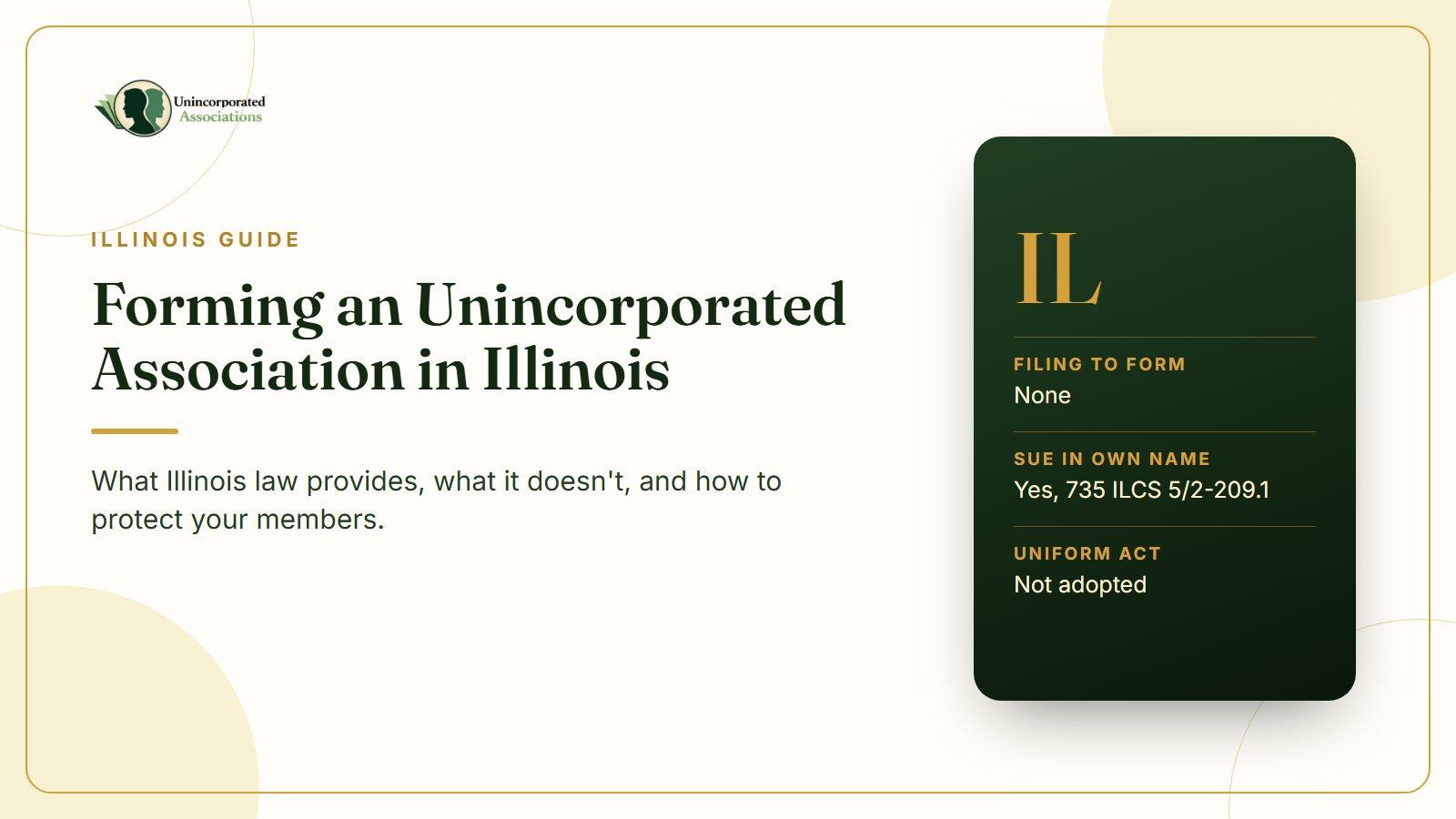
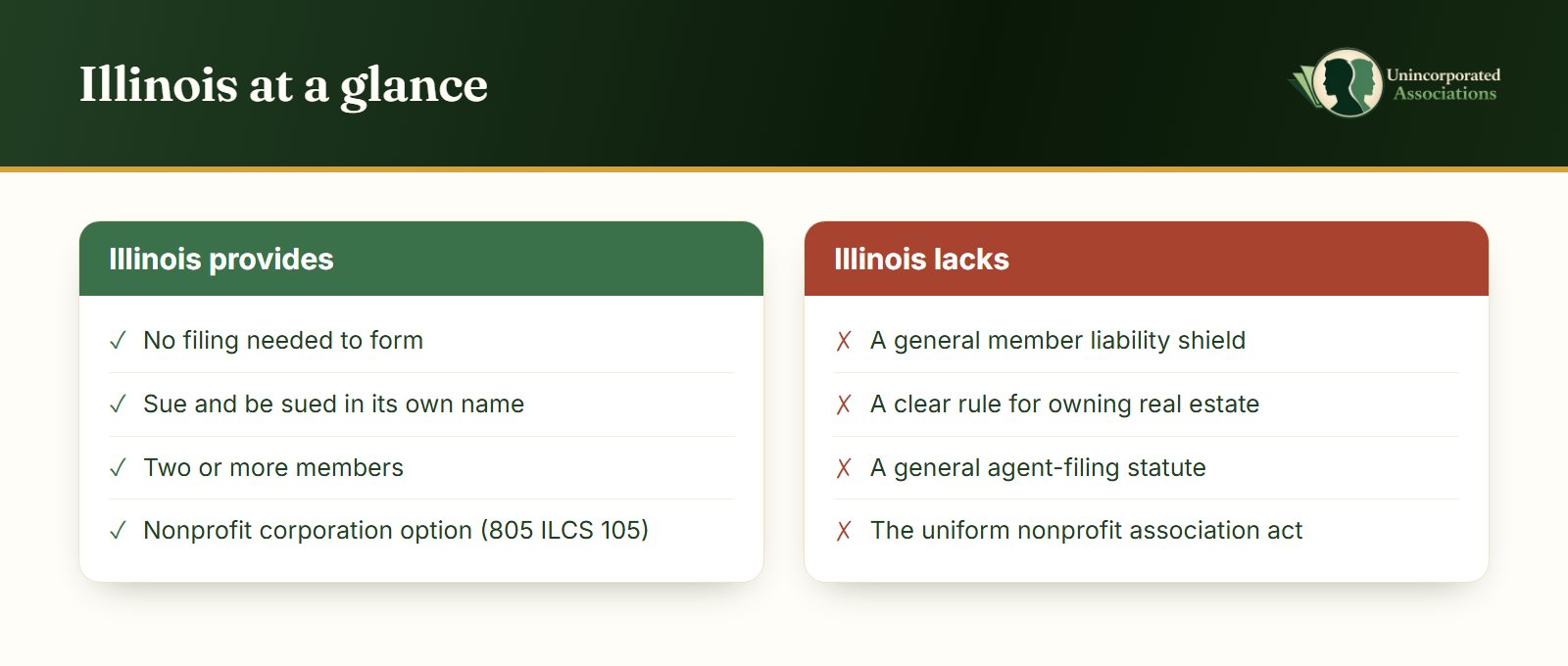
Short answer: In Illinois, a voluntary unincorporated association is formed when two or more people agree to pursue a common purpose; nothing is filed with the state to create it. Illinois law, at 735 ILCS 5/2-209.1, lets such an association sue and be sued in its own name. Unlike Texas or Iowa, Illinois has not adopted the uniform nonprofit association act, so there is no statute giving members broad liability protection or letting the association hold real estate in its own name in the way those states do. Good documents, insurance and careful property arrangements matter more in Illinois, and many growing groups incorporate under the Illinois General Not For Profit Corporation Act.
Illinois is a useful example of a state in the middle. It gives unincorporated associations real standing in court, but it has not adopted the modern uniform act that many states use to make associations full legal entities with statutory member protection.
This guide explains what Illinois law provides, how to form an association there, how to handle property and liability, and when incorporating makes more sense.
Key takeaways: No filing is needed to form an Illinois association. It can sue and be sued in its own name. Illinois has no uniform-act liability shield, so protect members with clear documents, insurance and contracts signed in the association's name. Consider an Illinois nonprofit corporation for property-heavy or higher-risk activities.
What Illinois law says
The key statute is in the Code of Civil Procedure. Under 735 ILCS 5/2-209.1, a voluntary unincorporated association may sue and be sued in its own name. The statute defines a voluntary unincorporated association as an organization of two or more individuals formed for a common purpose, excluding partnerships and corporations. It took effect January 1, 1984.
Beyond that, Illinois relies largely on common-law principles for associations. It has not adopted the Uniform Unincorporated Nonprofit Association Act, which, in states that did adopt it, makes nonprofit associations legal entities that can own property and shields members from the association's debts. Our guide to the Uniform Unincorporated Nonprofit Association Act explains what Illinois groups are missing compared with those states.
How Illinois compares
| Illinois | Texas (uniform act) | California | |
|---|---|---|---|
| Filing to form | None | None | None |
| Sue and be sued in own name | Yes (735 ILCS 5/2-209.1) | Yes (§ 252.007) | Yes (CCP § 369.5) |
| Statutory member liability shield | No general statute | Yes (§ 252.006) | Yes (§ 18605) |
| Own real estate in own name | No clear statute; often trustees | Yes (§ 252.004) | Yes (§ 18105) |
| Optional agent filing | No general association filing | Form 706 | Form UA-100 |
Our Texas and California guides cover those states in detail.
Step by step: forming an association in Illinois
Step 1: Define the purpose
Write a clear, lawful common purpose. If the group will run a business for its members' profit, stop and consider an LLC or partnership agreement instead: in Illinois, as elsewhere, co-owners in a for-profit business are generally treated as partners.
Step 2: Gather at least two founding members
Illinois's definition needs two or more individuals.
Step 3: Sign articles of association
State the name, purpose, how members join and leave, who the officers are, that money belongs to the association, how the articles are amended, and what happens on dissolution. If you may later seek tax exemption, include the purpose-limiting and dissolution language the IRS expects (IRS: 501(c)(3) requirements).
Step 4: Adopt bylaws
Cover meetings, voting, officers, who signs contracts and checks, records and disputes. See our guide to UNA bylaws.
Step 5: Appoint officers and record it
Record who the officers are and who may sign.
Step 6: Get an EIN
Apply with Form SS-4 or online, and keep the CP 575 confirmation.
Step 7: Open a bank account
Bring the articles, bylaws, EIN letter, signer resolution and IDs.
Step 8: Arrange insurance and property
See the next two sections; in Illinois these steps carry extra weight.
Liability in Illinois
Because Illinois has no general statute shielding association members, liability turns on common-law principles. Members who authorize, ratify or take part in a decision can face exposure for it, while passive members are less exposed. For a group in Illinois, that makes three habits essential:
- Sign everything in the association's name, with the officer's title, never personally.
- Carry insurance sized to the association's activities, including general liability and, where relevant, directors and officers coverage.
- Keep minutes showing who authorized what, and keep association money separate.
What suing "in its own name" means in practice
Before statutes like 735 ILCS 5/2-209.1, an association often could not be sued, or sue, as a group at all. Plaintiffs had to name individual members, and an association wanting to enforce a contract had to bring the claim through its members. The Illinois statute fixes the procedural side of that problem:
- The association can enforce its own contracts. If a vendor fails to deliver, the association can bring the claim as itself.
- A plaintiff can name the association. Someone injured at an association event can sue the association directly, rather than hunting down every member.
- The association's assets answer first. A claim against the association naturally looks to the association's own funds and insurance.
What the statute does not do is say that members are never personally liable. Being able to sue the association is a procedural rule; whether a particular member also owes money depends on what that member did, and on common-law agency and partnership principles. That is why the habits below matter.
Watch out: In Illinois, documents carry extra weight because there is no statutory member shield. A clear nonprofit purpose, contracts signed in the association's name and good minutes are the best protection; book a free call if you want help setting them up.
Property in Illinois
Without a clear statute letting associations hold real estate in their own name, Illinois associations commonly hold property through trustees: named individuals who hold title for the association's benefit under a written declaration. If your group plans to buy or receive real estate, get local legal advice on titling, or consider incorporating first so the corporation can hold title directly.
Pro tip: If you use trustees, document the trust arrangement in writing and in your minutes, and plan for succession: how a trustee is replaced, and how title moves when that happens.
Taxes in Illinois
- Federal: classification follows the IRS entity rules (26 CFR 301.7701-2); a qualifying association can apply for exemption. See how unincorporated associations are taxed.
- Illinois sales tax: exempt organizations generally need an Illinois exemption identification number from the Department of Revenue to buy items tax-free; see the Department's sales tax exemption information.
- Charitable registration: organizations soliciting or holding charitable assets in Illinois may need to register with the Attorney General's charitable trust bureau.
When to incorporate in Illinois
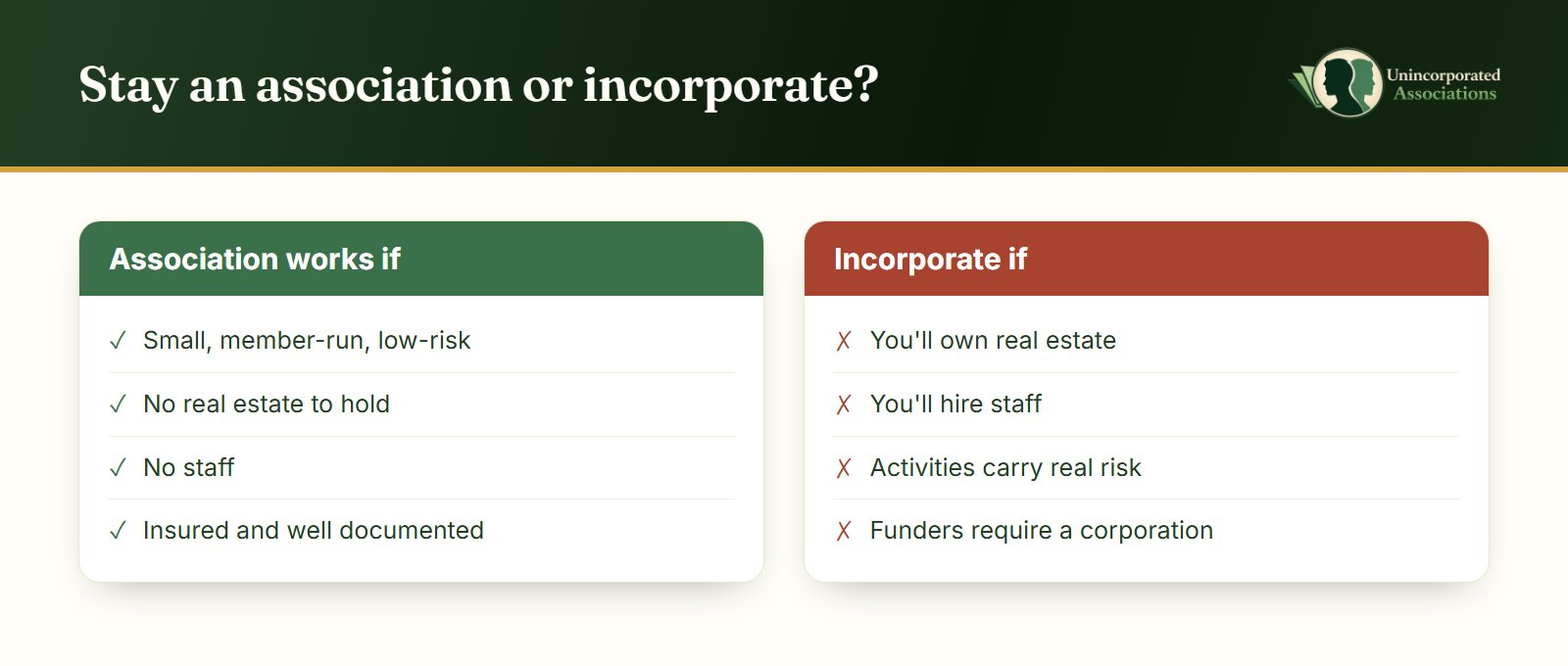
Illinois's gaps make incorporation more attractive than in uniform-act states. Consider forming an Illinois nonprofit corporation under the General Not For Profit Corporation Act when:
- the group will own real estate
- it will hire staff or run higher-risk activities
- it needs a clear liability shield for members and officers
- funders or lenders require a corporation
Our guide to incorporated vs unincorporated associations walks through the move.
Three Illinois examples
A Chicago neighborhood block club collecting small dues for an annual festival and street cleanups. No property, no staff. It stays an association, signs its festival contracts in the club's name, and buys event insurance each year.
A Springfield homeschool co-op renting church space weekly, with parents teaching classes. It stays an association for now but carries general liability coverage, keeps written parent agreements, and records in its minutes who approved each rental.
A Peoria congregation offered a building as a gift. Without a clear Illinois statute for association-held real estate, it either names trustees under a written declaration or incorporates first so the corporation can take title. Many choose to incorporate.
Common mistakes in Illinois
- Assuming another state's rules apply. Guides written for California or Texas describe statutory member protection Illinois does not provide.
- Officers signing leases personally. A lease signed by an individual, without the association's name and the officer's title, can bind that individual.
- Taking title to property in one member's name with no written trust arrangement.
- Skipping insurance because the group is small.
- Using another state's template that cites the wrong statute or leaves out Illinois's gaps.
Illinois formation checklist
- Signed articles of association with purpose, membership, officers and dissolution clauses
- Bylaws covering meetings, voting and signing authority
- Officer and signer resolution recorded in minutes
- EIN and CP 575 letter
- Bank account in the association's name
- Insurance sized to activities
- A written plan for any property: trustees or incorporation
- Illinois sales tax exemption number and charitable registration, if they apply
Frequently asked questions
Do I have to register an unincorporated association in Illinois?
No. An Illinois association is formed by its members' agreement. There is no general state filing to create it, though tax and charitable registrations may apply depending on its activities.
Can an Illinois unincorporated association sue and be sued?
Yes. 735 ILCS 5/2-209.1 lets a voluntary unincorporated association sue and be sued in its own name.
Are members personally liable in Illinois?
Illinois has no general statute shielding association members, so liability follows common-law principles. Members who authorize or take part in a decision face more exposure. Insurance, careful signing and good records help.
Can an Illinois association own property?
Illinois has no clear statute letting associations hold real estate in their own name, so property is often held by trustees. Many property-owning groups incorporate instead.
Should we form a nonprofit corporation instead?
If the group will own property, hire staff, carry significant risk or seek large grants, an Illinois nonprofit corporation is often the better fit.
Sources
- 735 ILCS 5/2-209.1 (voluntary unincorporated associations)
- Illinois General Not For Profit Corporation Act of 1986
- Illinois Department of Revenue: sales tax exemption
- IRS: Form SS-4
- IRS: Exemption requirements for 501(c)(3) organizations
- 26 CFR 301.7701-2
- Texas Business Organizations Code § 252.006 and California Corporations Code § 18605 (for comparison)
Forming an association in Illinois? Book a free 15-minute call with Kirk's team, or join the daily live Q&A.
Have questions? Bring them to the daily call.
Join our live Q&A every weekday and Saturday at 3PM PST, or get a free 15-minute call to see whether a UNA fits your situation.
Have a question about your situation?
Send us a message and we'll get back to you.
Keep reading
 The Well-Meaning Dragon: Straight Answers to the Hardest ObjectionsFor the family and friends who push back because they care — honest answers to the toughest questions about the Federal income tax and Unincorporated Associations.
 It's Not What You Believe, It's What You SignFor the cautious partner in the room: real risk rarely comes from asking questions. It comes from what you signed.
 What Most People Get Wrong About Taxes, Structure, and ControlThe real problem isn't taxes — it's structure, and who actually has control. A look at positioning over loopholes.
Educational, not legal or tax advice. Unincorporated Associations is a document-preparation and education company. Consult a licensed attorney or CPA before acting on any position discussed on this site.