
Incorporated vs Unincorporated Association: Should Your Group Incorporate?
By Kirk Carmichael · · 8 min read
Short answer: An incorporated association has filed articles of incorporation with the state and become a corporation (usually a nonprofit corporation), governed by a state corporation statute with a board, public filings and a statutory liability shield. An unincorporated association exists by its members' agreement, with no state filing, governed by its own articles and bylaws, with protections that depend on state association law. Many groups start unincorporated and incorporate later, when property, staff, grants or risk make the extra structure worth it.
"Incorporated or unincorporated?" is a question many groups face twice: once when they start, and again when they grow. The first time, staying unincorporated is often the simple, sensible choice. The second time, the group has property, money, maybe staff, and the answer may change.
This guide compares the two, lists the signs it is time to incorporate, and explains how to incorporate an existing association without losing its history, assets or exemption.
Key takeaways: The difference is the state filing and the statute that comes with it. Unincorporated is simpler, cheaper and more private; incorporated is more standardized and more familiar to banks, lenders and grant makers. Incorporate when the risk, assets or partners call for it, and plan the transfer of assets and any tax exemption carefully.
The core difference
An unincorporated association is "two or more persons joined by mutual consent for a common lawful purpose" (Cal. Corp. Code § 18035). It exists by agreement. Its articles and bylaws are its rulebook.
An incorporated association has filed articles of incorporation with the Secretary of State. It becomes a corporation, for a nonprofit usually under a nonprofit corporation statute such as California's Nonprofit Public Benefit Corporation Law (Corp. Code § 5110) or Texas's Business Organizations Code chapter 22. The statute then supplies many of its rules.
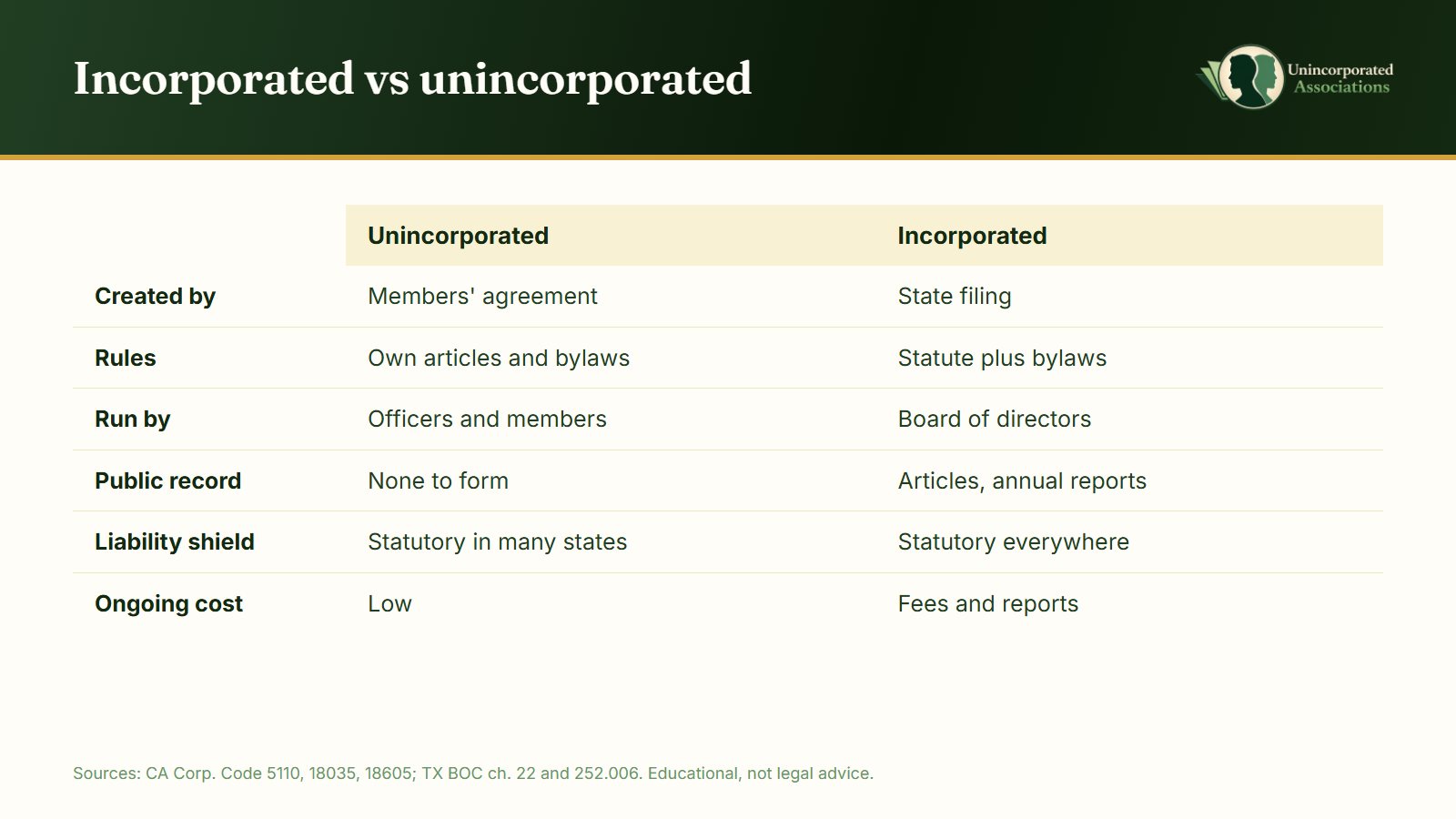
Side by side
| Unincorporated association | Incorporated association | |
|---|---|---|
| Created by | Members' agreement | Articles filed with the state |
| Governing rules | Its own articles and bylaws | State statute plus bylaws |
| Governing body | Officers and members, as the bylaws say | Board of directors, as the statute requires |
| Public record | No state formation record | Articles and annual reports are public |
| Liability shield | Statutory in many states (e.g., CA § 18605, TX § 252.006) | Statutory in every state |
| Owning property | In its own name in many states | In its own name everywhere |
| Tax exemption | Can apply | Can apply |
| Banks and grant makers | Accepted, with more questions | Familiar |
| Ongoing cost | Low | State fees and reports |
Why groups stay unincorporated
- Simplicity. No filing, no annual report, no state fee.
- Privacy. No public formation record.
- Member control. Members write the rules rather than following a statute's defaults.
- Speed. Sign the documents and start.
- Good-enough protection. In states with modern association statutes, nonprofit association members already have statutory liability protection.
The costs, compared
Unincorporated: no state formation fee and usually no annual state report. Optional filings, such as California's UA-100 or Texas's Form 706, carry small fees. The main costs are preparing good documents and keeping records.
Incorporated: a state filing fee to form, a registered agent (which may be free if a member serves, or an annual fee for a service), and an annual or biennial report with a fee in most states. Nonprofit corporations also need to keep board minutes, hold required meetings and, in many states, file additional charity reports.
Neither is expensive for most small groups, but incorporation adds a recurring cost and a recurring deadline. Missing a corporate report can lead to administrative suspension or dissolution, which an unincorporated association simply does not face.
What changes for members after incorporating
Incorporation changes more than paperwork. Members should understand:
- Who decides. In most nonprofit corporations, the board holds legal authority. Members keep only the rights the statute and bylaws give them, often electing directors and approving major changes. Groups used to deciding everything at members' meetings sometimes find this a big adjustment.
- Duties. Directors owe statutory duties of care and loyalty, and the corporation must follow the statute's procedures for meetings, notice and voting.
- Public visibility. The corporation's name, agent and often its officers or directors appear in public records.
- Continuity. The corporation continues regardless of who the members are, and its assets belong to it, not to the members.
Many groups write their corporate bylaws to keep as much member involvement as the statute allows, such as members electing the whole board each year, so the culture survives the change in form.
Signs it's time to incorporate
- You're buying significant property, especially in a state without a strong association statute.
- You're hiring staff and taking on employer risk.
- You're applying for large grants from funders that require incorporated charities.
- Your activities carry real risk: events, travel, children's programs, physical activity.
- Lenders or landlords require a corporation.
- You've grown beyond member-led decision-making and need a board.
- You operate in several states and want a structure every state recognizes the same way.
Pro tip: Incorporation is not all-or-nothing. Some groups keep a member-led association for their core community and form a separate corporation for a specific activity, such as a school or a building. Keep the two strictly separate if you do.
Questions to settle before you vote
Put these on the agenda before members vote to incorporate:
- What specific problem will incorporating solve: property, staff, grants, lenders or risk?
- Which state will we incorporate in, and what will the annual obligations be?
- Who will serve on the first board, and how will members elect future boards?
- Which assets, accounts, contracts and leases must move, and who will handle each one?
- Are we tax-exempt, and what is our plan and timeline for the corporation's own exemption?
- When will we formally dissolve the association, and where will any remaining assets go?
If the group can't answer the first question clearly, it may not be time yet.
How to incorporate an existing association
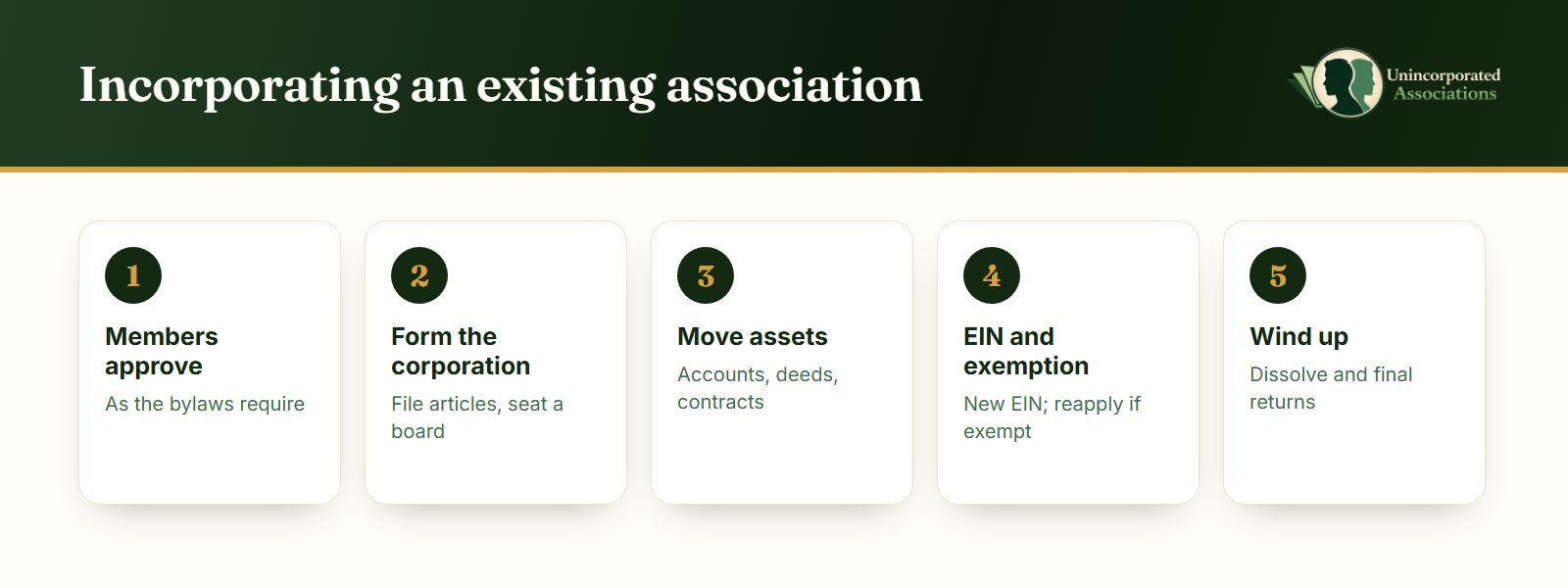
Step 1: Get member approval
Follow your own articles and bylaws. Most require a members' vote for major structural changes. Record the decision in minutes.
Step 2: Form the corporation
File articles of incorporation with the Secretary of State, appoint the initial board and adopt corporate bylaws. Carry over as much of your existing governance as the statute allows.
Step 3: Plan the transfer of assets and contracts
Decide how bank accounts, property, contracts, leases and intellectual property will move from the association to the corporation. Real estate needs a deed; leases and contracts may need the other party's consent. Some states provide merger or conversion procedures for associations; the revised uniform act includes a merger procedure, as in Iowa Code § 501B.30.
Step 4: Handle the EIN and taxes
A new corporation is a new entity and usually needs its own EIN (Form SS-4). If the association was tax-exempt, the corporation generally needs its own exemption; the IRS explains how in Publication 557. California's Franchise Tax Board similarly notes that an exempt unincorporated organization that incorporates must reapply (FTB 3500 booklet).
Step 5: Wind up the association
Once everything has moved, dissolve the association under its articles, file its final returns and record where its remaining assets went, as its dissolution clause requires.
Watch out: Don't move exempt assets into a new corporation before its exemption plan is settled. Assets dedicated to charitable purposes must stay in charitable use, and a careless transfer can create tax and legal problems for both entities.
Three examples
A book club with $800 in dues and no property: no reason to incorporate. It stays an association.
A community garden association buying the lot it has leased for ten years, hiring a part-time coordinator and applying for city grants: a strong case to incorporate, transferring its funds and exemption plan carefully.
A congregation that owns its building in a state with a strong association statute and has no plans to hire: it may stay unincorporated, with a recorded statement of authority for its property.
Common mistakes when incorporating
- Skipping the members' vote the bylaws require.
- Forgetting contracts and leases that name the association.
- Assuming the exemption transfers automatically.
- Running both entities in parallel without clear separation.
- Not dissolving the association properly once its assets have moved.
Our guides comparing an unincorporated association vs a corporation and vs a nonprofit corporation go deeper on each structure.
Frequently asked questions
What is the difference between an incorporated and an unincorporated association?
An incorporated association has filed articles with the state and become a corporation governed by a statute. An unincorporated association exists by its members' agreement, without a state filing, governed by its own documents.
Is an unincorporated association a legal entity?
In many states, yes, for important purposes such as contracts, property and lawsuits. See our guide on whether an unincorporated association is a legal entity.
Can an unincorporated association incorporate later?
Yes. The members approve the change, form a corporation, transfer assets and contracts, obtain a new EIN and, if needed, a new exemption, and then dissolve the association.
Does incorporating change our tax-exempt status?
Usually the new corporation needs its own exemption. Plan the application before transferring exempt assets.
Is it always better to incorporate?
No. Many groups are well served as associations, especially small, member-led groups in states with strong association statutes.
Sources
- California Corporations Code §§ 5110, 18035 and 18605
- Texas Business Organizations Code chapter 22 and § 252.006
- Iowa Code chapter 501B, including § 501B.30 (mergers)
- IRS: Form SS-4
- IRS Publication 557
- California Franchise Tax Board: Form 3500 booklet
Wondering whether it's time to incorporate? Book a free 15-minute call with Kirk's team, or join the daily live Q&A.
Have questions? Bring them to the daily call.
Join our live Q&A every weekday and Saturday at 3PM PST, or get a free 15-minute call to see whether a UNA fits your situation.
Have a question about your situation?
Send us a message and we'll get back to you.
Keep reading
 The Well-Meaning Dragon: Straight Answers to the Hardest ObjectionsFor the family and friends who push back because they care — honest answers to the toughest questions about the Federal income tax and Unincorporated Associations.
 It's Not What You Believe, It's What You SignFor the cautious partner in the room: real risk rarely comes from asking questions. It comes from what you signed.
 What Most People Get Wrong About Taxes, Structure, and ControlThe real problem isn't taxes — it's structure, and who actually has control. A look at positioning over loopholes.
Educational, not legal or tax advice. Unincorporated Associations is a document-preparation and education company. Consult a licensed attorney or CPA before acting on any position discussed on this site.