
Unincorporated Association vs Corporation: How They Really Differ
By Kirk Carmichael · · 9 min read
Short answer: A corporation is a legal person created when articles of incorporation are filed with the state; shareholders own it, a board of directors runs it, and state corporate law supplies its rules. An unincorporated association is created when two or more people agree in writing to pursue a common lawful purpose; nothing is filed to form it, members govern it through their own documents, and its legal treatment depends on state association law and on what it does. A corporation is not an unincorporated association, and an association does not become a corporation by calling itself one.
Both structures let a group of people act together. But they come from opposite directions. A corporation is a creation of the state, built from a statute and a public filing. An association is a creation of its members, built from their agreement. That difference runs through everything else: who owns it, who is liable, how it is taxed and how much of it is public.
This guide compares them side by side, explains where each one is stronger, and covers the points people most often get wrong.
Key takeaways: A corporation offers the most familiar liability shield and investor-friendly ownership, at the cost of state filings, corporate formalities and, for C corporations, double taxation. An association offers privacy, member-written governance and no formation filing, but its protections depend on your state's association law and on a genuine shared purpose.
What is a corporation?
A corporation is an entity that state law treats as a separate legal person. It can own property, sign contracts, sue and be sued, and it continues to exist even as its owners change. Cornell's Legal Information Institute summarizes the idea in its corporation entry: a corporation is a legal entity created under state law, separate from its owners.
To form one, you file articles of incorporation (sometimes called a certificate of incorporation or charter) with the Secretary of State, pay a filing fee, appoint a registered agent and adopt bylaws. Shareholders own the corporation through stock, elect a board of directors, and the board appoints officers to run day-to-day operations. Most states also require an annual report and fee.
What is an unincorporated association?
An unincorporated association is a group of two or more people who join by mutual consent for a common lawful purpose. California's statutory definition at Corporations Code section 18035 is a good summary. There is no charter and no state filing to form it: the members sign articles of association, adopt bylaws, appoint officers and the association exists.
Many states give nonprofit associations real legal standing. Texas, which adopted the Uniform Unincorporated Nonprofit Association Act, treats a nonprofit association as "a legal entity separate from its members" for contract and tort purposes under Business Organizations Code section 252.006. For a fuller introduction, see our guide on what an unincorporated association is.
Side by side
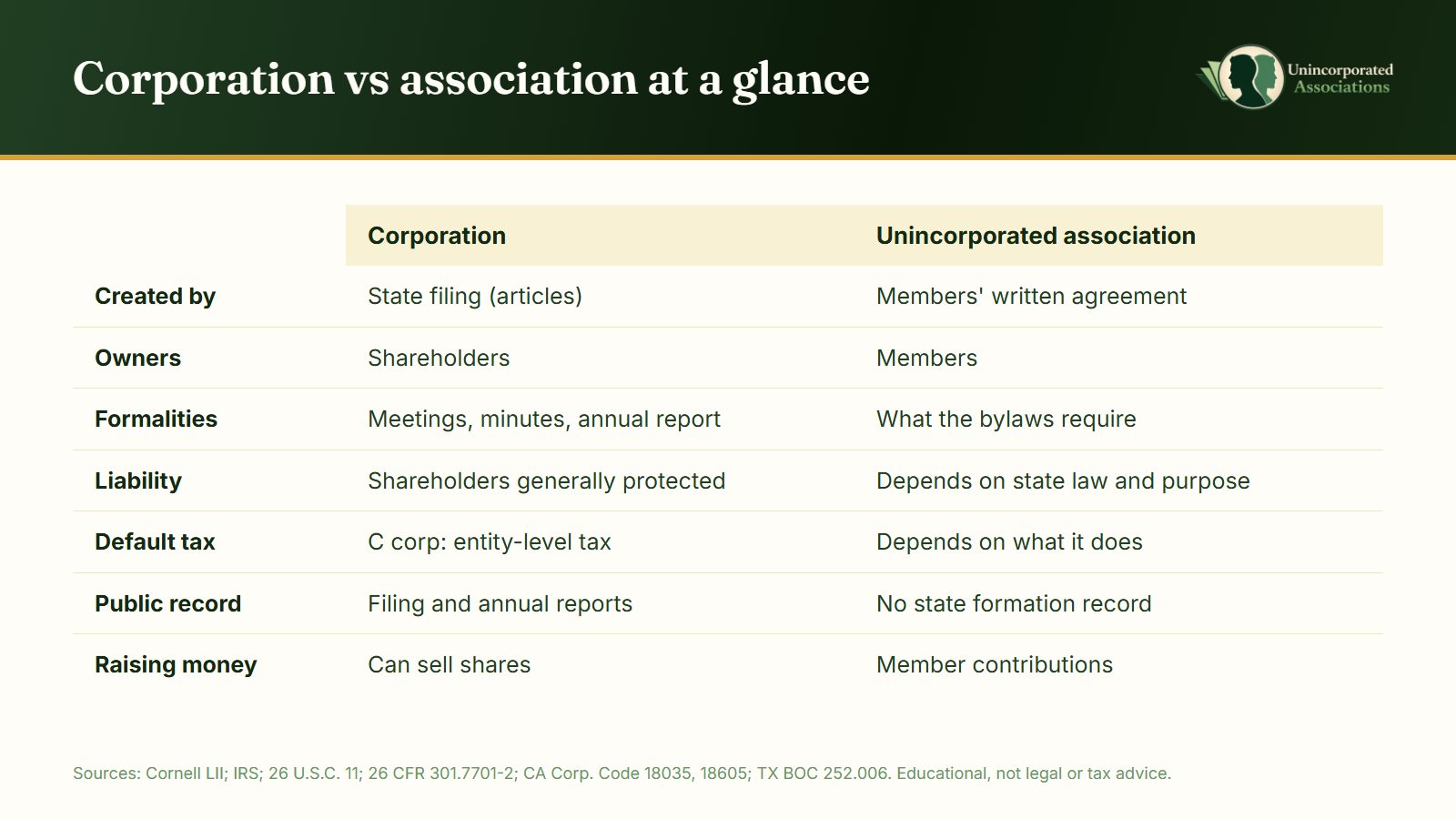
| Corporation | Unincorporated association | |
|---|---|---|
| Created by | Articles of incorporation filed with the state | Members' written agreement |
| State filing to form | Required, with a fee | None |
| Owners | Shareholders holding stock | Members, under the governing documents |
| Governance | Board of directors and officers, under state corporate law | Officers and members, under the association's own documents |
| Formalities | Annual meetings, minutes, board resolutions, annual report | Whatever the bylaws require; usually no state report |
| Liability | Shareholders generally not liable for corporate debts | Depends on state law and purpose |
| Default federal tax | C corporation: taxed at the entity level | Depends on what it does |
| Raising money | Can issue shares to investors | Members contribute; no shares to sell |
| Public record | Formation filing and annual reports are public | No state formation record |
| Lifespan | Perpetual, regardless of owners | As long as the members keep it going under its documents |
Formation and ongoing formalities
A corporation's main burden is formality. Beyond the filing and fees, corporations are expected to hold shareholder and board meetings, keep minutes, pass resolutions for major decisions and file annual reports. Skipping these is one of the reasons courts sometimes "pierce the corporate veil" and hold owners personally liable, as Cornell's veil-piercing explainer describes.
An association's formalities are the ones its members write into its bylaws. That is lighter and more flexible, but it is not "no formalities." Associations that keep minutes, follow their own rules and keep money separate are in a much stronger position than those that do not. Our guide on how to become an unincorporated association covers the documents that set those rules.
Pro tip: Whatever structure you choose, put three habits in place on day one: minutes for every decision that commits money, a separate bank account, and contracts signed in the entity's name with the signer's title. They protect a corporation and an association alike.
Liability: the shield and its limits
Corporations give shareholders the best-known liability shield: shareholders generally risk only what they invested. Directors and officers can still be liable for their own wrongdoing, and the veil can be pierced when a corporation is a sham or is run as the owner's personal piggy bank.
Associations give members protection by statute in many states. California says a nonprofit association member is not liable for its debts solely by reason of being a member (section 18605), and Texas says much the same. Where no such statute applies, older common-law rules can make members who authorize or take part in a decision personally responsible. And an association that is really a for-profit business owned by its members risks being treated as a general partnership, with unlimited liability for its partners.
Watch out: Neither structure protects you from your own personal guarantee, your own wrongful act or fraud. If you sign a lease or loan personally, it is your obligation regardless of the entity behind it.
Taxes: the biggest practical difference
C corporations pay federal income tax on their profits at the corporate rate under 26 U.S.C. § 11, and shareholders pay tax again on dividends. That is the "double taxation" people talk about. The IRS overview of corporations explains the filing requirements.
S corporations avoid most entity-level tax. An eligible corporation files Form 2553 to elect S status, and income passes through to shareholders, but S corporations have limits on the number and type of shareholders (IRS: S corporations).
Associations are classified by what they are and do. Under the federal entity classification rules at 26 CFR 301.7701-2, a non-exempt association with two or more members that runs a business defaults to partnership treatment; it can elect corporate treatment. An association organized and operated for a qualifying nonprofit purpose can apply for exemption, and the IRS accepts articles of association as an organizing document for 501(c)(3) status. Our guide on whether unincorporated associations file tax returns walks through each path.
Kirk's team covers tax positioning on every intro call, and a CPA should confirm the treatment for your specific activities.
Privacy and control
A corporation's existence, registered agent and often its directors appear in public state records, and annual reports keep that information current. Shareholders and directors also answer to a statutory framework that shapes how decisions are made.
An association has no state formation record, and its member list stays with the association. The Supreme Court recognized the importance of membership privacy in NAACP v. Alabama. Members also write their own governance: who joins, how votes work, who signs and what happens on dissolution.
Is an unincorporated association a corporation?
No. The word "unincorporated" means exactly that: the association has not been incorporated under a state's corporation statute. Some laws treat associations like corporations for particular purposes. For example, the federal tax rules allow a non-corporate entity to elect to be taxed as a corporation, and many states let associations sue and be sued in their own name. But that does not make an association a corporation. If a group wants to become a corporation, it must incorporate by filing articles with the state.
Which fits your purpose?
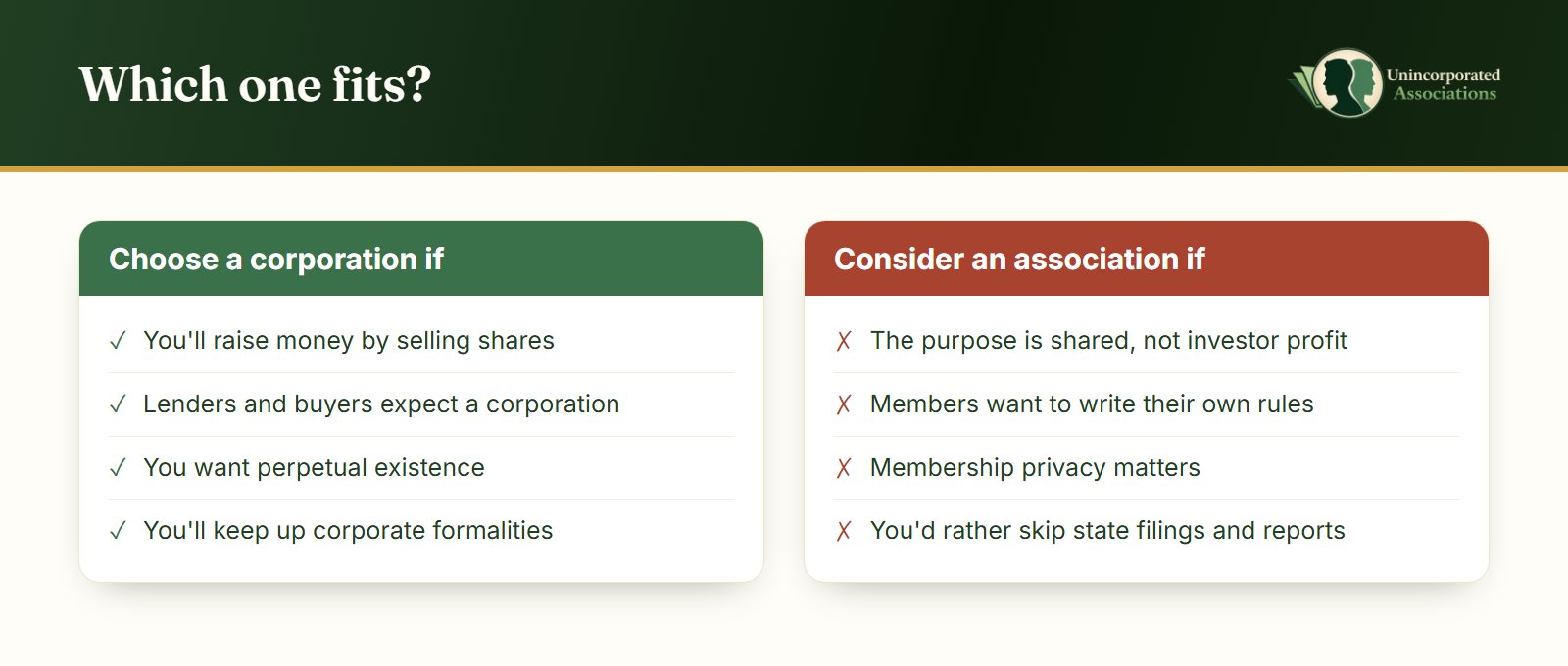
A corporation usually fits when:
- You plan to raise money from investors by selling shares.
- You want a structure lenders, investors and acquirers recognize instantly.
- You want perpetual existence that does not depend on any particular member.
- You are prepared for annual reports, meetings and corporate formalities.
An unincorporated association is worth considering when:
- The group exists for a shared, member-driven purpose rather than to return profit to investors.
- Members want to write their own governance instead of following a corporate statute's defaults.
- Privacy of membership matters.
- You want to avoid state formation filings and annual reports, and will keep good records instead.
If you are weighing other structures too, our comparison of LLP vs LLC and our services page show where each option fits, and our guide to the private membership association explains the members-only variant of an association.
Frequently asked questions
Is an unincorporated association better than a corporation?
Neither is better in general. A corporation offers a familiar liability shield, investor-friendly ownership and perpetual existence, with more formality and, for C corporations, double taxation. An association offers privacy and member-written rules with no formation filing, but its protections depend on state law and a genuine shared purpose.
Can an unincorporated association own property like a corporation?
In many states, yes. California, for example, lets an unincorporated association acquire and hold property in its own name. In states without such a statute, property is often held by trustees for the association.
Do association members have the same liability protection as shareholders?
Sometimes. Nonprofit association members in states like California and Texas are protected by statute from liability just for being members. Elsewhere, older common-law rules may apply, and a for-profit association risks partnership treatment.
Can an unincorporated association become a corporation later?
Yes, by incorporating: filing articles of incorporation with the state and moving the association's assets and activities into the new corporation under proper documents. Get tax advice before transferring assets.
Is an association taxed like a C corporation?
Only if it is classified or elects to be classified as a corporation for federal tax purposes. By default, a non-exempt association with two or more members running a business is treated as a partnership, and a qualifying nonprofit association can apply for exemption.
Sources
- Cornell LII: Corporation
- Cornell LII: Piercing the corporate veil
- IRS: Corporations
- 26 U.S.C. § 11, Tax imposed on corporations
- IRS: S corporations and Form 2553
- 26 CFR 301.7701-2, Business entities defined
- IRS: Exemption requirements for 501(c)(3) organizations
- California Corporations Code sections 18035 and 18605
- Texas Business Organizations Code section 252.006
- NAACP v. Alabama, 357 U.S. 449 (1958)
Weighing a corporation against an association? Book a free 15-minute call with Kirk's team, or join the daily live Q&A.
Have questions? Bring them to the daily call.
Join our live Q&A every weekday and Saturday at 3PM PST, or get a free 15-minute call to see whether a UNA fits your situation.
Have a question about your situation?
Send us a message and we'll get back to you.
Keep reading
 The Well-Meaning Dragon: Straight Answers to the Hardest ObjectionsFor the family and friends who push back because they care — honest answers to the toughest questions about the Federal income tax and Unincorporated Associations.
 It's Not What You Believe, It's What You SignFor the cautious partner in the room: real risk rarely comes from asking questions. It comes from what you signed.
 What Most People Get Wrong About Taxes, Structure, and ControlThe real problem isn't taxes — it's structure, and who actually has control. A look at positioning over loopholes.
Educational, not legal or tax advice. Unincorporated Associations is a document-preparation and education company. Consult a licensed attorney or CPA before acting on any position discussed on this site.