
The Uniform Unincorporated Nonprofit Association Act (UUNAA), Explained
By Kirk Carmichael · · 8 min read
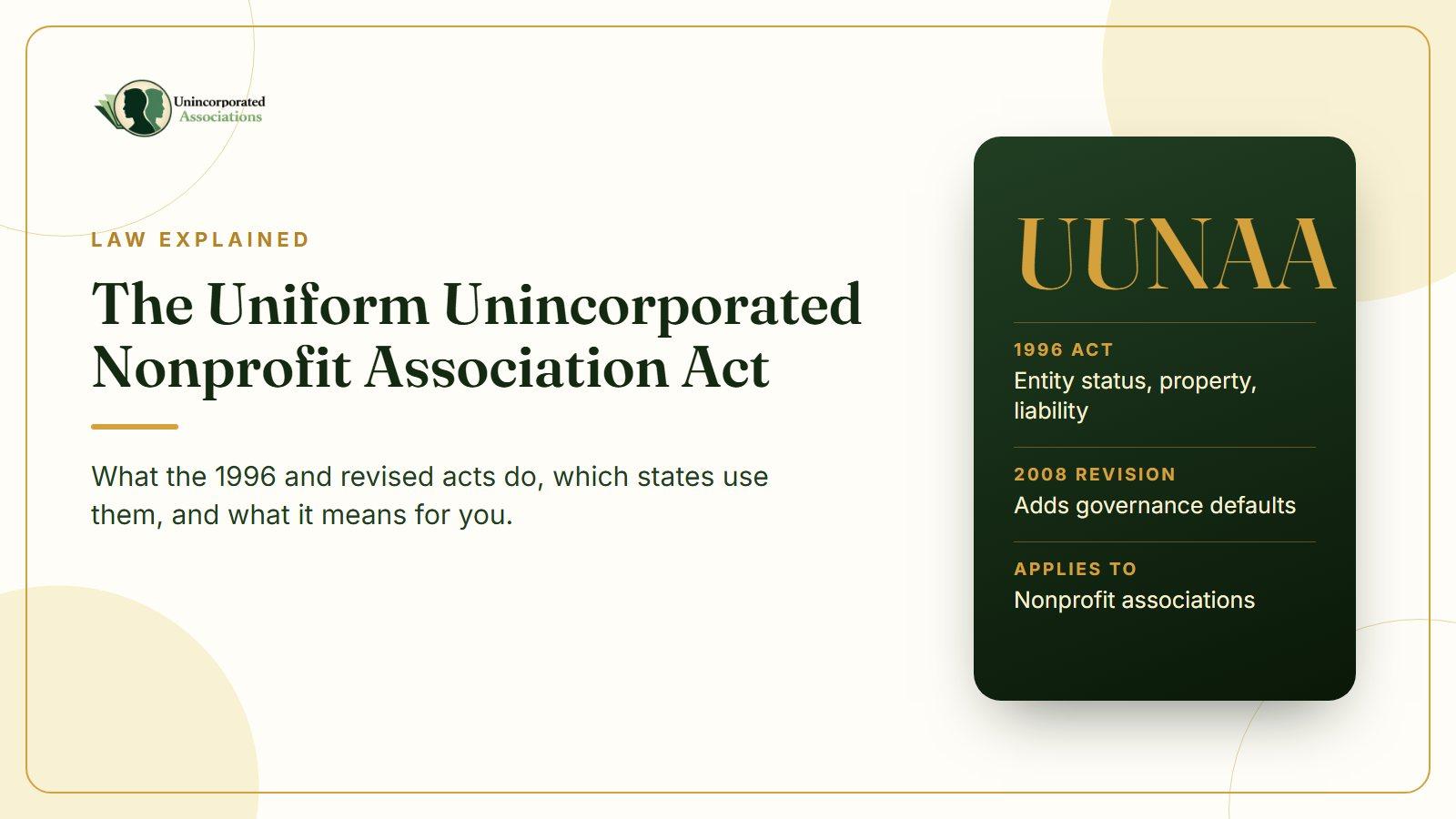
Short answer: The Uniform Unincorporated Nonprofit Association Act is a model law from the Uniform Law Commission that states can adopt to modernize the rules for unincorporated nonprofit associations. The original 1996 act makes these associations legal entities that can own property, sue and be sued in their own name, and shields members from liability for the association's debts just for being members. The revised 2008 act adds default governance rules: member votes, meetings, manager duties, dissolution and mergers. Texas, Colorado, Iowa, Nevada, Arkansas, West Virginia and others have adopted a version.
For centuries, an unincorporated association was legally just a collection of individuals. It could not own property in its own name, could struggle to sue or be sued, and its members could be personally liable for its debts. The Uniform Unincorporated Nonprofit Association Act was written to fix that.
This guide explains what the act does, how the original and revised versions differ, which states have adopted it, and what it means for anyone forming a nonprofit association.
Key takeaways: Where it applies, the UUNAA makes your nonprofit association a legal entity, lets it hold property and go to court in its own name, and protects members and managers from its debts just for their roles. The revised act also supplies default governance rules your bylaws can change. Whether it applies depends on your state.
Why the act was needed
Under traditional common law, an unincorporated association had no legal existence separate from its members. That caused real problems:
- Property: the association could not hold title, so property was held by trustees or individual members.
- Lawsuits: the association often could not sue or be sued in its own name.
- Liability: members who authorized or took part in a decision could be personally liable for its debts.
Millions of Americans belong to small nonprofit associations: churches, clubs, neighborhood groups and charities. The Uniform Law Commission, which drafts model laws for states to adopt, wrote the act to give these groups a modern legal footing without forcing them to incorporate. The Commission lists its current acts in its uniform acts catalog.
What the act does
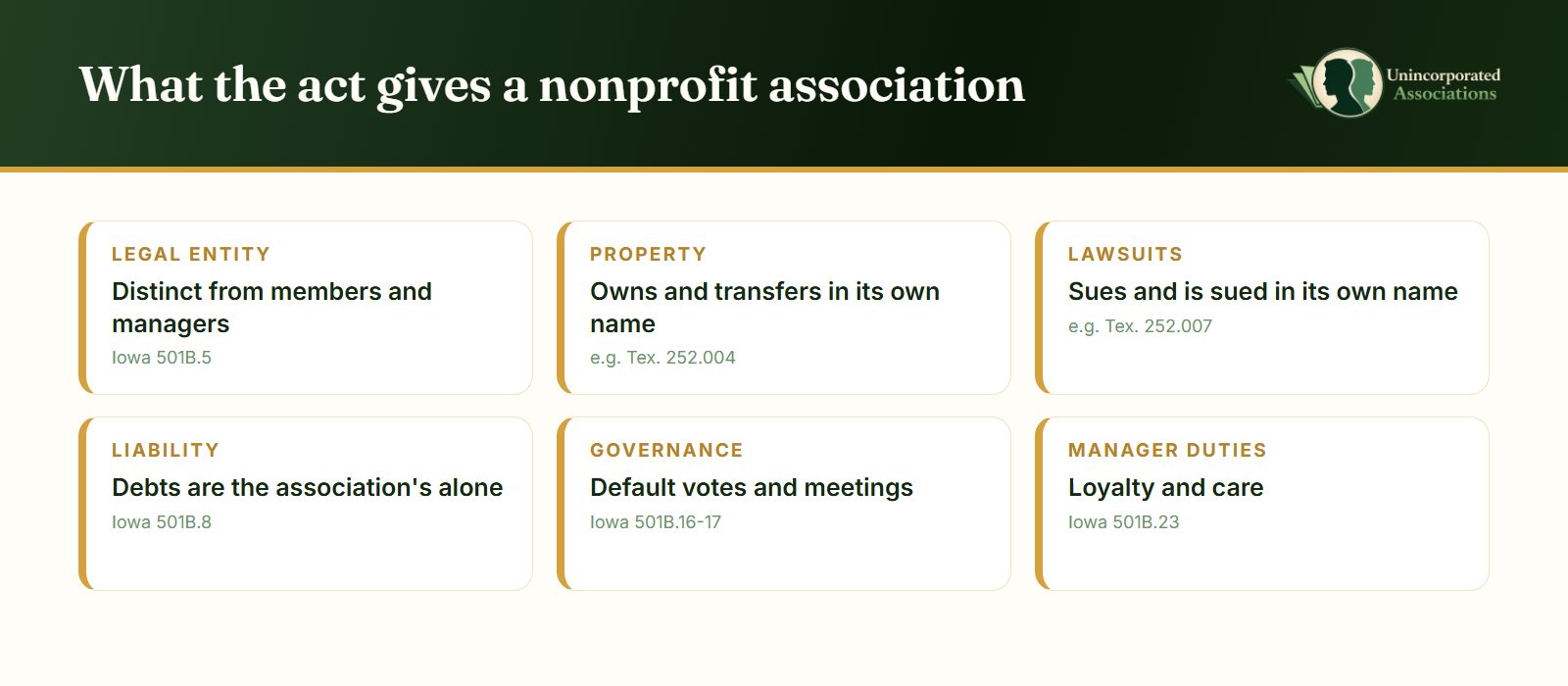
The revised act, as adopted in Iowa (Iowa Code chapter 501B), illustrates the key provisions:
| Provision | What it says | Iowa section |
|---|---|---|
| Legal entity | An association is "a legal entity distinct from its members and managers," with perpetual duration unless its rules say otherwise | 501B.5 |
| Powers | Same powers as an individual to do what is necessary to carry on its purposes | 501B.5 |
| Liability | A debt or obligation of the association is solely the association's, not a member's or manager's, just because they act in that role | 501B.8 |
| Member approval | Members must approve admitting or expelling members, choosing managers, amending the rules and selling substantially all assets, unless the rules say otherwise | 501B.16 |
| Voting | Unless the rules say otherwise, a majority of votes cast at a meeting decides, one vote per member | 501B.17 |
| Manager duties | Managers owe the association and its members duties of loyalty and care | 501B.23 |
| Dissolution | By the rules, by member approval, or if operations have stopped and no member can be found | 501B.28 |
| Mergers | Allowed with other organizations under set procedures | 501B.30 |
The 1996 act vs the 2008 revised act
There are two main versions.
The 1996 act focused on the essentials: entity status for contract and tort purposes, property ownership, the right to sue and be sued, member liability protection and an optional statement appointing an agent. Texas adopted this version as Business Organizations Code chapter 252; for example, § 252.006 makes a nonprofit association a legal entity separate from its members for contract and tort, and § 252.004 lets it own property.
The 2008 revised act keeps those essentials and adds default governance rules: how members approve decisions, meeting and voting defaults, who manages the association, the duties managers owe, rules on admitting and expelling members, dissolution and winding up, and mergers. An association's own governing principles can usually override the defaults.
| 1996 act | 2008 revised act | |
|---|---|---|
| Legal entity | For contract and tort | Distinct from members and managers |
| Property and lawsuits | Yes | Yes |
| Member liability protection | Yes | Yes, extended to managers, employees and volunteers |
| Default governance rules | Minimal | Detailed: approvals, meetings, voting, duties |
| Dissolution and mergers | Minimal | Detailed procedures |
A short history of the act
The Uniform Law Commission (formerly the National Conference of Commissioners on Uniform State Laws) approved the original act in 1996, after earlier work in the early 1990s. Its aim was modest but important: let small nonprofit groups own property, make contracts and go to court without incorporating, and stop members from being liable just for belonging.
Experience with the 1996 act showed that many associations had no written rules for basic questions, such as who can vote, how a manager is chosen or what happens when the group winds down. The Commission responded with the revised act in 2008 (later amended), which adds those default rules while keeping the original protections. States have adopted one version or the other, and a few have changed provisions along the way.
How the defaults interact with your bylaws
Under the revised act, an association's "governing principles," meaning its articles, bylaws and established practices, come first. The act's defaults only fill gaps. That has two practical consequences:
- If your bylaws are silent, the act's defaults decide. For example, Iowa's version says a matter is approved by an affirmative majority of the votes cast at a meeting, with one vote per member, unless the governing principles say otherwise.
- If your bylaws say something different, your bylaws usually win, within limits the act sets (some duties cannot be eliminated entirely).
So a well-drafted set of bylaws gives you control, and the act gives you a safety net. Associations that skip bylaws end up governed by defaults they may never have read. Our guide on how to become an unincorporated association shows what to put in yours.
Which states have adopted it?
States have adopted the original or revised act, sometimes with changes. Confirmed examples, with their statutes:
- Texas: Business Organizations Code chapter 252, starting at § 252.001
- Iowa: Iowa Code chapter 501B (revised act)
- Colorado: Colorado Revised Statutes, Title 7, Article 30
- Nevada: NRS 81.700 and following (revised act)
- Arkansas: Arkansas Code, Title 4, Chapter 28, Subchapter 6 (revised act)
- West Virginia: West Virginia Code chapter 36, article 11
Other jurisdictions, including Pennsylvania, the District of Columbia, Delaware, Wisconsin, Wyoming, Idaho and Alabama, have been reported as adopting a version. Always check your own state's current statutes, because names, numbering and changes vary.
California did not adopt the uniform act, but it has its own comprehensive association law in Corporations Code Title 3, with similar protections, such as member liability protection in § 18605. See our California guide.
Watch out: In states without the act or a similar statute, older common-law rules may still apply. Members who authorize or take part in a decision can be exposed to personal liability for it. Find out which rules govern your association before you rely on any protection.
What the act means for your association
If your state has adopted the act, your nonprofit association can:
- Own property in its own name, instead of through trustees.
- Sign contracts as an entity.
- Sue and be sued in its own name.
- Protect members, managers and volunteers from its debts just for their roles.
- Rely on default rules for decisions your bylaws don't cover, if your state adopted the revised act.
What the act does not do:
- It does not make the association tax-exempt. Federal exemption depends on qualifying under section 501; most 501(c)(3) charities must also apply for IRS recognition. See our guide on whether an unincorporated association is tax exempt.
- It does not protect for-profit groups. The act covers nonprofit associations. A group of co-owners running a business for profit is a partnership under laws like Texas § 152.051.
- It does not protect people from their own wrongdoing or their personal guarantees.
Pro tip: Even in a uniform-act state, write your own governance rules. The revised act's defaults (majority vote, one member one vote) are a backstop, not a substitute for bylaws that fit your group.
Practical checklist for associations in uniform-act states
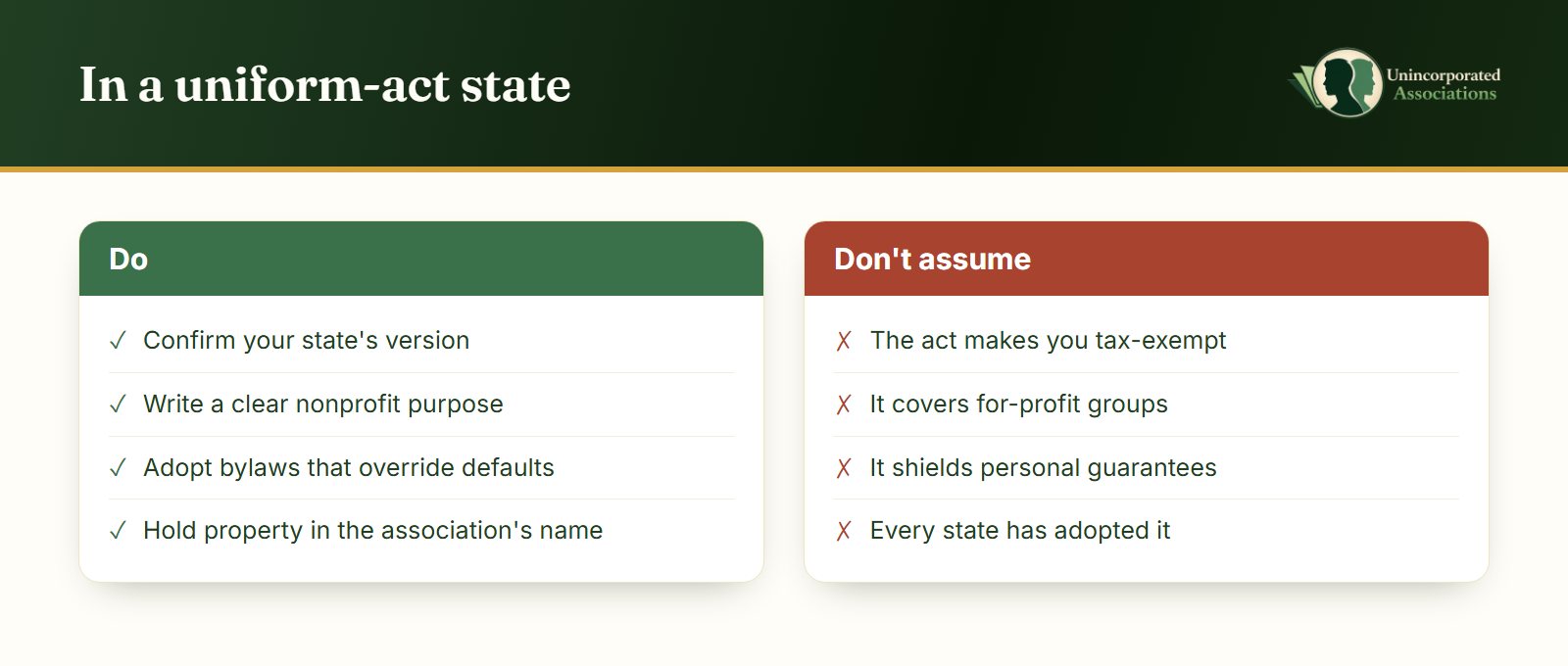
- Confirm your state's version (original or revised) and read its definition of "nonprofit association." Texas, for example, requires three or more members.
- Write a clear nonprofit purpose so the act applies.
- Adopt bylaws that override any defaults you don't want.
- Consider the optional statement appointing an agent; in Texas it is Form 706 under § 252.011.
- Hold property in the association's name and record a statement of authority for real estate where your state allows it.
- Keep minutes and separate finances so the association operates as the entity the act recognizes.
Our Texas guide walks through all of this for a uniform-act state.
Frequently asked questions
What is the UUNAA?
It is a model law drafted by the Uniform Law Commission that states can adopt to give unincorporated nonprofit associations legal entity status, property rights, the ability to sue and be sued, and member liability protection.
What is the difference between the 1996 and 2008 versions?
The 1996 act covers entity status, property, lawsuits and liability. The 2008 revised act keeps those and adds default governance rules on member approvals, meetings, voting, manager duties, dissolution and mergers.
Does my state have the UUNAA?
Many states have adopted a version, including Texas, Iowa, Colorado, Nevada, Arkansas and West Virginia. California has its own similar statute. Check your state's current code to be sure.
Does the act make my association tax-exempt?
No. Tax exemption is a federal and state tax question. The act concerns your association's legal status, property and liability.
Does the act apply to for-profit associations?
No. It covers nonprofit associations, so the articles should state a clear nonprofit purpose.
Sources
- Uniform Law Commission: uniform acts catalog
- Iowa Code chapter 501B (Revised Uniform Unincorporated Nonprofit Association Act)
- Texas Business Organizations Code §§ 252.001, 252.004, 252.006, 252.011 and 152.051
- Colorado Revised Statutes, Title 7, Article 30
- Nevada Revised Statutes 81.700
- Arkansas Code, Title 4, Chapter 28, Subchapter 6
- West Virginia Code chapter 36, article 11
- California Corporations Code section 18605
Want to know how your state's rules affect your association? Book a free 15-minute call with Kirk's team, or join the daily live Q&A.
Have questions? Bring them to the daily call.
Join our live Q&A every weekday and Saturday at 3PM PST, or get a free 15-minute call to see whether a UNA fits your situation.
Have a question about your situation?
Send us a message and we'll get back to you.
Keep reading
 The Well-Meaning Dragon: Straight Answers to the Hardest ObjectionsFor the family and friends who push back because they care — honest answers to the toughest questions about the Federal income tax and Unincorporated Associations.
 It's Not What You Believe, It's What You SignFor the cautious partner in the room: real risk rarely comes from asking questions. It comes from what you signed.
 What Most People Get Wrong About Taxes, Structure, and ControlThe real problem isn't taxes — it's structure, and who actually has control. A look at positioning over loopholes.
Educational, not legal or tax advice. Unincorporated Associations is a document-preparation and education company. Consult a licensed attorney or CPA before acting on any position discussed on this site.