
How Are Unincorporated Associations Taxed? Who Pays, and How Much
By Kirk Carmichael · · 8 min read
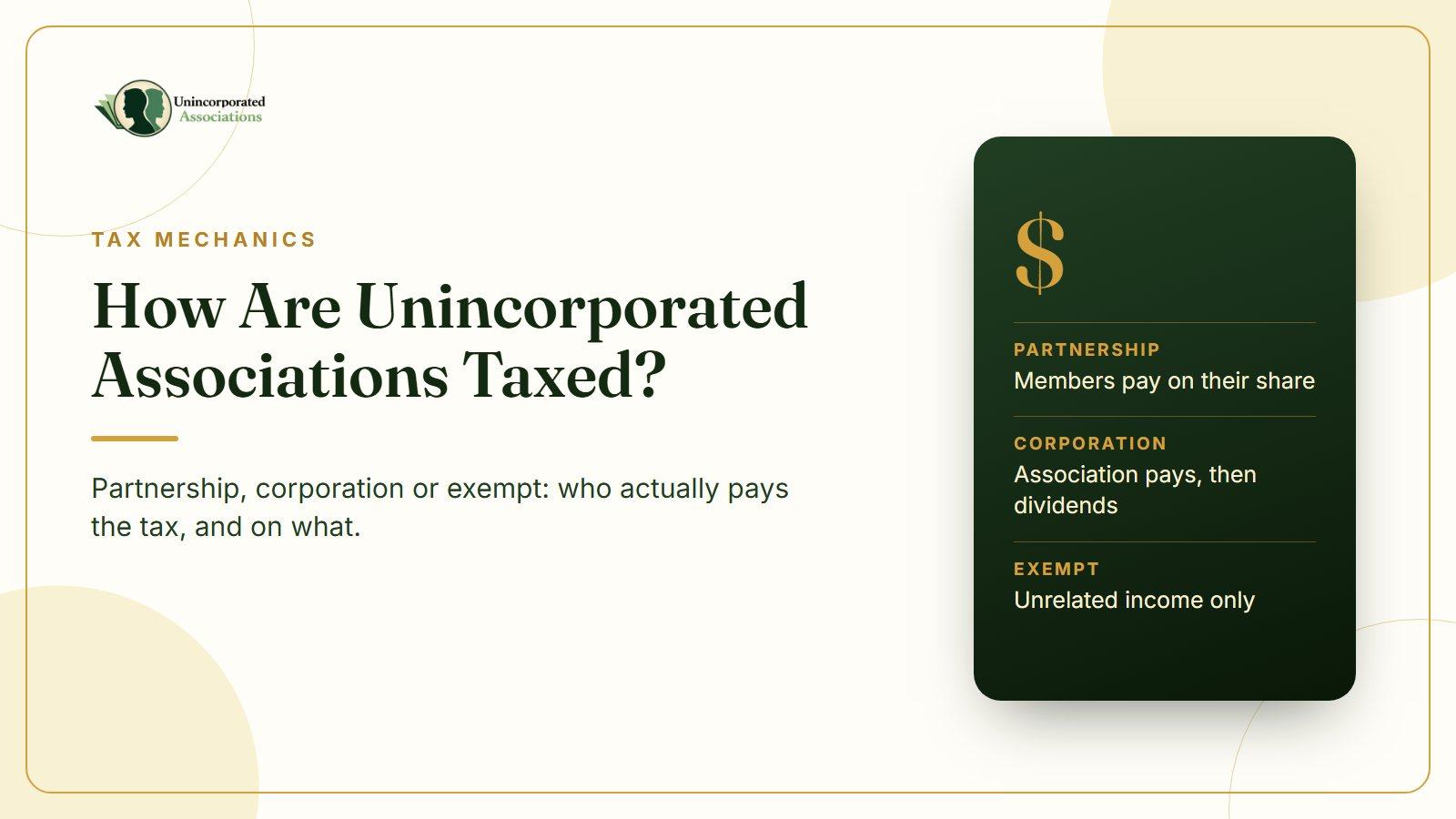
Short answer: It depends on how the association is classified. A non-exempt association with two or more members running a business is a partnership by default: the association itself pays no income tax, and each member pays tax on their share. If it elects corporate treatment, the association pays corporate income tax and members are taxed again on distributions. If it is exempt under section 501(c), it pays no tax on exempt-purpose income but can owe tax on unrelated business income. Social clubs, homeowners associations and political organizations have their own special rules.
Our guide on whether unincorporated associations file tax returns explains which form applies. This guide answers the next question: who actually pays the tax, on what, and roughly how much?
Key takeaways: Partnership associations pass income to members, who pay the tax. Corporate associations pay tax themselves, and members pay again on dividends. Exempt associations pay tax only on unrelated business income, with special rules for social clubs and HOAs. State taxes are separate. The label "unincorporated association" does not by itself decide any of this.
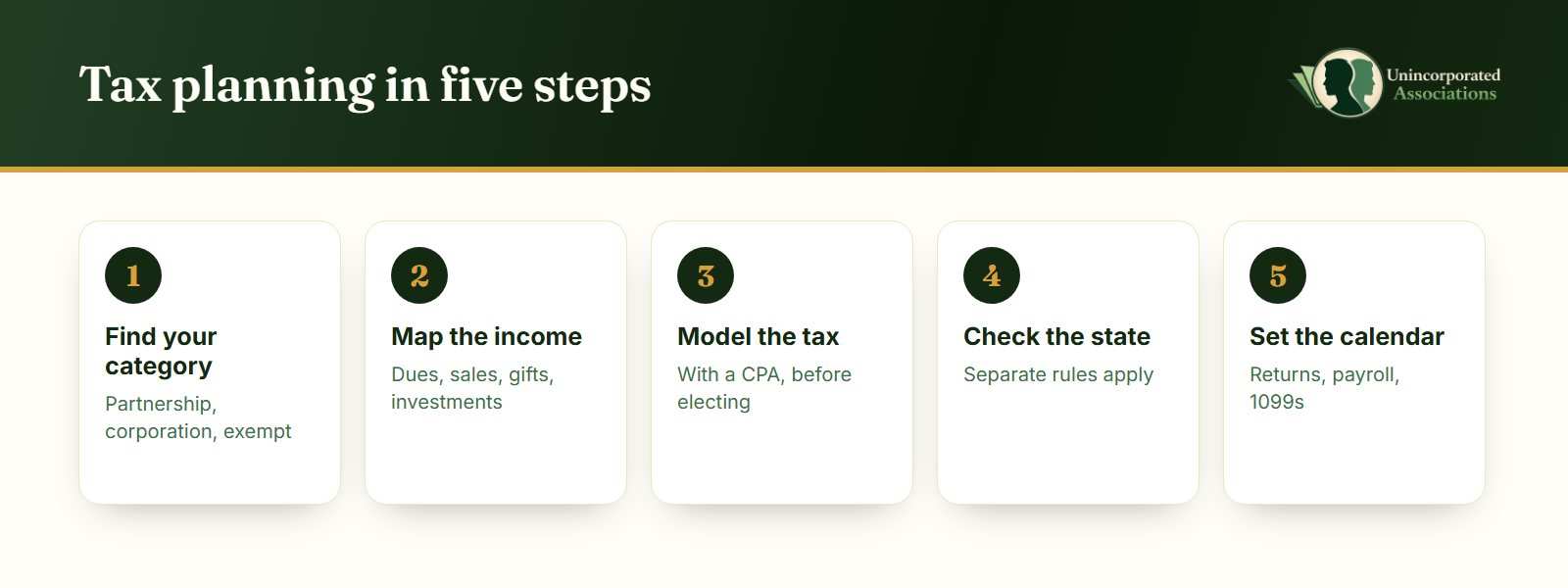
Step 1: which tax category is your association in?
The federal entity classification rules sort organizations into trusts and business entities (26 CFR 301.7701-2). For an unincorporated business entity with two or more members, the default under 26 CFR 301.7701-3 is partnership treatment, with the option to elect corporate treatment. Organizations that qualify under section 501 can instead be exempt.
So most associations fall into one of four buckets:
- Partnership (default for a non-exempt, multi-member business)
- Corporation (by election)
- Exempt organization (501(c)(3), (c)(4), (c)(7) and others)
- Special regimes (homeowners associations under section 528, political organizations under section 527)
Bucket 1: partnership treatment
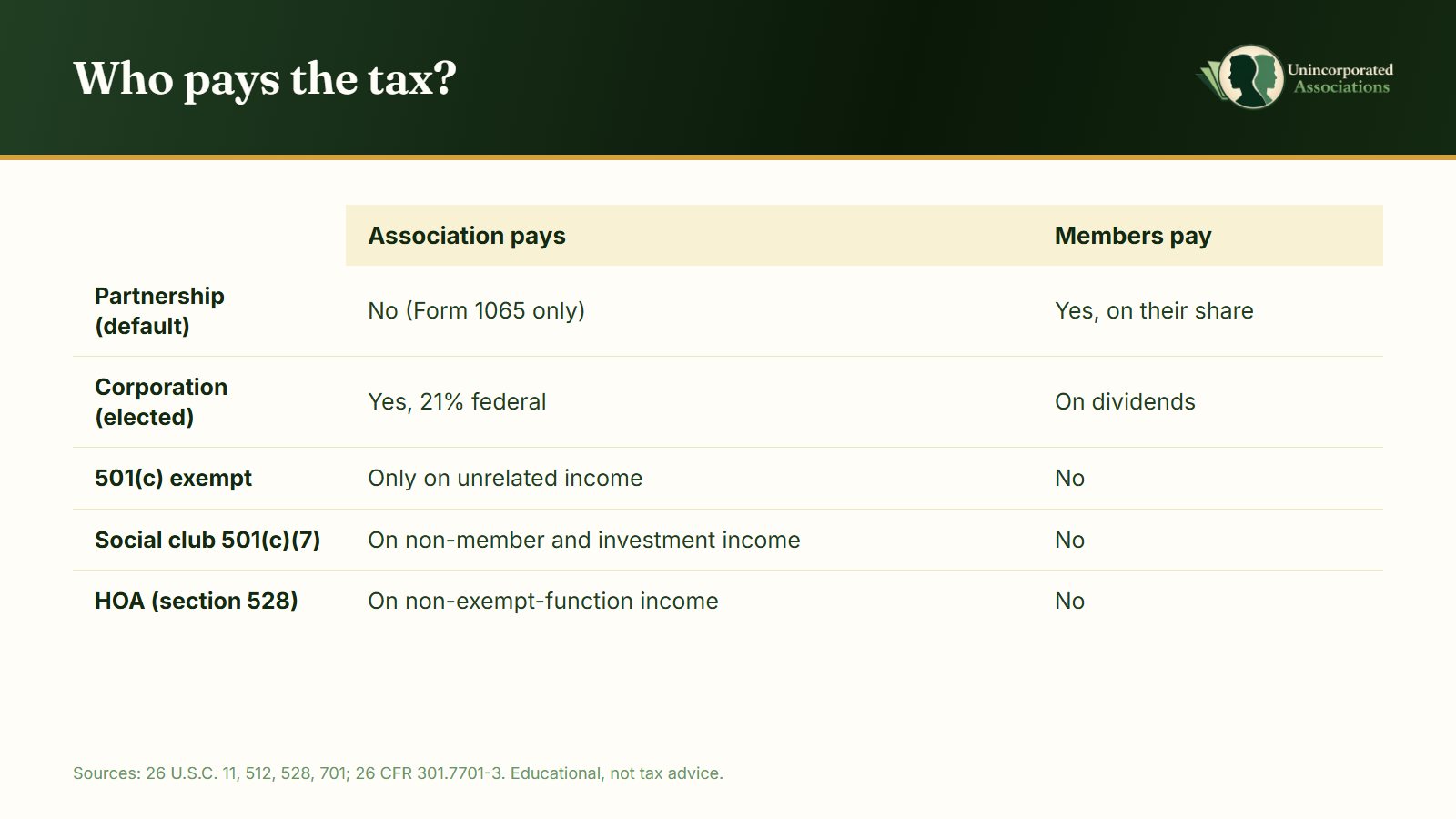
Under 26 U.S.C. § 701, a partnership "shall not be subject to the income tax"; instead, the partners are liable for tax in their separate capacities. The association files an information return (Form 1065), and each member reports their share on their own return.
What that means in practice:
- Members pay tax on their share of profit whether or not it is paid out to them.
- Members active in the business may also owe self-employment tax on their share.
- Losses can pass through to members, subject to limits.
- The association's written agreement can set how profits and losses are shared, within tax rules; without one, shares usually follow each member's interest.
- Payments to a member for services, regardless of profit, are generally treated as "guaranteed payments" taxed to that member as ordinary income.
Bucket 2: corporate treatment
If the association files Form 8832 to be taxed as a corporation, it pays federal corporate income tax under 26 U.S.C. § 11, currently a flat 21 percent. If it later distributes profits to members, those distributions can be taxed again as dividends. Corporate treatment can make sense when profits are kept in the association for future activities rather than paid out.
Bucket 3: exempt organizations
An association recognized under section 501(c) pays no federal income tax on income from its exempt activities. But exemption has limits:
- Unrelated business income. Income from a regular trade or business not substantially related to the exempt purpose is taxable, as the IRS explains for unrelated business income tax. Organizations with $1,000 or more of gross unrelated business income file Form 990-T.
- Social clubs are taxed differently. A 501(c)(7) club generally pays tax on income from non-members and investments, not on members' dues for its exempt activities, under the special rules in 26 U.S.C. § 512(a)(3).
See our guides on whether an unincorporated association is tax exempt and whether one can be a 501(c)(3).
Bucket 4: special regimes
- Homeowners associations can elect under 26 U.S.C. § 528 to file Form 1120-H, which excludes "exempt function income" such as members' assessments and taxes the rest.
- Political organizations are taxed under 26 U.S.C. § 527 only on certain income, such as investment income, not on contributions used for political purposes.
Partnership or corporation: how to choose
If your association is not exempt, the main tax decision is whether to keep the default partnership treatment or elect to be taxed as a corporation. The factors that usually decide it:
- Will profits be paid out or kept? Paying out most profit favors partnership treatment, which avoids a second layer of tax. Keeping profit for future projects can favor corporate treatment, at least in the short term.
- Members' tax brackets. If members are in high brackets, a flat corporate rate on retained earnings can look attractive; if they are in low brackets, pass-through may cost less.
- Self-employment tax. Active members of a partnership may owe self-employment tax on their shares; corporate structures handle this differently.
- Simplicity. Partnership returns are usually simpler; corporate returns and dividend reporting add work.
- Exit and change. Once an election is made, changing it again is restricted for a period, so decide deliberately.
None of these is a reason to elect without modeling the numbers. A CPA can compare both for your actual income and plans.
Records that support your tax position
Whatever your category, keep the records that prove it:
- the governing documents showing your purpose and how money may be used
- any Form 8832 election and the IRS acceptance
- your IRS determination letter, if exempt
- a ledger separating dues, sales, donations, investment and non-member income
- minutes approving payments to members or insiders
Clean categories in your books make the difference between a straightforward return and an expensive reconstruction later.
Worked examples
These simplified illustrations show how the same $50,000 of net income can be taxed very differently. They ignore deductions, credits and state tax.
| Association | Category | Who pays | Roughly how |
|---|---|---|---|
| Four members run a resale business, $50,000 profit | Partnership | The four members | Each reports $12,500 on their own return at their own rate, plus self-employment tax if active |
| Same business, elected corporation, keeps profit | Corporation | The association | 21% of $50,000 = $10,500 federal corporate tax; members taxed again only if dividends are paid |
| Education charity, $50,000 donations surplus | 501(c)(3) | Nobody, on exempt income | $0 income tax; files annual 990-series return |
| Social club, $50,000 from members' dues + $5,000 from non-member events | 501(c)(7) | The club, on the $5,000 | Tax applies to net non-member and investment income, not members' dues |
Pro tip: Run these numbers with a CPA before you decide whether to elect corporate treatment. For a group that pays out most of its profit, partnership treatment is usually simpler; for one that keeps money for future projects, a corporation can cost less in the short term.
State taxes
States make their own rules. California treats unincorporated organizations as subject to state tax until the Franchise Tax Board grants exemption, and nonprofit associations are subject only to income tax rather than franchise tax (FTB 3500 booklet). Texas handles franchise and sales tax exemptions through the Comptroller. Sales tax can apply to goods sold even to members.
Payroll and other taxes
Whatever its income tax category, an association with employees must handle payroll taxes, and an association paying contractors may need to issue Forms 1099. Property taxes depend on local rules and any property tax exemptions for nonprofits. Many states and counties exempt property used for religious, charitable or educational purposes, but usually only after the organization applies, and the exemption often covers only the portion of property actually used for the exempt purpose. Check with your county assessor before assuming property is exempt.
Watch out: No legal form makes members' own income disappear. Under 26 U.S.C. § 61, gross income means income "from whatever source derived." Income routed through an association is taxed to the association, to its members, or both, depending on its category.
Common mistakes
- Assuming members owe nothing because no money was paid out. In a partnership, members are taxed on their share either way.
- Assuming nonprofit means no tax. Exemption requires qualifying, and unrelated business income can still be taxed.
- Electing corporate status without modeling it. Double taxation can cost more if profits are paid out.
- Forgetting the social club rules. Non-member income is taxable for a 501(c)(7).
- Ignoring state tax. Federal status does not settle state obligations.
Frequently asked questions
Does an unincorporated association pay income tax?
It depends on its category. As a partnership, it pays no federal income tax itself; its members do. As a corporation, it pays corporate tax. As an exempt organization, it generally pays tax only on unrelated business income.
Are members taxed on association income?
In a partnership association, yes, on their share, even if it isn't distributed. In a corporate association, only on distributions. In an exempt association, members are not taxed on its income.
What tax rate does an association pay?
A corporate association pays the federal corporate rate under section 11, currently 21 percent. Partnership income is taxed at each member's own rate. Exempt organizations pay corporate rates on unrelated business taxable income.
Do social clubs pay tax on dues?
A 501(c)(7) social club generally does not pay tax on members' dues for its exempt activities, but does pay tax on net income from non-members and investments.
How are homeowners associations taxed?
HOAs can elect under section 528 to file Form 1120-H, which excludes members' assessments as exempt function income and taxes other net income.
Sources
- 26 CFR 301.7701-2 and 301.7701-3
- 26 U.S.C. § 11, § 61, § 512, § 527, § 528 and § 701
- IRS: Form 8832
- IRS: Unrelated business income tax
- California Franchise Tax Board: Form 3500 booklet
Want to model your association's taxes before you choose a path? Book a free 15-minute call with Kirk's team, or join the daily live Q&A.
Have questions? Bring them to the daily call.
Join our live Q&A every weekday and Saturday at 3PM PST, or get a free 15-minute call to see whether a UNA fits your situation.
Have a question about your situation?
Send us a message and we'll get back to you.
Keep reading
 The Well-Meaning Dragon: Straight Answers to the Hardest ObjectionsFor the family and friends who push back because they care — honest answers to the toughest questions about the Federal income tax and Unincorporated Associations.
 It's Not What You Believe, It's What You SignFor the cautious partner in the room: real risk rarely comes from asking questions. It comes from what you signed.
 What Most People Get Wrong About Taxes, Structure, and ControlThe real problem isn't taxes — it's structure, and who actually has control. A look at positioning over loopholes.
Educational, not legal or tax advice. Unincorporated Associations is a document-preparation and education company. Consult a licensed attorney or CPA before acting on any position discussed on this site.