Unincorporated Association Documents: The Full List, Stage by Stage
By Kirk Carmichael · · 8 min read
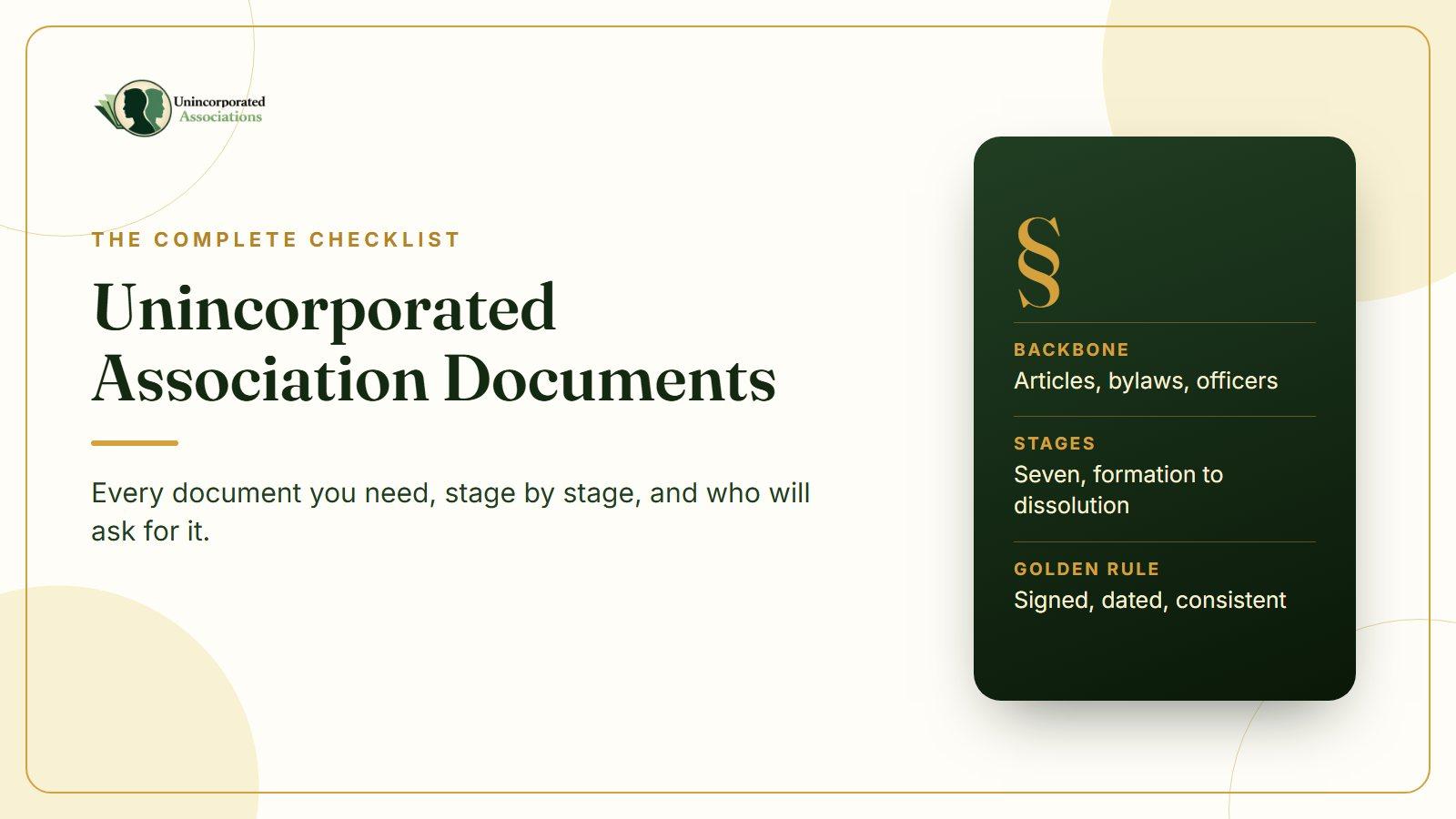
Short answer: An unincorporated association's core documents are its articles of association (or constitution), bylaws and a record of its officers. Around those sit stage-specific documents: an EIN confirmation and signer resolution for banking; minutes, a member register and policies for operations; a statement of authority for real estate; exemption applications and returns for taxes; amendments and agent statements for changes; and a dissolution resolution at the end. Because there is no state charter, these documents are the association's legal backbone.
A corporation has a state charter and a statute that fills in the blanks. An unincorporated association has only what its members write down. That makes the document set more important, not less, and it explains why banks, the IRS and title companies ask for them by name.
This guide lists every document an association typically needs, organized by stage, with who asks for each one and why.
Key takeaways: Three documents form the backbone: articles, bylaws and an officer record. Each later stage adds its own: banking, operations, property, tax, changes and dissolution. Keep them consistent, signed, dated and stored safely. If your group is members-only, see our separate PMA document guide.
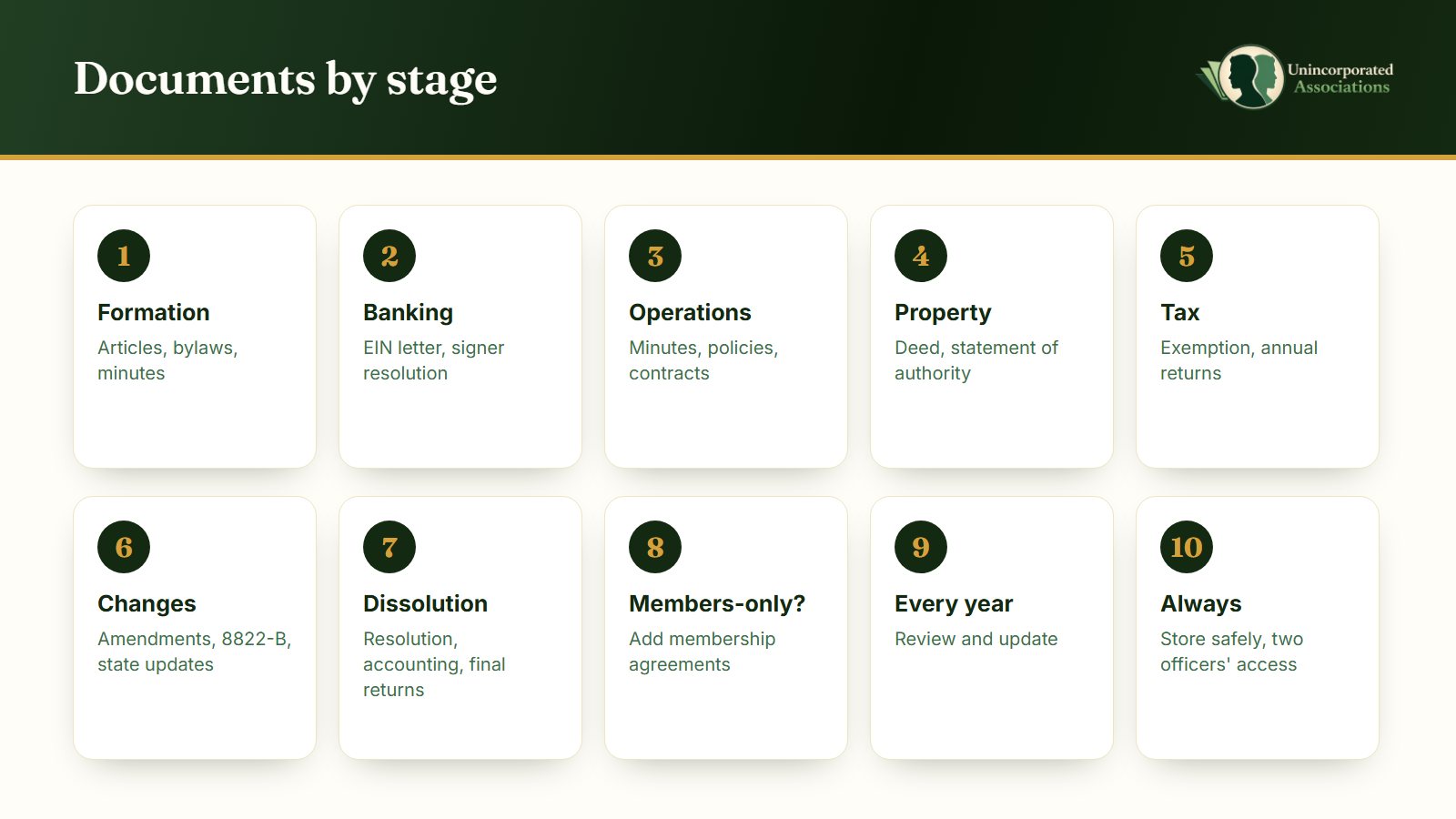
Stage 1: Formation
| Document | What it does | Who asks for it |
|---|---|---|
| Articles of association (or constitution) | Creates the association; states name, purpose, membership and asset rules | Banks, IRS (for exemption), title companies |
| Bylaws | Sets meetings, voting, officers, finances and disputes | Banks, members, IRS (exemption) |
| Founders' minutes | Records adoption of the articles and bylaws and first officers | Banks, auditors |
| Member register | Lists members and when they joined | Your own records; evidence of membership |
The articles are the key document. California's definition, "two or more persons joined by mutual consent for a common lawful purpose" (Corp. Code § 18035), and Texas's three-member definition for nonprofit associations (Bus. Orgs. Code § 252.001) are what the articles document. If the association may seek 501(c)(3) status, the articles must also contain the purpose-limiting and dissolution clauses the IRS requires; see can an unincorporated association be a 501(c)(3).
What the backbone documents should contain
Articles of association should state, at a minimum:
- the association's exact legal name
- that it is an unincorporated association, and under which state's law if that matters
- a specific, lawful purpose (and, for exempt purposes, the limiting language the IRS expects)
- who the founding members and first officers are
- how members join and leave
- that money and property belong to the association, not to individual members
- how the articles can be amended
- what happens to assets on dissolution
Bylaws should answer the practical questions:
- when and how meetings are called, and how much notice is required
- what counts as a quorum and what vote passes a decision
- which officers exist, their duties, terms and how they are chosen or removed
- who may sign contracts and bank documents, and whether two signatures are needed above a set amount
- how the budget is approved and how finances are reported to members
- how conflicts of interest are handled
- how disputes between members, or with the association, are resolved
If a question comes up often in your group and the bylaws don't answer it, that's a sign the bylaws need an amendment. Write the answer down once, adopt it properly, and it stops being an argument.
When documents decide the outcome
The disputed bank account. Two factions of a club each claimed the right to control its account. The bylaws said officers are elected at the annual meeting, and the minutes recorded who was elected. The bank followed the minutes, and the dispute ended in a week.
The house left to "the association." A member left a house to her congregation in her will. Because the congregation's state allowed associations to own property, and its articles and a recorded statement of authority named who could act, the transfer went smoothly.
The leftover funds. A neighborhood group wound down with money in the bank. Its articles said remaining assets go to a named local charity, so there was nothing to argue about.
Stage 2: Banking
| Document | What it does |
|---|---|
| IRS EIN confirmation (CP 575 or Letter 147C) | Proves the association's tax ID and legal name |
| Officer and signer resolution | Names who may open and operate accounts |
| Signer IDs | Required by every bank |
| Control certification (optional) | States who manages the association and that no one owns equity |
Apply for the EIN with Form SS-4 or online. Our guide to beneficial ownership for associations explains what banks may ask about control.
Stage 3: Operations
| Document | Why it matters |
|---|---|
| Minutes of meetings | Show that decisions were made the way the bylaws require |
| Membership agreements (if members-only) | Define the members-only relationship |
| Financial records and annual budget | Support taxes, reports to members and audits |
| Contracts signed in the association's name | Keep obligations with the association, not individuals |
| Policies (conflict of interest, privacy, conduct, record retention) | Reduce disputes and protect officers |
| Insurance policies | Protect the association and its volunteers |
Pro tip: Every contract should be signed "[Association name], by [Officer name], [Title]." It shows the obligation belongs to the association and helps protect the signer personally.
Stage 4: Property
| Document | What it does |
|---|---|
| Deed in the association's name | Records ownership where state law allows (California § 18105; Texas § 252.004) |
| Statement of authority (recorded in the county) | Names who may sell or mortgage real estate (California § 18120; Texas § 252.005) |
| Resolution approving a purchase, sale or loan | Shows the decision was properly made |
| Leases | Signed in the association's name |
Stage 5: Tax and exemption
| Document | When it applies |
|---|---|
| Form 1023, 1023-EZ or 1024, and the determination letter | If seeking federal exemption |
| Annual federal return (990-series, 1065 or 1120) | Depending on classification |
| State exemption application (e.g., California FTB 3500) | If exempt and the state requires it |
| Form 8832 election, if made | If electing corporate tax treatment |
| 1099s and payroll records | If paying contractors or employees |
See our guide on whether unincorporated associations file tax returns.
Stage 6: Changes
| Document | When |
|---|---|
| Amendments to articles or bylaws | When rules change, adopted as the documents require |
| New officer resolution | When officers or signers change |
| IRS Form 8822-B | When the address or responsible party changes |
| Optional state statement or update | E.g., California UA-100 under § 18200, Texas Form 706 under § 252.011 |
Stage 7: Dissolution
| Document | What it does |
|---|---|
| Dissolution resolution | Records the members' decision to dissolve |
| Final accounting | Shows debts paid and remaining assets |
| Asset distribution record | Shows assets went where the articles require |
| Final tax returns | Closes out federal and state filings |
For exempt associations, remaining assets must go to exempt purposes, as the articles' dissolution clause requires. Before dissolving, also cancel any optional state statements, close bank accounts after final payments clear, notify the IRS on the final return, and keep the dissolution records with the founding documents in case questions arise later. Congregations and other groups with long histories often keep their records with a successor organization or an archive.
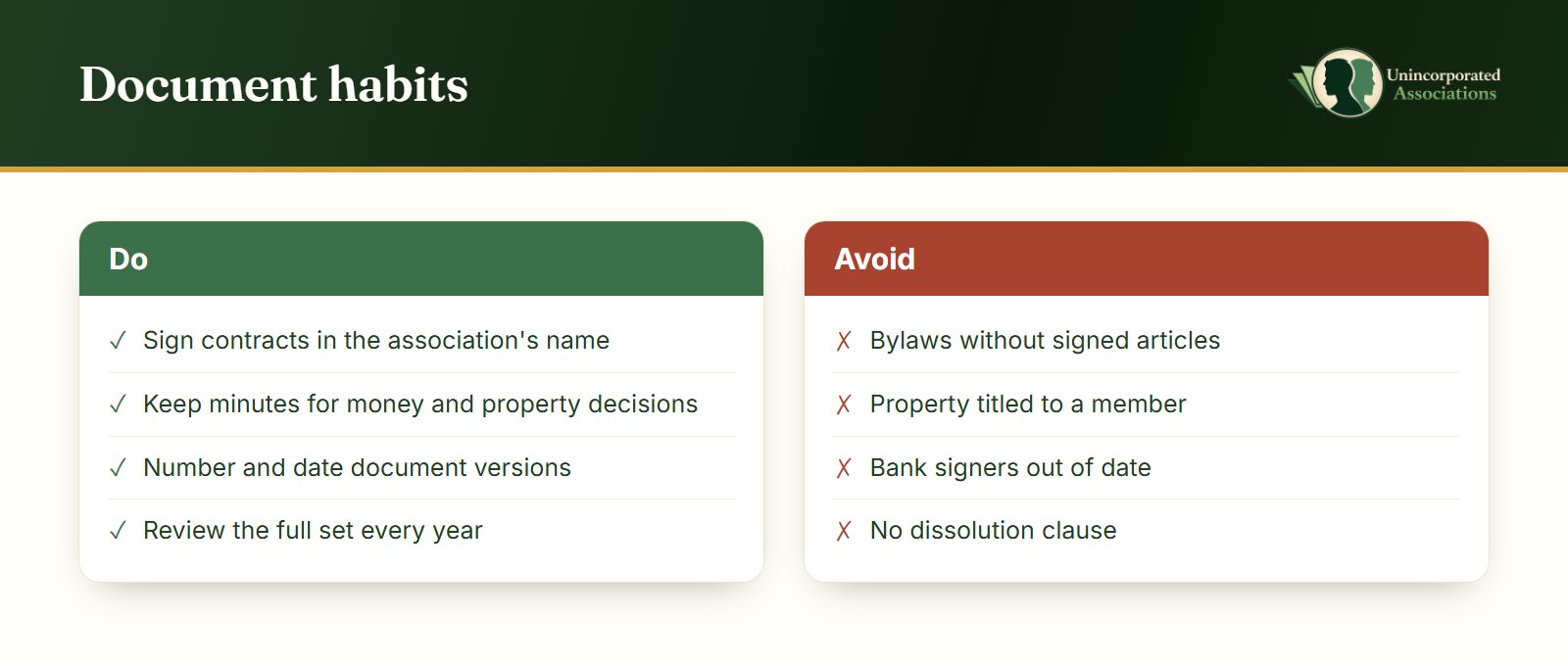
Watch out: Missing or contradictory documents are the main reason associations struggle at banks, with the IRS and in disputes. A bylaw that says "two signatures required" while the bank resolution names one signer is a problem waiting to happen.
Keeping documents safe and current
- Sign and date everything, and number versions of the bylaws and agreements.
- Store originals securely, with scanned copies in a shared, backed-up folder that at least two officers can access.
- Review annually at the members' meeting.
- Keep founding documents and minutes permanently; keep financial records at least as long as the IRS can examine the related returns (IRS: how long to keep records).
Templates: helpful or harmful?
A template can show you what a document looks like. Problems start when founders combine templates from different sources, each assuming different state laws and purposes, or copy language that promises protections no document can provide. Treat templates as examples, and make sure your final set is consistent and fits your state and activities. Members-only groups should also read our guide to private membership association documents.
Common mistakes
- Bylaws without articles. Banks and the IRS want the founding document.
- Unsigned or undated documents.
- No minutes for decisions about money or property.
- Property titled to a member instead of the association.
- Outdated signer lists at the bank.
- No dissolution clause, leaving assets in limbo.
Frequently asked questions
What is the governing document of an unincorporated association?
Its articles of association, sometimes called a constitution or charter. The bylaws add operating rules. Together they are the association's governing documents.
Is a constitution the same as articles of association?
They serve the same function: the founding agreement stating the association's name, purpose and basic rules. Different groups use different names.
What documents does a bank need from an unincorporated association?
Usually the articles and bylaws, the IRS EIN confirmation, a resolution naming officers and signers, and IDs for each signer.
Do I need to file my association's documents with the state?
No. They are kept by the association. Some states offer optional filings, and real estate may require a recorded statement of authority.
How often should we update our documents?
Review them every year, and amend them whenever the association's activities, officers or address change, using the procedure your documents set out.
Sources
- California Corporations Code sections 18035, 18105, 18120 and 18200
- Texas Business Organizations Code sections 252.001, 252.004, 252.005 and 252.011
- IRS: Form SS-4
- IRS: How long should I keep records?
Want a complete, consistent document set for your association? Book a free 15-minute call with Kirk's team, or join the daily live Q&A.
Have questions? Bring them to the daily call.
Join our live Q&A every weekday and Saturday at 3PM PST, or get a free 15-minute call to see whether a UNA fits your situation.
Have a question about your situation?
Send us a message and we'll get back to you.
Keep reading
 The Well-Meaning Dragon: Straight Answers to the Hardest ObjectionsFor the family and friends who push back because they care — honest answers to the toughest questions about the Federal income tax and Unincorporated Associations.
 It's Not What You Believe, It's What You SignFor the cautious partner in the room: real risk rarely comes from asking questions. It comes from what you signed.
 What Most People Get Wrong About Taxes, Structure, and ControlThe real problem isn't taxes — it's structure, and who actually has control. A look at positioning over loopholes.
Educational, not legal or tax advice. Unincorporated Associations is a document-preparation and education company. Consult a licensed attorney or CPA before acting on any position discussed on this site.