
Beneficial Ownership Reporting for Unincorporated Associations (2026)
By Kirk Carmichael · · 8 min read
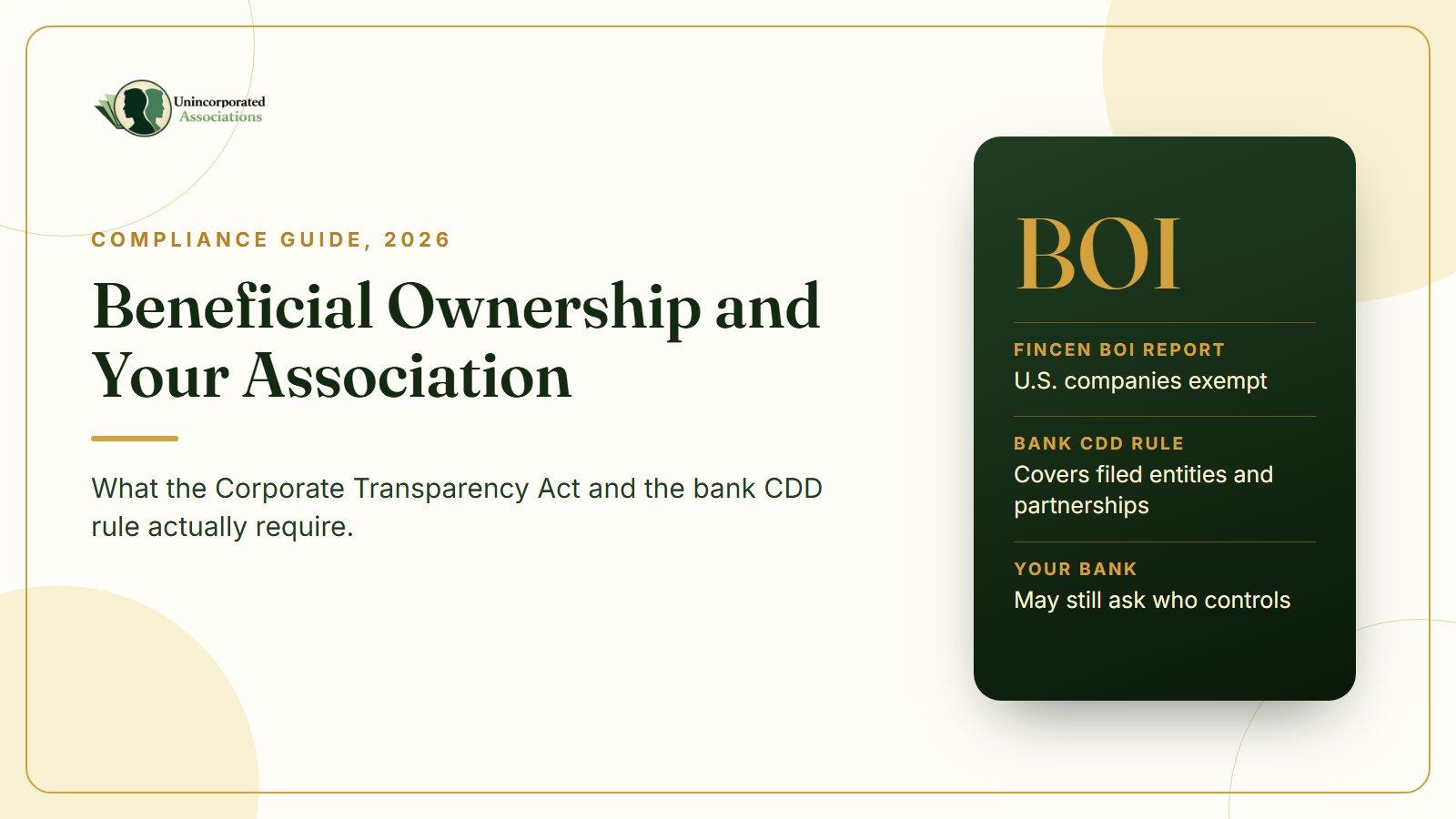
Short answer: Generally no federal beneficial ownership report is required of a U.S. unincorporated association. The Corporate Transparency Act only ever covered entities created by filing a document with a Secretary of State, which an association is not, and since FinCEN's 2025 rule, U.S. companies are exempt from beneficial ownership reporting anyway. Separately, the bank customer-due-diligence rule asks for beneficial owners of "legal entity customers," a term that likewise covers entities created by a state filing and general partnerships. Banks can still ask an association for information under their own risk procedures, so be ready to identify your officers and signers.
Few compliance topics caused as much confusion in recent years as "beneficial ownership." Associations heard about the Corporate Transparency Act, about banks asking for owner information, and about percentage thresholds, and many were unsure whether any of it applied to them.
This guide separates the two sets of rules that use the phrase, explains how each treats unincorporated associations, and lists what banks may still ask for.
Key takeaways: Two different rules use "beneficial ownership": FinCEN reporting under the Corporate Transparency Act, and bank customer due diligence. Both are written around entities created by a state filing. A genuine unincorporated association usually falls outside both definitions, but a for-profit association that is really a general partnership can fall inside the bank rule. Banks may still ask who controls the association.
Two different "beneficial ownership" rules
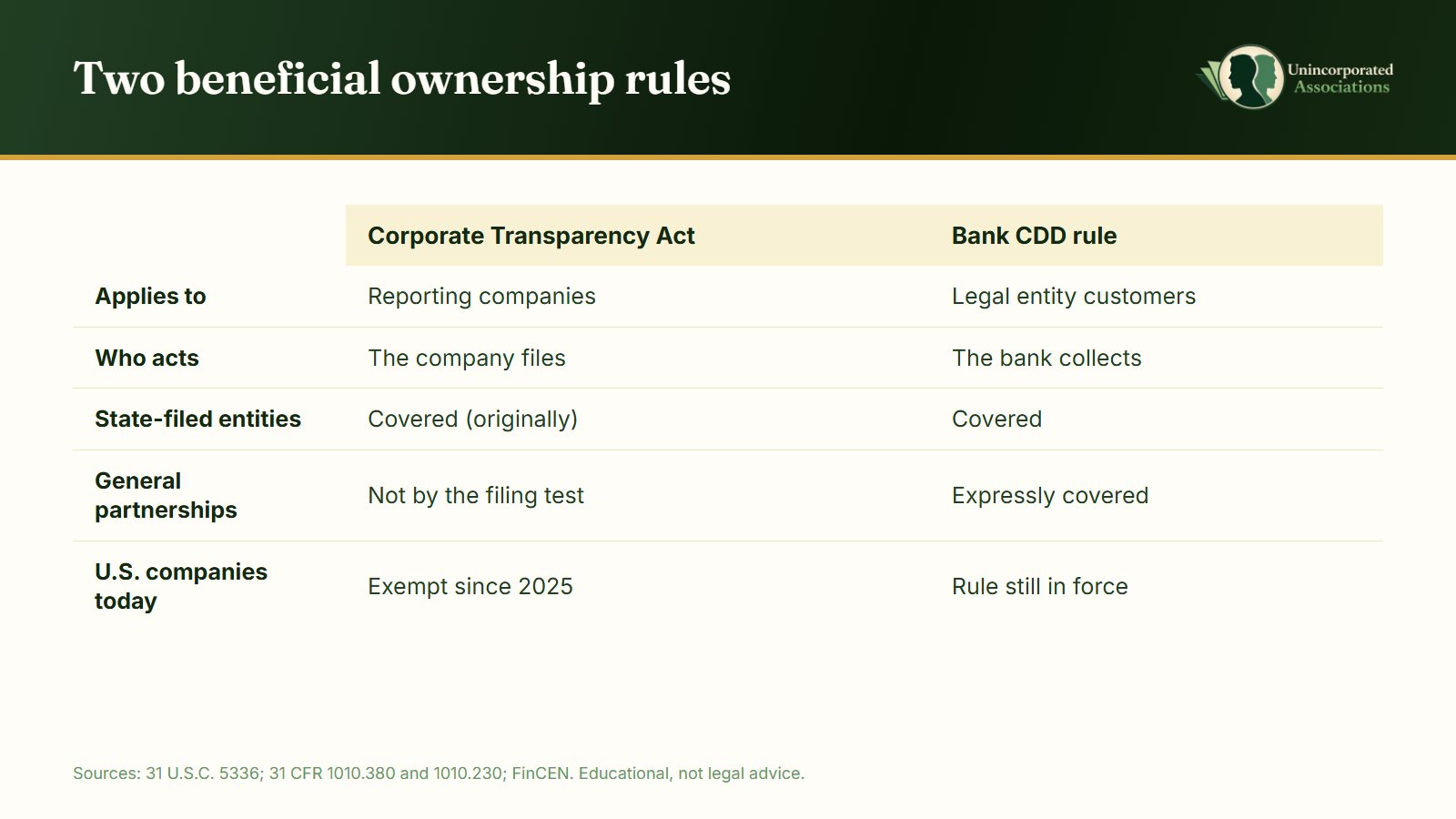
| Corporate Transparency Act reporting | Bank customer due diligence (CDD) | |
|---|---|---|
| Who it applies to | "Reporting companies" | Banks' "legal entity customers" |
| Who must act | The company files with FinCEN | The bank collects information at account opening |
| Covers entities created by state filing | Yes (originally) | Yes |
| Covers general partnerships | Not by the filing test | Yes, expressly |
| Status for U.S. companies | Exempt since FinCEN's 2025 rule | Still in force |
| Main law | 31 U.S.C. § 5336; 31 CFR 1010.380 | 31 CFR 1010.230 |
Rule 1: the Corporate Transparency Act
The Corporate Transparency Act required certain companies to report their beneficial owners to FinCEN. The statute defines a domestic "reporting company" as "a corporation, limited liability company, or other similar entity that is ... created by the filing of a document with a secretary of state or a similar office" (31 U.S.C. § 5336(a)(11)).
An unincorporated association is created by its members' agreement, not by a state filing. That means a genuine association was generally outside the definition from the start. Optional state statements, such as California's Form UA-100 or Texas's Form 706, record an address or agent; they do not create the association.
Then the rules changed for everyone. In March 2025, FinCEN issued an interim final rule removing the reporting requirement for U.S. companies and U.S. persons, and it later made those exemptions permanent. FinCEN's beneficial ownership page now states that U.S. companies are exempt from BOI reporting and are no longer required to file reports.
Watch out: Rules in this area have changed several times. Check FinCEN's current guidance before relying on any summary, including this one, and watch for changes in your state, as some states have considered their own transparency laws.
Rule 2: the bank customer-due-diligence rule
Banks have their own, separate obligation. Under 31 CFR 1010.230, when a "legal entity customer" opens an account, the bank must identify and verify its beneficial owners. FinCEN explains the rule on its CDD final rule page.
The regulation defines a legal entity customer as "a corporation, limited liability company, or other entity that is created by the filing of a public document with a Secretary of State or similar office, a general partnership, and any similar entity formed under the laws of a foreign jurisdiction."
For a beneficial owner, the rule looks at two prongs:
- Ownership: each individual who owns 25 percent or more of the equity interests
- Control: one individual with significant responsibility to control or manage the entity, such as an officer or managing member
A nonprofit association created by agreement is generally not a "legal entity customer" under that definition. But a general partnership is, expressly. An association that is really a for-profit business run by co-owners may be treated as a general partnership, and the bank rule would then apply.
What your bank may still ask for
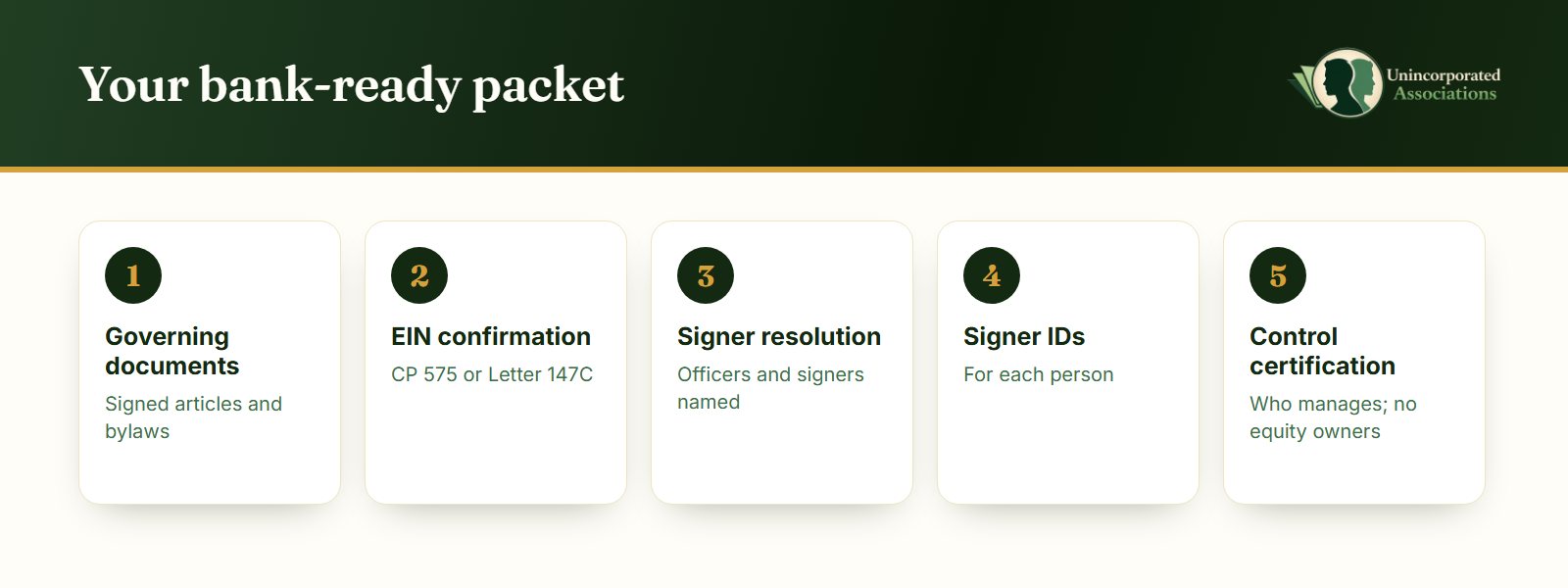
Even when the federal rule does not require it, banks set their own know-your-customer procedures based on risk. When opening an account for an association, expect to provide:
- the signed articles of association and bylaws
- the IRS EIN confirmation (CP 575 or Letter 147C)
- a resolution naming officers and authorized signers
- identification for each signer
- sometimes, a certification naming the person who controls the association day to day
Our guide to opening an unincorporated association bank account covers the full packet.
Pro tip: Prepare a one-page "control certification" signed by your officers: the association's name and EIN, its officers, its authorized signers, and a statement that no individual owns an equity interest in it. Many banks accept something like this and it speeds up account opening.
"Beneficial owner percentage" for associations
People often search for the "beneficial owner percentage" for an association. The 25 percent figure comes from the bank rule's ownership prong. In a nonprofit association, members usually do not own equity interests at all: they hold membership rights, not shares, and the association's assets are dedicated to its purpose. So there is typically no one who "owns 25 percent," and the relevant person is whoever controls or manages the association.
In a for-profit association where members do hold profit shares, the analysis changes: each person with a 25 percent or greater share may be identified, and the group may be a general partnership in the first place.
Why associations were treated differently
The logic behind both rules is to see through companies that can be bought, sold and used to hide who profits from them. An LLC or corporation has owners with transferable equity, and a state record that anyone can create quickly. A nonprofit association is different: members join by agreement, usually cannot sell or transfer their membership, and the association's assets are dedicated to its purpose rather than owned by anyone. Lawmakers drew the lines around entities created by a state filing, and general partnerships for the bank rule, because those are the vehicles most often used to hold and move private wealth.
That is also why the analysis flips for for-profit groups. When members hold profit shares in a business, they look much more like owners, and the partnership rules, including the bank's beneficial ownership questions, come into play. Our unincorporated association vs LLC guide explains where that line falls.
Keep your control records current
Banks will ask again when signers change. Keep a simple record of:
- current officers and the date each took office
- authorized signers on each account
- the resolution that appointed them
- the date the bank was last updated
When an officer leaves, pass a new resolution, update the bank, and file IRS Form 8822-B if the person named as responsible party on your EIN has changed. Our guide on how to register an unincorporated association covers the other records to keep current.
Three examples
A neighborhood nonprofit association opens a checking account for dues. No equity owners; its treasurer and chair are the signers. The bank asks for the articles, EIN letter and a signer resolution, and records the chair as the controlling person.
An investment club of five members, each with a 20 percent share, opens a brokerage account. As a group investing for profit it is likely a general partnership, so it falls within the bank rule; with no one at 25 percent, the bank still identifies a controlling person.
A church association opens an account for offerings. Like the nonprofit association, it has no equity owners. The bank documents its pastor or treasurer as the controlling person, along with its governing documents.
Common mistakes
- Filing a BOI report "just in case." U.S. companies are now exempt, and a genuine association was generally not a reporting company anyway.
- Arriving at the bank without a signer resolution.
- Calling members "owners" in your documents. For a nonprofit association, that language invites confusion.
- Ignoring partnership risk. A for-profit association can be a general partnership, with different rules.
- Relying on old articles or videos. The rules changed in 2025.
Frequently asked questions
Do unincorporated associations have to file a BOI report with FinCEN?
Generally no. The Corporate Transparency Act's definition of a domestic reporting company covered entities created by a state filing, which an association is not, and since 2025 U.S. companies are exempt from BOI reporting.
Do unincorporated associations have beneficial owners?
A nonprofit association usually has no one who owns equity in it, so the "owner" concept does not fit well. Banks will instead want to know who controls or manages it, such as its chair or treasurer.
What is the beneficial owner percentage for an association?
The 25 percent threshold comes from the bank CDD rule's ownership prong. Most nonprofit associations have no equity owners, so the bank identifies a controlling person instead.
Will my bank ask for beneficial ownership information?
Possibly. Even where the federal rule doesn't strictly apply, banks follow their own risk procedures. Bring your governing documents, EIN letter, signer resolution and IDs.
Does the bank rule apply to a for-profit association?
It may. The bank rule expressly covers general partnerships, and a for-profit association run by co-owners is often treated as one.
Sources
- FinCEN: Beneficial ownership information
- 31 U.S.C. § 5336 (Corporate Transparency Act)
- 31 CFR 1010.380 (BOI reporting)
- 31 CFR 1010.230 (bank customer due diligence)
- FinCEN: CDD final rule
- Texas Business Organizations Code section 152.051
Opening an account for your association? Book a free 15-minute call with Kirk's team, or join the daily live Q&A.
Have questions? Bring them to the daily call.
Join our live Q&A every weekday and Saturday at 3PM PST, or get a free 15-minute call to see whether a UNA fits your situation.
Have a question about your situation?
Send us a message and we'll get back to you.
Keep reading
 The Well-Meaning Dragon: Straight Answers to the Hardest ObjectionsFor the family and friends who push back because they care — honest answers to the toughest questions about the Federal income tax and Unincorporated Associations.
 It's Not What You Believe, It's What You SignFor the cautious partner in the room: real risk rarely comes from asking questions. It comes from what you signed.
 What Most People Get Wrong About Taxes, Structure, and ControlThe real problem isn't taxes — it's structure, and who actually has control. A look at positioning over loopholes.
Educational, not legal or tax advice. Unincorporated Associations is a document-preparation and education company. Consult a licensed attorney or CPA before acting on any position discussed on this site.