
Unincorporated Association Advantages and Disadvantages: An Honest List
By Kirk Carmichael · · 8 min read
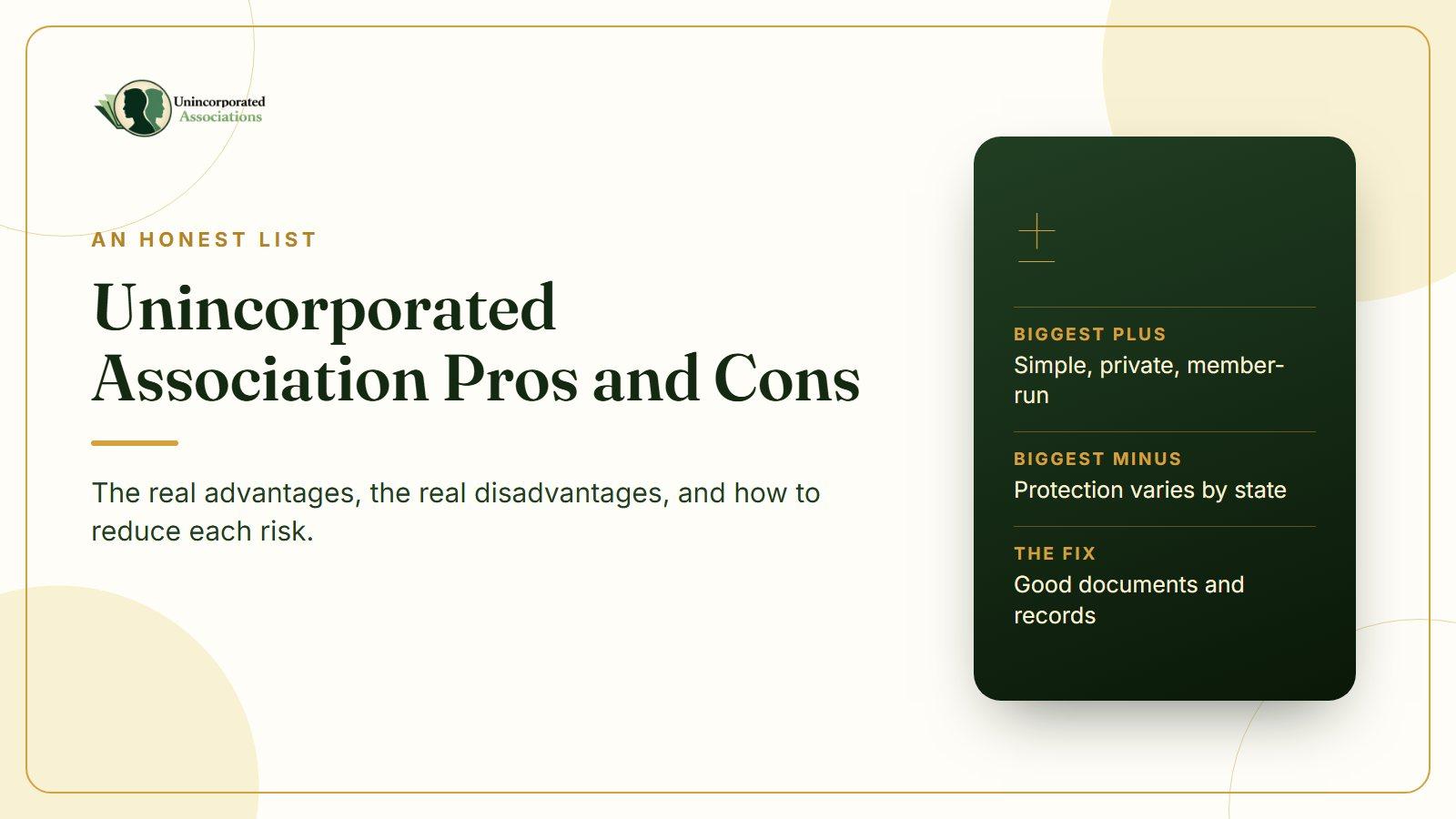
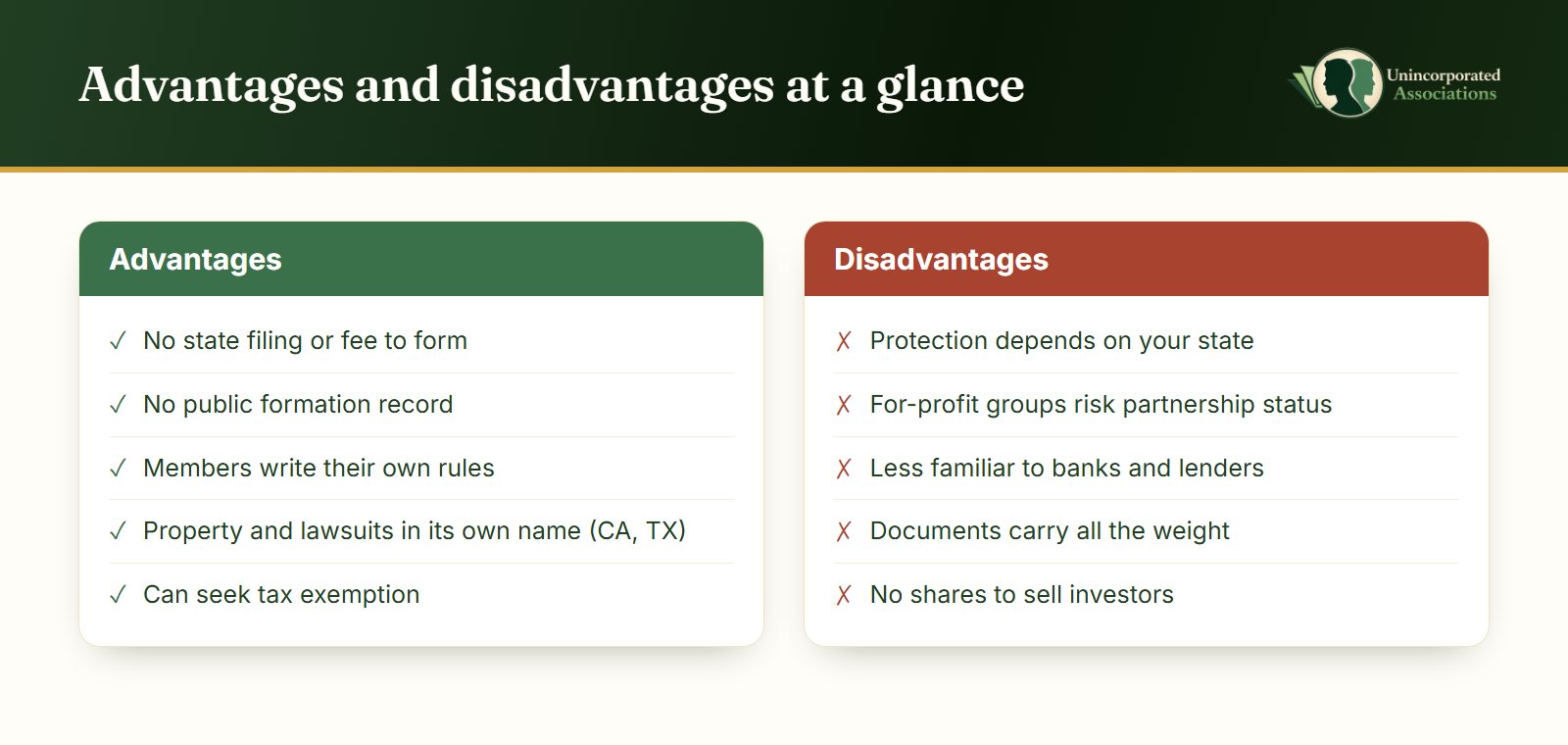
Short answer: The main advantages of an unincorporated association are that it costs nothing to form with the state, keeps no public formation record, lets members write their own rules, and in states like California and Texas can own property, sue in its own name and protect members from liability just for being members. The main disadvantages are that its legal protections vary by state, banks and lenders find it less familiar, a for-profit association risks being treated as a general partnership, and the quality of its documents carries all the weight.
Every legal structure is a set of trade-offs. An unincorporated association is no exception. Its strengths, simplicity, privacy and member control, are real. So are its weaknesses, and anyone forming one should understand both before signing anything.
This guide lists the advantages and disadvantages honestly, shows how much each one depends on your state and purpose, and explains how to reduce the risks.
Key takeaways: Associations are cheap, private and flexible, and in many states legally robust. Their weak points are state-by-state variation, less familiarity at banks, and the partnership risk for for-profit groups. Strong documents, a genuine shared purpose and good record-keeping solve most of the disadvantages.
The advantages
1. No state filing or fee to form
An association exists when its members agree to form it. California's definition, "two or more persons joined by mutual consent for a common lawful purpose" (Corp. Code § 18035), needs no filing. There is no articles fee and, in most states, no annual report fee. Compared with an LLC or corporation, that saves both money and paperwork every year.
2. Privacy
Because nothing is filed to form it, there is no state formation record listing the association's founders, managers or members. Membership lists stay with the association. The Supreme Court recognized the importance of membership privacy in NAACP v. Alabama.
3. Members write the rules
An LLC or corporation statute fills in default rules for voting, management and dissolution. An association's own articles and bylaws are the rulebook: who joins, how decisions are made, who signs and what happens on dissolution. Groups that want to run themselves their own way value this most.
4. Real legal standing in many states
Modern statutes have given associations much of what corporations have:
- In California, an association can own property in its own name (§ 18105) and sue or be sued in its own name (Code Civ. Proc. § 369.5).
- In Texas, a nonprofit association is a legal entity separate from its members for contract and tort (Bus. Orgs. Code § 252.006) and can hold property (§ 252.004).
5. Member liability protection (for nonprofit associations)
California says a nonprofit association member is not liable for its debts solely by reason of being a member (§ 18605); Texas says much the same in section 252.006.
6. Can seek tax exemption
A qualifying association can apply for federal exemption; the IRS accepts articles of association as the organizing document for 501(c)(3) status.
7. Quick to start and easy to adapt
With good documents, founders can sign, get an EIN and open a bank account in days. Changing the rules later means amending your own bylaws, not filing with the state.
The disadvantages
1. Protection depends on your state
California, Texas and the states that adopted the uniform nonprofit association act protect members by statute. In states without such a statute, older common-law rules can make members who authorize or take part in a decision personally liable for it. Where you are matters.
2. The for-profit partnership trap
If co-owners run a business for their own profit, the law may treat them as a general partnership, whatever they call themselves. Texas puts it plainly in § 152.051. General partners are personally liable for the partnership's debts. This is the single biggest risk for anyone thinking of an association as a "cheaper LLC." We explain it in our unincorporated association vs LLC guide.
3. Less familiar to banks, lenders and landlords
Banks know LLCs and corporations. With an association, expect to provide more documents and answer more questions. Some lenders and large grant makers prefer or require incorporated entities.
4. Your documents carry all the weight
There is no statute filling the gaps your bylaws leave. Vague or contradictory documents can lead to disputes over money, authority and membership.
5. Tax treatment is not obvious
Associations are classified by what they do under the federal entity rules (26 CFR 301.7701-2). A non-exempt association with members running a business is usually a partnership; an exempt one must file annual returns. See our guide on whether unincorporated associations file tax returns.
6. Federal court complications
For federal diversity jurisdiction, an unincorporated association is a citizen of every state where its members are citizens (United Steelworkers v. Bouligny), which can affect where it can sue or be sued.
7. Not ideal for raising investment
An association has no shares to sell. Groups planning to raise money from investors usually need a corporation or LLC.
How the disadvantages show up in real life
Abstract risks are easier to judge with examples. These are simplified illustrations.
The bank that said "not yet." A new association arrived at its bank with articles of association but no officer resolution and an EIN letter showing a slightly different name. The bank declined to open the account until both were fixed. Two weeks lost, entirely avoidable with consistent documents.
The club treasurer who kept the money. A sports club let its treasurer hold funds in a personal account "for convenience." When the treasurer moved away, the club spent months recovering its money. With an account in the association's name under its own EIN, the issue would never have arisen.
The "association" that was really a partnership. Four friends ran a small resale business, split the profits and called themselves an association. When a supplier sued over an unpaid invoice, the court looked at what they actually did, a for-profit business run by co-owners, and treated them as general partners. Each was exposed for the full debt.
The bylaws that said nothing about leaving. A members' group never wrote down what happens when someone leaves. A departing member demanded a share of the group's savings. Without a clause saying contributions stay with the association, the dispute dragged on.
Each of these problems comes from the same root: the structure was fine, but the documents or habits were not.
How much the protections vary by state
| State type | Member liability for nonprofit associations | Property in own name | Sue in own name |
|---|---|---|---|
| California | Protected by statute (§ 18605) | Yes (§ 18105) | Yes (CCP § 369.5) |
| Texas and uniform-act states | Protected by statute (e.g., Tex. § 252.006) | Yes | Yes |
| States without a modern statute | Older common-law rules; members who authorize decisions can be exposed | Often held by trustees | Varies |
If your state is in the last row, strong documents and conservative habits matter even more. Our state guides start with California and Texas.
Advantages vs disadvantages at a glance
| Advantage | The matching disadvantage | How to reduce the risk |
|---|---|---|
| No formation filing | Less familiar to banks | Bring complete documents and an officer resolution |
| Members write the rules | Documents carry all the weight | Use clear, consistent, state-aware documents |
| Privacy | Less public proof of existence | Keep an EIN, a bank account and good records |
| Statutory protection (some states) | Protection varies by state | Know your state's law; consider an optional state filing |
| Flexible purpose | For-profit groups risk partnership treatment | Keep a genuine, written, shared purpose |
| Can seek exemption | Tax treatment isn't automatic | Decide your tax path early with a CPA |
Pro tip: Most disadvantages shrink dramatically with three things: well-drafted articles and bylaws, a separate bank account under the association's EIN, and minutes for every decision that commits money.
Who benefits most from an association?
- Member-run groups with a shared purpose: clubs, congregations, mutual-aid groups, education and advocacy groups.
- Groups that value privacy and self-governance over a state-standardized structure.
- Groups in states with strong association statutes, such as California and Texas.
- Groups that want to start quickly and may incorporate later if they grow.
Who should probably choose something else?
- A business run to make profit for its owners. An LLC or corporation fits better and avoids the partnership trap.
- A group that depends on large institutional grants that require incorporation.
- A venture that will raise money from investors.
- Anyone unwilling to keep records. An association's protections rely on operating as the documents say.

Watch out: Every structure has trade-offs. Ask whoever prepares your documents to walk you through the disadvantages above for your state and your activity.
Frequently asked questions
What is the main advantage of an unincorporated association?
Simplicity combined with control: there is no state filing to form it, no public formation record, and the members write their own rules. In states like California and Texas, it also gets real legal standing and member liability protection.
What is the main disadvantage?
Its protections depend on state law and on genuinely operating for a shared purpose. A for-profit association can be treated as a general partnership, with personal liability for its members.
Is an unincorporated association risky?
It can be if it is poorly documented, used for an owner-profit business, or formed in a state without protective statutes. With good documents and records in a supportive state, the risks are manageable.
Can an unincorporated association open a bank account?
Yes, with an EIN and signed governing documents. Expect more questions than an LLC would get. Our bank account guide lists what to bring.
Is it better than an LLC?
For a member-driven group with a shared purpose, it can be the better fit. For a conventional business owned for profit, an LLC is usually better. Our corporation comparison and LLC comparison go deeper.
Sources
- California Corporations Code sections 18035, 18105 and 18605
- California Code of Civil Procedure section 369.5
- Texas Business Organizations Code sections 152.051, 252.004 and 252.006
- 26 CFR 301.7701-2
- IRS: Exemption requirements for 501(c)(3) organizations
- NAACP v. Alabama, 357 U.S. 449 (1958)
- United Steelworkers v. R. H. Bouligny, Inc., 382 U.S. 145 (1965)
Weighing the pros and cons for your group? Book a free 15-minute call with Kirk's team, or join the daily live Q&A.
Have questions? Bring them to the daily call.
Join our live Q&A every weekday and Saturday at 3PM PST, or get a free 15-minute call to see whether a UNA fits your situation.
Have a question about your situation?
Send us a message and we'll get back to you.
Keep reading
 The Well-Meaning Dragon: Straight Answers to the Hardest ObjectionsFor the family and friends who push back because they care — honest answers to the toughest questions about the Federal income tax and Unincorporated Associations.
 It's Not What You Believe, It's What You SignFor the cautious partner in the room: real risk rarely comes from asking questions. It comes from what you signed.
 What Most People Get Wrong About Taxes, Structure, and ControlThe real problem isn't taxes — it's structure, and who actually has control. A look at positioning over loopholes.
Educational, not legal or tax advice. Unincorporated Associations is a document-preparation and education company. Consult a licensed attorney or CPA before acting on any position discussed on this site.