
8 Alternatives to a 501(c)(3): When Charity Status Isn't the Right Fit
By Kirk Carmichael · · 8 min read
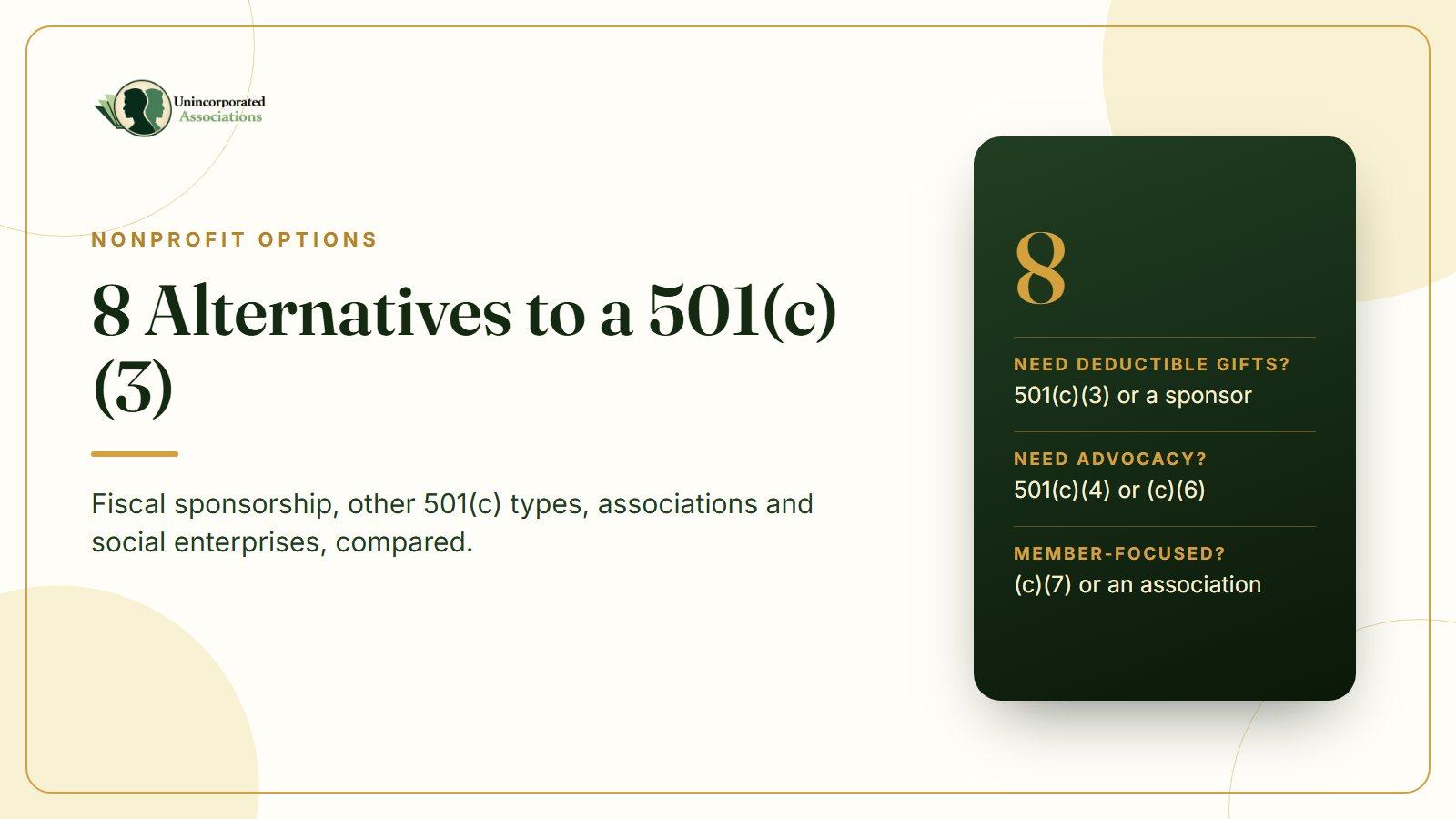
Short answer: The main alternatives to forming a 501(c)(3) are: fiscal sponsorship under an existing charity; a 501(c)(4) social welfare organization (more advocacy freedom, no deductible donations); a 501(c)(6) business league or 501(c)(7) social club for member-focused groups; an unincorporated association without exemption; a social enterprise such as an L3C or benefit company; or an ordinary LLC. Each trades away something a 501(c)(3) offers, usually tax-deductible donations, in exchange for flexibility, simplicity or freedom to advocate.
A 501(c)(3) is the gold standard for charities: tax-exempt income and tax-deductible donations. But it is not right for every group. It comes with an application, annual returns, a ban on campaign activity, limits on lobbying and strict rules against private benefit.
This guide covers eight alternatives, what each gives up and gains, and how to choose. If you are weighing structures more broadly, see our comparison of an unincorporated association vs a nonprofit corporation.
Key takeaways: Choose based on three questions: do donors need a tax deduction, how much advocacy do you plan, and who benefits from the group's work? If deductible donations are essential, a 501(c)(3) or fiscal sponsorship is usually the answer. If advocacy or member benefit is central, look at (c)(4), (c)(6), (c)(7) or an association.
Why look beyond a 501(c)(3)?
The IRS sets out what a 501(c)(3) must and must not do on its exemption requirements page. Groups look elsewhere when:
- they want to support or oppose candidates, or lobby extensively
- the main beneficiaries are their own members
- they need to start immediately and can't wait for an IRS determination
- they are running a social enterprise that will generate profit
- the paperwork and limits outweigh the benefit of deductible donations
1. Fiscal sponsorship
An existing 501(c)(3) agrees to receive and manage funds for your project. Donors give to the sponsor, so their gifts are deductible, and the sponsor supports your work under a written agreement.
- Gains: deductible donations immediately, no application of your own.
- Gives up: control over the funds (the sponsor has legal control), plus a fee.
- Fits: new projects testing an idea, or groups that may never need their own charity.
Read the sponsorship agreement closely. It should say what the sponsor charges, how quickly it releases funds, who owns anything bought with the money, and what happens to remaining funds if the project ends or leaves to form its own charity.
2. 501(c)(4) social welfare organization
Organizations operated primarily to promote social welfare. They can lobby without the 501(c)(3) limits and engage in some political activity as long as it is not their primary activity (IRS: social welfare organizations). They must notify the IRS within 60 days of forming.
- Gains: advocacy freedom.
- Gives up: donations are generally not tax-deductible as charitable gifts.
- Fits: advocacy and community-improvement groups.
A (c)(4) also has fewer restrictions on private benefit to members than a (c)(3), but it must still be operated primarily for the community's welfare, not for a small group's benefit.
3. 501(c)(6) business league
Trade associations, chambers of commerce and professional associations that promote a common business interest (IRS: business leagues).
- Gains: exempt income for an industry or professional group.
- Gives up: dues are not charitable contributions, though members may be able to deduct them as business expenses, subject to rules on lobbying.
- Fits: professional networks and industry groups.
4. 501(c)(7) social club
Clubs organized for pleasure, recreation and similar purposes, supported mainly by members (IRS: social clubs).
- Gains: members' dues for exempt activities are generally not taxed.
- Gives up: donations aren't deductible; non-member income is taxed.
- Fits: recreational, hobby and social groups, such as sports clubs, garden clubs and dining clubs.
5. Unincorporated association without exemption
A group of members joined by agreement for a common purpose (Cal. Corp. Code § 18035), operating without applying for exemption.
- Gains: no state filing, no IRS application, member-written rules, privacy. In states like California and Texas, legal standing and member liability protection by statute.
- Gives up: donations aren't deductible, and the association may owe tax depending on its classification. See how unincorporated associations are taxed.
- Fits: small community groups, clubs and member-driven projects. It can always apply for exemption later; see whether an unincorporated association can be a 501(c)(3).
6. Low-profit limited liability company (L3C)
An LLC variation, available in some states, designed for ventures with a primarily charitable purpose and profit as a secondary goal (Cornell LII: L3C).
- Gains: can make modest profits and attract mission-aligned investment.
- Gives up: not tax-exempt, and donations aren't deductible.
- Fits: social enterprises in states that recognize L3Cs.
7. Benefit corporation or similar social enterprise
A for-profit corporation, available in many states, that commits in its documents to a public benefit alongside profit.
- Gains: investor capital plus a formal mission commitment.
- Gives up: full taxation as a corporation; no deductible donations.
- Fits: mission-driven businesses seeking investors.
8. An ordinary LLC
Sometimes the honest answer is that the project is a business. An LLC gives limited liability and pass-through taxation by default (IRS: LLC), with no restrictions on profit or advocacy. See our guide to alternatives to an LLC for the other side of the decision.
Side by side
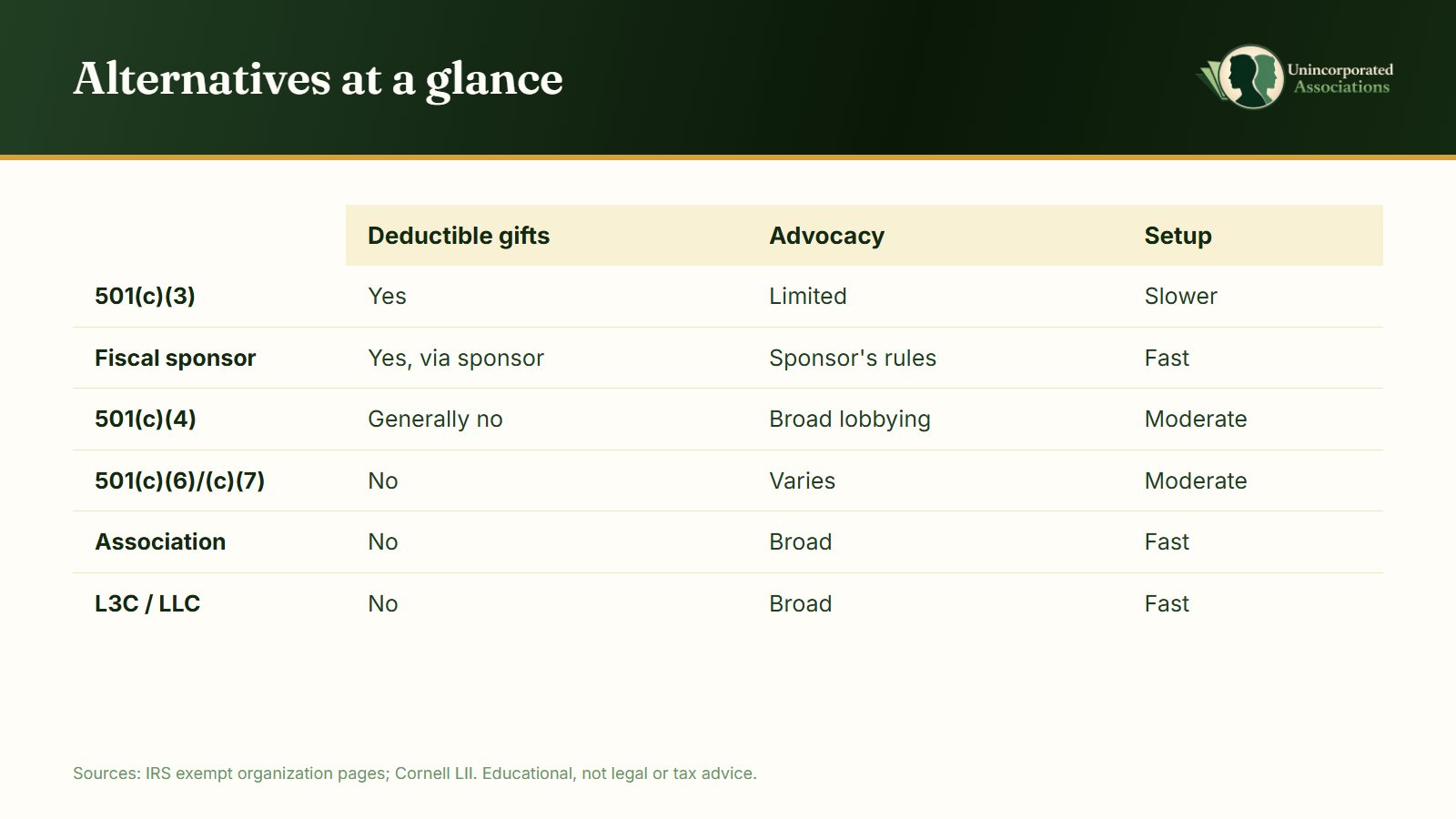
| Option | Exempt income? | Deductible donations? | Advocacy freedom | Setup speed |
|---|---|---|---|---|
| 501(c)(3) | Yes | Yes | Limited; no campaigns | Slower (application) |
| Fiscal sponsorship | Via sponsor | Yes (to sponsor) | Sponsor's rules | Fast |
| 501(c)(4) | Yes | Generally no | Broad lobbying; limited campaign | Moderate |
| 501(c)(6) | Yes | No (maybe business deduction) | Broad lobbying | Moderate |
| 501(c)(7) | On member income | No | Not its purpose | Moderate |
| Association, not exempt | Depends | No | Broad | Fast |
| L3C / benefit company | No | No | Broad | Fast |
| LLC | No | No | Broad | Fast |
Watch out: Don't promise donors a tax deduction unless your organization, or your fiscal sponsor, actually qualifies. Telling donors a gift is deductible when it isn't can create problems for them and for you.
How to choose
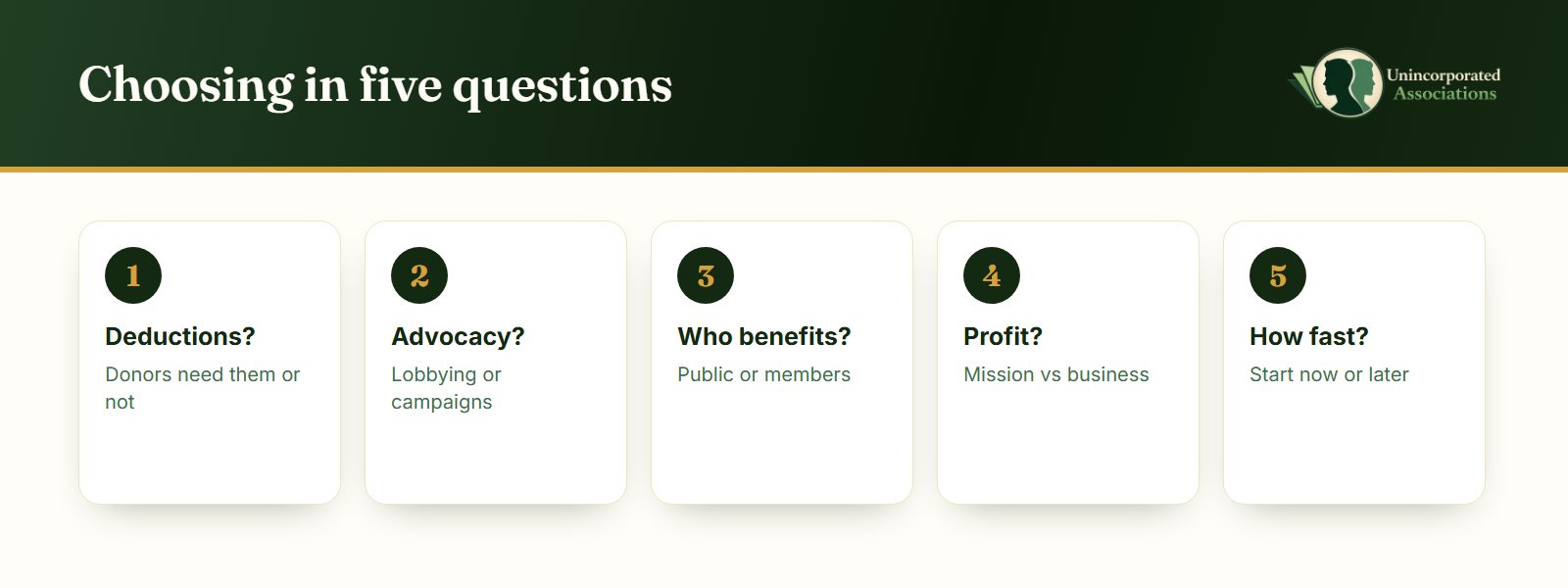
- Do donors need a deduction? If yes, a 501(c)(3) or a fiscal sponsor.
- Will you advocate or campaign? Advocacy points to (c)(4) or (c)(6); campaign activity rules out (c)(3).
- Who benefits? Members point to (c)(7), (c)(6) or an association; the public points to (c)(3) or (c)(4).
- Will the venture make profit? Profit points to an LLC, L3C or benefit company.
- How fast do you need to start? Fiscal sponsorship or an association can start immediately.
Pro tip: Many groups combine structures: a 501(c)(4) for advocacy alongside a related 501(c)(3) for charitable work, or an association that later applies for exemption. Keep combined structures strictly separate, with their own accounts and records.
Switching structures later
Choosing an alternative now does not lock you in, but some moves are easier than others:
- Association to 501(c)(3): straightforward if the articles already contain the purpose and dissolution clauses the IRS requires. The association applies on Form 1023 or 1023-EZ, and exemption can generally be recognized back to formation if you apply within 27 months.
- Fiscal sponsorship to your own charity: common. Plan how funds and grants held by the sponsor will move to the new organization, and put it in the sponsorship agreement from the start.
- 501(c)(4) to 501(c)(3): possible in some cases, but assets built up under (c)(4) rules may need careful handling. Many groups run both side by side instead.
- LLC or social enterprise to charity: usually means forming a new charity and transferring only what can properly move, with tax advice.
What you keep, whatever you choose
Every option on this list still requires the basics: clear governing documents, a separate bank account under its own EIN, records of decisions, and honest communication with supporters about whether their gifts are deductible. Those habits matter more to long-term success than which box on an IRS form you tick.
Three examples
A neighborhood cleanup group funded by members' small contributions, with no need for donor deductions. An unincorporated association is a simple, fast fit.
A housing advocacy coalition planning to lobby the city council and endorse ballot measures. A 501(c)(4) fits its advocacy; it might add a related 501(c)(3) for charitable programs.
A new arts program that wants grants and deductible gifts this season. Fiscal sponsorship now, with its own 501(c)(3) application later if it grows.
Frequently asked questions
What can I do instead of a 501(c)(3)?
Common alternatives are fiscal sponsorship, a 501(c)(4), (c)(6) or (c)(7) organization, an unincorporated association without exemption, an L3C or benefit company, or an LLC. The right choice depends on donors, advocacy, beneficiaries and profit.
Is a 501(c)(4) better than a 501(c)(3)?
Not better, different. A (c)(4) allows more advocacy, but donations to it generally aren't tax-deductible.
Can a nonprofit operate without 501(c)(3) status?
Yes. A nonprofit association or corporation can operate without exemption, but it may owe tax and its donors can't deduct gifts. Some apply later as they grow.
What is fiscal sponsorship?
An arrangement where an existing 501(c)(3) receives and manages funds for your project under a written agreement, so donors can deduct their gifts. The sponsor keeps legal control of the funds.
Are churches required to be 501(c)(3)?
Churches that meet the 501(c)(3) requirements are treated as exempt without applying. See our guide to the unincorporated association for a church.
Sources
- IRS: Exemption requirements for 501(c)(3) organizations
- IRS: Social welfare organizations
- IRS: Business leagues
- IRS: Social clubs
- IRS: Limited liability company
- Cornell LII: Low-profit limited liability company (L3C)
- California Corporations Code § 18035
- IRS Publication 557
Weighing 501(c)(3) against the alternatives? Book a free 15-minute call with Kirk's team, or join the daily live Q&A.
Have questions? Bring them to the daily call.
Join our live Q&A every weekday and Saturday at 3PM PST, or get a free 15-minute call to see whether a UNA fits your situation.
Have a question about your situation?
Send us a message and we'll get back to you.
Keep reading
 The Well-Meaning Dragon: Straight Answers to the Hardest ObjectionsFor the family and friends who push back because they care — honest answers to the toughest questions about the Federal income tax and Unincorporated Associations.
 It's Not What You Believe, It's What You SignFor the cautious partner in the room: real risk rarely comes from asking questions. It comes from what you signed.
 What Most People Get Wrong About Taxes, Structure, and ControlThe real problem isn't taxes — it's structure, and who actually has control. A look at positioning over loopholes.
Educational, not legal or tax advice. Unincorporated Associations is a document-preparation and education company. Consult a licensed attorney or CPA before acting on any position discussed on this site.