
Unincorporated Association for a Church: How It Works and What to Know
By Kirk Carmichael · · 8 min read
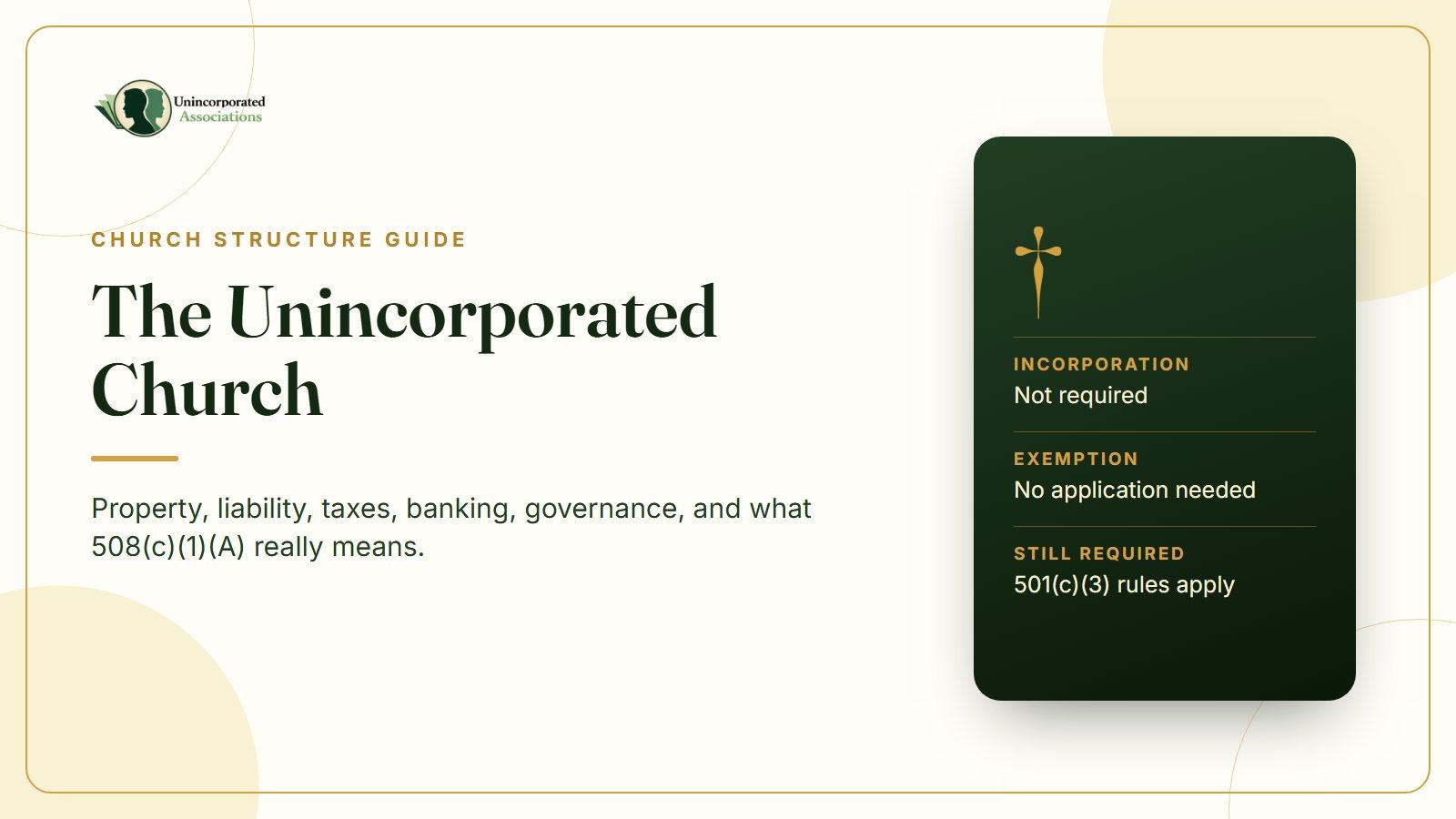
Short answer: A church can operate as an unincorporated association: members agree in writing to form a congregation, adopt governing documents and act through officers, without filing articles of incorporation. Churches that meet the 501(c)(3) requirements are treated as tax-exempt without applying to the IRS, which is what the often-quoted "508(c)(1)(A)" refers to, and they are generally not required to file Form 990. In states like California and Texas, a church association can own property and protect members from liability by statute. Churches still need an EIN, a bank account in the church's name and sound governance.
Many congregations have never incorporated. Some started as home gatherings and simply grew. Others prefer to stay unincorporated for reasons of conviction, simplicity or independence. Either way, the law has a place for them: the unincorporated association.
This guide explains how a church works as an association, what the tax rules actually say, how to hold property and open accounts, and when incorporating makes more sense.
Key takeaways: A church does not need to incorporate. It can be an unincorporated association with written governing documents. Churches meeting 501(c)(3) requirements are exempt without applying, under the exception in 26 U.S.C. § 508(c)(1)(A), but they still must follow the 501(c)(3) rules. Good governance and clear property arrangements matter more for an unincorporated church, not less.
How a church becomes an association
The same rules that apply to any association apply to a congregation. In California, an unincorporated association is "two or more persons joined by mutual consent for a common lawful purpose" (Corp. Code § 18035); Texas requires three or more members for its nonprofit association statute (Bus. Orgs. Code § 252.001).
In practice, a congregation formalizes its existence by:
- Adopting a governing document (articles of association, a constitution or a church covenant) stating its religious purpose.
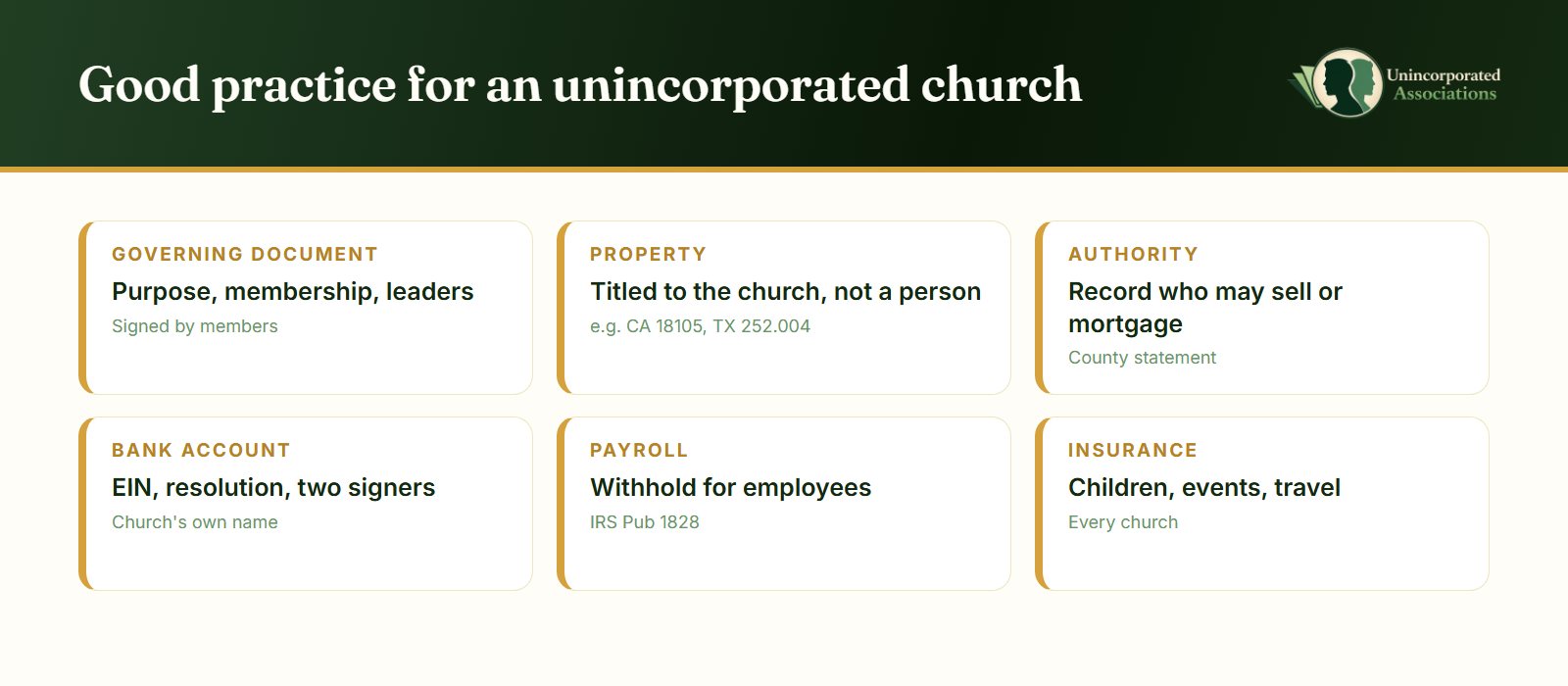
- Adopting bylaws covering membership, leadership, decisions, finances and discipline.
- Recording its leaders: elders, deacons, trustees or officers, and who may sign for the church.
- Getting an EIN and opening a bank account in the church's name.
Our guide on how to become an unincorporated association covers the core documents.
What "508(c)(1)(A)" really means
You will see "508(c)(1)(A)" everywhere online, sometimes presented as a special kind of church. It is not a separate entity type. It is a subsection of the tax code.
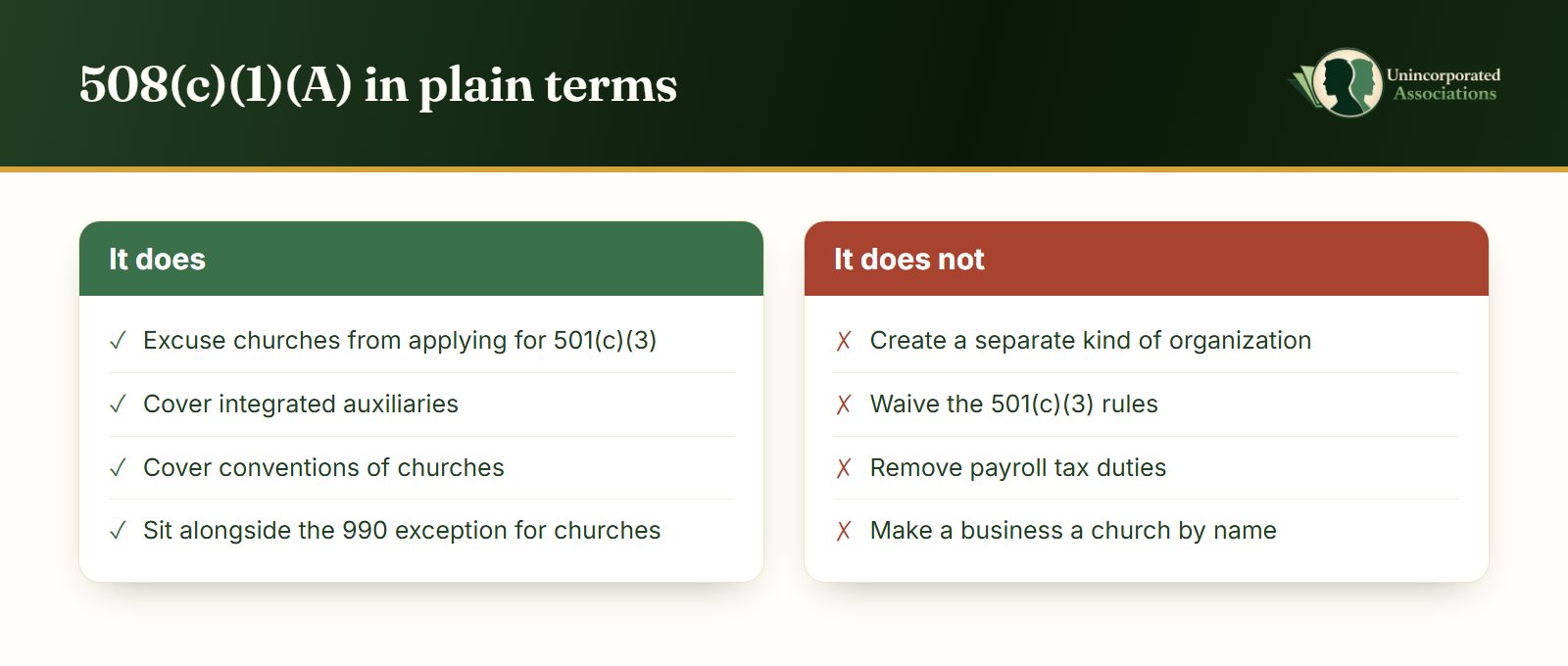
Section 508 requires most new organizations to notify the IRS and apply in order to be treated as 501(c)(3). Subsection (c)(1) lists mandatory exceptions, and the first is "(A) churches, their integrated auxiliaries, and conventions or associations of churches" (26 U.S.C. § 508). In other words, a church that meets the 501(c)(3) requirements does not have to file Form 1023 to be treated as exempt.
That exception does not:
- create a different kind of organization outside the 501(c)(3) rules
- free a church from the ban on private benefit or political campaign activity
- remove payroll tax obligations for church employees
- make a non-church organization exempt by calling itself a church
The IRS explains the rules for churches in Publication 1828, Tax Guide for Churches and Religious Organizations and on its churches and religious organizations page.
Should a church apply for exemption anyway?
It is optional, but many churches do. A determination letter gives donors, banks and grantors certainty, and some foundations and denominations ask for one. An unincorporated church can apply on Form 1023 using its articles of association as the organizing document; see our guide on whether an unincorporated association can be a 501(c)(3).
Choosing a governance model
An unincorporated church writes its own governance, so it helps to decide which model fits the congregation before drafting bylaws:
- Congregational. The members decide major matters, such as calling a pastor, adopting the budget and buying property, by vote at members' meetings. Leaders carry out those decisions.
- Elder- or board-led. A body of elders or trustees holds authority between meetings, with members approving only specified matters.
- Connected to a denomination. The congregation follows a denomination's book of order or discipline, which may control property, leadership and doctrine. The local governing documents should say exactly how the two relate.
Whichever model you choose, and whatever your tradition calls its leaders, write down three things clearly: who decides, how they decide (vote thresholds and notice), and who may sign for the church. Those three answers resolve most disputes before they start, and they are exactly what banks and title companies will ask to see.
Formalizing a congregation that already exists
Many churches are formalizing something that has existed informally for years. A practical order:
- Agree the church's legal name and statement of purpose.
- Hold a members' meeting to adopt the governing document and bylaws, and record it in minutes.
- Elect or confirm leaders and record who may sign.
- Obtain an EIN, then move church money from any personal accounts into a church account.
- Review property: who holds title today, and how to transfer it to the church or to trustees for the church.
- Set up giving records, offering procedures and, if needed, payroll.
- Review insurance for the building, events and children's ministries.
- Schedule an annual members' meeting to approve the budget and review the year, and keep minutes of it.
Holding church property
Property is where unincorporated churches most often run into trouble.
- Where state law allows, hold title in the church's name. California lets an unincorporated association own property in its own name (§ 18105), as does Texas (§ 252.004).
- Record who may sell or mortgage it. California and Texas let an association record a statement of authority in the county naming who can act on real estate.
- Avoid title in a pastor's or member's personal name. It creates problems on death, departure or divorce, and can blur the line between personal and church assets.
- Know your denomination's rules. In congregations affiliated with a denomination, property disputes can turn on the denomination's governing documents. In Jones v. Wolf (1979), the Supreme Court held that civil courts may resolve church property disputes using "neutral principles of law," looking at deeds, state statutes and the governing documents.
Pro tip: If your congregation is affiliated with a denomination, write down clearly in your governing documents who owns the property and what happens if the congregation leaves the denomination. It is the single best way to avoid a future property dispute.
Liability
In states with modern association statutes, members of a nonprofit association are not liable for its debts just for being members (California § 18605; Texas § 252.006). Elsewhere, older common-law rules can expose leaders who authorize decisions. Every church, incorporated or not, should carry appropriate insurance for its activities, especially those involving children, travel and events.
Banking and money
An unincorporated church can open a bank account. Expect to bring:
- the governing document and bylaws
- the IRS EIN confirmation (CP 575 or Letter 147C)
- a resolution naming authorized signers
- IDs for each signer
Good financial habits protect both the church and its leaders: two signers or two counters for offerings, monthly reconciliation, and a treasurer's report to the congregation.
Donors also need records. Churches commonly send each giver an annual statement; for any single gift of $250 or more, the donor needs a written acknowledgment from the church to claim a deduction, as IRS Publication 526 explains. Keep giving records separate from members' personal information, and limit who can see them.
Employment and ministers
Being exempt from income tax does not remove employment tax duties. Churches with employees generally withhold income tax and file payroll returns. Ministers have special rules, including the housing allowance under 26 U.S.C. § 107 and particular Social Security treatment, which Publication 1828 explains. Have a CPA familiar with church tax set up payroll correctly.
Church audits
Congress gave churches extra procedural protection: the IRS may begin a church tax inquiry only under the conditions in 26 U.S.C. § 7611, including approval by a high-level Treasury official and written notice. That is a procedural safeguard, not an exemption from the rules.
When should a church incorporate instead?
Incorporation may suit a church better when:
- it owns significant property in a state without a strong association statute
- it employs several staff, runs a school or operates large programs
- lenders or partners require a corporation
- the congregation wants the statutory structure of a religious corporation (California, for example, has a Religious Corporation Law beginning at Corp. Code § 9110)
Our comparison of an unincorporated association vs a nonprofit corporation covers the trade-offs.
Watch out: Calling an organization a "church" does not make it one for tax purposes. The IRS looks at characteristics such as a distinct religious history and creed, regular worship services and a congregation. A business renamed as a church to avoid tax is not exempt.
Frequently asked questions
Does a church have to incorporate?
No. A church can operate as an unincorporated association with written governing documents. Some choose to incorporate for property, lending or governance reasons.
What is a 508(c)(1)(A) church?
There is no separate legal entity by that name. Section 508(c)(1)(A) of the tax code says churches are not required to apply to the IRS to be treated as 501(c)(3) organizations. They must still meet the 501(c)(3) requirements.
Can an unincorporated church own property?
In states like California and Texas, yes, in its own name. Elsewhere, property may need to be held by trustees for the congregation. Avoid titling church property in a pastor's or member's personal name.
Can an unincorporated church open a bank account?
Yes, with an EIN, its governing documents, a signer resolution and signer IDs.
Does an unincorporated church file Form 990?
Churches are generally not required to file Form 990. They may still have other filings, such as payroll returns for employees.
Sources
- 26 U.S.C. § 508 (including subsection (c)(1)(A))
- IRS Publication 1828, Tax Guide for Churches and Religious Organizations
- IRS: Churches and religious organizations
- 26 U.S.C. § 107 (housing allowance) and § 7611 (church tax inquiries)
- Jones v. Wolf, 443 U.S. 595 (1979)
- California Corporations Code sections 9110, 18035, 18105 and 18605
- Texas Business Organizations Code sections 252.001, 252.004 and 252.006
Setting up your congregation's structure? Book a free 15-minute call with Kirk's team, or join the daily live Q&A.
Have questions? Bring them to the daily call.
Join our live Q&A every weekday and Saturday at 3PM PST, or get a free 15-minute call to see whether a UNA fits your situation.
Have a question about your situation?
Send us a message and we'll get back to you.
Keep reading
 The Well-Meaning Dragon: Straight Answers to the Hardest ObjectionsFor the family and friends who push back because they care — honest answers to the toughest questions about the Federal income tax and Unincorporated Associations.
 It's Not What You Believe, It's What You SignFor the cautious partner in the room: real risk rarely comes from asking questions. It comes from what you signed.
 What Most People Get Wrong About Taxes, Structure, and ControlThe real problem isn't taxes — it's structure, and who actually has control. A look at positioning over loopholes.
Educational, not legal or tax advice. Unincorporated Associations is a document-preparation and education company. Consult a licensed attorney or CPA before acting on any position discussed on this site.