
Unincorporated Association Examples: 12 Real-World Groups in the US
By Kirk Carmichael · · 8 min read
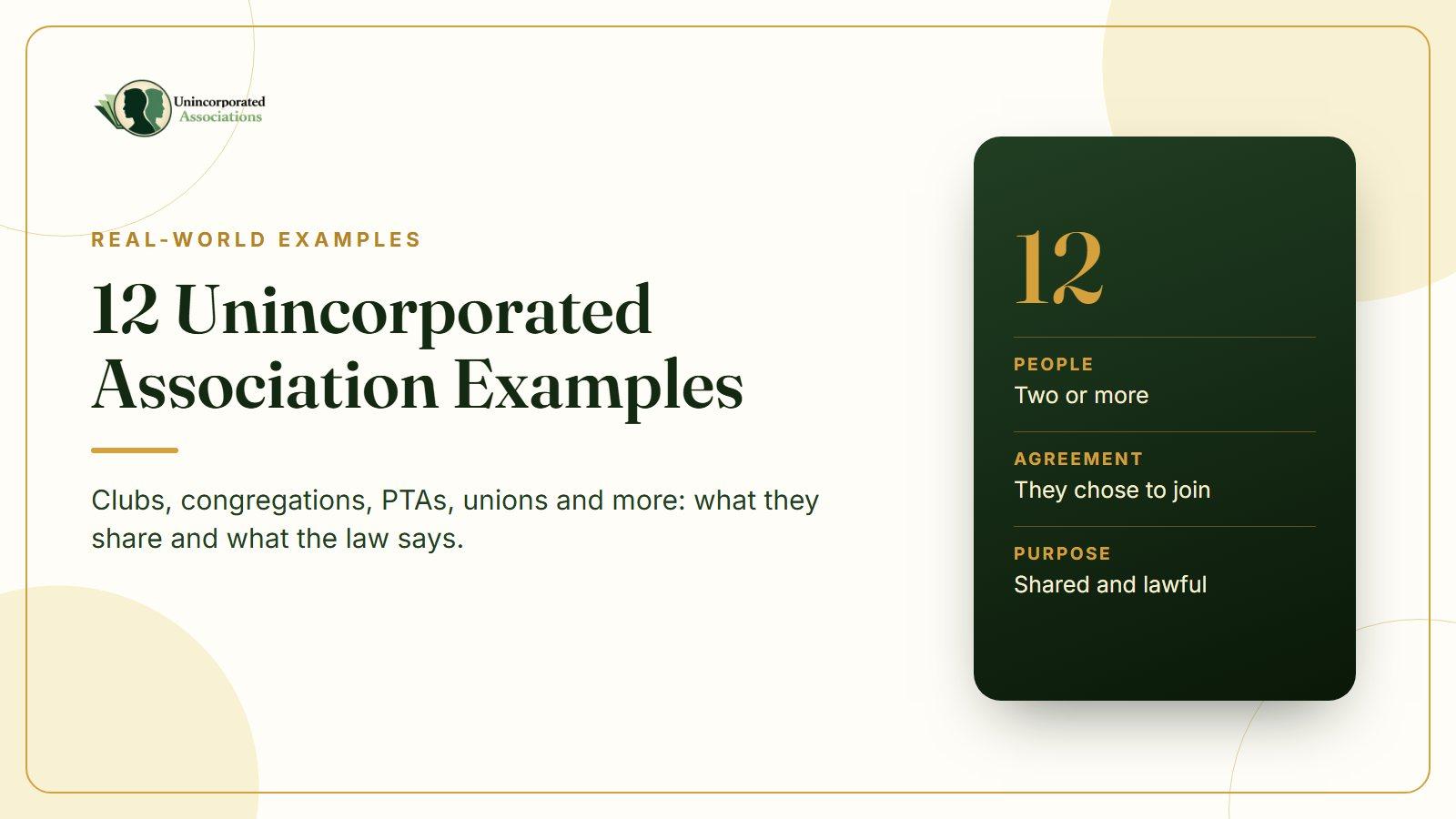
Short answer: Common examples of unincorporated associations in the US include social and sports clubs, book clubs, neighborhood and mutual-aid groups, PTAs and booster clubs, many churches and congregations, investment clubs, professional and hobby societies, homeowners or tenants groups that never incorporated, political committees, and historically, labor unions. What they share is that two or more people joined by agreement for a common lawful purpose without incorporating under a state statute.
Most people belong to at least one unincorporated association without realizing it. The weekly running club, the parent-teacher group, the neighborhood watch and the church that never filed articles of incorporation are all likely unincorporated associations.
This guide gives 12 concrete examples, explains what makes each one an association, and covers the legal points that matter once a group starts handling money, property or contracts.
Key takeaways: An unincorporated association is simply people joined by agreement for a common lawful purpose, without a state charter. Clubs, congregations, PTAs, investment clubs and many advocacy groups fit that description. Once a group holds money or signs contracts, written documents, an EIN and a bank account in its own name become important.
What makes a group an unincorporated association?
California's statute offers a clear definition: "an unincorporated group of two or more persons joined by mutual consent for a common lawful purpose, whether organized for profit or not" (Corporations Code § 18035). Texas uses a similar definition for nonprofit associations but requires three or more members (Bus. Orgs. Code § 252.001).
So the test has three parts:
- People: at least two (three in Texas for the nonprofit statute).
- Agreement: they chose to join together.
- Shared lawful purpose: something they do together, other than simply co-owning property.
If a group like that has not incorporated or formed an LLC, it is generally an unincorporated association.

12 examples of unincorporated associations
1. Social and recreational clubs
Running clubs, cycling groups, garden clubs and dinner clubs. Members join, pay dues and share an activity. Larger social clubs can even seek federal exemption as 501(c)(7) organizations (IRS: social clubs).
2. Amateur sports teams and leagues
Adult leagues and youth teams run by volunteers often operate as associations, collecting fees and buying equipment without ever incorporating.
3. Book clubs and study groups
Informal, but still an agreement among people for a shared purpose. Most never need anything more than a shared understanding, until they start collecting money for events.
4. Neighborhood associations and mutual-aid groups
Neighborhood watches, block associations and mutual-aid networks. Once they hold funds or apply for small grants, they usually need a bank account and an EIN in the association's name.
5. PTAs, PTOs and booster clubs
Parent groups raise significant money for schools and teams. Some incorporate; many operate as unincorporated associations with their own bylaws.
6. Churches and congregations
Many congregations, especially smaller or independent ones, have never incorporated. The IRS treats churches that meet 501(c)(3) requirements as automatically exempt, regardless of whether they incorporated (IRS: churches and religious organizations).
7. Investment clubs
Groups of people who pool money to invest together. The IRS discusses investment clubs in Publication 550; a club with two or more members is usually treated as a partnership for tax purposes unless it is organized differently.
8. Professional and hobby societies
Local chapters of professional networks, photography societies and amateur radio clubs often begin as associations and incorporate only when they grow.
9. Tenants and homeowners groups
Tenants unions and some homeowners associations that never incorporated operate as unincorporated associations. Homeowners associations can elect special tax treatment under Form 1120-H.
10. Political committees and advocacy groups
Political organizations are frequently unincorporated. The IRS has special rules and forms for them (IRS: political organizations).
11. Labor unions
Historically, many labor unions were unincorporated associations, and some major Supreme Court decisions about associations involved unions. In United Mine Workers v. Coronado Coal Co. (1922), the Court held that an unincorporated union could be sued in its own name. In United Steelworkers v. R. H. Bouligny (1965), it held that an unincorporated union's citizenship for federal diversity jurisdiction depends on the citizenship of its members.
12. Private membership associations
Members-only groups formed by written membership agreements, from farm buying clubs to education communities. Our explainer on what a private membership association is covers how they work and their limits.
What is not an unincorporated association
The boundaries are as useful as the examples. These are usually not unincorporated associations:
- Co-owners of property, by themselves. Two siblings who inherit a house share ownership, not an association. California's definition says co-ownership alone does not create one.
- A sole proprietor. One person cannot form an association with themselves.
- A corporation or LLC. Once a group incorporates or forms an LLC, the state statute for that entity governs it.
- A trust. A trust is created by a settlor transferring property to a trustee for beneficiaries. Texas expressly excludes organizations created by a trust from its nonprofit association definition.
- A government body. City councils, school boards and agencies exist under public law, not private agreement.
- A one-off gathering. People who meet once for an event, with no ongoing agreement or shared purpose, have not formed an association. Associations involve a continuing relationship built around a purpose.
- A business partnership run for owners' profit. It may be legally an "association" in the broad sense, but the law treats it as a partnership, with partnership rules and personal liability for partners.
What these examples have in common
| Example | Shared purpose | Typical money handling | Usually needs |
|---|---|---|---|
| Social club | Recreation | Dues, event fees | Bank account, EIN |
| PTA or booster club | Supporting a school or team | Fundraising | Bylaws, EIN, bank account, maybe exemption |
| Congregation | Worship and community | Donations | Governing documents, bank account |
| Investment club | Investing together | Pooled investments | Partnership agreement, EIN, tax filings |
| Mutual-aid group | Helping neighbors | Small donations | Bank account, simple bylaws |
| Advocacy group | A cause | Donations, spending | Careful records, possible IRS filings |
When an informal association needs to formalize
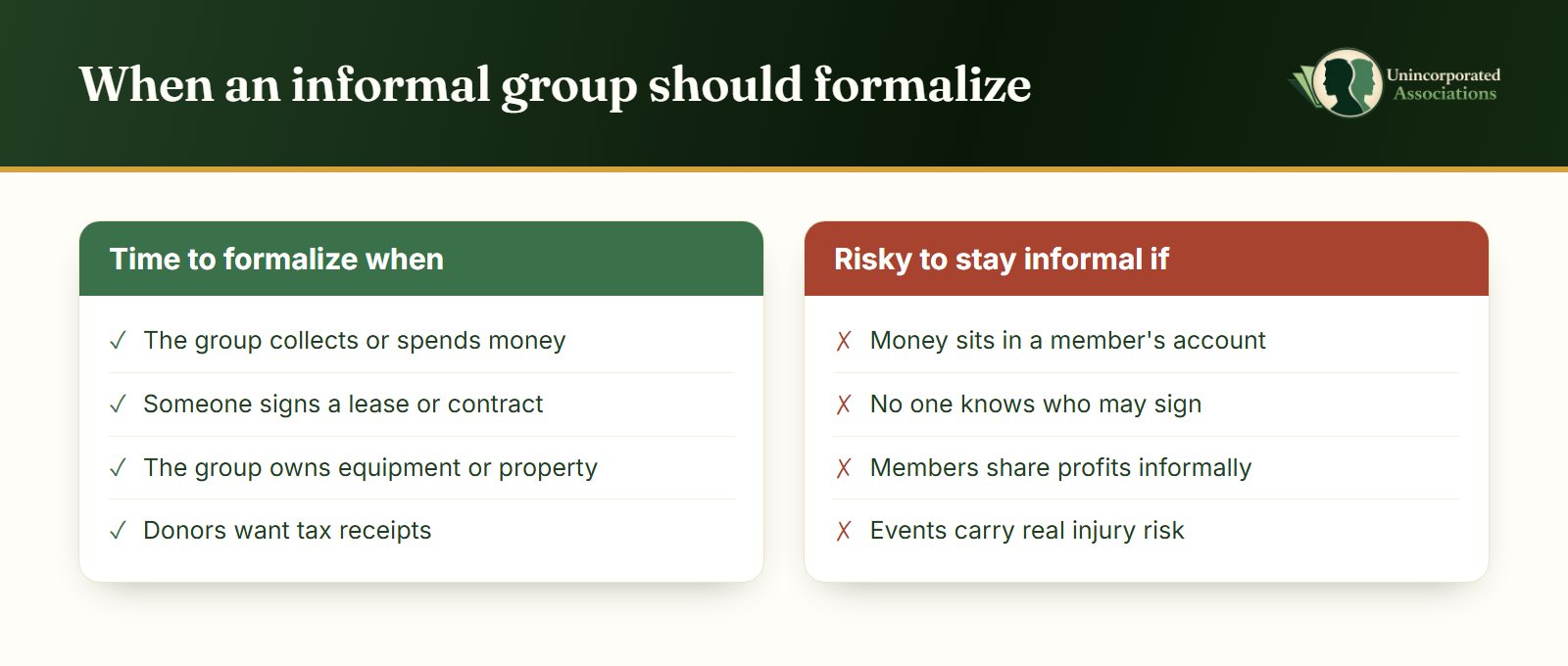
Informal works until money, property or risk enters the picture. Signs it is time to put documents in place:
- The group collects or spends money. It needs a bank account in its own name, which means an EIN and signed governing documents.
- The group signs contracts. Leases, venue rentals and vendor agreements need someone clearly authorized to sign.
- The group owns property. Equipment, real estate or vehicles need a clear owner.
- Members face risk. Events, travel and physical activities raise liability questions.
- Donors want receipts. Tax-deductible gifts require recognized exemption, which requires proper organizing documents.
Pro tip: The moment your group opens a bank account, write down who the officers are and who may sign. One page, signed by the members, prevents most disputes later.
Legal points every association should know
- Capacity to sue and be sued. Under Federal Rule of Civil Procedure 17(b), an unincorporated association's capacity to sue or be sued in federal court generally depends on state law, with an exception for enforcing federal rights.
- Citizenship for federal courts. Following Bouligny and Carden v. Arkoma Associates (1990), an unincorporated entity is a citizen of every state where its members are citizens, for diversity purposes.
- Member liability. Statutes in states like California (§ 18605) and Texas (§ 252.006) protect nonprofit association members from liability just for being members.
- Taxes. An association's tax treatment depends on what it does. See our guide on whether unincorporated associations file tax returns.
Watch out: Groups that pool money for members, like investment clubs, need a written agreement covering contributions, withdrawals and taxes before money changes hands.
Is your group an unincorporated association?
Ask four questions:
- Are there two or more people (three in Texas for the nonprofit statute)?
- Did they agree to join together?
- Is there a shared, lawful purpose beyond simply co-owning something?
- Has the group not incorporated or formed an LLC?
If all four answers are yes, your group is very likely an unincorporated association, and it may be worth putting the right documents in place. Our guide on how to become an unincorporated association shows how, and our comparisons with an LLC and a corporation help you decide whether to stay one.
Frequently asked questions
What is a common example of an unincorporated association?
A local club, such as a running club or book club, is the most common example: members join by agreement for a shared purpose without forming a corporation or LLC. PTAs, congregations and neighborhood groups are also common.
Is a church an unincorporated association?
Many churches are, especially smaller or independent congregations that never filed articles of incorporation. Others are incorporated. The IRS treats churches that meet 501(c)(3) requirements as exempt either way.
Is an investment club an unincorporated association?
Often, yes. An investment club with two or more members that has not incorporated is generally an unincorporated association and is usually treated as a partnership for tax purposes.
Are unions unincorporated associations?
Historically, many were, and some still are. The Supreme Court has decided several important cases about unincorporated unions, including that they can be sued in their own name.
Does an informal group need to register anywhere?
Usually not to exist. But once it handles money, it needs an EIN and a bank account, and some states offer optional filings, such as California's Form UA-100.
Sources
- California Corporations Code sections 18035 and 18605
- Texas Business Organizations Code sections 252.001 and 252.006
- Federal Rule of Civil Procedure 17
- United Mine Workers v. Coronado Coal Co., 259 U.S. 344 (1922)
- United Steelworkers v. R. H. Bouligny, Inc., 382 U.S. 145 (1965)
- Carden v. Arkoma Associates, 494 U.S. 185 (1990)
- IRS: Social clubs, churches and religious organizations, political organizations
- IRS Publication 550 (investment clubs)
Want to formalize your group the right way? Book a free 15-minute call with Kirk's team, or join the daily live Q&A.
Have questions? Bring them to the daily call.
Join our live Q&A every weekday and Saturday at 3PM PST, or get a free 15-minute call to see whether a UNA fits your situation.
Have a question about your situation?
Send us a message and we'll get back to you.
Keep reading
 The Well-Meaning Dragon: Straight Answers to the Hardest ObjectionsFor the family and friends who push back because they care — honest answers to the toughest questions about the Federal income tax and Unincorporated Associations.
 It's Not What You Believe, It's What You SignFor the cautious partner in the room: real risk rarely comes from asking questions. It comes from what you signed.
 What Most People Get Wrong About Taxes, Structure, and ControlThe real problem isn't taxes — it's structure, and who actually has control. A look at positioning over loopholes.
Educational, not legal or tax advice. Unincorporated Associations is a document-preparation and education company. Consult a licensed attorney or CPA before acting on any position discussed on this site.