
Running a Business Without an LLC: What's Legal, What's Risky, What to Do
By Kirk Carmichael · · 8 min read
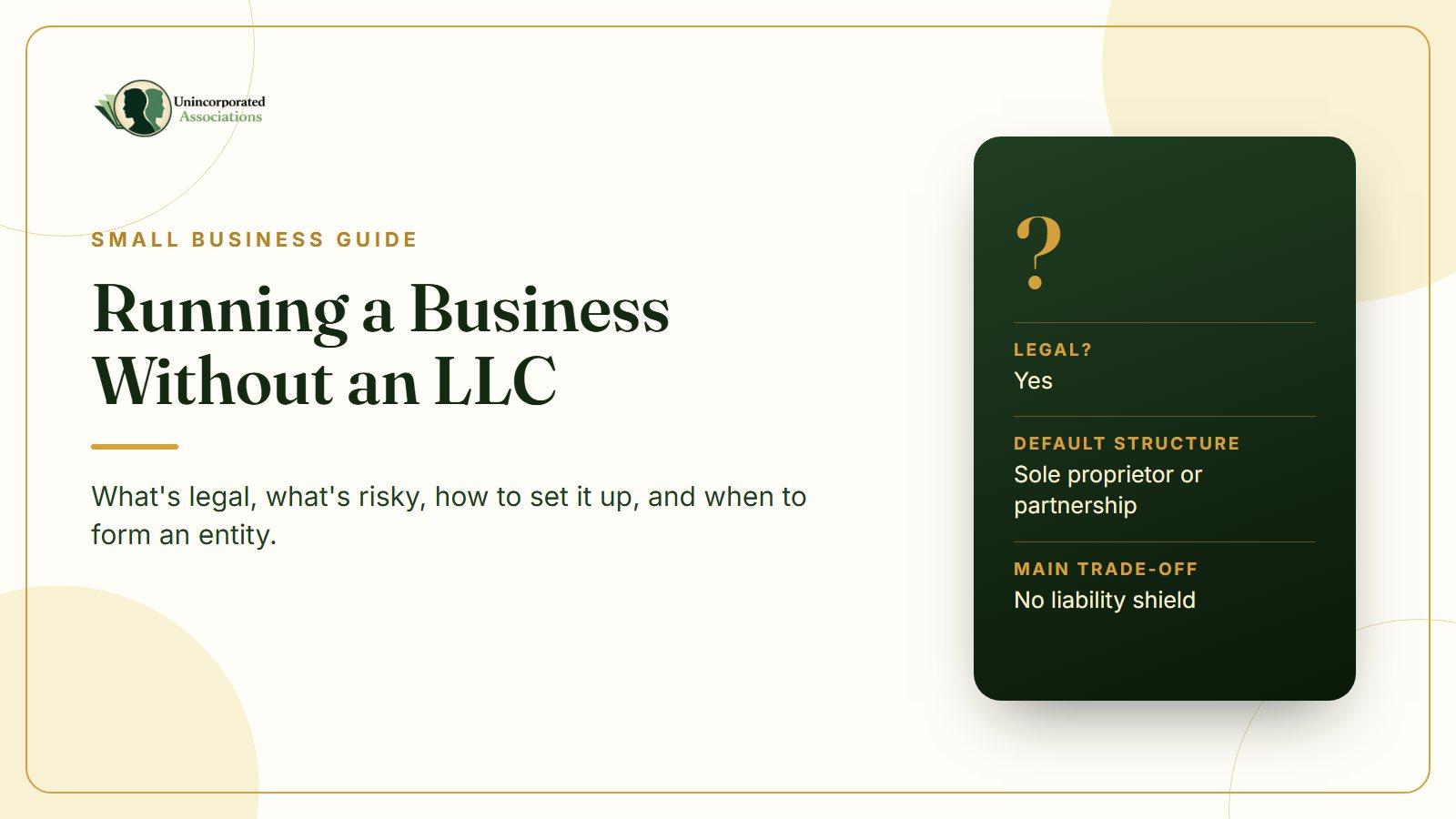
Short answer: Yes. You can legally run a business without forming an LLC. If you work alone, you are a sole proprietor by default; if you work with others for profit, you are a general partnership by default. Neither needs a state formation filing, but you still need the right licenses, a tax ID if you hire or open a business account, a fictitious name filing if you use a trade name, and good records. The trade-off is that you have no liability shield: your personal assets are exposed to the business's debts and lawsuits.
Forming an LLC is common advice, but it is not a legal requirement for most businesses. Millions of Americans run businesses as sole proprietors, freelancers and partnerships. Doing so is lawful; it is just a different balance of cost, simplicity and risk.
This guide explains what running a business without an LLC means in practice, how to set it up correctly, and the signs that it is time to form an entity.
Key takeaways: No LLC is required. Without one, you are a sole proprietor or partnership with no liability shield. You still need licenses, the right tax registrations and separate finances. Insurance and contracts become your main protections. Form an entity when risk, revenue, partners or lenders make it worth it.
What you are by default
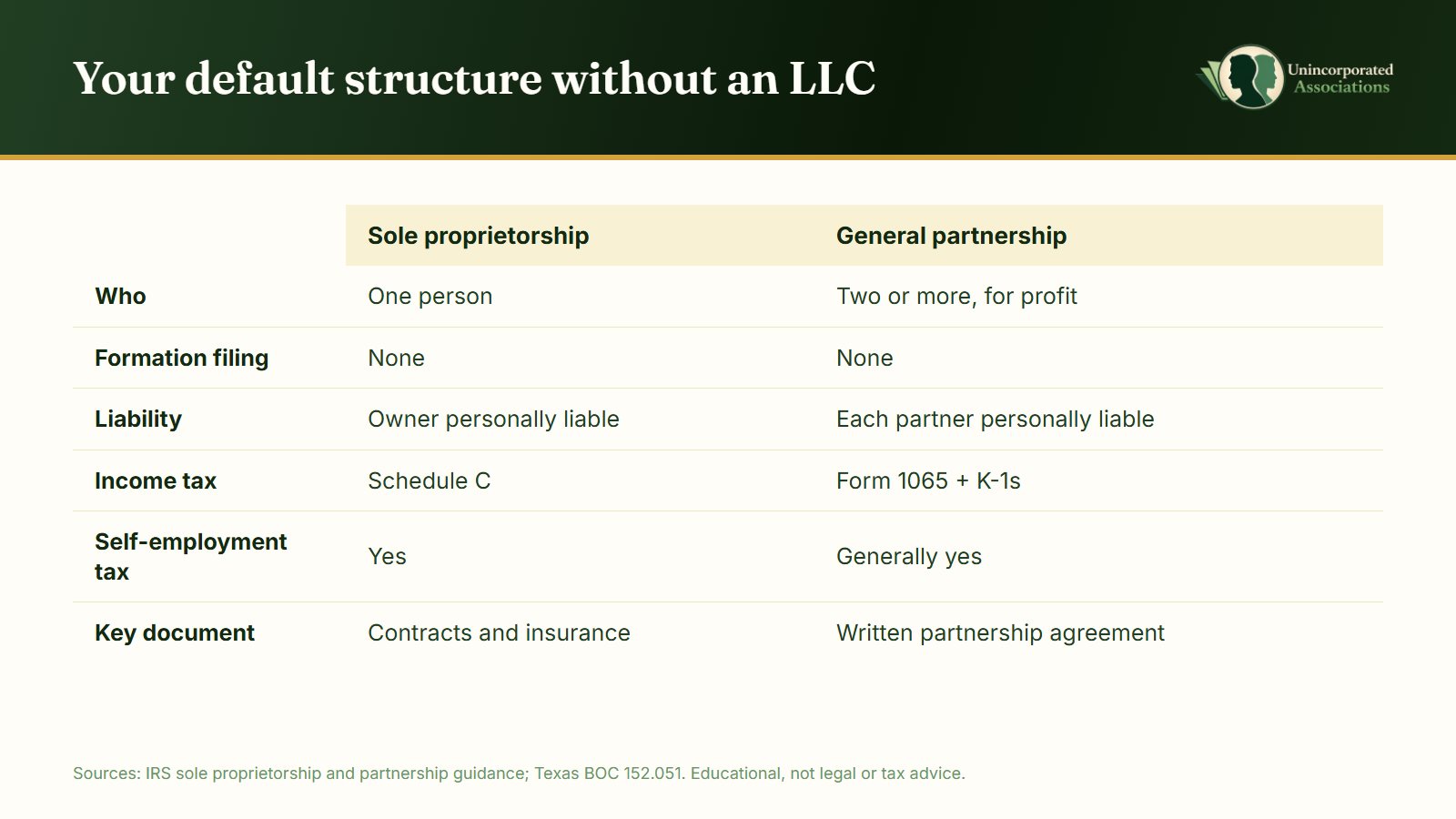
Working alone: a sole proprietorship. You and the business are legally the same person, and business income goes on your personal return (Schedule C), as the IRS explains for sole proprietorships.
Working with others for profit: a general partnership, whether you meant to form one or not. Texas law says an association of two or more persons carrying on a business for profit as owners creates a partnership, "regardless of whether the persons intend to create a partnership" (Bus. Orgs. Code § 152.051). Partnerships file an information return and partners report their shares, as the IRS explains for partnerships.
How to set it up properly
1. Choose your name and check fictitious-name rules
If you trade under a name other than your own legal name, many states require a fictitious business name (DBA) filing. California's rule applies to every person who regularly transacts business for profit under a fictitious name (Bus. & Prof. Code § 17910). Rules differ by state and county.
2. Get the licenses and permits your work requires
Licensing depends on the activity and the location, not on the structure. The SBA's guide to licenses and permits explains how to find federal, state and local requirements.
3. Get an EIN when you need one
A sole proprietor with no employees can often use their Social Security number, but an EIN is required if you hire employees or form a partnership, and many banks want one for a business account. It is free from the IRS via Form SS-4 or online.
4. Open a separate business bank account
Even without an entity, keep business money separate. It makes taxes accurate, records clean and audits easier.
5. Get the right insurance
Without a liability shield, insurance is your first line of defense: general liability, professional liability where relevant, and commercial auto if you drive for work.
6. Use written contracts
Clear contracts with clients and suppliers limit disputes and can include limits on liability. For partners, a written partnership agreement is essential: who contributes what, how profits split, who decides, and what happens if someone leaves.
7. Register for state taxes
Sales tax permits, state income tax and, if you hire, employer accounts.
Pro tip: If you work with even one other person for profit, put a partnership agreement in writing before you earn your first dollar together. Without it, your state's default partnership rules decide how profits split and who can bind the business, and every partner is personally liable.
Protecting yourself without an entity
If you choose to stay a sole proprietor or partnership for now, these habits narrow the gap:
- Insurance sized to your real risk. Ask an agent what a serious claim in your line of work costs, and buy limits that cover it.
- Contracts with limitation clauses. Where the law allows, cap your liability to the fees paid and exclude consequential damages.
- Clear scope. Write down exactly what you will and won't do for each client. Many claims start with a misunderstanding about scope.
- Professional standards. Follow your industry's licensing and safety rules to the letter; it is your best defense if something goes wrong.
- Separate assets. Keep the tools and money you use for the business clearly separate from household assets, and keep records of both.
Your first-month checklist
- Decide your business name and check fictitious-name rules.
- Apply for the licenses and permits your activity needs.
- Get an EIN if you will hire, have partners or your bank asks.
- Open a business bank account and use it for everything business-related.
- Buy insurance before your first job.
- Prepare a simple client contract, and a partnership agreement if you have partners.
- Register for any state taxes, and set reminders for quarterly estimated payments.
The taxes
- Income tax: sole proprietors report profit on Schedule C; partners report their K-1 shares.
- Self-employment tax: sole proprietors and general partners generally pay Social Security and Medicare tax on net earnings, as the IRS explains for self-employment tax.
- Estimated payments: without withholding, you usually pay quarterly estimated taxes.
Notably, forming a single-member LLC does not change these by default; the IRS disregards it and you still file Schedule C (IRS: LLC). The LLC's main benefit is liability protection, not tax savings.
The real risk: personal liability
Without an entity:
- a lawsuit against the business is a lawsuit against you
- business debts are your debts
- in a partnership, you can be liable for debts your partner created
Insurance, contracts and careful practices reduce the risk, but they do not replace a statutory shield. That is the core trade-off.
The risk is not the same for everyone. A bookkeeper working from home faces mostly contract and professional-error claims, which insurance and good contracts handle well. A contractor on job sites, a food business or anyone driving for work faces injury and property claims that can exceed insurance limits. The higher your exposure, the sooner an entity makes sense.
Watch out: Calling your business an "association" does not create a shield. Co-owners running a business for profit are a partnership in the eyes of the law. Unincorporated associations fit shared-purpose groups, not businesses run for owners' profit, as our unincorporated association vs LLC guide explains.
When it's time to form an entity
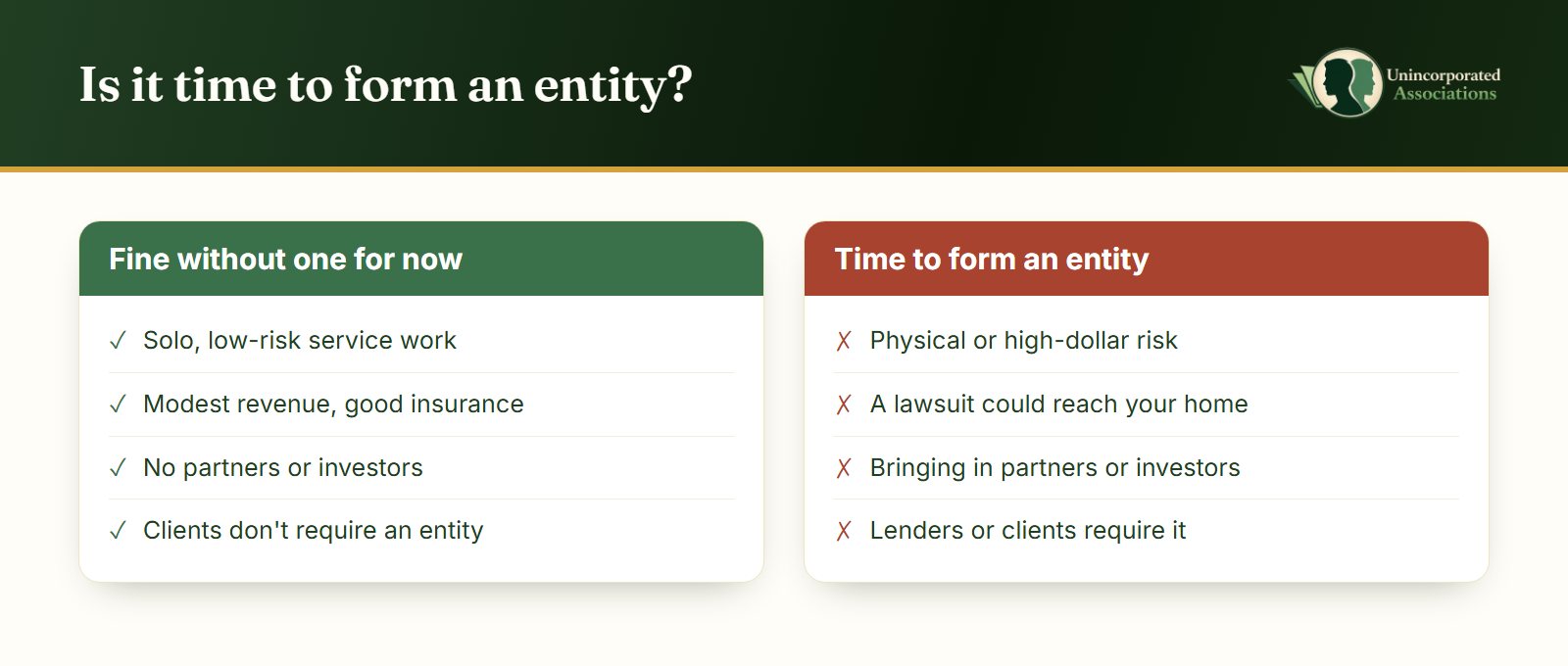
Consider an LLC or corporation when:
- your work carries real risk of injury, property damage or large claims
- revenue grows to the point where a lawsuit could threaten personal savings or your home
- you bring in partners or investors
- lenders, landlords or major clients require an entity
- you want to separate business and personal life clearly
Our guide to alternatives to an LLC compares the options, from S corporations to LLPs.
What about member-run groups?
If your venture is not really a business for your own profit, but a group of people pursuing a shared purpose, such as a club, community, education group or congregation, an unincorporated association may fit better than either an LLC or a sole proprietorship. Our explainers on the private membership association and PMA vs LLC show where that line falls.
Three examples
A freelance graphic designer. Works alone from home, low physical risk. A sole proprietorship with professional liability insurance, a business account and good contracts is a reasonable start.
Two friends starting a food truck. Shared ownership, vehicles, the public and food safety risk. They are already a partnership by default. An LLC or corporation, plus insurance and permits, is strongly advisable.
A neighborhood skills-sharing club. Members teach each other, dues cover supplies, no one takes profit. Not really a business: an unincorporated association is a natural fit.
Common mistakes
- Mixing personal and business money.
- No written agreement between partners.
- Skipping licenses because "it's just a side business."
- Assuming a name filing creates protection. A DBA is just a name; it is not an entity.
- Waiting until after a claim to think about insurance or an entity.
Frequently asked questions
Is it legal to run a business without an LLC?
Yes. You can operate as a sole proprietor or partnership without forming an LLC. You still need the licenses, permits and tax registrations your activity requires.
What's the biggest risk of not having an LLC?
Personal liability. Without an entity, business debts and lawsuits can reach your personal assets, and in a partnership you can be liable for a partner's business debts.
Do I need an EIN without an LLC?
Not always. A sole proprietor with no employees can often use a Social Security number. You need an EIN if you hire, form a partnership or your bank requires one.
Does an LLC save taxes compared with a sole proprietorship?
Not by default. A single-member LLC is taxed like a sole proprietorship unless it elects otherwise. An LLC's main advantage is liability protection.
Is a DBA the same as an LLC?
No. A DBA is a registered trade name. It does not create a separate entity or limit your liability.
Sources
- IRS: Sole proprietorships
- IRS: Partnerships
- IRS: Self-employment tax
- IRS: Limited liability company (LLC)
- IRS: Form SS-4
- Texas Business Organizations Code section 152.051
- California Business and Professions Code section 17910
- SBA: Apply for licenses and permits
Wondering whether you need an entity at all? Book a free 15-minute call with Kirk's team, or join the daily live Q&A.
Have questions? Bring them to the daily call.
Join our live Q&A every weekday and Saturday at 3PM PST, or get a free 15-minute call to see whether a UNA fits your situation.
Have a question about your situation?
Send us a message and we'll get back to you.
Keep reading
 The Well-Meaning Dragon: Straight Answers to the Hardest ObjectionsFor the family and friends who push back because they care — honest answers to the toughest questions about the Federal income tax and Unincorporated Associations.
 It's Not What You Believe, It's What You SignFor the cautious partner in the room: real risk rarely comes from asking questions. It comes from what you signed.
 What Most People Get Wrong About Taxes, Structure, and ControlThe real problem isn't taxes — it's structure, and who actually has control. A look at positioning over loopholes.
Educational, not legal or tax advice. Unincorporated Associations is a document-preparation and education company. Consult a licensed attorney or CPA before acting on any position discussed on this site.