
Can an Unincorporated Association Have Employees? Yes. Here's What It Takes
By Kirk Carmichael · · 8 min read
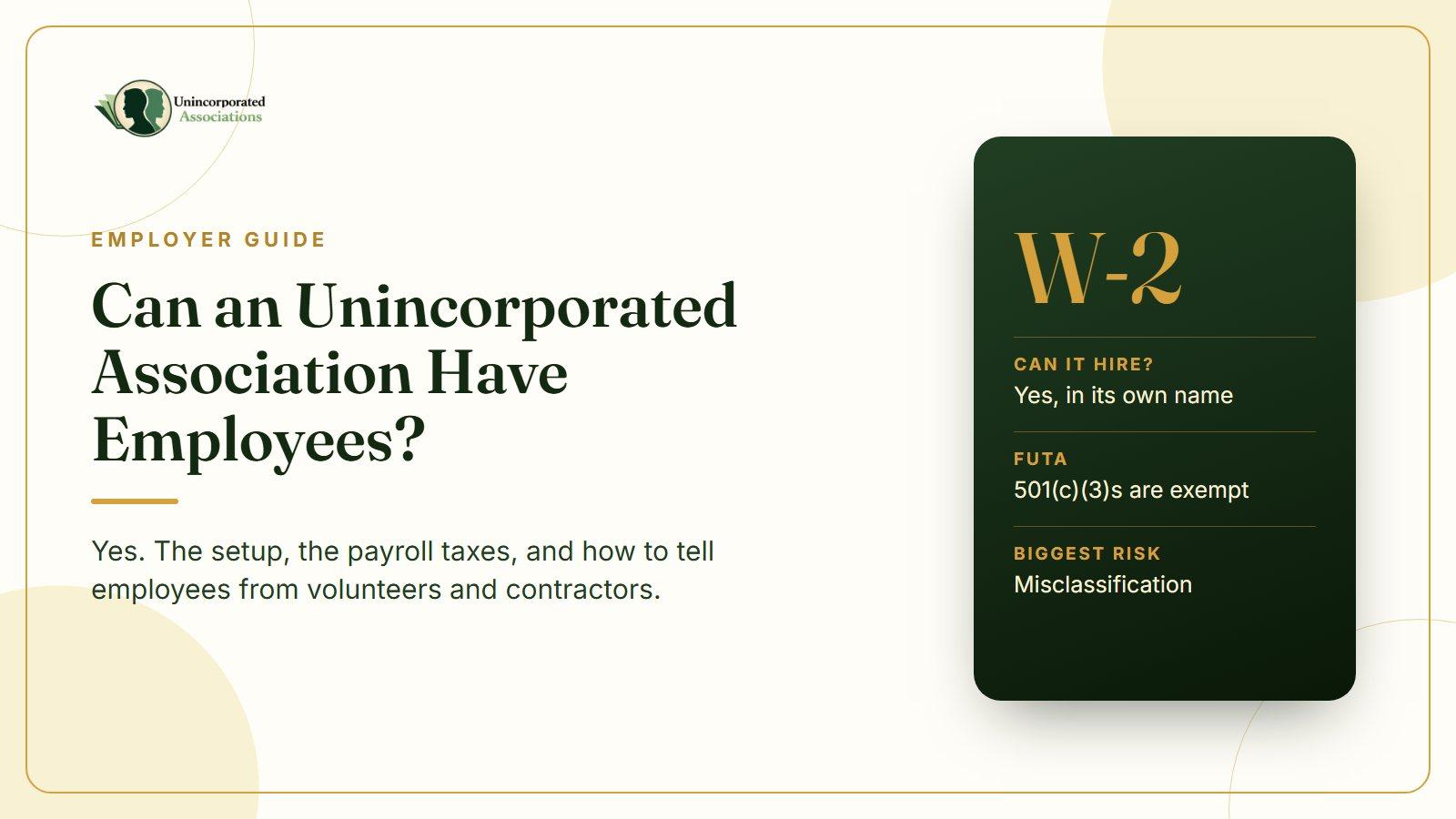
Short answer: Yes. An unincorporated association can hire employees in its own name. Once it does, it has the same employer duties as any business: an EIN, employment eligibility checks (Form I-9), income tax withholding, Social Security and Medicare taxes, quarterly payroll returns, W-2s, state unemployment and, in most states, workers' compensation. Some nonprofit associations get relief: 501(c)(3) organizations are exempt from federal unemployment tax (FUTA). Volunteers and independent contractors are treated differently, so classify carefully.
Associations often start with volunteers and grow into needing paid help: a coordinator for a community group, staff for a congregation, an administrator for a club. Hiring is a normal step, but it brings legal and tax obligations that are easy to get wrong. The good news is that none of them are unique to associations; they are the same rules every small employer follows, and a good payroll setup handles most of them automatically.
This guide walks through how an association becomes an employer, the taxes involved, the difference between employees, volunteers and contractors, and the special rules for nonprofit associations.
Key takeaways: Associations can be employers. Hiring means EIN, I-9s, withholding, payroll taxes and returns, state registrations and usually workers' comp. 501(c)(3) associations are exempt from FUTA. Misclassifying employees as volunteers or contractors is the most common, and costly, mistake.
Can an association be an employer?
Yes. In states with modern association statutes, the association itself can enter into contracts, including employment relationships. Texas treats a nonprofit association as a legal entity for contract and tort (Bus. Orgs. Code § 252.006), and the revised uniform act gives associations the powers of an individual to carry on their purposes (Iowa Code § 501B.5). For federal employment taxes, the IRS treats the association as the employer under its own EIN.
In states without a modern statute, associations still hire staff, but it is especially important that employment contracts are signed in the association's name by an authorized officer.
Step by step: becoming an employer
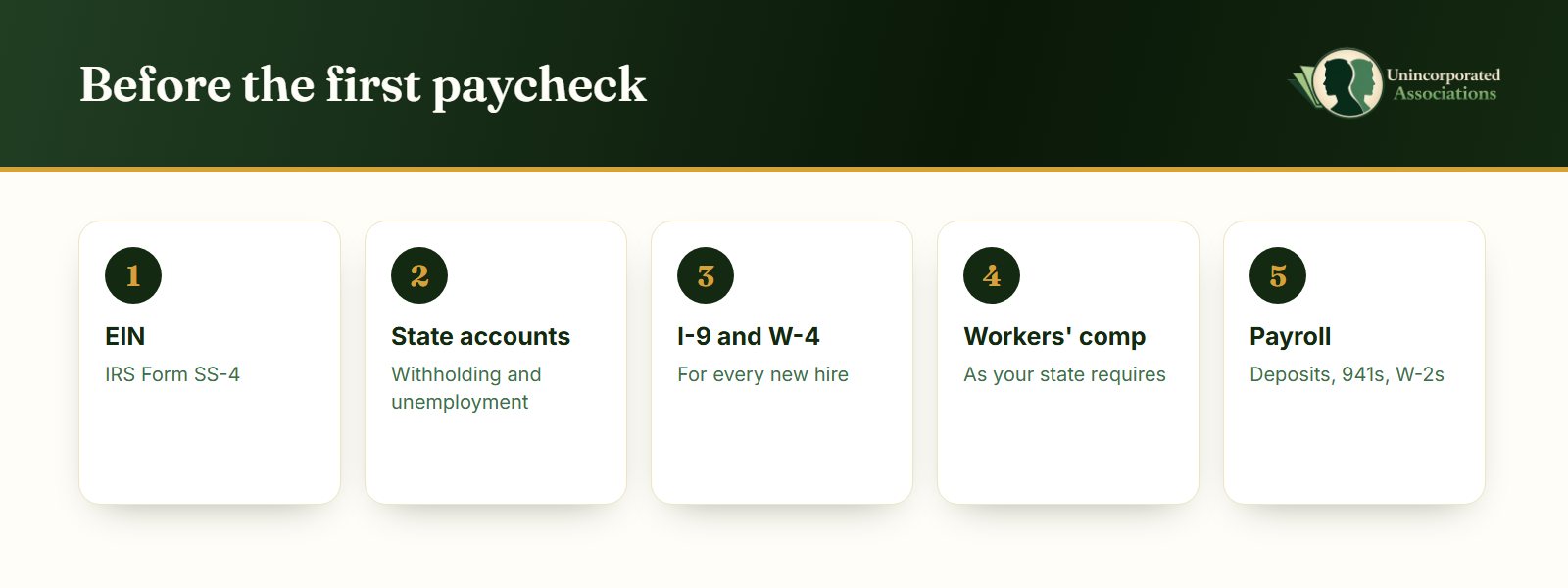
- Get an EIN if you don't have one (Form SS-4). Our guide to the CP 575 EIN letter explains the confirmation.
- Register with your state for income tax withholding and unemployment insurance.
- Verify work eligibility with Form I-9 for each new hire (USCIS: Form I-9).
- Collect Form W-4 so you know how much federal income tax to withhold (IRS: Form W-4).
- Report new hires to your state's new-hire registry.
- Arrange workers' compensation insurance as your state requires, before the first day of work.
- Set up payroll to withhold and deposit taxes on schedule.
Pro tip: Use a payroll service from the first paycheck. It handles withholding, deposits, quarterly returns and W-2s, and the cost is small compared with the penalties for missed deposits.
The payroll taxes
The IRS explains the basics in understanding employment taxes and in detail in Publication 15 (Circular E).
| Tax | Who pays | Notes |
|---|---|---|
| Federal income tax withholding | Withheld from employee | Based on Form W-4 |
| Social Security and Medicare (FICA) | Employer and employee share | Employer withholds employee share and adds its own |
| Federal unemployment (FUTA) | Employer | 501(c)(3) organizations are exempt |
| State unemployment | Employer | Some states let nonprofits reimburse claims instead of paying rates |
| State income tax withholding | Withheld from employee | Where the state has income tax |
Most employers file Form 941 quarterly and issue W-2s each January.
Relief for nonprofit associations
The FUTA exemption comes from the definition of "employment" in 26 U.S.C. § 3306, which excludes service performed for a 501(c)(3) organization. Being exempt from federal income tax does not, however, exempt an association from Social Security, Medicare or income tax withholding for its employees. Churches have some special elections and rules, including for ministers, described in IRS Publication 1828.
Employees, volunteers and contractors
This is where associations most often get into trouble.
Volunteers
People who donate their time to a nonprofit for civic, charitable or humanitarian reasons, without expecting pay, are generally volunteers. The Department of Labor explains how wage-and-hour law applies to nonprofits in its fact sheet on nonprofit organizations. Small expense reimbursements or nominal amounts usually don't change volunteer status; regular pay does. Associations operating as businesses for profit generally cannot have "volunteers" doing the business's work.
Independent contractors
A contractor runs their own business and controls how the work is done. The IRS uses a common-law test focused on behavioral control, financial control and the relationship of the parties (IRS: independent contractor or employee?). Contractors receive a Form 1099-NEC where required, not a W-2.
Employees
Someone the association directs, on a schedule it sets, doing the association's core work, is usually an employee, whatever the paperwork says.
Watch out: Calling an employee a "volunteer" or "contractor" does not change their legal status. Misclassification can bring back taxes, penalties and interest, and the people responsible for withholding can sometimes be held personally liable for unpaid payroll taxes.
Part-time, seasonal and remote staff
The same rules apply whatever the schedule:
- Part-time staff are employees if the association controls their work; hours don't change classification.
- Seasonal or event staff hired for a few weeks are still employees, with I-9s, withholding and payroll filings for that period.
- Remote staff in another state usually make the association an employer in that state too, with that state's withholding, unemployment and workers' compensation rules.
- Members who are paid for work beyond their volunteer role are employees for that paid work, even though they are also members.
When in doubt, treat the person as an employee and run them through payroll; correcting an over-cautious choice is far cheaper than correcting misclassification.
Officers who also work for the association
Officers who are paid for services they perform are generally employees for those services. Unpaid officers serving as volunteers usually are not. If an officer receives regular compensation, set it by resolution, keep it reasonable, and run it through payroll.
Liability as an employer
Employment brings new liability exposure: wage claims, discrimination laws, workplace injuries. A nonprofit association's members are protected by statute in states like California (§ 18605) and Texas, but the association itself is responsible as the employer. Insurance (workers' compensation and employment practices liability) and written policies help, as does training whoever supervises staff on basic employment rules.
Budgeting for the true cost of an employee
A wage is only part of what an employee costs. Before hiring, budget for:
- The employer's share of Social Security and Medicare, on top of the gross wage
- State unemployment contributions (or reimbursement, for nonprofits that choose it where available)
- FUTA, unless the association is a 501(c)(3)
- Workers' compensation premiums
- Payroll service fees
- Any benefits the association offers, such as paid leave
A simple rule many small organizations use is to add a meaningful percentage on top of wages for these costs, then confirm the real figure with your payroll provider. Members approving the budget should see the full cost, not just the hourly rate.
Documents for your first hire
- Board or members' resolution approving the position, pay and budget
- Job description setting out duties, schedule and who supervises
- Offer letter signed in the association's name by an authorized officer
- Employee policies, even a short handbook covering conduct, time off and complaints
- Personnel file holding the I-9 (stored as required), W-4, offer letter and payroll records
These documents protect both the association and the employee, and they make the next hire much easier.
Three examples
A community garden association pays a part-time coordinator 15 hours a week on a set schedule. Employee: payroll, I-9, W-4, state registrations, workers' comp. If the association is a 501(c)(3), no FUTA.
A congregation pays a bookkeeping firm a monthly fee for monthly reports. Contractor: the firm controls its work and serves other clients; 1099-NEC where required.
A youth sports association relies on unpaid parent coaches who receive a free team jacket. Volunteers: nominal items don't create employment.
Common mistakes
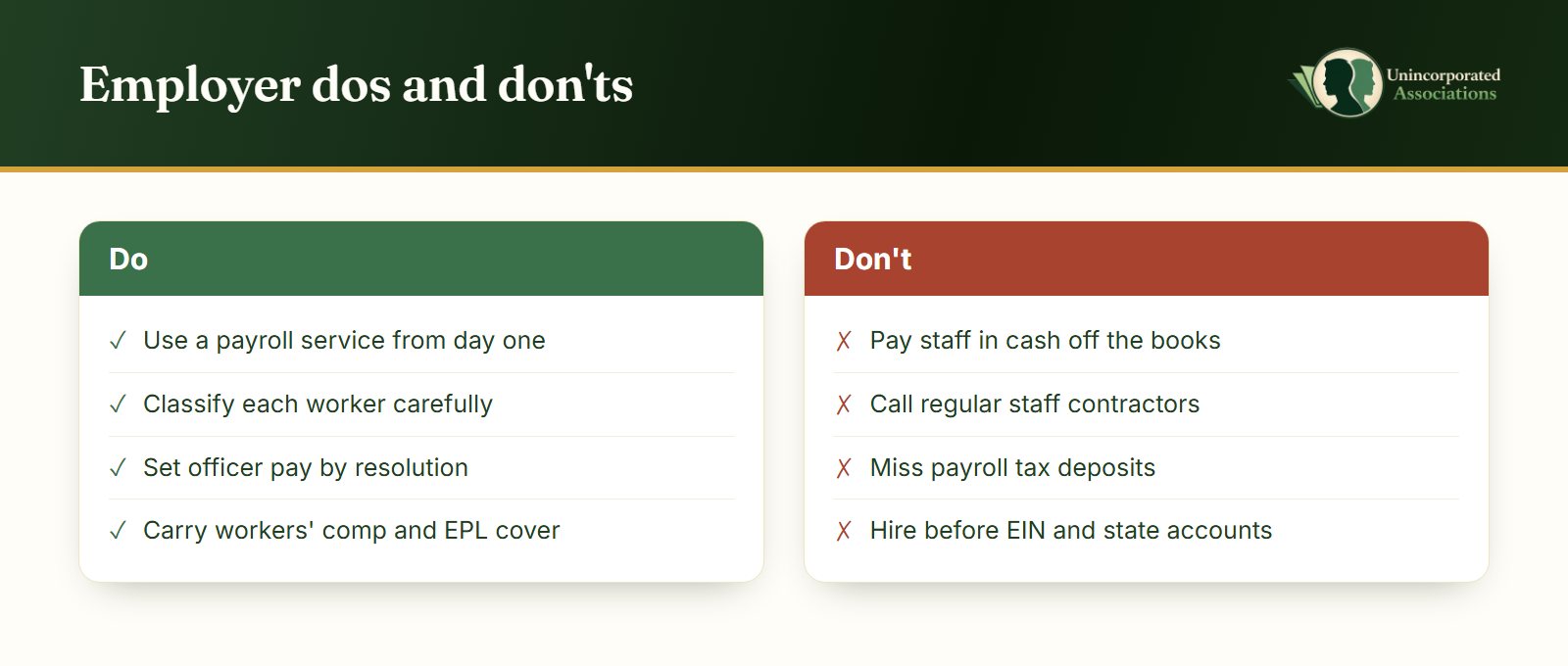
- Paying people in cash "off the books."
- Treating regular staff as contractors.
- Missing payroll tax deposits.
- Skipping workers' compensation.
- Hiring before getting an EIN and state accounts.
- Paying officers without a resolution.
Our guides to how unincorporated associations are taxed and association documents cover the related setup.
Frequently asked questions
Can an unincorporated association hire employees?
Yes. It can hire in its own name and must meet the same employer obligations as any business: EIN, I-9s, withholding, payroll taxes, returns and state registrations.
Does a nonprofit association pay payroll taxes?
Yes, for Social Security, Medicare and income tax withholding. A 501(c)(3) association is exempt from federal unemployment tax (FUTA), and some states offer nonprofits alternatives for state unemployment.
Can our volunteers receive anything?
Reimbursed expenses and nominal items generally don't make a volunteer an employee. Regular pay for work usually does.
Are paid officers employees?
Generally, if they are paid for services they perform. Set officer compensation by resolution and run it through payroll.
Who is liable if payroll taxes aren't paid?
The association is liable, and individuals responsible for collecting and paying the taxes can sometimes be held personally liable as well.
Sources
- IRS: Understanding employment taxes
- IRS Publication 15 (Circular E), Employer's Tax Guide
- IRS: Form 941, Form W-4, Form SS-4
- IRS: Independent contractor or employee?
- 26 U.S.C. § 3306 (FUTA definitions)
- USCIS: Form I-9
- U.S. Department of Labor: FLSA and nonprofit organizations
- Texas Business Organizations Code § 252.006; Iowa Code chapter 501B; California Corporations Code § 18605
Planning your association's first hire? Book a free 15-minute call with Kirk's team, or join the daily live Q&A.
Have questions? Bring them to the daily call.
Join our live Q&A every weekday and Saturday at 3PM PST, or get a free 15-minute call to see whether a UNA fits your situation.
Have a question about your situation?
Send us a message and we'll get back to you.
Keep reading
 The Well-Meaning Dragon: Straight Answers to the Hardest ObjectionsFor the family and friends who push back because they care — honest answers to the toughest questions about the Federal income tax and Unincorporated Associations.
 It's Not What You Believe, It's What You SignFor the cautious partner in the room: real risk rarely comes from asking questions. It comes from what you signed.
 What Most People Get Wrong About Taxes, Structure, and ControlThe real problem isn't taxes — it's structure, and who actually has control. A look at positioning over loopholes.
Educational, not legal or tax advice. Unincorporated Associations is a document-preparation and education company. Consult a licensed attorney or CPA before acting on any position discussed on this site.