
Wyoming DUNA: The Decentralized Unincorporated Nonprofit Association, Explained
By Kirk Carmichael · · 8 min read
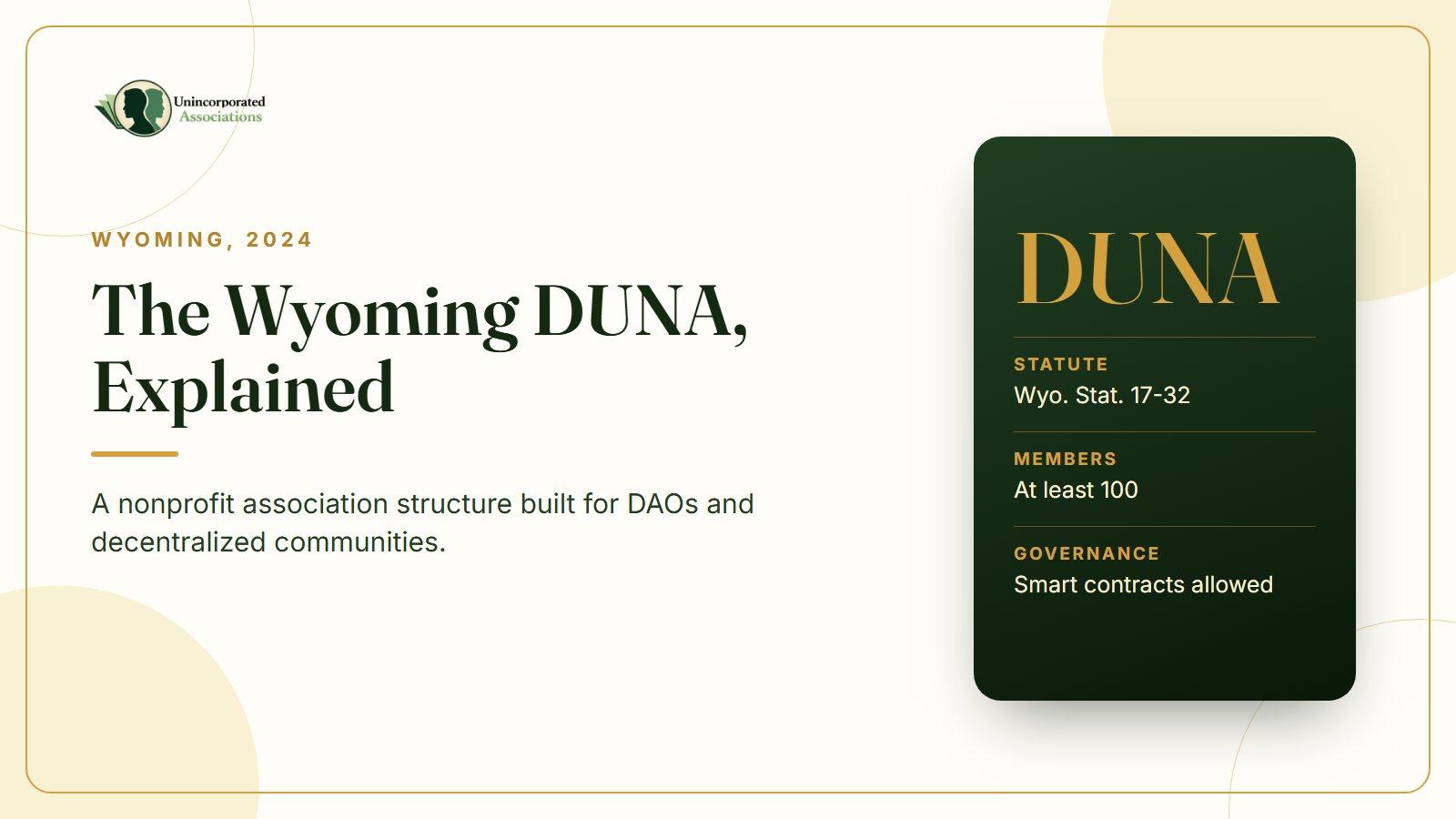
Short answer: A Wyoming DUNA (decentralized unincorporated nonprofit association) is a legal structure created by Wyoming's Decentralized Unincorporated Nonprofit Association Act, enacted in 2024 as Senate File 50 and effective July 1, 2024 (Wyoming Statutes 17-32-101 through 17-32-129). It is designed for decentralized groups such as DAOs. To qualify, an association needs at least 100 members joined by mutual consent for a common nonprofit purpose, and it must elect to be formed under the act. It can be governed through smart contracts, and members are not liable for its torts merely because they are members.
For years, decentralized autonomous organizations (DAOs) faced a legal problem: with no recognized structure, courts could treat their participants as members of a general partnership, exposing them to personal liability. Wyoming's DUNA act is one of the first attempts to give these groups a purpose-built home inside nonprofit association law.
This guide explains what a DUNA is, what the act requires, what it offers, how it compares with an ordinary unincorporated association, and what to check before relying on it.
Key takeaways: The DUNA is Wyoming's nonprofit association structure for decentralized groups. It requires at least 100 members, a common nonprofit purpose and an election to be formed under the act. It accommodates smart-contract governance and protects members from tort liability for membership alone. It is not a tax exemption or a for-profit vehicle, and parts of the act may be amended, so check the current statute.
Where the DUNA came from
Wyoming has been an early mover on digital-asset law. In 2024, the legislature passed Senate File 50, creating Chapter 32 of Title 17 of the Wyoming Statutes, citable as the "Wyoming Decentralized Unincorporated Nonprofit Association Act" (enrolled act; Title 17, Chapter 32). It took effect July 1, 2024.
The act builds on traditional unincorporated nonprofit association concepts, which states like Texas have long recognized (Tex. Bus. Orgs. Code § 252.006), and adapts them for groups whose members may be anonymous, numerous and coordinated by software.
What the act requires
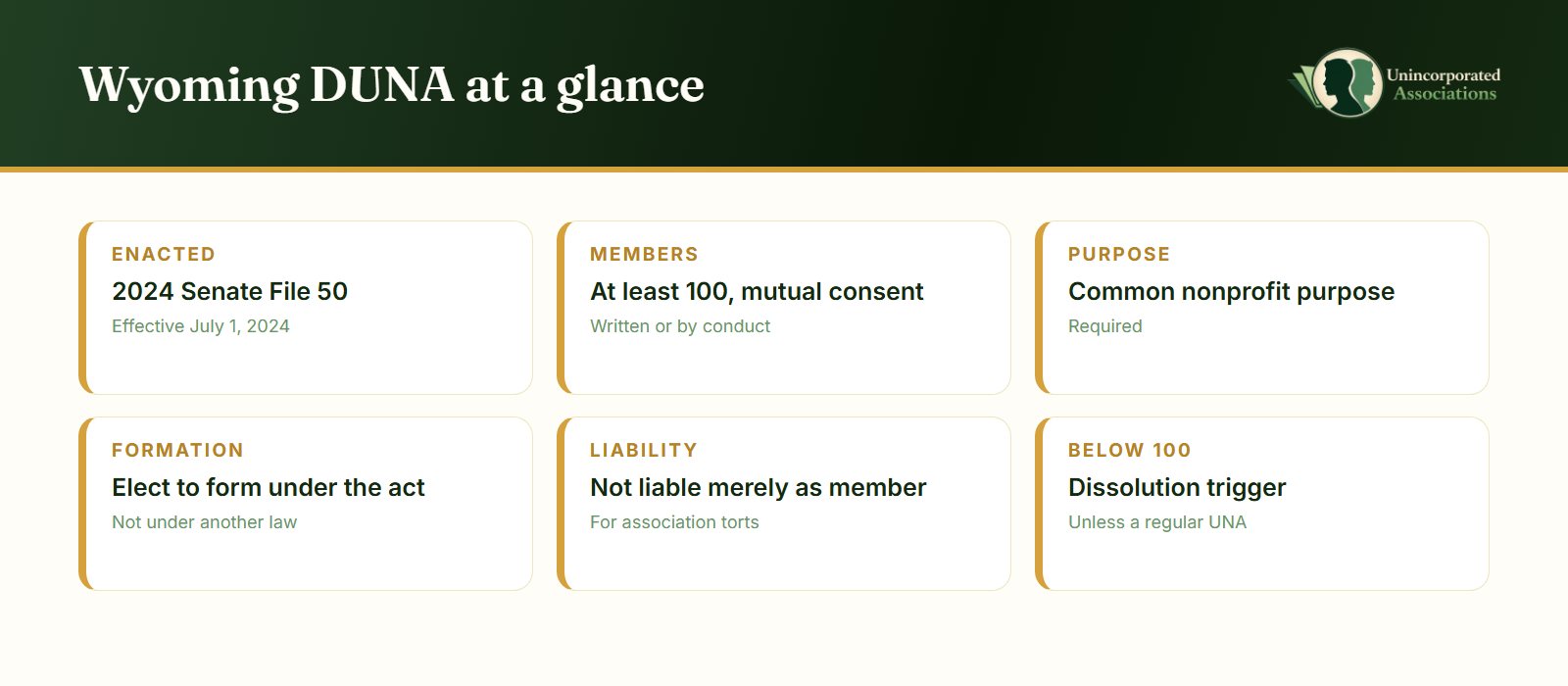
Under the act's definitions, a DUNA is an association that:
- Has at least 100 members joined by mutual consent, which may be written or inferred from conduct
- Shares a common nonprofit purpose
- Elects to be formed under the act
- Is not formed under another law governing its organization or operation
If membership later drops below 100, the act provides for dissolution unless the association meets the requirements of an ordinary Wyoming unincorporated nonprofit association.
Why DAOs needed a legal structure
A DAO without any legal wrapper is still a group of people acting together, and the law has to put it somewhere. Two risks pushed communities to look for a structure:
The partnership risk. When people carry on a business together for profit, many states treat them as a general partnership whether or not they intended it; Texas states the rule plainly in § 152.051. General partners are personally liable for the partnership's debts, which would expose token holders who vote on proposals.
Enforcement against the DAO itself. In 2023, a federal court entered a default judgment against Ooki DAO in a case brought by the Commodity Futures Trading Commission, which had sued the DAO as an unincorporated association. The CFTC announced a civil penalty and an order shutting down the DAO's website (CFTC Release 8715-23). Because it was a default judgment, its value as precedent is limited, but it showed regulators were willing to treat a DAO as an entity that can be sued.
A recognized structure does not remove regulation. What it does is give the community a known legal status, clear rules on liability, and the ability to act in its own name: to sign contracts, pay vendors, hold assets for its purpose and respond to legal claims.
Practical operations for a DUNA
On-chain governance does not remove off-chain needs. A working DUNA usually needs:
- An administrator or service provider to sign contracts and deal with banks, vendors and regulators on its behalf
- An EIN and appropriate tax filings, depending on its classification
- Records linking on-chain decisions to off-chain actions, so anyone can see how a payment or contract was authorized
- A clear process for legal notices, so claims reach someone who can respond
Ooki DAO's default judgment came after it did not respond in court; a DUNA that cannot receive and answer legal process loses much of the benefit of having a structure at all.
What it offers
- Legal standing. A DUNA is treated as a nonprofit association with its own legal status separate from its members.
- Member liability protection. A person is not liable for a tort committed by the association merely because the person is a member or administrator. The act also provides that a member does not become an agent of the association simply by being a member.
- Smart-contract governance. The act recognizes governance through smart contracts, defined by reference to automated transactions under Wyoming's electronic transactions law, and addresses digital assets.
- Flexibility for decentralized membership. Mutual consent can be inferred from conduct, which suits token-based participation where members may never sign a paper agreement.
Watch out: Liability protections in any statute have limits. Other laws can still impose liability on the association, and people remain responsible for their own conduct. Securities, consumer protection, sanctions and tax laws continue to apply to what a DUNA does.
What a DUNA is not
- Not a for-profit vehicle. It is a nonprofit association. Groups formed mainly to generate returns for token holders should look elsewhere; the act's treatment of profits and distributions is one of the areas a 2026 bill proposed to amend, so check the current text.
- Not automatically tax-exempt. Federal tax treatment follows the entity classification rules (26 CFR 301.7701-2) and, if sought, exemption under section 501. See how unincorporated associations are taxed.
- Not a substitute for securities compliance. If tokens are offered as investments, federal and state securities laws may apply regardless of the structure.
DUNA vs ordinary unincorporated nonprofit association
| Wyoming DUNA | Ordinary unincorporated nonprofit association | |
|---|---|---|
| Statute | Wyo. Stat. 17-32 (2024) | State association law (e.g., Tex. ch. 252) |
| Minimum members | 100 | Two (CA) or three (TX), varies |
| Election required | Must elect to be formed under the act | Exists by agreement |
| Governance | May use smart contracts | Articles and bylaws |
| Membership consent | Written or inferred from conduct | Usually written agreement |
| Purpose | Nonprofit | Nonprofit (for the statutory protections) |
| Typical users | DAOs, protocol communities | Clubs, congregations, community groups |
Our guides to the Uniform Unincorporated Nonprofit Association Act and whether an unincorporated association is a legal entity explain the traditional framework a DUNA builds on.
Who might use a DUNA?
- Protocol and open-source communities that govern shared software
- DAOs with a nonprofit or public-goods mission
- Online communities coordinated through tokens or on-chain voting
- Decentralized groups needing legal standing to sign contracts, pay vendors or defend claims
Groups with fewer than 100 members, or with a traditional membership model, usually fit an ordinary unincorporated nonprofit association better. And communities whose real aim is to build a product and return value to token holders should talk to counsel about other structures, such as an LLC or corporation, before choosing a nonprofit vehicle that does not match their purpose.
Before you form a DUNA: a checklist
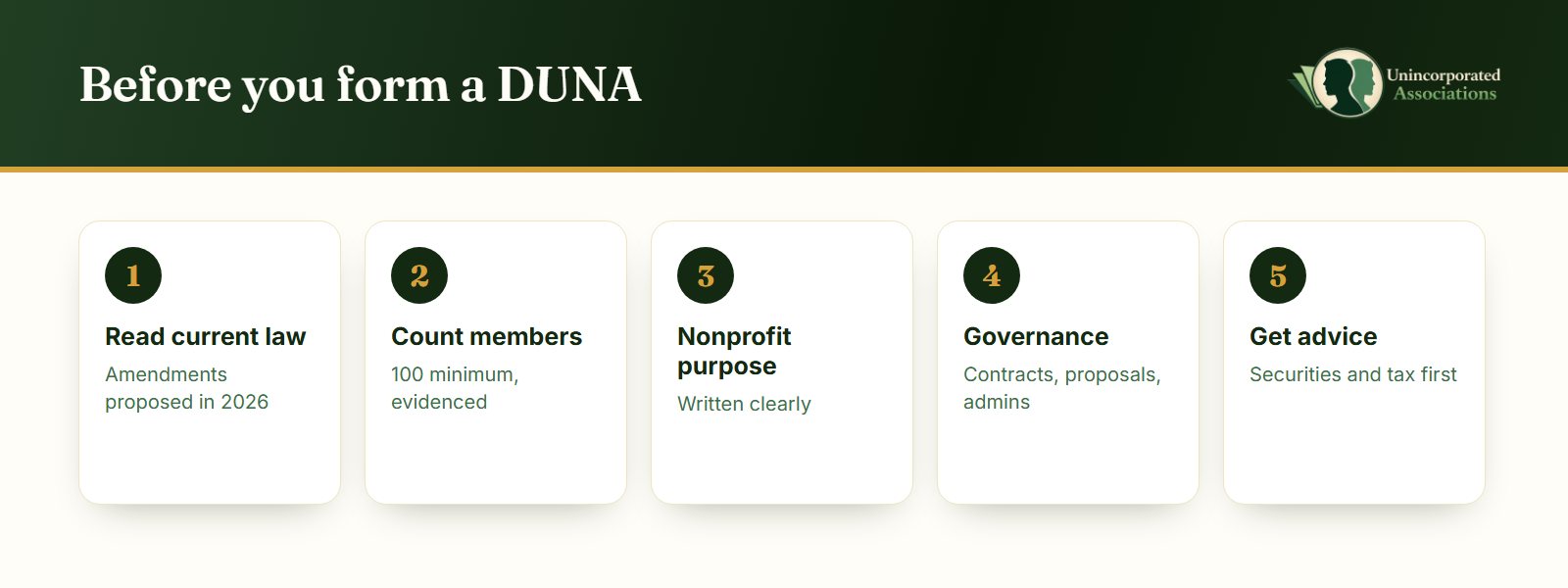
- Read the current statute. The act is new, and a 2026 bill proposed amendments; confirm what is in force.
- Confirm the 100-member threshold and how your community will evidence consent.
- Write the nonprofit purpose clearly.
- Document governance: which smart contracts govern, how proposals pass, and who acts as administrator.
- Plan off-chain operations: an EIN, banking, contracts and records.
- Get securities and tax advice before issuing or distributing tokens.
- Plan for falling membership, given the dissolution trigger below 100 members.
Pro tip: Publish a plain-English governance summary alongside your smart contracts: what the association is for, how decisions are made, who the administrators are and how to contact them. Courts, banks and members will all look for it.
Frequently asked questions
What is a DUNA?
A decentralized unincorporated nonprofit association: a Wyoming legal structure, created by a 2024 statute, designed for decentralized groups such as DAOs that pursue a common nonprofit purpose.
How many members does a Wyoming DUNA need?
At least 100 members joined by mutual consent for a common nonprofit purpose. If membership falls below 100, the act provides for dissolution unless the group qualifies as an ordinary Wyoming unincorporated nonprofit association.
Does a DUNA protect members from liability?
The act provides that a person is not liable for the association's torts merely because they are a member or administrator. That protection has limits, and other laws can still impose liability.
Can a DUNA make a profit?
It is a nonprofit structure. The act's provisions on profits and distributions have been the subject of proposed amendments, so check the current statute and get advice before planning any distributions.
Do I have to be in Wyoming to use a DUNA?
The act is Wyoming law, and the association elects to be formed under it. Groups elsewhere should get advice on how other states and federal law will treat a Wyoming DUNA in their circumstances.
Sources
- Wyoming Legislature: 2024 Senate File 50 (enrolled act)
- Wyoming Statutes, Title 17, Chapter 32
- Texas Business Organizations Code § 252.006
- 26 CFR 301.7701-2
- Iowa Code chapter 501B (revised uniform act, for comparison)
- Texas Business Organizations Code § 152.051 (partnership default)
- CFTC Release 8715-23 (Ooki DAO judgment)
Exploring a DUNA or another association structure for your community? Book a free 15-minute call with Kirk's team, or join the daily live Q&A.
Have questions? Bring them to the daily call.
Join our live Q&A every weekday and Saturday at 3PM PST, or get a free 15-minute call to see whether a UNA fits your situation.
Have a question about your situation?
Send us a message and we'll get back to you.
Keep reading
 The Well-Meaning Dragon: Straight Answers to the Hardest ObjectionsFor the family and friends who push back because they care — honest answers to the toughest questions about the Federal income tax and Unincorporated Associations.
 It's Not What You Believe, It's What You SignFor the cautious partner in the room: real risk rarely comes from asking questions. It comes from what you signed.
 What Most People Get Wrong About Taxes, Structure, and ControlThe real problem isn't taxes — it's structure, and who actually has control. A look at positioning over loopholes.
Educational, not legal or tax advice. Unincorporated Associations is a document-preparation and education company. Consult a licensed attorney or CPA before acting on any position discussed on this site.