Unincorporated Association Reviews: How to Vet a Document Preparer
By Kirk Carmichael · · 8 min read
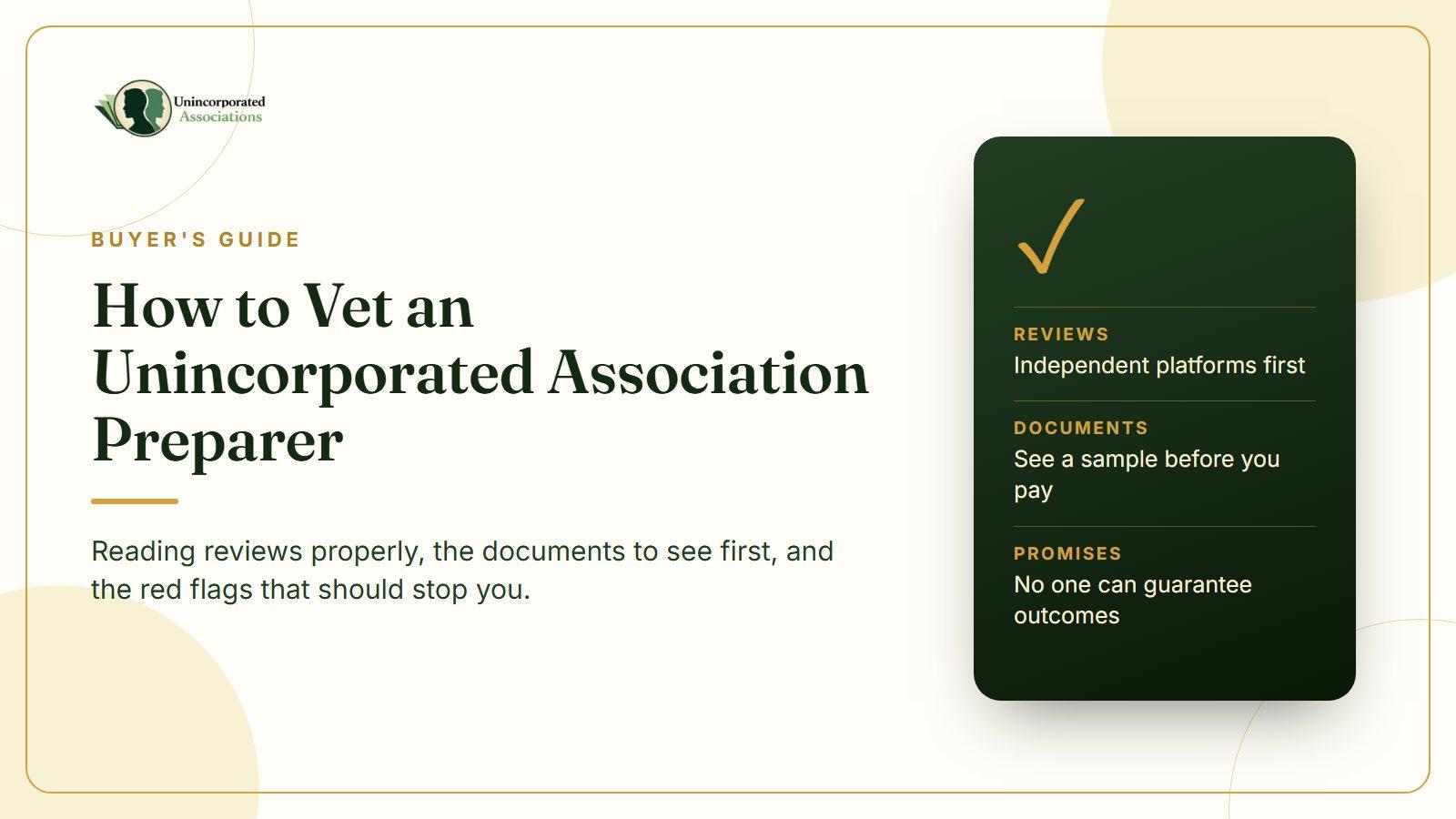
Short answer: Read reviews on independent platforms such as Trustpilot and the Better Business Bureau, not only on the preparer's own site, and look for detail about support after the sale. Then vet the preparer directly: ask to see what documents you will receive, who drafts and reviews them, what ongoing support is included, what the total cost and refund terms are, and what the preparer will not do. Walk away from anyone who guarantees a legal or tax outcome.
If you searched for "unincorporated associations reviews," you are doing exactly the right thing: checking before you buy. Forming an association involves real documents with real consequences, and the quality of the preparer matters.
This guide is written by a document preparer, so we will be upfront about that. The checklist below is the one we would want any customer to use on us and on anyone else. A good preparer should pass it easily.
Key takeaways: Check independent reviews, not just testimonials. Ask to see sample documents and the support you get after formation. Get the full price and refund terms in writing. Treat any guaranteed legal or tax result as a red flag, from anyone.
Where to read reviews you can trust
Not all reviews carry the same weight. In order of usefulness:
- Independent review platforms. Trustpilot and the Better Business Bureau collect reviews the business does not control. Look at the spread of ratings, how recent they are, and whether the company replies to criticism.
- Detailed reviews over short ones. "Great service!" tells you little. A review that says what documents someone received, how long it took and how questions were handled months later tells you a lot.
- The negative reviews. Every busy service has some. What matters is the pattern: are complaints about one-off delays, or about the same serious problem again and again? And did the company respond and fix it?
- Testimonials on the preparer's own site. These are useful for understanding who the service is for, but they are curated. Give them less weight than independent platforms.
Federal law now backs this up. The FTC's rule on consumer reviews and testimonials, at 16 CFR Part 465, bans fake reviews, buying reviews and suppressing negative ones. If something looks manufactured, such as dozens of identical five-star reviews posted on the same day, trust your instinct.
Pro tip: Sort reviews by "most recent" and read the last 20. A company's service today matters more than its reputation from three years ago.
How to read a single review like an investigator
Once you have found reviews on an independent platform, a few minutes of careful reading tells you far more than the average score.
Look for specifics. A useful review names what the person bought, how long it took, and what happened afterwards: "The bank asked for a signer resolution and support sent a template the same day" is evidence. "Amazing, life-changing!" is enthusiasm.
Check the timeline. Was the review written the day after purchase, or months later? Early reviews tell you about the sales experience; later ones tell you whether the documents held up at the bank and whether support was still there.
Separate the product from the promise. If a negative review says "they didn't make my taxes disappear," that is a complaint about an expectation no preparer can honestly meet. If it says "my articles had the wrong state law in them," that is a complaint about the product. The second kind matters more.
Read the company's reply. A defensive or copy-pasted reply is a signal. So is a reply that offers to fix the problem and then the reviewer updates the review.
Look for the same issue repeated. One complaint about a slow email is noise. Ten complaints about missing documents is a pattern.
Remember who leaves reviews. Very happy and very unhappy customers write most reviews. The average customer usually says nothing, so a handful of strong opinions on either side should not decide things alone.
Compare like with like. Reviews of a full-service preparer with live support and attorney-backed documents are not directly comparable with reviews of a low-cost template download. Make sure you are comparing services that offer the same thing.
The vetting checklist
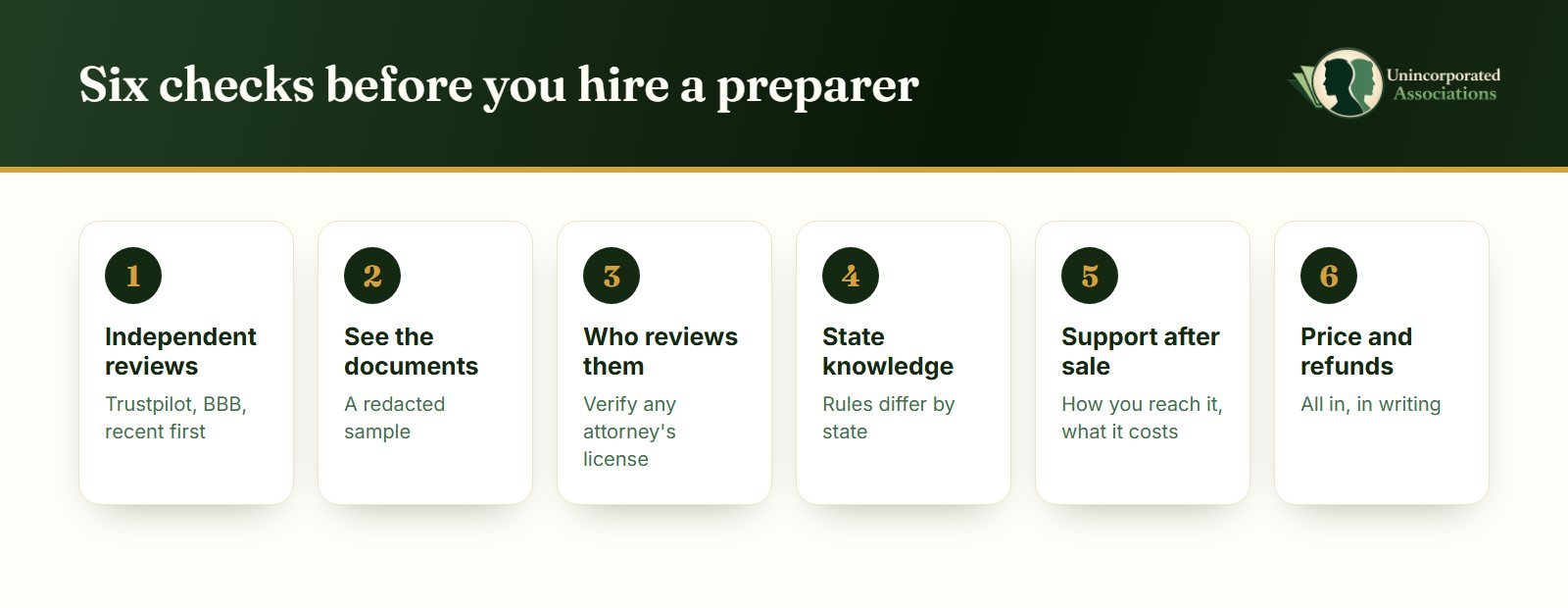
1. What exactly will you receive?
Ask for a plain list of the documents included. For a typical unincorporated association, that means articles of association, bylaws, any membership agreement, resolutions naming officers, and guidance on getting an EIN and opening a bank account. A good preparer will happily show you a redacted sample. Our guide on how to become an unincorporated association lists the core documents, so you know what to expect.
2. Who drafts and reviews the documents?
Ask whether the documents are prepared from a template, customized for your purpose, and reviewed by an attorney. If attorney review is promised, ask who the attorney is and verify their license with the state bar, for example through the State Bar of California's attorney search. Be clear about the difference: a document preparer is not your lawyer unless a lawyer has agreed to represent you.
3. Does the preparer know your state?
Association law varies by state. California, Texas and the states that adopted the uniform nonprofit association act protect nonprofit association members by statute; other states rely on older rules. A preparer should be able to tell you which rules apply where you are. Our California guide shows the level of state detail you should expect.
4. What support do you get after the sale?
Formation is the start, not the end. Banks ask questions, officers change and members join and leave. Ask: Is there ongoing support? How do you reach it: phone, email, live calls? Is it included or extra? Reviews that mention support months after purchase are especially valuable here.
5. What does it cost, all in?
Get the total price in writing, what it includes, any ongoing or renewal fees, and the refund policy. Be cautious with prices that seem too low to include real customization, and with any pressure to pay before you have seen what you are buying.
6. What will the preparer not do?
A trustworthy preparer tells you the limits of the service. For example, we are a document-preparation and education company, not a law firm, and nothing we provide is legal or tax advice. If a preparer will not tell you what is outside their scope, that is a warning sign.
Red flags that should stop you
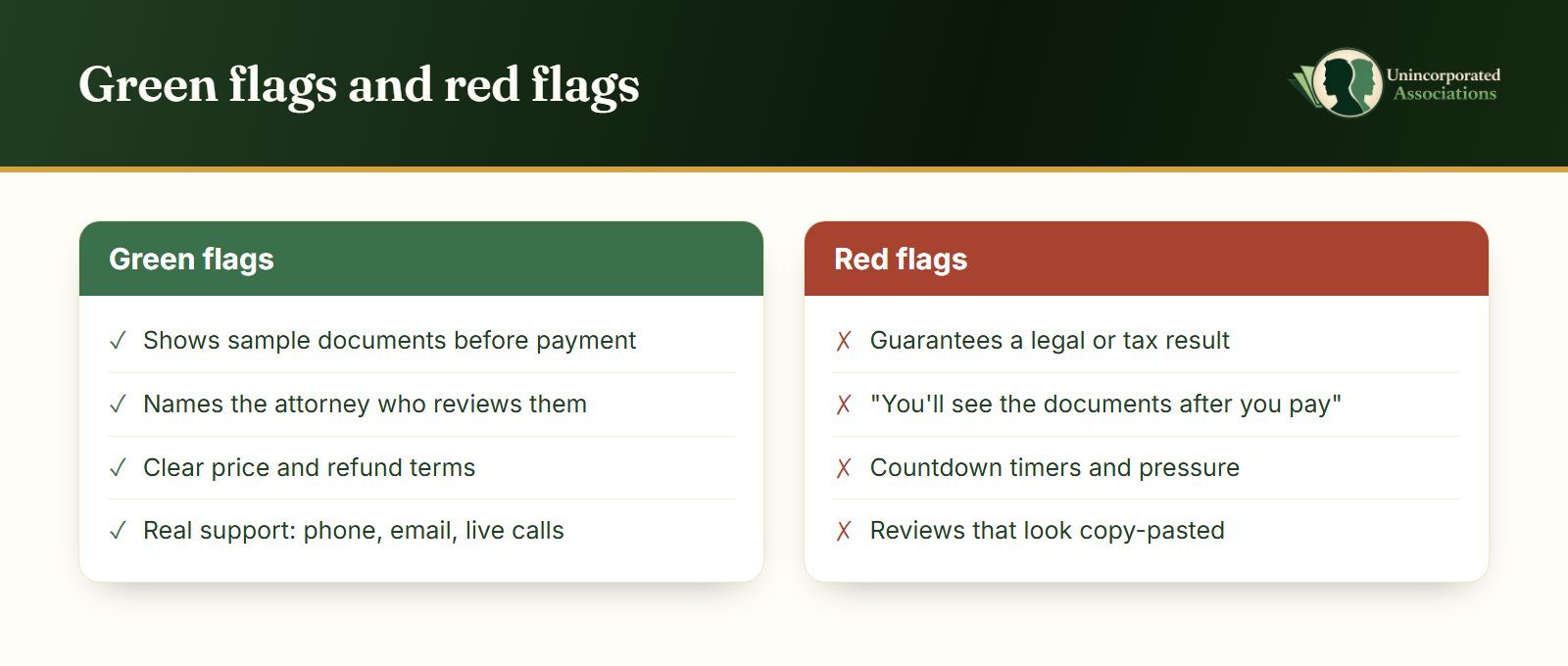
Watch out: Any preparer, including us, who guarantees you a legal or tax result is overpromising. No one can guarantee how a court, the IRS or a state agency will treat your specific situation.
- Guarantees. "Guaranteed protection," "guaranteed to eliminate taxes" or "100% lawsuit-proof."
- Secrecy about documents. No sample, no list, "you'll see it after you pay."
- Pressure. Countdown timers on the price, or "only today" offers for a legal structure.
- No real support channel. Only a contact form, with no phone, email or scheduled calls.
- Reviews that look manufactured. Identical wording, bursts on the same day, no negatives at all.
- No state awareness. The same answer for every state.
Questions to ask on the first call
- Can I see a redacted sample of the articles and bylaws?
- Who prepares them, and does a licensed attorney review them? Which attorney?
- Which state's law will apply to my association, and what does that mean for liability?
- What exactly is included in the price, and what costs extra later?
- What support is available after formation, and how do I reach it?
- What happens if the bank asks for something the documents don't cover?
- What is your refund policy?
- What will you not do for me?
How we answer those questions
Since this checklist applies to us too, here are our answers in brief. Our formation documents for unincorporated associations are attorney-prepared, we run a daily live Q&A call for members' questions, and more than 4,000 families have used our documents, according to our internal records. You can read every review of us on Trustpilot, including the critical ones. We are a document-preparation and education company, not a law firm, and we do not give legal or tax advice. Our services page lists what is included, and you can ask us any of the questions above on a free call.
What to do if you've already bought and you're unhappy
- Write down the problem. What was promised, what you received, and what is missing.
- Contact the company in writing. Give them a fair chance to fix it, and keep copies.
- Check the refund terms you agreed to.
- Leave an honest review on an independent platform, describing facts rather than feelings.
- Get independent advice if the documents may not do what you need. A local attorney can review them.
Frequently asked questions
Are unincorporated association preparers legitimate?
Many are. Forming an unincorporated association is lawful, and document preparation is a real service. Quality varies, which is why the checklist above matters. Judge each preparer on the documents, support, transparency and reviews, not on promises.
Where can I read unincorporated associations reviews?
Start with independent platforms such as Trustpilot and the Better Business Bureau. Read recent and negative reviews, and check whether the company responds. Testimonials on a company's own site are curated, so weigh them less.
Is a document preparer the same as a lawyer?
No. A document preparer prepares documents; a lawyer gives legal advice and can represent you. If a preparer says documents are attorney-reviewed, ask who the attorney is and verify the license with the state bar.
What is the biggest red flag?
A guarantee of a legal or tax outcome. No one can promise how the IRS, a court or a state agency will treat your particular facts.
How long should preparing association documents take?
It varies with how much customization is needed and how quickly you answer the preparer's questions. Ask for a timeline in writing before you pay.
Sources
- FTC rule on the use of consumer reviews and testimonials, 16 CFR Part 465
- Trustpilot: Unincorporated Associations reviews
- Better Business Bureau
- State Bar of California: attorney license search
- IRS: Choosing a tax professional
- California Corporations Code section 18605
Want to run this checklist on us? Book a free 15-minute call and ask anything, or join the daily live Q&A.
Have questions? Bring them to the daily call.
Join our live Q&A every weekday and Saturday at 3PM PST, or get a free 15-minute call to see whether a UNA fits your situation.
Have a question about your situation?
Send us a message and we'll get back to you.
Keep reading
 The Well-Meaning Dragon: Straight Answers to the Hardest ObjectionsFor the family and friends who push back because they care — honest answers to the toughest questions about the Federal income tax and Unincorporated Associations.
 It's Not What You Believe, It's What You SignFor the cautious partner in the room: real risk rarely comes from asking questions. It comes from what you signed.
 What Most People Get Wrong About Taxes, Structure, and ControlThe real problem isn't taxes — it's structure, and who actually has control. A look at positioning over loopholes.
Educational, not legal or tax advice. Unincorporated Associations is a document-preparation and education company. Consult a licensed attorney or CPA before acting on any position discussed on this site.