
Tax Exempt EIN: Why an EIN Alone Doesn't Exempt You
· 13 min read

An EIN does not make an organization tax-exempt. It is an identification number. Exemption is a separate status, and it comes from a different process. The same rule applies to a nonprofit corporation, a club, or an unincorporated association.
That sounds simple, yet it trips up founders constantly. Does the number you get in minutes carry any tax meaning? What does carry that meaning? And where does a private association fit in? Let’s walk through it.
TL;DR
- An EIN is a nine-digit identifier. It does not grant tax-exempt status, and the IRS says so in its own assignment letter.
- Exemption is recognized through a separate IRS application. Most 501©(3) groups use the Form 1023 series, and other groups generally use Form 1024.
- You can check any organization’s recognized status in the IRS Tax Exempt Organization Search, by name or EIN.
- Unincorporated associations can be recognized as exempt, but the form of the association and its governing documents matter a great deal.
- Treat any pitch that says “get an EIN and stop paying tax” with caution, and ask a tax attorney to review your specific facts.
Table of Contents
- What an EIN actually is
- What does make an organization tax-exempt
- How to check whether an organization is exempt
- Where unincorporated associations fit
- Questions worth asking before you trust any “tax-exempt” claim
- Our perspective
- Common mistakes to avoid
- Where our service fits
- FAQ
- Sources
What an EIN actually is
An Employer Identification Number is a nine-digit number the IRS assigns to an entity. According to LegalClarity’s explainer on EINs and exemption, it identifies who is filing returns, paying employees, and opening bank accounts. It says nothing about whether the organization owes income tax.
Think of it as a Social Security number for an entity. A sole proprietor with an EIN still owes tax. A for-profit company with an EIN still owes tax. A nonprofit with an EIN has simply been given a name tag.
The IRS itself is direct about this. A sample EIN assignment letter published by Texas A&M 4-H states that assigning an EIN does not grant tax-exempt status to nonprofit organizations.
Why the confusion is so common
Three things blur the line:
- Search results mix the two topics. Pages about nonprofit EINs sit next to pages about tax exemption, so the two ideas get fused.
- The EIN comes first. An organization cannot apply for tax-exempt status without a valid EIN already in hand, so people assume the number is the first half of the exemption.
- “Tax-exempt number” is a common phrase. LegalClarity notes that the IRS does not issue a separate tax-exempt number. When an exemption application is approved, the IRS sends a determination letter that confirms your existing EIN and names the code section you qualify under.
So the “tax exempt EIN” is really an ordinary EIN plus a determination letter. The letter is what matters.
What does make an organization tax-exempt
Recognition of exempt status comes from the IRS after you apply. The Texas A&M sample letter says organizations seeking recognition under Section 501©(3) complete a Form 1023-series application. It adds that all other entities should file Form 1024 for recognition under Section 501(a).
The ECFA makes the same point from the ministry side: being incorporated as a nonprofit and holding an EIN does not make a ministry exempt. The organization is exempt only if it meets the requirements of federal law, and the IRS is authorized to recognize that exemption.
There are narrow exceptions to the filing step. The same ECFA page explains that churches, interchurch organizations, local units of a church, conventions or associations of churches, and integrated auxiliaries do not need the IRS to recognize their exemption. Subordinate organizations covered by a group exemption are also in that category. These are specific categories, not a general workaround.

The application and its cost
Take a business league or trade association under Section 501©(6). A paper from Moore Nonprofit Law explains that such groups file Form 1024 with Schedule C. A substantially complete filing needs:
- the current version of the form
- the correct user fee (the paper cites $600 as of 2018)
- the signature of an authorized individual
- the organization’s EIN
- a statement of receipts and expenses
- a copy of the organizing documents
- a detailed narrative of proposed activities
- bylaws or similar governing rules, if adopted
Fees change, so confirm the current amount on the IRS’s own form instructions before you file.
Federal exemption is not the whole picture
Federal recognition does not settle everything. LegalClarity points out that a common new-nonprofit mistake is assuming the IRS determination letter exempts the group from state taxes. It does not. Most states require a separate application for state income tax exemption, and sales and property tax exemptions usually involve more filings with the state revenue department.
Exempt status also carries ongoing duties. According to a federal tax guide from the VFW, organizations exempt under Section 501© generally file Form 990 by the 15th day of the fifth month after the fiscal year closes. Groups with annual gross receipts normally above $50,000 file Form 990 or 990-EZ. Smaller ones with $50,000 or less submit Form 990-N electronically. The same guide says that failing to file for three consecutive years costs a group its exemption, and that exemption does not remove income and payroll tax filing duties.

How to check whether an organization is exempt
Want to know if a group really holds recognized status? Use the IRS Tax Exempt Organization Search. LegalClarity describes it as the definitive way to confirm federal recognition. It includes Publication 78 data, which lists organizations eligible to receive tax-deductible contributions, and you can search by name or EIN.
A few practical points:
- Search by EIN when you have it. Names are often similar, and the number removes doubt.
- No listing means no recognition on file. An organization with an EIN and no determination letter will not appear as exempt.
- Revocations show up too. The same LegalClarity piece notes that revocation for missing three straight annual returns appears in the database.
- Donors rely on this. The United Church of Christ explains that a recognized organization receives a determination letter and is listed in the search tool, and that donors can verify the information there.
The National Council of Nonprofits also points readers to the IRS’s searchable list of recognized nonprofits, which can be searched by state.
Does a 501©(3) need its own EIN?
Yes. The UCC article is a good example. Local churches that are subordinates in a group ruling must have their own EINs, separate from the denomination’s group-exemption number. A local church should not use the denomination’s EIN for banking, payroll taxes, filings, or grant applications.
Where unincorporated associations fit
Does a private association need an EIN? Generally, if it opens a bank account, hires help, or files returns, it will want one. Does the EIN then make it exempt? No, for the same reasons above.
Can an unincorporated association be exempt at all? The National Council of Nonprofits says that for the IRS to recognize exemption, an organization must be organized as a trust, a corporation, or an association. It adds that unincorporated associations can gain recognition, though lacking a corporate form can expose volunteers to legal liability.
Moore Nonprofit Law adds a useful point of structure. To qualify, an unincorporated association has to adopt a governing instrument with the provisions exemption requires. In practice, it needs to look and act much like a nonprofit corporation.
What does that tell us? Documents decide the outcome. The number on the SS-4 is the easy part. The governing instrument, the member structure, and how the association actually operates are what the IRS looks at.
That is also why risks for members matter. Without a corporate shield, the way the association is organized and run shapes the exposure of those involved. Other tax-advantaged structures carry their own rules and tradeoffs too: qualified opportunity zone rules, benefits and risks are a good example of how a tax benefit always comes with conditions you have to meet.
If you want the practical mechanics of getting a number for an association, we cover them in our guide to getting an EIN for an unincorporated association. For the bigger picture, see how to form an unincorporated association.
Questions worth asking before you trust any “tax-exempt” claim
A good habit is to ask the same short set of questions every time you hear that a structure is tax-free.
- Which code section is the claim based on? Real exemption names one, such as 501©(3) or 501©(6).
- Is there a determination letter? If the group says it is recognized, it should have one. If it relies on a category that needs no filing, it should be able to say which one.
- What do the governing documents say? Purpose, member rights, and treatment of net earnings all count.
- What still gets filed? Returns, state filings, payroll, and information returns do not vanish.
- Who reviewed your facts? A tax attorney or CPA who knows your situation is worth more than any general article, ours included.
That last question is not a formality. Your income, your state, and how members take value out of the association all change the answer. Treat anything that promises a result without looking at your facts as a reason to slow down.
Our perspective
Most people hear “tax exempt” and picture a number. We would invite you to picture a structure instead.
The number is an identifier. The structure is what carries meaning: who the members are, what the association exists to do, how decisions are made, and where the assets sit. When those pieces are written down clearly and followed, you are working with a system. When they are not, you are working with a label.
That is why we built our process around documents and education rather than a quick filing. A Unincorporated Nonprofit Association (UNA) is a member-governed framework. It does not require a public registry listing, and it does not carry the annual fees many people associate with an LLC or corporation. Our package is designed to give you attorney-backed documentation, state registration, an EIN, Revocation of Election preparation, and asset transfer paperwork in one place.
We also believe you should keep asking questions. What does my structure say? Which of my goals is it designed to serve? Our members get lifetime support, daily Q&A, and a training library so that understanding keeps growing after the paperwork is done.
The best choice is the informed one. If an EIN has ever made you wonder whether you were missing something, you were asking the right question.
Kirk Carmichael
Common mistakes to avoid
Assuming the EIN letter is proof of exemption. It is proof the number exists. Read it: the IRS letter itself says assignment does not grant exempt status.
Using one group’s EIN for another. As the UCC guidance shows, each entity needs its own number. Sharing one muddles banking, payroll, and filings.
Forgetting state rules. Federal recognition does not carry over to state income, sales, or property tax automatically. Check your state’s revenue department.
Letting filings lapse. Three missed annual returns in a row can end exempt status where it was recognized.
Skipping the documents. For an association, the governing instrument is the heart of the matter. Do not treat it as a template to paste in.
Where our service fits
If you are exploring a private, member-based alternative to a public LLC or corporation, our attorney-backed UNA + ROE package is the way we help. It is a one-time $4,950 fee and includes state registration, EIN assignment, Revocation of Election preparation, customizable association naming, asset transfer documentation, and lifetime support with daily Q&A and a training library.
You can see everything on our services page, or order the UNA + ROE package directly.
Prefer to read first? Our book, Eliminate Income Tax, is available for $20. Want to talk through your facts? You can meet with an attorney about unincorporated associations. For our overview of how a private association is designed to reduce taxes, read our tax strategy guide.
FAQ
Does an EIN make you tax exempt?
No. An EIN only identifies your entity to the IRS. Exemption is recognized separately, usually through a Form 1023-series or Form 1024 application, and confirmed by a determination letter.
Can I look up whether an EIN belongs to a tax-exempt organization?
Yes. Use the IRS Tax Exempt Organization Search and enter the organization’s name or EIN. If it has recognized status, it will be listed there, and revoked status shows up too.
Can an unincorporated association get an EIN and apply for exemption?
Yes, an association can obtain an EIN, and the National Council of Nonprofits says unincorporated associations can gain IRS recognition. The association needs governing documents with the provisions exemption requires, and a tax attorney should review your facts.
Do I still file returns if my organization is exempt?
Often, yes. Most 501© organizations file Form 990, 990-EZ, or 990-N depending on gross receipts. Exemption also does not remove payroll tax duties, and state rules may differ from federal ones.
Sources
- Sample IRS EIN assignment letter (Texas A&M 4-H)
- ECFA: applying for tax-exempt status
- LegalClarity: is an EIN the same as a tax-exempt number
- LegalClarity: how to tell if a nonprofit is legit
- Moore Nonprofit Law: Business Leagues and Trade Associations
- VFW: Federal Tax Information guide
- United Church of Christ: the group exemption and your church’s EIN
- National Council of Nonprofits: frequently asked questions
- National Council of Nonprofits: filing for federal tax-exempt status
- Qualified opportunity zones: rules, benefits and risks
Recommended
- EIN Privacy: 5 Controls U.S. Business Owners Need Now
- Instant EIN and Bank Ready SS-4 for U.S. Unincorporated Associations
- Running a Nonprofit Without 501(c)(3) Status: Your Options
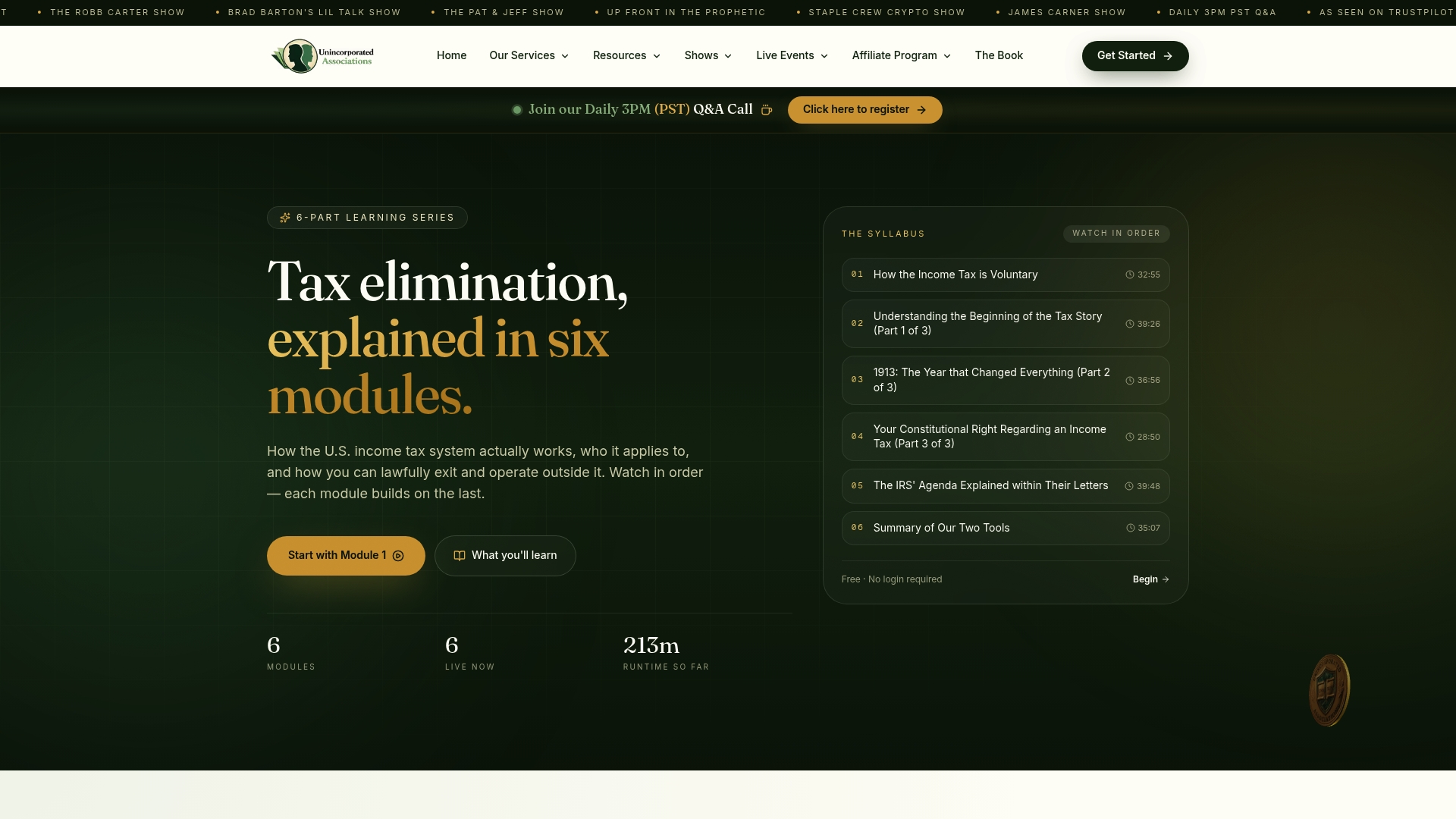
- 6-Part Tax Elimination Learning Series
This article is provided for general informational and educational purposes only and does not constitute legal, tax, accounting, or financial advice. Reading this content or contacting UnincorporatedAssociations.com does not create an attorney-client, CPA-client, or other professional-client relationship. In accordance with IRS Circular 230, any discussion of federal tax matters herein is not intended or written to be used, and cannot be used, for the purpose of avoiding penalties.
Have questions? Bring them to the daily call.
Join our live Q&A every weekday and Saturday at 3PM PST, or get a free 15-minute call to see whether a UNA fits your situation.
Have a question about your situation?
Send us a message and we'll get back to you.
Keep reading
 The Well-Meaning Dragon: Straight Answers to the Hardest ObjectionsFor the family and friends who push back because they care — honest answers to the toughest questions about the Federal income tax and Unincorporated Associations.
 It's Not What You Believe, It's What You SignFor the cautious partner in the room: real risk rarely comes from asking questions. It comes from what you signed.
 What Most People Get Wrong About Taxes, Structure, and ControlThe real problem isn't taxes — it's structure, and who actually has control. A look at positioning over loopholes.
Educational, not legal or tax advice. Unincorporated Associations is a document-preparation and education company. Consult a licensed attorney or CPA before acting on any position discussed on this site.