EIN Privacy: 5 Controls U.S. Business Owners Need Now
· 11 min read
An EIN is not confidential in the same way a Social Security number is, but that does not make it fair game for every request that lands in your inbox. Treat it as controlled business information: shared only when law or routine process genuinely requires it. If you are reading this because you already suspect a problem, secure your original IRS confirmation notice now, stop sending your EIN by email, and call the IRS if anything looks off.
TL;DR:
- Your EIN is publicly disclosed through specific filings like Form 990 and SEC reports but remains private in most casual searches unless paired with other business details.
- Legitimate requests for your EIN are limited to tax filings, banking, and licensing, while vague requests should always be verified with the specific legal requirement cited.
- Protect your EIN by securely transmitting it, restricting internal access, and monitoring for misuse, since pairing it with other data can lead to fraud or impersonation.
- Forming a Unincorporated Nonprofit Association can reduce your public footprint by avoiding state registry ownership disclosures, but it does not exempt you from tax reporting requirements.
- If your EIN is stolen, promptly notify the IRS, preserve evidence, reset credentials, and monitor your business credit report to prevent further fraud.
Table of Contents
- Understanding EIN Privacy Concerns: What the Law Actually States
- When You Actually Have to Hand Over Your EIN
- Your EIN Protection Checklist: 5 Controls That Actually Matter
- If Someone Misuses Your EIN, Act in This Order
- How Forming a UNA Changes What the Public Can See About Your EIN
- Getting the Privacy and Compliance Balance Right
- Ready to Reduce Your Business’s Public Footprint?
- Sources
- FAQ
Understanding EIN Privacy Concerns: What the Law Actually States
The confusion around ein privacy concerns starts with a real legal distinction. Federal law under 26 U.S.C. §6103 protects tax returns and “return information,” but an EIN by itself is not automatically classified the same way. That gap is where most of the anxiety lives.
Your EIN shows up in places you might not expect. Nonprofits disclose theirs on Form 990. Public companies list theirs in SEC filings. Some state business registrations publish them too. But there is no general public directory where anyone can search for a private company’s EIN, according to legal guidance on EIN confidentiality. Most private EINs stay out of casual reach.
The real danger is not the number in isolation. It is what happens when someone pairs your EIN with your business name, address, or banking details. Fraudsters use that combination to file fake tax documents, open credit lines, or impersonate your company with vendors. An EIN “leak” rarely causes harm on its own. It is the multiplier effect that does the damage, which is why treating an EIN as sensitive by default makes practical sense even though it is not legally classified.
When You Actually Have to Hand Over Your EIN
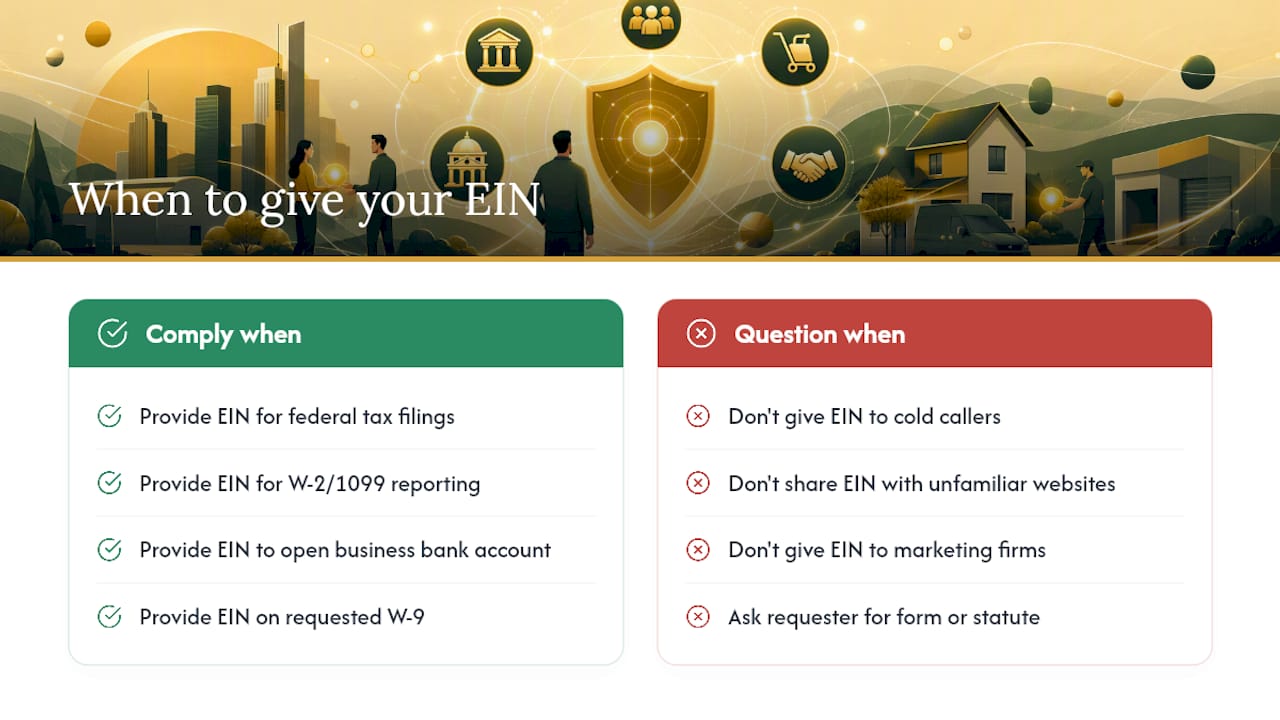
Some requests for your EIN are non-negotiable. Others deserve a follow-up question before you comply.
You are legally required to provide your EIN for federal tax filings, W-2 and 1099 reporting, opening a business bank account, and most state and local licensing applications. If a client or vendor sends you a W-9, that is a legitimate request tied directly to their own IRS reporting duty.
Not every request carries that weight. If a caller, an unfamiliar website, or a marketing firm asks for your EIN with no clear tax or banking purpose attached, ask them to name the specific form or statute requiring it. Legitimate requesters can answer that in one sentence. Vague ones usually cannot.
Sole proprietors have an extra lever here. If you currently give clients your Social Security number on W-9 forms, apply for an EIN instead. It costs nothing through the official IRS EIN application, and it removes your SSN from a document that could end up in someone else’s filing cabinet or inbox for years.
Your EIN Protection Checklist: 5 Controls That Actually Matter
Most advice on protecting an EIN reads like generic cybersecurity boilerplate. Here is what actually moves the needle, ranked by effort versus payoff.
- Lock down transmission. Never put your EIN in an email subject line, and strip it from forwarded thread history before sending a W-9. The Census Bureau’s guidance on protecting EINs specifically flags email chains as a common leak point. Use a secure upload portal instead of attachments whenever a client offers one.
- Secure the original documents. Your IRS confirmation notice (the CP 575) and any Form 147C you request as a replacement should live in a locked file or encrypted folder, not a shared drive everyone in the office can browse.
- Restrict internal access. Limit who can view or share your EIN to the people who genuinely need it for payroll, banking, or filings. Require a second person to verify any request to change bank account details tied to your EIN.
- Train your staff on phishing. A shocking number of EIN exposures start with someone convincingly impersonating the IRS or a bank on the phone. A five-minute team briefing on verification steps beats any software purchase.
- Monitor for misuse. Check your business credit report periodically and read every IRS notice carefully, even ones that look routine. Combining tighter disclosure with faster detection is the highest-impact protection strategy available, according to legal analysis of EIN confidentiality.
Pro Tip: Never pay a third-party website to “obtain” your EIN. The FTC and IRS jointly warned that the IRS issues EINs for free through its own online portal, and paid intermediary sites add nothing but a fee and, often, your data on a third-party server you never asked to trust.
If Someone Misuses Your EIN, Act in This Order
Speed matters more than perfection here. Work through these steps in sequence.
- Preserve everything first. Screenshot suspicious notices, save emails, and do not delete anything before you have copies.
- Reset credentials on any accounts tied to your business banking or tax software, and notify your bank immediately if you suspect a fraudulent account was opened.
- Call the IRS Business & Specialty Tax Line at 800-829-4933 to report the issue directly.
- File Form 14039-B, the Business Identity Theft Affidavit, which starts the IRS’s formal investigation process, as outlined in guidance on business tax ID protection.
- Loop in your attorney or accountant before responding to any third party claiming a debt or filing tied to your business.
- Monitor your business credit report in the following months. Fraudulent filings sometimes surface weeks after the initial incident, not immediately.
How Forming a UNA Changes What the Public Can See About Your EIN
An Unincorporated Nonprofit Association, or UNA, is a member-governed structure that operates differently from an LLC or corporation at the filing level. Where an LLC typically sits in a state’s public business registry with ownership details attached, a UNA generally does not carry the same public registration requirements in most states. That structural difference is worth understanding if a big part of your privacy concern is who can look up your entity and connect it to you personally.
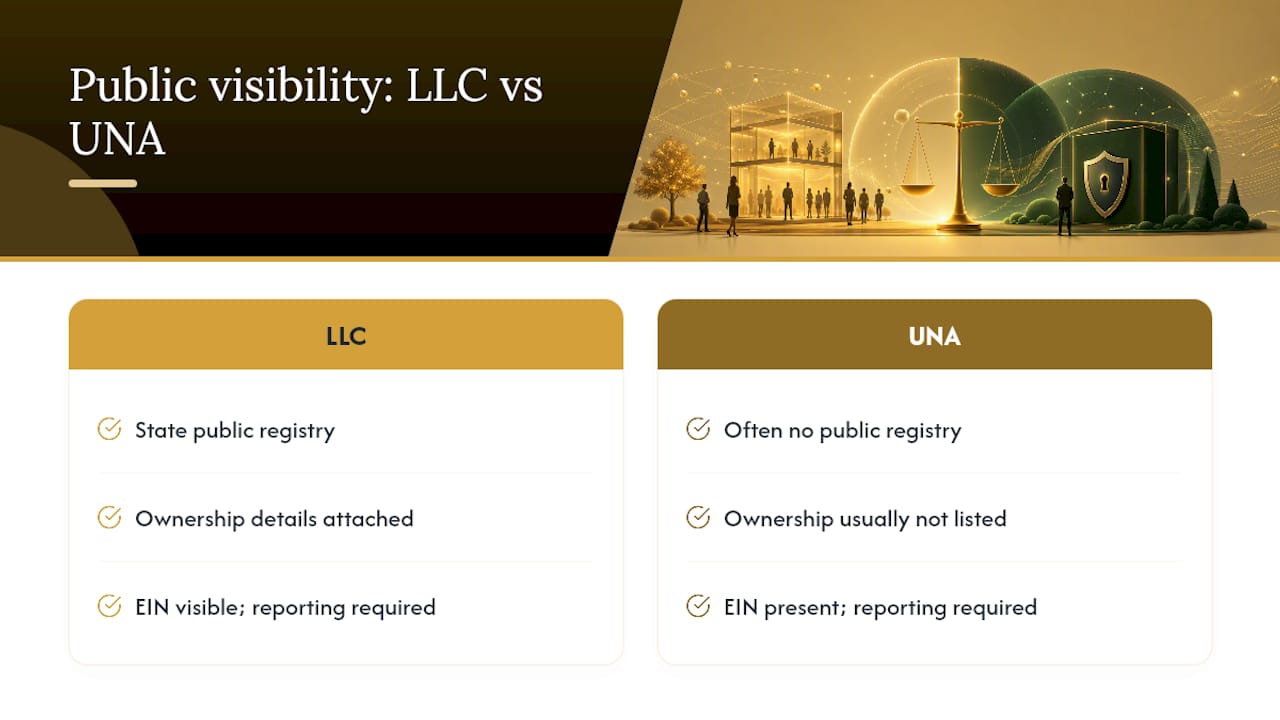
A UNA does not make your EIN invisible, and it does not exempt you from required tax reporting. What it can do is reduce the number of public filings where your name, address, and entity details sit next to your EIN for anyone to find. For someone weighing an unincorporated association structure against a traditional LLC specifically for privacy reasons, that reduction in public footprint is often the deciding factor.
Unincorporated Associations build its formation packages around this exact concern, pairing attorney-backed UNA documentation with guidance on EIN handling and Revocation of Election preparation for members who also want to address tax-free operation. None of this replaces legal advice for your specific situation. If you have complex assets, multiple stakeholders, or a history of exposure, talk to an advisor before you decide which structure fits.
Getting the Privacy and Compliance Balance Right
Privacy protections should make your business run smoother, not create friction with every client who sends you a W-9. The mistake I see most often is business owners treating every information request with the same suspicion, when the smarter approach separates routine, lawful requests from genuinely unnecessary ones.
If you are a sole proprietor, get an EIN and stop handing out your Social Security number today. That single change closes more risk than most of the advanced measures people chase. Save the bigger moves, like exploring a UNA or consulting an attorney, for when you have real exposure: repeated fraud attempts, significant assets, or a business structure with several stakeholders who all touch sensitive filings.
— Kirk Carmichael
Ready to Reduce Your Business’s Public Footprint?
If the public filings tied to a traditional LLC are the source of your discomfort, a UNA takes a different route to the same goal: asset protection without a state registry listing your ownership details for anyone to search. Attorney-backed formation is available for Unincorporated Nonprofit Associations, including EIN handling guidance, Revocation of Election preparation, customizable naming, and support for members navigating questions long after formation is complete.
This approach fits people who have already tried the standard privacy checklist and still want a structure with a smaller public profile, whether that’s freelancers tired of their home address sitting in a state registry or investors consolidating assets under member-based governance instead of personal ownership. The UNA + ROE package bundles the formation documents and revocation materials into one order, or you can speak with an advisor first to see whether a UNA actually solves the specific privacy problem you have.
Sources
For direct verification, the FTC’s consumer alert on EIN services, the text of 26 U.S.C. §6103, and IRS guidance and contact pages cover the legal and procedural basics discussed above. Business owners weighing tax-category questions alongside privacy planning may also find this explainer on earned versus unearned income useful for context.
This article is general information, not a substitute for advice from a qualified financial advisor. Consult a qualified financial professional about your own circumstances before acting on anything here.
- Don’t pay — get your Employer Identification Number (EIN)
- 26 U.S.C. § 6103 – Confidentiality and disclosure of returns and return information
- Back to the basics: AES and protecting company EINs (Census blog)
FAQ
Is an EIN Considered Public Information?
An EIN is not classified as confidential the same way an SSN is, but it is also not sitting in any general public directory. It becomes visible mainly through required disclosures like Form 990 filings or SEC documents, not through casual public lookup.
Can I Refuse to Give Out My EIN?
You can decline requests that are not tied to a specific legal or tax purpose, but you cannot refuse legitimate requests like a W-9 from a paying client without risking backup withholding. Ask any unfamiliar requester which form or statute requires the disclosure before you comply.
What Should I Do if My EIN Is Stolen or Misused?
Contact the IRS Business & Specialty Tax Line at 800-829-4933 and file Form 14039-B, the Business Identity Theft Affidavit, as soon as you notice suspicious activity. Preserve any related documents or notices before you take further action, and notify your bank if a fraudulent account appears linked to your business.
Does an EIN Carry the Same Privacy Risk as an SSN?
No. An SSN ties directly to your personal credit and identity, while an EIN is scoped to your business, which limits the damage a bad actor can do with it alone. The risk grows sharply when your EIN is combined with other personal or banking details, which is why treating it as controlled information still matters.
How Does Forming a UNA Affect My EIN’s Privacy?
A UNA generally does not carry the same public state registration requirements as an LLC, which can reduce how many public filings list your name next to your EIN. Unincorporated Associations provides attorney-backed guidance on structuring a UNA and handling EIN-related documentation as part of that process, though it does not eliminate your underlying tax reporting obligations.
Recommended
This article is provided for general informational and educational purposes only and does not constitute legal, tax, accounting, or financial advice. Reading this content or contacting UnincorporatedAssociations.com does not create an attorney-client, CPA-client, or other professional-client relationship. In accordance with IRS Circular 230, any discussion of federal tax matters herein is not intended or written to be used, and cannot be used, for the purpose of avoiding penalties.
Have questions? Bring them to the daily call.
Join our live Q&A every weekday and Saturday at 3PM PST, or get a free 15-minute call to see whether a UNA fits your situation.
Have a question about your situation?
Send us a message and we'll get back to you.
Keep reading
 The Well-Meaning Dragon: Straight Answers to the Hardest ObjectionsFor the family and friends who push back because they care — honest answers to the toughest questions about the Federal income tax and Unincorporated Associations.
 It's Not What You Believe, It's What You SignFor the cautious partner in the room: real risk rarely comes from asking questions. It comes from what you signed.
 What Most People Get Wrong About Taxes, Structure, and ControlThe real problem isn't taxes — it's structure, and who actually has control. A look at positioning over loopholes.
Educational, not legal or tax advice. Unincorporated Associations is a document-preparation and education company. Consult a licensed attorney or CPA before acting on any position discussed on this site.