Can a Nonprofit Operate a Business? Yes, With These Rules
· 13 min read

Yes, a nonprofit can operate a business. It can sell products, charge for services and earn more than it spends. What it cannot do is hand the surplus to the people who run it. The real question is not whether a nonprofit may earn money, but how the structure around the business is built, because that structure decides who benefits, what is taxed and what is exposed.
That is where the choice of entity matters. A Unincorporated Nonprofit Association (UNA) is a member-governed structure, and it is the one we help people form. Below you will find the rules that apply to any nonprofit running a business, then how to think about the structure that fits your plans.
TL;DR
- Nonprofits may earn income from a business. The restriction is on who receives the profit, not on earning it.
- Income from a regular business unrelated to the mission can be taxed as unrelated business income, at the 21% corporate rate.
- Tax-exempt status is at risk only when unrelated activity becomes substantial, and there is no fixed percentage.
- A separate for-profit subsidiary is a common way to keep a larger business apart from the nonprofit.
- Choosing the structure before you start is cheaper than rebuilding it later.
Table of Contents
- What “nonprofit” actually means for a business
- Who may receive the money
- When business income gets taxed
- How much business is too much?
- Using a separate for-profit subsidiary
- Earned income versus donations
- What this means if you are not building a traditional charity
- Choosing your structure before you launch
- Our perspective
- Form your UNA with attorney-backed support
- FAQ
- Sources
What “nonprofit” actually means for a business
Many people hear “nonprofit” and picture an organization that must lose money or stay small. That is not how the law works. A professional guide from Public Counsel notes that many nonprofits run income-generating activities such as renting space, selling merchandise, running a café or licensing programs, and use the money to fund their work.
So what is the difference between a nonprofit and a for-profit business? It is the destination of the money. In a for-profit company, owners share the profit. In a nonprofit, the surplus stays with the organization and goes back into its activities. There are no shareholders and no dividends.
The North Carolina Center for Nonprofits and the state bar’s board guidebook put it plainly: a nonprofit corporation can do most of what a for-profit corporation can do, except distribute surplus funds as dividends. The surplus must stay in the organization for its operations and programs.
Who may receive the money
This is the rule that matters most. For organizations that hold federal 501©(3) status, the IRS’s Exempt Organizations Technical Guide (Publication 6101, revised May 2025) explains that no part of net earnings may benefit a private shareholder or individual. The rule reaches insiders: founders, directors, officers, members and key employees. The guide treats any taking of net earnings by an insider as fatal to exemption.
Does that mean nobody gets paid? No. Insiders may receive reasonable pay for work they actually do, or fair market value for goods and services they provide. The line is between payment for value delivered and a share of the surplus because you hold a title.
State law adds its own layer. Washington’s RCW 24.03A.155, for example, bars a nonprofit corporation from distributing property held for charitable purposes to its members, directors or officers, with narrow exceptions such as another charity or a government. Other states have their own versions, so check yours.
For a deeper look at how this plays out, see our guide to nonprofit private benefit rules.

When business income gets taxed
Earning money does not by itself create a tax bill for a tax-exempt nonprofit. The tax applies to a specific kind of income, called unrelated business income. Public Counsel’s guide explains that a 501©(3) owes unrelated business income tax (UBIT) only when income is from a trade or business, regularly carried on, and not substantially related to the exempt purpose. All three elements must be present.
A quick example. A nonprofit that teaches woodworking charges tuition: that is related to its educational mission. The same nonprofit also runs a weekly online store selling unrelated gadgets. That second activity is a regular business with no tie to the mission, so its net income is likely unrelated business income.
The American Bar Association’s 2021 overview by Jeffrey Scott Tenenbaum explains why this tax exists. Congress enacted UBIT in 1950 so tax-exempt groups could not use their status to compete unfairly with taxable businesses. Congress chose to allow a degree of business activity and tax it like any other business, at the flat 21% federal corporate rate.
The numbers to know
| Item | What the sources say |
|---|---|
| UBIT rate | 21% federal corporate rate |
| Specific deduction | $1,000 |
| Form 990-T | Required at $1,000 or more of gross unrelated business income, due with Form 990 |
| Estimated payments | Required if annual UBIT is expected to be $500 or more after certain adjustments |
| Public disclosure | Form 990-T is open to public inspection like Form 990 |
These figures come from the ABA’s UBIT overview. Tax law changes, so confirm current figures with the IRS or a tax professional before you file.
Since 2018, there is one more wrinkle. Under IRC § 512(a)(6), as Public Counsel’s guide describes, losses from one unrelated activity cannot offset profits from another. Each line of unrelated business is calculated separately.
How much business is too much?
This is the question that keeps founders up at night. Could a successful business cost the nonprofit its exemption?
The honest answer is that there is no bright-line percentage. A Mitchell Hamline law review article explains that the Internal Revenue Code and regulations give no fixed number, and that IRS examiners look at the activity’s relationship to the whole in time, effort and income, its link to the exempt function, the reason for doing it, and how the board controls it.
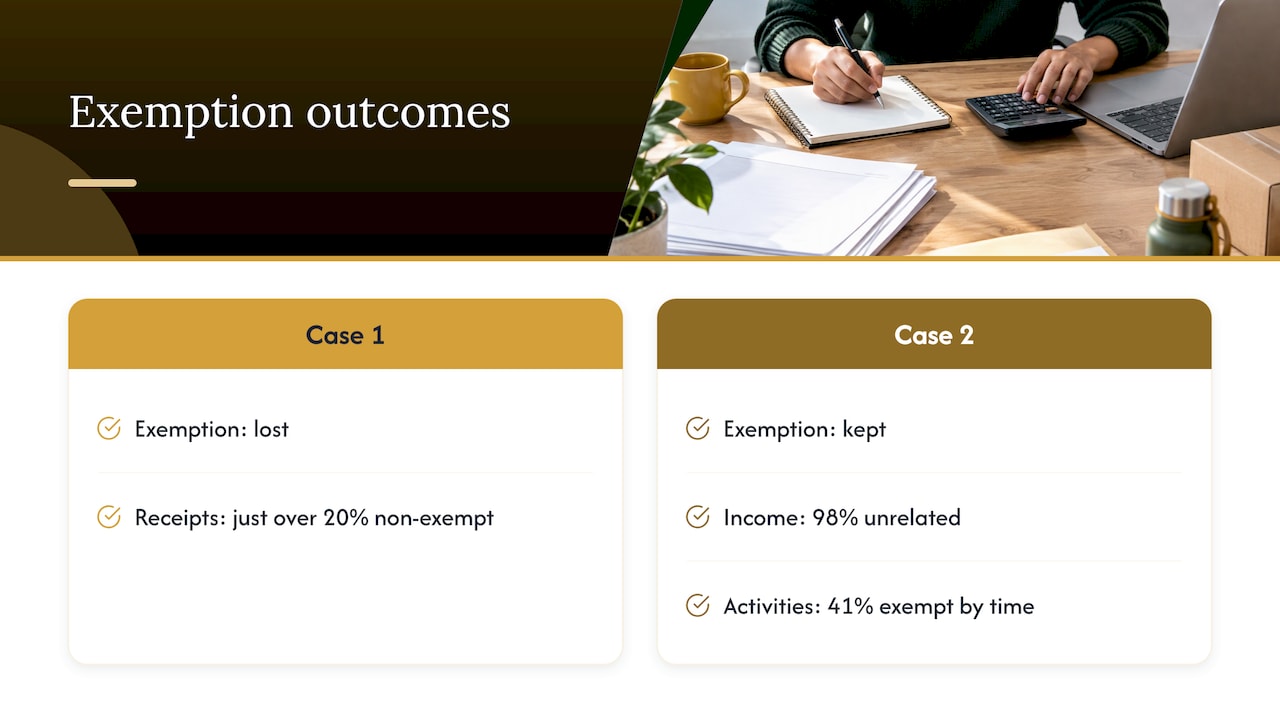
Public Counsel’s guide describes how uneven the outcomes can be. In one case an organization lost exemption with a little over 20% of receipts coming from non-exempt programs. In another, an organization with 98% unrelated income kept exemption because 41% of its activities, measured by time, were exempt.
The Tax Adviser adds that the IRS has long taken the position that a 501©(3) may run an unrelated business as a substantial part of its activities so long as it is not the organization’s primary purpose. It also acknowledges that the regulations create real confusion on this point. The practical lesson: keep the mission first, document how each activity serves it, and have the board oversee the business side.
Using a separate for-profit subsidiary
When a business line grows, many nonprofits place it in a separate for-profit company that the nonprofit owns. The ABA’s 2014 article on this approach advises considering a subsidiary when unrelated activity may become substantial enough to threaten exempt status, or when the nonprofit wants to sell to the broadest audience at market prices. The subsidiary pays corporate tax, then can pass after-tax profits to the parent as dividends.
There is a tax advantage too. All of a subsidiary’s expenses can offset its income before corporate tax applies, so a loss in one activity can offset a gain in another. Inside the parent nonprofit, each unrelated business stands alone.
The separation has to be real. According to the ABA’s 2014 article, the IRS attributes a subsidiary’s activities to the parent only on clear and convincing evidence that it is an arm or integral part of the parent. That is why the parent should keep separate books, stay out of day-to-day management and deal at arm’s length. Overlapping officers carry more risk than overlapping directors.
The federal regulations also close one door: under 26 CFR § 1.502-1, an organization operated primarily to carry on a business for profit is not exempt just because all its profits go to exempt organizations.
A note on SBA loans
If you plan to borrow, know this. The SBA’s SOP 50 10 8, effective June 1, 2025, states that applicants must be organized for profit, so nonprofits are not eligible for SBA business loans. A for-profit subsidiary of a nonprofit may be eligible if other requirements are met, and the nonprofit’s receipts or employees count in the size determination.
Earned income versus donations
A business also changes how you handle money you receive. Sales are revenue. Gifts are donations, and donors expect documentation. If you take both, keep them apart in your books, and learn the rules on donation receipts for nonprofits so the two streams never blur.
What this means if you are not building a traditional charity
Most people reading this are not planning a 501©(3) with a public board and a fundraising calendar. You may be a freelancer, coach, creator, family or small business owner who wants a private, member-governed home for activity and assets. The search for “can a nonprofit operate a business” is really a search for a structure that lets you operate, keep control and avoid unnecessary cost.
Three points separate the options:
- Federal tax-exempt status is not automatic. A 501©(3) must pass organizational and operational tests and answer to the inurement rules above. We cover how an association relates to that status in Can an Unincorporated Association Be a 501©(3)?
- Ownership looks different. A nonprofit has no owners to pay out. A member-based association is governed by its members under its own documents.
- Paperwork and visibility differ. Public registries and annual state fees come with many traditional entities. Our UNA is designed without ongoing fees and without a public registration requirement.
If you want to compare structures side by side, read Unincorporated Association vs Nonprofit Corporation and how unincorporated associations are taxed.
Choosing your structure before you launch
Here is a practical order of questions.
- What is the activity? Is it tied to a mission such as education, community or member services, or is it a pure side business? That tells you whether income is likely related or unrelated.
- Who should control it? One founder, a family or a group of members? Write that down in governing documents before money moves.
- Who will be paid, and for what? Plan reasonable compensation for real work, and keep surplus inside the organization.
- How private do you want it? Decide how much of your ownership and activity you are comfortable placing in public records.
- What will it cost to keep alive? Add up formation, annual fees and filings, not just the first invoice.
Skipping these questions is the usual mistake. People form an entity first, then discover it does not match how they actually operate.
Our perspective
Most of the confusion about nonprofits comes from one assumption: that a nonprofit is a smaller, poorer version of a business. It is not. It is a different system, one where the benefit goes to the organization and its purpose instead of to an owner.
When we talk with members, the question is rarely whether they can earn. It is whether the structure matches how they want to live and work. Do you want control without a public registry? Do you want to avoid annual fees on an entity that does not need them? Do you want members, not shareholders, at the center?
That is why we built our process around the Unincorporated Nonprofit Association. Our approach pairs a UNA with a Revocation of Election, attorney-backed documents, and lifetime support, so you are not left to figure out the paperwork alone. We designed our education, with a daily Q&A and a training library, so you understand the system you own.
The rules above are real. Private benefit, unrelated business income and substantial activity tests all matter. The advantage of building correctly from the start is that you operate with them in mind instead of discovering them later.
Kirk Carmichael
Form your UNA with attorney-backed support
If you want a private, member-governed structure for your business activity, our Full UNA package is $4,950, one-off. It covers state registration, EIN assignment, Revocation of Election preparation, customizable association naming and asset transfer documentation, with lifetime support and ongoing education through a daily Q&A and a training library. You can see everything on our services page, or meet with an attorney about your situation first.

If you prefer to read first, our book, Eliminate Income Tax, is $20 and is available on the book page.
FAQ
Can a nonprofit make a profit?
Yes. A nonprofit can take in more than it spends in a year. The restriction is on who benefits: the surplus must stay with the organization for its purposes rather than being paid out to founders, directors or members as dividends.
Does a nonprofit pay tax on its business income?
It depends on the income. Income from an activity related to the mission is generally not taxed. Income from a regular trade or business unrelated to the mission can be subject to UBIT at the 21% corporate rate, with a $1,000 specific deduction and a Form 990-T filing at $1,000 or more of gross unrelated business income.
Can a nonprofit own a for-profit company?
Yes. Many nonprofits hold a for-profit subsidiary for larger or unrelated activities. The subsidiary pays corporate tax and can send after-tax profits to the parent. Keep separate books and arm’s-length dealings so the two stay legally distinct.
Can a nonprofit get an SBA loan?
Not directly. SBA rules effective June 1, 2025 require applicants to be organized for profit. A for-profit subsidiary of a nonprofit may qualify if it meets the other requirements, and the nonprofit’s receipts or employees count toward the size test.
Sources
- Revenue Generating Activities for Nonprofits (Public Counsel, 2025)
- Unrelated Business Income Tax (UBIT): A Comprehensive Overview (American Bar Association, 2021)
- Taking Care of Business: Use of a For-Profit Subsidiary (American Bar Association, 2014)
- Publication 6101, Exempt Organizations Technical Guide (IRS, 5-2025)
- Guidebook for Boards of Directors of North Carolina Nonprofits
- RCW 24.03A.155 (Washington State Legislature)
- Quest for Cash: Exempt Organizations, Joint Ventures (Mitchell Hamline Law Review)
- How much unrelated business activity is too much? (The Tax Adviser, 2021)
- 26 CFR § 1.502-1, Feeder organizations
- SBA SOP 50 10 8 Technical Updates, effective June 1, 2025
- Donation receipts for U.S. nonprofits and donors
Recommended
- Running a Nonprofit Without 501(c)(3) Status: Your Options
- Nonprofit Private Benefit Rules: What They Are and Why They Matter
- 8 Alternatives to a 501(c)(3) Explained
- Can an Unincorporated Association Be a 501(c)(3)?
This article is provided for general informational and educational purposes only and does not constitute legal, tax, accounting, or financial advice. Reading this content or contacting UnincorporatedAssociations.com does not create an attorney-client, CPA-client, or other professional-client relationship. In accordance with IRS Circular 230, any discussion of federal tax matters herein is not intended or written to be used, and cannot be used, for the purpose of avoiding penalties.
Have questions? Bring them to the daily call.
Join our live Q&A every weekday and Saturday at 3PM PST, or get a free 15-minute call to see whether a UNA fits your situation.
Have a question about your situation?
Send us a message and we'll get back to you.
Keep reading
 The Well-Meaning Dragon: Straight Answers to the Hardest ObjectionsFor the family and friends who push back because they care — honest answers to the toughest questions about the Federal income tax and Unincorporated Associations.
 It's Not What You Believe, It's What You SignFor the cautious partner in the room: real risk rarely comes from asking questions. It comes from what you signed.
 What Most People Get Wrong About Taxes, Structure, and ControlThe real problem isn't taxes — it's structure, and who actually has control. A look at positioning over loopholes.
Educational, not legal or tax advice. Unincorporated Associations is a document-preparation and education company. Consult a licensed attorney or CPA before acting on any position discussed on this site.