
Bylaws vs. Operating Agreement for U.S. Founders: 4 Priorities
· 9 min read
Bylaws govern corporations. Operating agreements govern LLCs. That’s the whole rule, and if you take nothing else from this article, take that. Both are internal governance documents, meaning they typically aren’t filed with any state agency, but skipping either one leaves your business running on generic default rules that a court, a bank, or a co-owner can use against you. Adopt the right one for your entity, and do it before a dispute forces the question.
TL;DR:
- Default management rules can misalign with founders’ intentions, especially regarding profit sharing, voting power, and dispute resolution.
- Bylaws are mandatory for corporations and focus on board and officer structure, while operating agreements are flexible contracts mainly used for LLC ownership and profit distribution.
- Neither bylaws nor operating agreements are filed publicly; instead, they are private documents kept by owners and should be adopted before disputes arise.
- Skipping or improperly drafting these documents risks management conflicts, legal liabilities, and difficulties with banks or investors.
- For simple LLCs or corporations, templates often suffice, but complex ownership structures require legal review, especially for buy-sell, deadlock, and exit clauses.
Table of Contents
- Bylaws vs. Operating Agreement: The Quick Comparison
- What Goes Into Each Document, Clause by Clause
- Do States Require These Documents to Be Filed?
- Why Bother? The Real Cost of Skipping It
- Which Document Should You Adopt, and What’s Next?
- Where Founders Actually Get This Wrong
- An Alternative Worth Knowing About: The Unincorporated Nonprofit Association
- Where to Verify These Rules Yourself
- Sources
- FAQ
Bylaws vs. Operating Agreement: The Quick Comparison
Think of it this way: a corporation has a board, officers, and shareholders. An LLC has members and, sometimes, managers. The document each one needs follows from that structure.
Bylaws apply to corporations, while operating agreements apply to LLCs. Beyond that basic mapping, the two documents diverge in how they’re built and how much room you have to change them.
- Legal posture: Bylaws are quasi-mandatory. Nearly every state expects a corporation to adopt them at organization. Operating agreements are contractual. Some LLCs operate for years without a written one, though that’s a mistake worth avoiding.
- Governance structure: Bylaws lock in a board of directors and named officers with defined duties. Operating agreements let you choose between member-managed and manager-managed structures, with far more freedom in how you assign authority.
- Flexibility: Operating agreements are contracts, so they’re flexible; bylaws follow a more formal statutory framework tied to shareholder votes, quorum rules, and officer roles.
- Public vs. private: Neither document is filed publicly. Your Articles of Incorporation or Articles of Organization are the public record; bylaws and operating agreements stay private among owners, signed and adopted by resolution or written consent.
That distinction between filed and private surprises a lot of new founders, so we’ll cover it in more detail below.
What Goes Into Each Document, Clause by Clause
Bylaws and operating agreements cover overlapping ground, ownership, decision-making, and exit rights, but the details look different because bylaws focus on board and officer structure while operating agreements focus on ownership percentages and profit-sharing.
Bylaws typically address:
- Board size, election, and removal procedures for directors
- Officer titles, duties, and appointment authority
- Meeting requirements, quorum thresholds, and notice rules
- Shareholder voting rights and proxy procedures
- Stock transfer restrictions and share classes
Operating agreements typically address:
- Membership interest percentages and voting weight
- Initial and future capital contributions
- Profit and loss allocation formulas
- Distribution timing and priority
- Manager authority and decision-making scope
- Buy-sell terms, admission of new members, and exit procedures
Both documents also tend to share a handful of boilerplate provisions: amendment procedures, dispute resolution (arbitration or litigation venue), governing law, confidentiality, and transfer restrictions on ownership stakes.
Pro Tip: Buy-sell and admission clauses are the ones founders skip most often, and the ones that cause the most expensive fights later. Practitioners consistently recommend prioritizing these over cosmetic language about mission statements or company culture.
Do States Require These Documents to Be Filed?
Neither bylaws nor operating agreements go to the Secretary of State. Both are private documents, kept internally by the owners, while the Articles of Incorporation or Articles of Organization serve as the public filing. A lot of new founders assume otherwise and are surprised to learn the public database only shows their entity exists, not how it’s run.
That said, “internal” doesn’t mean optional. Some states legally require a written operating agreement or specify an adoption timeframe, and corporations in nearly every state are expected to adopt bylaws as part of standard formation practice. If you’re forming an entity in a new state, checking that state’s specific rule takes ten minutes and saves you a compliance headache later.
Practical steps that apply regardless of state:
- Adopt the document by board resolution or member consent
- Keep signed copies with your corporate or LLC records, not just in a lawyer’s file
- Reference your state’s law explicitly in the governing-law clause
If you’re setting up an entity in a state you haven’t worked with before, a state-specific formation checklist can catch requirements that generic advice misses.
Why Bother? The Real Cost of Skipping It
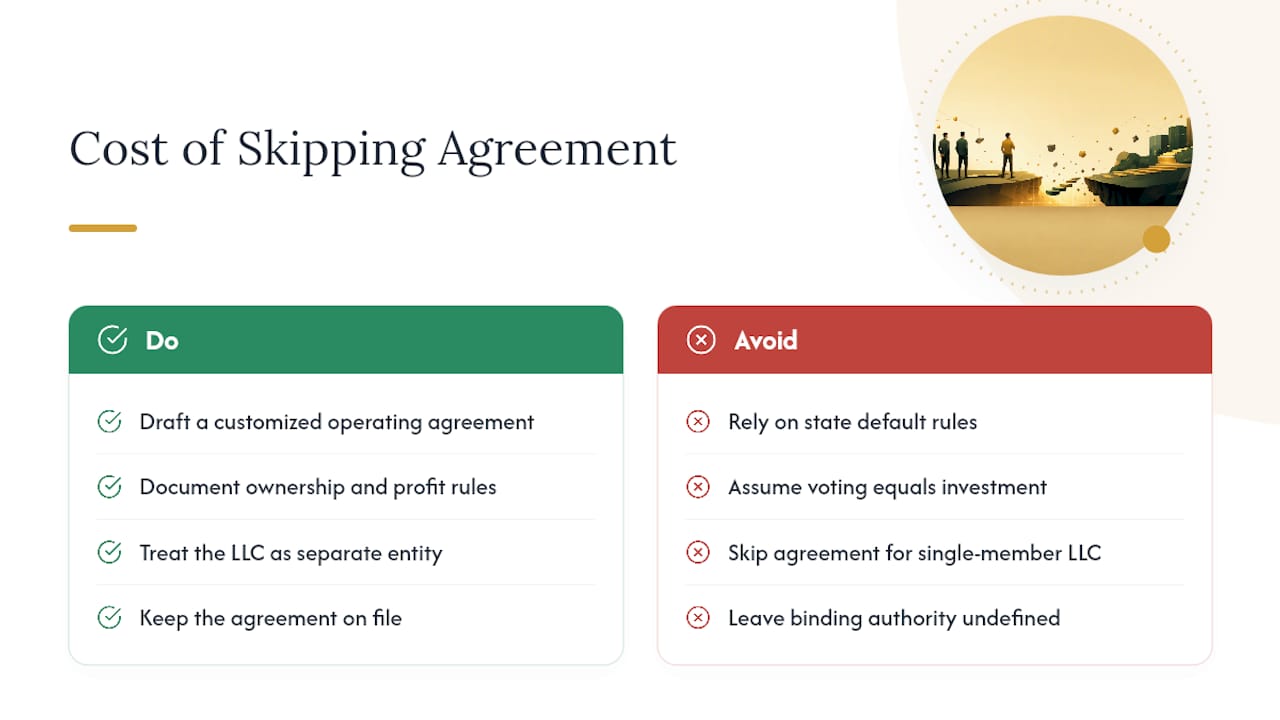
Here’s the part most founders underestimate: without a customized document, state default rules fill the gap, and those defaults can produce management and distribution outcomes founders never intended. Default rules might split profits by ownership percentage when you meant to reward sweat equity differently, or hand every member equal voting power regardless of investment size.
There’s also a liability angle. A written operating agreement that treats the LLC as genuinely separate from its owners supports the liability shield that’s the whole reason people form an LLC in the first place. Even single-member LLCs benefit from having one on file, particularly when a bank asks for it.
And banks do ask. So do investors, landlords, and anyone signing a contract with your company. A governing document that spells out who can bind the entity and how ownership actually breaks down is often the first thing a lender’s underwriter requests.
Which Document Should You Adopt, and What’s Next?
The decision rule is simpler than it looks: match the document to your entity type, then confirm your tax election separately since neither document changes how you’re taxed.
- Identify your decision-makers. Name who votes, who manages daily operations, and how ties get broken.
- Set clear voting thresholds. Define what counts as a simple majority versus a supermajority decision.
- Prioritize exit and buy-sell language. Decide now how a member or shareholder leaves, dies, or gets bought out.
- Sign and store it properly. Every owner signs, and copies go into your permanent business records.
For a single-owner LLC or a simple two-person corporation, a solid template plus careful review often covers it. Once you add outside investors, multiple LLC managers, or unequal ownership splits, hire an attorney and prioritize the buy-sell, capital-call, and deadlock provisions first. Those are the clauses that cause litigation when they’re vague.
Pro Tip: Draft the deadlock clause before you need it. Two 50/50 owners who disagree on a major decision, with no tiebreaker written down, often end up in court instead of at the negotiating table.
Where Founders Actually Get This Wrong
Most disputes I see trace back to two habits: founders who assume state defaults match their handshake agreement, and founders who copy a corporate bylaws template into an LLC because it “looked more official.” That second habit creates real ambiguity and can put your liability shield at risk since the two legal frameworks aren’t interchangeable. Write down your allocation rules and decision-making process in plain language, specific to your entity, before a disagreement forces the question.
— Kirk Carmichael
An Alternative Worth Knowing About: The Unincorporated Nonprofit Association
Bylaws and operating agreements aren’t your only options if what you actually want is control without complexity. An Unincorporated Nonprofit Association, or UNA, uses member-based governance instead of a board or a managing member structure, and it isn’t built around shareholder stock or LLC membership units at all.

For owners whose priority is asset control, privacy, and avoiding the annual fees and public registries that come with LLCs and corporations, a UNA can be worth a serious look. Some providers offer attorney-backed formation, state registration, EIN assignment, and lifetime support to assist with interpreting statutes. If you want to see whether member-based governance fits your goals better than a standard LLC or corporate structure, visit the UNA formation page to see how the process works and what’s included.
Where to Verify These Rules Yourself
For state-specific filing rules, check your state’s Secretary of State site. For drafting guidance, the SBA and Thomson Reuters are solid starting points, but binding advice still needs an attorney.
Sources
- LLC bylaws explained: What actually governs an LLC | Stripe
- What is an operating agreement? | Thomson Reuters
- Basic Information About Operating Agreements | SBA
- Operating Agreements vs Bylaws: When to Use Each | TC Advisors CPA
FAQ
Are LLCs required to have bylaws?
No. LLCs use operating agreements, not bylaws. Bylaws are a corporate governance document tied to a board and officer structure that LLCs don’t have.
Can an LLC exist without an operating agreement?
Legally, yes, in most states, but the LLC will operate under that state’s default statutes for management, profit splits, and dissolution, which rarely match what founders actually want.
Does an S corp have an operating agreement or bylaws?
An S corp is a tax election, not an entity type, so it follows the governance rules of the underlying entity. An S corp that’s structured as a corporation adopts bylaws; one structured as an LLC electing S corp tax treatment adopts an operating agreement.
Should every LLC have an operating agreement?
Yes, including single-member LLCs. A written operating agreement supports your liability shield and is often requested by banks when you open a business account or apply for financing.
Recommended
- How to Become an Unincorporated Association
- How a Private Unincorporated Association Can Reduce Taxes
- What Is an Unincorporated Association?
This article is provided for general informational and educational purposes only and does not constitute legal, tax, accounting, or financial advice. Reading this content or contacting UnincorporatedAssociations.com does not create an attorney-client, CPA-client, or other professional-client relationship. In accordance with IRS Circular 230, any discussion of federal tax matters herein is not intended or written to be used, and cannot be used, for the purpose of avoiding penalties.
Have questions? Bring them to the daily call.
Join our live Q&A every weekday and Saturday at 3PM PST, or get a free 15-minute call to see whether a UNA fits your situation.
Have a question about your situation?
Send us a message and we'll get back to you.
Keep reading
 The Well-Meaning Dragon: Straight Answers to the Hardest ObjectionsFor the family and friends who push back because they care — honest answers to the toughest questions about the Federal income tax and Unincorporated Associations.
 It's Not What You Believe, It's What You SignFor the cautious partner in the room: real risk rarely comes from asking questions. It comes from what you signed.
 What Most People Get Wrong About Taxes, Structure, and ControlThe real problem isn't taxes — it's structure, and who actually has control. A look at positioning over loopholes.
Educational, not legal or tax advice. Unincorporated Associations is a document-preparation and education company. Consult a licensed attorney or CPA before acting on any position discussed on this site.