Anonymous Business Structures in 2026: What U.S. Owners Can Keep Private
· 14 min read

Yes, you can structure a U.S. business so owners do not appear on public state records, but federal reporting, banks, and courts can still identify beneficial owners when it matters. The main route combines a privacy-friendly state with a registered agent or organizer. We will walk through which states work, how to form one step by step, and where a privacy-focused Unincorporated Nonprofit Association fits instead of an LLC.
TL;DR:
- Wyoming, Delaware, New Mexico, and Nevada generally let organizers file without naming LLC members, but registering where you operate may expose owners locally.
- Use a dedicated registered agent and keep ownership in a signed operating agreement; the IRS requires a responsible party, and banks verify every beneficial owner.
- FinCEN’s August 11, 2026, final rule changed reporting requirements for domestic entities; exemptions vary by entity and ownership, so confirm current obligations before filing.
- Courts, licensing boards, landlords, and vendors can still demand ownership details; this can slow deals, while litigation may compel disclosure of private records.
- In most states, an Unincorporated Nonprofit Association avoids public LLC registry filings, but its tax treatment and suitability differ, so consult counsel first.
Table of Contents
- What Does an Anonymous Business Structure Actually Mean?
- Which States Let You Form a Business Without Naming Owners Publicly?
- How to Form a Privacy-Focused LLC Step by Step
- How Do FinCEN and Beneficial Ownership Rules Affect Privacy in 2026?
- When Can Your Privacy Be Pierced? Practical Limits to Understand
- When Does an Unincorporated Nonprofit Association Fit Better Than an LLC?
- Myths About Anonymous Business Structures That Keep Costing People Money
- How Do You Keep a Privacy-Focused Structure Private Over Time?
- How Does Business Privacy Affect Contracts, Licensing, and Vendor Relationships?
- How Do You Structure Member Governance to Actually Protect Identity and Assets?
- A Straight Answer on Privacy and Compliance
- How We Help You Form a Private, Attorney-Backed Association
- FAQ
- Sources
What Does an Anonymous Business Structure Actually Mean?
Here is the honest version. An anonymous LLC is not invisible. It is a standard LLC formed in a state that does not require member or manager names on the public filing. A standard LLC, by contrast, lists owners right in the secretary of state’s database for anyone to search.
Who actually wants this? Think about it for a second.
- Real estate investors who do not want their home address tied to every property they buy.
- Public figures or executives who face harassment risk if their holdings are easy to trace.
- Operators running several related entities who want each one to stand on its own without broadcasting the connection.
Academic research on this topic frames privacy as a functional business feature rather than a loophole. A law review analysis by William J. Moon describes this as “identity shielding,” a deliberate design choice that can attract capital and protect legitimate business interests, not just a tool for people with something to hide.
Which States Let You Form a Business Without Naming Owners Publicly?
Not every state works the same way here, and that is the whole point. A handful of states let the organizer, not the members, appear on the public filing.
- Wyoming: Often cited as the most consistently privacy-friendly option, with low fees and no state income tax; the articles of organization ask for an organizer, not member names.
- Delaware: Widely used for its established case law and flexible LLC statute; formation forms also rely on an organizer rather than listing members.
- New Mexico: Known for low cost and minimal ongoing reporting, though the privacy framework is less tested than Wyoming’s.
- Nevada: Offers privacy features but tends to carry higher annual fees and a business license requirement.
Here is where it gets tricky. The organizer field on these forms is filled by whoever submits the paperwork, often a registered agent or formation service, not the actual owner. That keeps your name off the public record.
But foreign qualification can undo all of it. If you form in Wyoming and then operate in your home state, you may need to register there too, and that second filing can expose the same ownership details you just worked to keep private.
How to Form a Privacy-Focused LLC Step by Step
Forming a private entity is not complicated, but skipping a step tends to be where privacy quietly breaks down. Walk through it in order.
- Pick your formation state based on privacy, cost, and where you actually operate. Wyoming and Delaware are common choices, but your home state’s foreign qualification rules matter just as much as the formation state’s privacy rules.
- Hire a dedicated registered agent. Do not act as your own agent. Doing so places your name and address directly on the public record, which state guidance on registered agents points out defeats the purpose entirely.
- Consider an organizer or nominee service to file the formation documents so your name never touches the public paperwork.
- Draft an internal operating agreement. This document, kept privately, is where real ownership and control get documented, even though it never reaches the state.
- Apply for an EIN. The IRS requires a responsible party’s information here, so this step is never anonymous to the federal government.
- Open a bank account. Expect the bank to request your operating agreement, EIN confirmation, and identification for every beneficial owner before they will let you deposit a check.
Pro Tip: Keep a signed, dated copy of your operating agreement in a secure location from day one. Banks and courts will ask for it eventually, and scrambling to reconstruct ownership history after the fact rarely goes well.
How Do FinCEN and Beneficial Ownership Rules Affect Privacy in 2026?
The Corporate Transparency Act created a federal Beneficial Ownership Information reporting requirement, meaning many entities had to report their real owners to FinCEN, separate from whatever appears on state records.
FinCEN issued a final rule on August 11, 2026, changing BOI filing requirements for domestic entities. This matters because it shifts what gets reported to the federal government, even when state filings stay private.
So who still sees this information? FinCEN’s BOI FAQs explain that beneficial ownership data is not published publicly. It is accessible to authorized government agencies and, under specific circumstances, to financial institutions conducting due diligence. State-level anonymity and federal reporting are two separate systems. One keeps your name off a public search. The other keeps a record available to regulators regardless.

When Can Your Privacy Be Pierced? Practical Limits to Understand
Privacy-friendly formation reduces casual exposure. It does not make you untouchable. A few situations consistently override it.
- Court-ordered disclosure. Litigation and creditor discovery can compel ownership records to surface, regardless of which state you formed in.
- Bank compliance requirements. Banks must follow KYC and AML obligations under the USA PATRIOT Act, and FinCEN’s customer due diligence rule means they will verify beneficial owners before opening or maintaining your account.
- Foreign qualification. Operating outside your formation state often means a second filing that names owners where you actually do business.
- Federal tax reporting. Your EIN responsible party, along with other IRS disclosures, is never anonymous even when your LLC’s public filing is.
One structuring option worth knowing about: a post-2026 analysis of BOI reporting changes notes that certain domestic entities gained exemptions, though the specifics depend heavily on entity type and ownership. None of this amounts to guaranteed secrecy, and treating it that way is where people get into trouble.
When Does an Unincorporated Nonprofit Association Fit Better Than an LLC?
So where does a UNA fit into all this? A UNA is a member-governed structure that operates without the public registry requirements tied to LLCs and corporations in most states. Instead of filing member names with a secretary of state, governance runs through private association documents.
We built our approach around attorney-backed documentation, personalized association naming, and lifetime support, so members are not left holding a template and guessing what comes next. Our members have collectively saved on fees and taxes, and we maintain a strong Trustpilot rating based on customer reviews.
A UNA is not the right fit for every business. When you are weighing privacy, governance, and tax treatment against an LLC’s familiarity, talking with counsel about your specific situation is worth the time before you commit either way.
Myths About Anonymous Business Structures That Keep Costing People Money
Let’s clear a few things up, because the misconceptions here are common and they get expensive.
Myth: an anonymous LLC means total secrecy. It means your name is not on the public state filing. Banks, the IRS, and courts can still reach it.
Myth: forming in Wyoming protects you no matter where you operate. If you do business in your home state, foreign qualification may require you to file there too, which can reintroduce exactly the exposure you were avoiding.
Myth: anonymous structures are mainly for people hiding something. Investors protecting their home address, executives avoiding harassment, and operators managing multiple properties all have ordinary reasons to want privacy.
Myth: BOI reporting and state-level privacy are the same system. They are not. One is a public-facing filing. The other is a federal reporting requirement accessible to regulators and, in limited cases, financial institutions.
Myth: once you form the entity, you are done. Ongoing registered agent fees, annual reports, and renewal filings are a recurring part of keeping the structure in good standing, and missing one can expose the exact information you set out to protect.
How Do You Keep a Privacy-Focused Structure Private Over Time?
Formation is the easy part. Keeping things private for years afterward takes a bit more discipline.
Store your operating agreement, EIN confirmation, and any nominee or organizer agreements in one secure, organized location. You will need to produce these quickly when a bank, lender, or title company asks, and scrambling under pressure tends to create mistakes.
Route all official correspondence through your registered agent rather than a personal address. This single habit does more to preserve anonymity than almost anything else, since a mismatched address on a lease or utility bill can undo the whole arrangement.
Review your state’s annual report requirements every year. Some privacy-friendly states still require periodic filings, and a missed deadline can trigger administrative dissolution, which forces a messier re-formation process that may expose details you had kept private.
Keep personal and business finances fully separate. Commingled funds are one of the fastest ways to pierce whatever privacy protection your entity structure offers, and it undermines liability protection at the same time.

How Does Business Privacy Affect Contracts, Licensing, and Vendor Relationships?
Privacy has a cost in day-to-day operations, and it shows up fastest with the people you do business with.
Vendors and landlords frequently want to know who they are actually dealing with before they sign anything. A private LLC with only an organizer’s name on file can slow down a lease negotiation if the other party insists on verifying beneficial ownership before committing.
Licensing boards, particularly in regulated industries like contracting or healthcare, often require disclosure of ownership regardless of how your entity is formed. Privacy at the state filing level does not exempt you from industry-specific disclosure rules.
Contracts involving financing or larger transactions tend to require more documentation, not less. Lenders and title companies will ask for your operating agreement and beneficial ownership details before closing, so a privacy-focused structure rarely saves you from disclosure at the moments that matter most financially.
How Do You Structure Member Governance to Actually Protect Identity and Assets?
Governance documents, not the public filing, are where real protection lives. A thorough operating agreement or association document should spell out who holds decision-making authority, how assets are titled, and what happens if a member exits or a dispute arises.
Keep membership interests and voting rights documented privately rather than relying on default state statutes, which often assume disclosure you may not want. A structuring resource on LLC and Family Limited Partnership approaches notes that layering entities can add asset protection, though it also adds complexity and cost, and it is never a guaranteed way to conceal ownership from a determined creditor or regulator.
Review your governance documents whenever ownership changes, a new state filing becomes necessary, or tax treatment shifts. Letting these documents go stale is one of the more common ways privacy-focused governance quietly stops working the way it was designed to.
A Straight Answer on Privacy and Compliance
Privacy and compliance are not opposites. They are a balance you manage on purpose. Banks and regulators will always expect proof of who actually owns a business, so the real goal is controlling who gets to ask, not pretending no one ever will.
Document your ownership clearly from day one, and keep it ready to produce. When your situation gets complicated, talk to counsel before you file anything.
— Kirk Carmichael
How We Help You Form a Private, Attorney-Backed Association
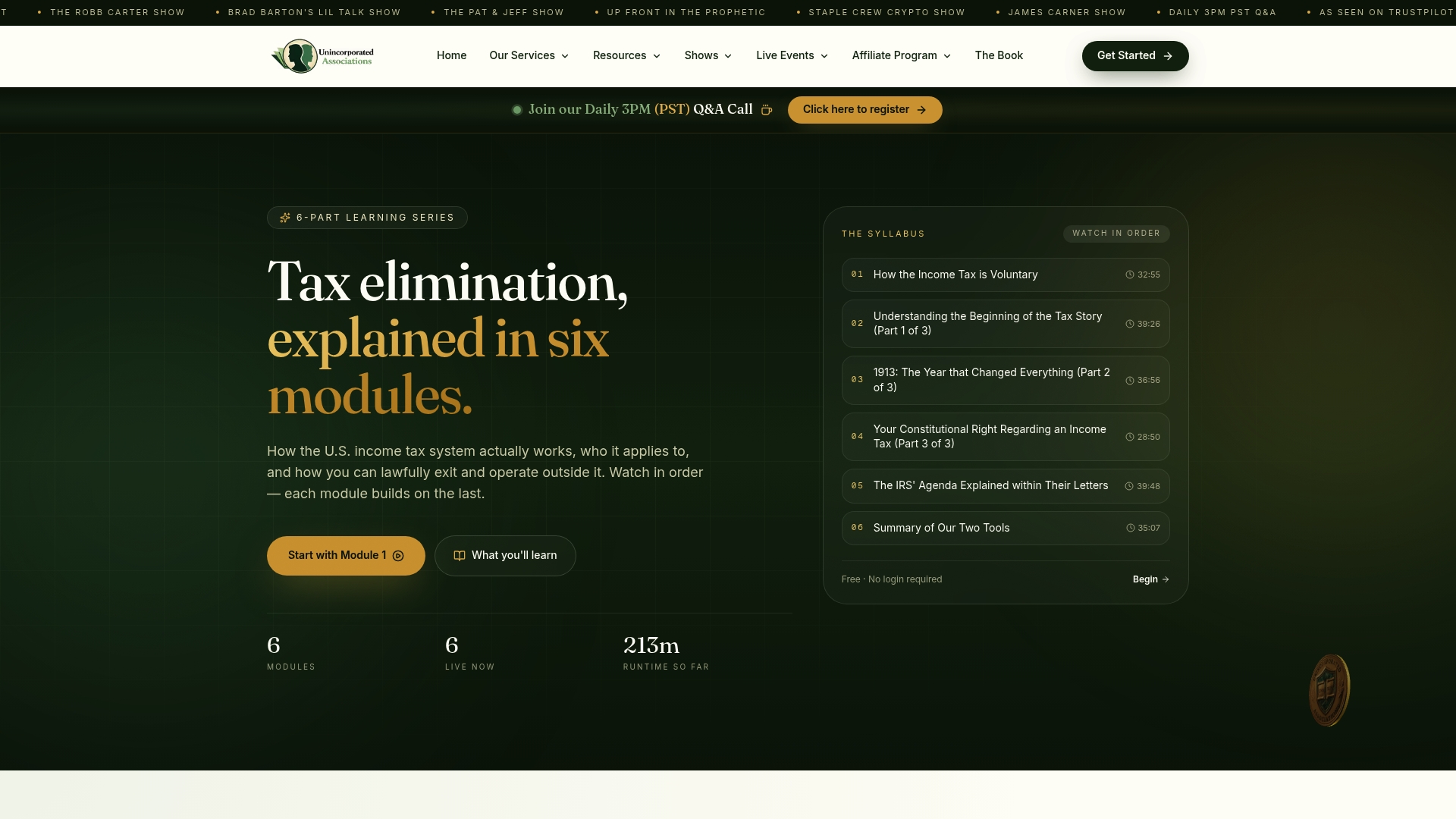
If an LLC’s public registry and recurring fees are not what you are looking for, we built a different path. Our Full UNA package pairs attorney-backed formation with the privacy and governance structure a UNA offers, without the ongoing state reporting that LLCs and corporations carry.
- Full UNA package, a one-off $4,950 covering attorney-backed formation and documentation.
- ROE Affidavit preparation, included as part of your formation documents.
- Attorney consultation available for questions specific to your situation.
- Lifetime support, including daily Q&A access and an ongoing training library.
Start by reviewing our services page or order your UNA and ROE package directly when you are ready to move forward.
This article is general information, not a substitute for advice from a qualified financial advisor. Consult a qualified financial professional about your own circumstances before acting on anything here.
FAQ
What happens if your LLC makes no money?
An LLC with no income still typically owes its state’s annual report or franchise fee and still needs a registered agent in good standing. Federal tax filing requirements can also apply even at zero revenue, depending on your entity’s election.
What are the four types of business ownership?
The SBA’s guidance on choosing a business structure outlines sole proprietorships, partnerships, LLCs, and corporations as the core categories, each with different liability, tax, and filing implications.
Is it illegal to say you are an LLC if you are not?
Representing a business as an LLC when it has not been legally formed as one is misrepresentation and can expose you to personal liability and potential legal consequences. Forming the entity properly with your state before using the designation avoids this risk entirely.
Which state allows an LLC to be anonymous?
Wyoming, Delaware, New Mexico, and Nevada are commonly cited for allowing LLC formation without listing member names on the public filing, with Wyoming’s registered agent framework frequently noted as the most consistent option. Privacy still depends on using a registered agent and avoiding foreign qualification that could expose ownership elsewhere.
Sources
Recommended
- EIN Privacy: 5 Controls U.S. Business Owners Need Now
- Avoid State Traps: LLP vs LLC and the S Corp Option (U.S.)
- Protect U.S. Investment Club Structure: Compliance, BOI 2026, and UNA
This article is provided for general informational and educational purposes only and does not constitute legal, tax, accounting, or financial advice. Reading this content or contacting UnincorporatedAssociations.com does not create an attorney-client, CPA-client, or other professional-client relationship. In accordance with IRS Circular 230, any discussion of federal tax matters herein is not intended or written to be used, and cannot be used, for the purpose of avoiding penalties.
Have questions? Bring them to the daily call.
Join our live Q&A every weekday and Saturday at 3PM PST, or get a free 15-minute call to see whether a UNA fits your situation.
Have a question about your situation?
Send us a message and we'll get back to you.
Keep reading
 The Well-Meaning Dragon: Straight Answers to the Hardest ObjectionsFor the family and friends who push back because they care — honest answers to the toughest questions about the Federal income tax and Unincorporated Associations.
 It's Not What You Believe, It's What You SignFor the cautious partner in the room: real risk rarely comes from asking questions. It comes from what you signed.
 What Most People Get Wrong About Taxes, Structure, and ControlThe real problem isn't taxes — it's structure, and who actually has control. A look at positioning over loopholes.
Educational, not legal or tax advice. Unincorporated Associations is a document-preparation and education company. Consult a licensed attorney or CPA before acting on any position discussed on this site.