
$50,000 Threshold: When a UNA Beats 501(c)(3) or 501(c)(4) in the U.S.
· 11 min read
A UNA is a legal, member-controlled option for holding and protecting private assets in many U.S. states, and for most individuals and families, it is a lighter, faster path than either a 501©(3) or a 501©(4). Where a state has adopted the Uniform Unincorporated Nonprofit Association Act (UUNAA), members get a liability shield without incorporation fees or public filings. The trade-off? State law still varies widely, so what you check first is your own state’s statute. Keep reading for the formation steps.
TL;DR:
- The liability shield for UNAs in states that adopt UUNAA provides protection similar to corporations but depends heavily on your state’s specific law.
- Proper governance, including a written rulebook, an EIN, and meticulous record-keeping, is crucial to maintain liability protection and favorable tax treatment.
- Formation is informal but requires discipline in the first year, with emphasis on consistent legal name use, separate accounts, and documented authority for major transactions.
- Eligibility for streamlined IRS processing through Form 1023-EZ depends on receipts staying below $50,000 and assets under $250,000, making governance and bookkeeping vital.
- Using attorney-backed documentation for formation ensures the UNA functions correctly legally and financially, reducing the risk of disputes or legal gaps.
Table of Contents
- What Is a UNA and How Does It Form?
- How Do UNAs Provide Liability Protection and Tax Efficiency?
- Why Does State Law Vary So Much for UNAs?
- What Are the Practical Steps to Form and Run a UNA?
- Is a UNA the Right Choice for You?
- Why Attorney-Backed Documentation Changes the Outcome
- How Unincorporated Associations Helps You Form a UNA
- Sources
- FAQ
What Is a UNA and How Does It Form?
A UNA forms the moment two or more people agree, by mutual consent, to work together for a nonprofit purpose. There is no mandatory state filing to trigger it. In fact, at common law, the UNA has always been the default structure for people pooling resources without incorporating. That informality is the appeal, and also why so many people confuse “no filing required” with “no paperwork needed.”
You still want a written governing document. Think of it as the association’s internal rulebook, the thing that turns a loose agreement into something a bank, an insurer, or a court can actually read and rely on.
A solid governing document typically covers:
- The association’s stated purpose and scope of activity
- Who counts as a member and how decisions get made
- Who holds authority to sign contracts or transfer assets
- Dissolution terms and where remaining assets go
Where a state has adopted UUNAA, the UNA gains real entity capacity. It can hold property, sign contracts, and sue or be sued in its own name, the same functional toolkit a corporation has, minus the incorporation paperwork.
How Do UNAs Provide Liability Protection and Tax Efficiency?
Here’s the mechanism, not just the marketing line. In states that follow UUNAA, the statute creates a legal wall between the association and its individual members. Legal scholarship on nonprofit law describes this as a liability shield comparable to what a corporation offers, insulating members and managers from the association’s own debts and legal exposure. That protection is not automatic goodwill from the state. It is a specific statutory allocation of liability, and it only works where the underlying law exists.
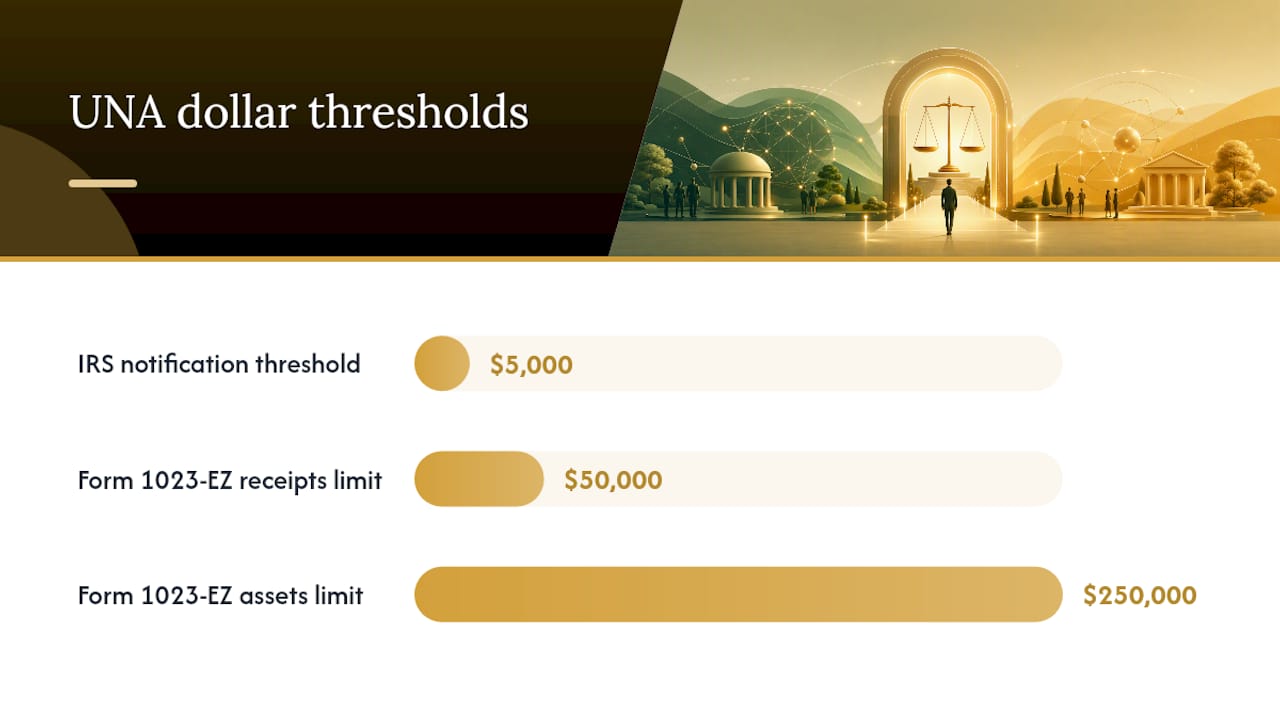
Statistic Callout: Small associations often qualify for a lighter IRS path. Under current guidance on unincorporated associations, a group can typically use Form 1023-EZ for streamlined tax-exempt processing when projected and past annual receipts stay at or below $50,000 and total assets stay at or below $250,000. Groups with gross receipts normally above $5,000 generally need to notify the IRS of their existence.
On the tax side, three thresholds matter in practice:
- Whether the IRS notification requirement applies to your receipts
- Whether Form 1023-EZ eligibility fits your projected income and assets
- Whether Form 990 or Form 990-N filing gets triggered once you’re operating
None of this runs on autopilot. A UNA with sloppy books, no meeting minutes, and a member who signs contracts under their own name instead of the association’s name will struggle to prove the separation that both liability protection and tax treatment depend on. Governance quality is the whole game here, not a footnote to it.
Why Does State Law Vary So Much for UNAs?
Not every state has adopted the Uniform Unincorporated Nonprofit Association Act, and that single fact determines how much protection your UNA actually gets. The Uniform Act sets default rules for entity status, capacity, liability allocation, and dissolution, but it only applies where a legislature has passed it. Where it hasn’t, you’re relying on older common-law principles that offer far less certainty.
Before you form anything, verify three things about your own state’s code:
- Does the statute grant the association capacity to hold property and enter contracts in its own name?
- Does it explicitly treat the UNA as a separate legal entity distinct from its members?
- Does it set out liability allocation rules, and how do those default rules compare to what your governing document would specify?
North Carolina offers a clean model. Its statute grants UNAs the ability to hold property and sue or be sued in their own name, a straightforward adoption of the Uniform Act framework. Wisconsin’s code goes further with practical tools, including statutory references to a “statement of authority” that names who can sign for the association on real estate deals. Two states, same underlying concept, different statutory texture. That difference is exactly why “check your state” isn’t a throwaway line. It’s the first real step.
What Are the Practical Steps to Form and Run a UNA?
Forming a UNA doesn’t take a law degree, but it does take discipline in the first twelve months, because the habits you build early are what a bank, an insurer, or a court will look at later if anything gets challenged.
Start with the governing document. It needs a clear statement of purpose, membership rules, a defined chain of authority, and, critically, dissolution language spelling out where assets go if the association ends. Skipping that last piece is one of the more common mistakes people make, and it’s the one that tends to cause the ugliest disputes among members down the road.
Once the document exists, get an EIN from the IRS and open a dedicated bank account in the association’s name. Never run association money through a personal account, even temporarily. Keep minutes of major decisions and a simple ledger of income and expenses.
A few more items belong on your checklist:
- Draft and, where your state allows it, record a statement of authority for real estate or major asset transactions
- Anticipate that banks and insurers will ask who can bind the association, and have that answer documented before they ask
- Use the association’s exact legal name consistently on every contract, deed, and account
- Revisit the governing document annually as membership or activity changes
Pro Tip: Third parties don’t reward informality. Practitioners who work with UNAs regularly point to three habits that consistently protect members: separate bank accounts and bookkeeping, documented authority with meeting minutes, and consistent use of the association’s legal name on every signed document. Skip any one of those, and you weaken the very protections the structure is supposed to give you.
If your assets, membership, or activity are getting complex, this is the point to bring in attorney-backed documentation rather than freehand it. A UNA formed with generic templates can still leave gaps that only show up when a bank or a dispute forces the question.
Is a UNA the Right Choice for You?
Weigh the trade-offs plainly. On the upside, a UNA gives you privacy, low formality, lower cost than incorporating, member control over governance, and, where UUNAA applies, a real liability shield. On the downside, protection depends entirely on your state’s law, banks and insurers sometimes hesitate with unfamiliar structures, and a UNA isn’t built for large-scale commercial growth or heavy outside investment.
Ask yourself a few questions before you commit:
- How many members are involved, and how aligned are they on purpose and control?
- What kind of assets will the association hold, real estate, investments, or mostly cash?
- How often will you need banks, insurers, or vendors to recognize the association’s authority?
- Are you planning to stay small and member-controlled, or eventually scale into something that needs outside capital?
If your answers point toward a small group protecting shared assets without heavy government reporting, a UNA usually fits. If you’re planning aggressive growth or outside investment, it probably won’t hold up long term.
Why Attorney-Backed Documentation Changes the Outcome
The gap between a UNA that protects its members and one that doesn’t rarely comes down to state law. It comes down to paperwork quality. Anyone can file the bare minimum and call it done. Fewer people build a governing document that actually anticipates the moment a bank compliance officer or an opposing attorney starts asking hard questions about authority and separation.
That’s where attorney-backed documentation earns its keep. A properly drafted statement of authority, EIN setup done correctly the first time, and lifetime support when questions come up later, those aren’t luxuries. They’re the difference between a UNA that functions as designed and one that collapses under its first real test. Unincorporated Associations reports members have collectively saved millions through this approach, and its Trustpilot rating sits at 4.9 stars from over 330 reviews, which tells you something about how people feel once the paperwork is actually in place.
— Kirk Carmichael
How Unincorporated Associations Helps You Form a UNA
This service offers an alternative to navigating statute research alone or paying corporate formation fees for unnecessary structures. Instead of creating your own governing document and hoping it holds up, attorney-backed formation is provided specifically for member-controlled asset protection.
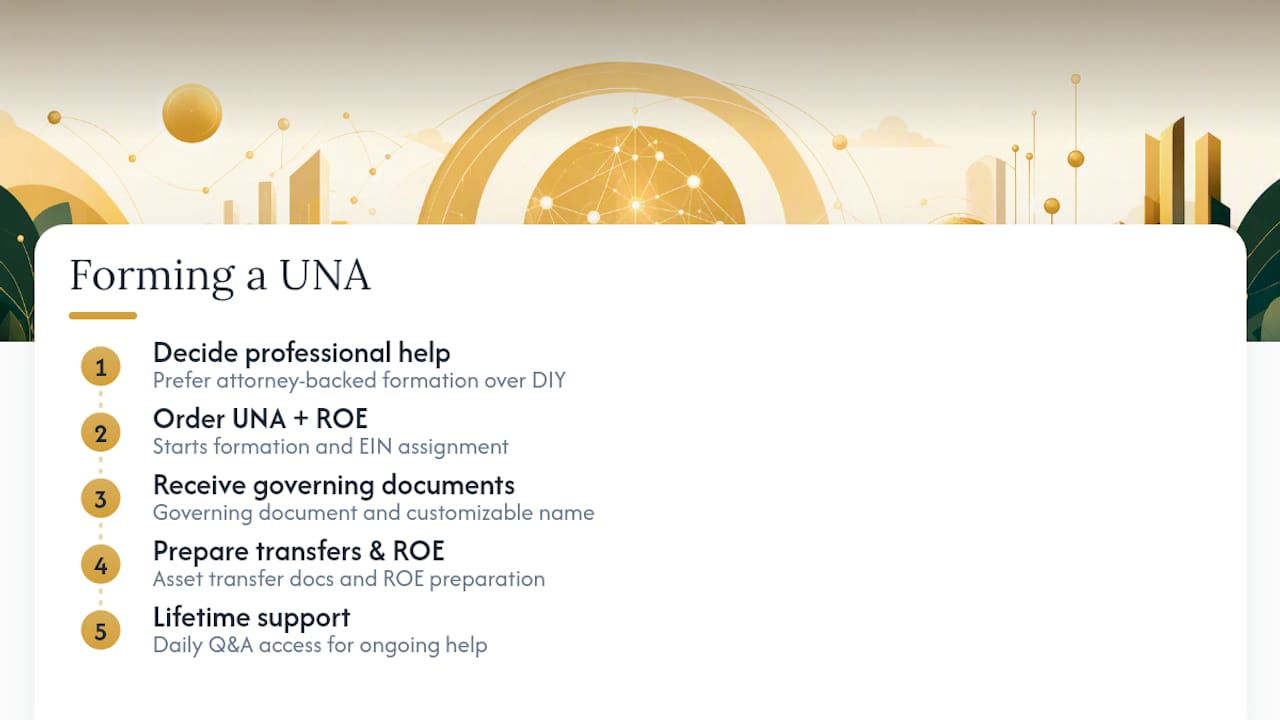
The UNA + ROE package includes your governing document, EIN assignment, Revocation of Election preparation, a customizable association name, asset transfer documentation, and lifetime support with daily Q&A access. It’s built for people who read through the checklist above and realized they’d rather have a professional handle the details than risk a gap showing up later with a bank or in a dispute.
If you’re an entrepreneur, investor, or family looking to protect assets outside a traditional LLC or corporate structure, this is worth a serious look. Start by ordering your UNA + ROE package or speak with an advisor first if you want questions answered before you commit.
This article is general information, not a substitute for advice from a qualified lawyer. Consult a qualified legal professional about your own circumstances before acting on anything here.
Sources
- Uniform Law Commission — Unincorporated Nonprofit Association Act (Final Act)
- North Carolina General Statutes — Chapter 59B (Unincorporated Nonprofit Associations)
- Legal monograph on nonprofit organizations and unincorporated associations (NYU Law/Monograph)
- Wisconsin Statutes — provisions referenced regarding unincorporated associations
FAQ
Does a UNA Need to File With the State?
No, a UNA typically forms through mutual consent without mandatory state filing, though a written governing document is strongly recommended for protection and clarity.
Does a UNA Protect Members From Personal Liability?
In states that have adopted UUNAA, yes, members generally get a liability shield comparable to a corporation’s protections, but the strength of that shield depends entirely on your state’s statute.
When Must a UNA Notify the IRS?
Associations with gross receipts normally above $5,000 generally need to notify the IRS, and groups under the $50,000 receipts and $250,000 asset thresholds often qualify for streamlined Form 1023-EZ processing.
How Is a UNA Different From Forming an LLC?
A UNA is member-governed and nonprofit in purpose, with no public ownership registry or annual corporate fees, while an LLC involves state filing, ongoing compliance, and public records of ownership.
Can Unincorporated Associations Help Form My UNA?
Yes, Unincorporated Associations provides attorney-backed formation, including governing documents, EIN assignment, and lifetime support through its UNA + ROE package.
Recommended
This article is provided for general informational and educational purposes only and does not constitute legal, tax, accounting, or financial advice. Reading this content or contacting UnincorporatedAssociations.com does not create an attorney-client, CPA-client, or other professional-client relationship. In accordance with IRS Circular 230, any discussion of federal tax matters herein is not intended or written to be used, and cannot be used, for the purpose of avoiding penalties.
Have questions? Bring them to the daily call.
Join our live Q&A every weekday and Saturday at 3PM PST, or get a free 15-minute call to see whether a UNA fits your situation.
Have a question about your situation?
Send us a message and we'll get back to you.
Keep reading
 The Well-Meaning Dragon: Straight Answers to the Hardest ObjectionsFor the family and friends who push back because they care — honest answers to the toughest questions about the Federal income tax and Unincorporated Associations.
 It's Not What You Believe, It's What You SignFor the cautious partner in the room: real risk rarely comes from asking questions. It comes from what you signed.
 What Most People Get Wrong About Taxes, Structure, and ControlThe real problem isn't taxes — it's structure, and who actually has control. A look at positioning over loopholes.
Educational, not legal or tax advice. Unincorporated Associations is a document-preparation and education company. Consult a licensed attorney or CPA before acting on any position discussed on this site.